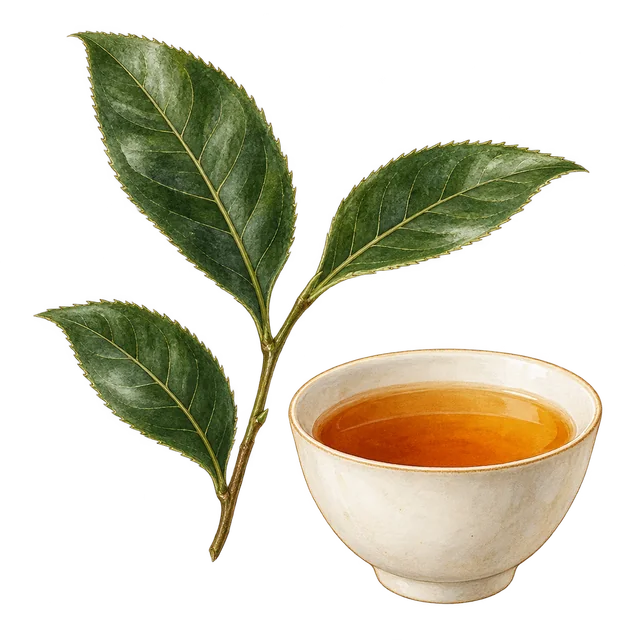
绿茶:采下后马上高温杀青(蒸或炒),让氧化酶失活,几乎不氧化,保留的原始儿茶素最多,汤色青绿乌龙茶:部分氧化,介于两者之间红茶(英文叫 black tea):充分氧化,儿茶素大量转化成茶黄素、茶红素,汤色红浓白茶、黄茶:工艺不同带来的轻度氧化变体 凉茶、菊花茶、薄荷茶、洋甘菊这些花草茶其实不是茶:它们不含茶树叶,没有茶多酚,也没有咖啡因加茶氨酸这个组合,是另一类植物泡出来的饮品。
U.S. Department of Agriculture, Agricultural Research Service. (2019). FoodData Central — Tea, brewed (black/green), and caffeine component data. Brewed black tea ~40-50 mg caffeine per ~240 mL cup, green tea lower. fdc.nal.usda.gov
Khan, N., & Mukhtar, H. (2013). Tea and health: studies in humans. Current Pharmaceutical Design, 19(34), 6141-6147. Review of tea catechins/polyphenols (EGCG), low oral bioavailability, and cell-signaling rather than direct radical-scavenging as the likely in-vivo basis of effects. 10.2174/1381612811319340008
Camfield, D. A., Stough, C., Farrimond, J., & Scholey, A. B. (2014). Acute effects of tea constituents L-theanine, caffeine, and epigallocatechin gallate on cognitive function and mood: a systematic review and meta-analysis. Nutrition Reviews, 72(8), 507-522. L-theanine + caffeine improved attention-switching accuracy and subjective alertness 1-2 h post-dose. 10.1111/nure.12120
Inoue-Choi, M., Ramirez, Y., Cornelis, M. C., et al. (2022). Tea consumption and all-cause and cause-specific mortality in the UK Biobank: a prospective cohort study. Annals of Internal Medicine, 175(9), 1201-1211. ~498,000 adults, ~11 y; >=2 cups/day associated with modestly lower all-cause and cardiovascular mortality, independent of milk/sugar/temperature/caffeine-metabolism genotype. 10.7326/M22-0041
Jurgens, T. M., Whelan, A. M., Killian, L., Doucette, S., Kirk, S., & Foy, E. (2012). Green tea for weight loss and weight maintenance in overweight or obese adults. Cochrane Database of Systematic Reviews, (12), CD008650. Pooled non-Japan studies (6 RCTs, n=532): mean difference -0.04 kg (95% CI -0.5 to 0.4), statistically non-significant. 10.1002/14651858.CD008650.pub2
EFSA Panel on Food Additives and Nutrient Sources added to Food (ANS). (2018). Scientific opinion on the safety of green tea catechins. EFSA Journal, 16(4), e05239. EGCG >=800 mg/day as a food supplement associated with increased risk of hepatotoxicity (raised ALT/AST); no clearly safe supplement dose could be defined; brewed tea differs from concentrated extracts. 10.2903/j.efsa.2018.5239
Hurrell, R. F., Reddy, M., & Cook, J. D. (1999). Inhibition of non-haem iron absorption in man by polyphenolic-containing beverages. British Journal of Nutrition, 81(4), 289-295. Black tea reduced non-heme iron absorption 79-94% vs a water-control bread meal; peppermint 84%, cocoa 71%, camomile 47%. Dose-dependent with total polyphenols. Green tea was not tested. 10.1017/S0007114599000537
American College of Obstetricians and Gynecologists Committee on Obstetric Practice. (2010, reaffirmed). Committee Opinion No. 462: Moderate caffeine consumption during pregnancy. Obstetrics & Gynecology, 116(2 Pt 1), 467-468. Recommends limiting caffeine to <200 mg/day in pregnancy. 10.1097/AOG.0b013e3181eeb2a1
Drake, C., Roehrs, T., Shambroom, J., & Roth, T. (2013). Caffeine effects on sleep taken 0, 3 or 6 hours before going to bed. Journal of Clinical Sleep Medicine, 9(11), 1195-1200. Randomized, double-blind, placebo-controlled Latin-square crossover in 12 healthy normal sleepers: one fixed 400 mg dose of caffeine (the authors call it moderate) at 0, 3 or 6 h before habitual bedtime vs placebo, sleep measured at home by diary and a portable monitor. All three timings disrupted sleep vs placebo (P < 0.05). By the objective monitor, even at 6 h caffeine reduced sleep by more than 1 hour; by diary, the 6-h reduction in total sleep time (41 min) only approached significance (p = 0.08). The authors conclude that substantial caffeine should be avoided for a minimum of 6 hours before bedtime, and that afternoon caffeine should at least be restricted to before 17:00 (abstract, PMID 24235903; full text, PMC3805807). 10.5664/jcsm.3170