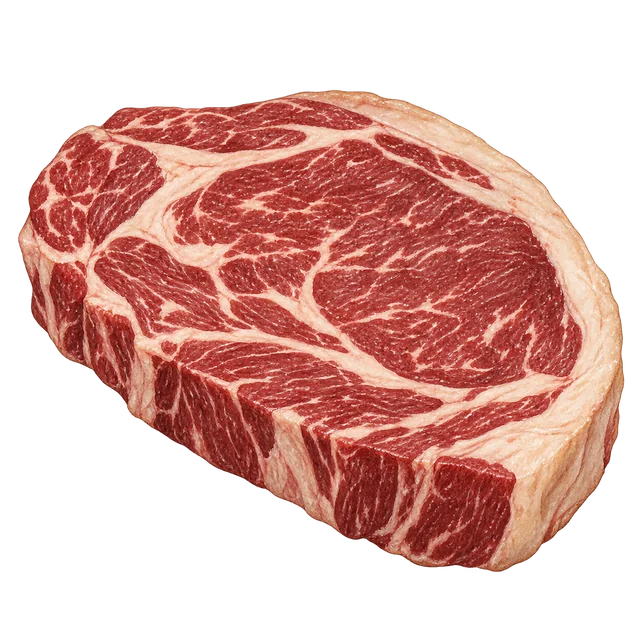
膳食纤维为 0:肉没有纤维。光吃肉的一餐对肠道菌群不友好,搭蔬菜、全谷、豆类补上维生素 C 几乎没有:这一点反而能利用——维 C 能促进植物里非血红素铁的吸收,配一盘彩椒、西兰花、番茄,同盘米饭、豆子、绿叶菜里的铁会吸收得更好(见 铁)碳水和钙也很低:牛肉不是碳水或钙的来源 最划算的吃法是牛肉加大量蔬菜:蔬菜补纤维和维 C,也稀释了这一餐的饱和脂肪和血红素铁密度。有烹饪实验报告,腌肉时加大蒜、迷迭香、柠檬能减少高温产生的杂环胺。
反过来,牛肉加精制碳水加高温油(汉堡套餐)是最不划算的组合。
机制 · 维 C 帮的是菜里的铁
配蔬菜能让整餐的铁吸收得更好这句话是对的,但它很容易被读成维 C 让牛肉的铁吸收更多。那是两件不同的事,分清楚才知道该怎么配。
维 C 干的正是这件事:递一个电子过去把铁还原,顺手再把它抓住,不让植酸和茶多酚把它抱走。所以维 C 的作用点在植物铁那扇门上。牛肉的铁走的是另一扇门,维 C 帮不上,也不需要帮。
于是这一餐该怎么摆就清楚了
配一盘彩椒、西兰花、番茄,提升的是同盘的米饭、豆子、深绿叶菜里那部分铁——而这些恰恰是平时最容易被浪费掉的铁茶和咖啡里的多酚是同一场争夺里的对手方,所以它们拖住的主要也是植物铁。想让一餐的铁总量最大,把茶和咖啡挪到饭后隔开一段时间反过来说:一顿全是肉的饭,加维 C 几乎没有增益;一顿全素的饭,加维 C 的增益最大 再说纤维那一条,它比听起来重要
先改做法:把高温直火从日常降成偶尔,收益最大,也最不需要意志力再改处理:不吃焦的部分、别用会滴油进火的架法、下锅前腌一下最后才轮到总量:每周约 500 g 那个量级是一个上限,不是一个目标 这个顺序本身就是这一页的结论——同样的力气花在前两条上,拿到的改变比反复纠结克数大得多。
参考文献 · 14
U.S. Department of Agriculture, Agricultural Research Service. (2019). FoodData Central: Beef (ground/loin/round, raw and cooked). fdc.nal.usda.gov
Daley, C. A., Abbott, A., Doyle, P. S., Nader, G. A., & Larson, S. (2010). A review of fatty acid profiles and antioxidant content in grass-fed and grain-fed beef. Nutrition Journal, 9, 10. Grass-fed beef has a higher omega-3 share and more CLA, but the absolute omega-3 amount remains far below oily fish. 10.1186/1475-2891-9-10
Hunt, J. R. (2003). Bioavailability of iron, zinc, and other trace minerals from vegetarian diets. The American Journal of Clinical Nutrition, 78(3 Suppl), 633S-639S. Heme iron is absorbed far more efficiently than non-heme iron and is less affected by dietary inhibitors. The abstract gives NO absorption percentages and does not itself state the heme vs non-heme comparison above: it says iron and zinc absorption is lower from vegetarian than non-vegetarian diets, vegetarians have lower iron stores, adverse effects have not been shown with varied vegetarian diets in developed countries, and routine iron supplementation has no demonstrated benefit. The heme 15-35% / non-heme 2-20% figures sometimes attached to this record are not in it (abstract, PMID 12936958). 10.1093/ajcn/78.3.633S
National Institutes of Health, Office of Dietary Supplements. (2024). Iron — Fact Sheet for Health Professionals. Fact sheet (updated September 4, 2025; Wayback snapshot 21 September 2026): RDAs 8 mg/day for men and for women 51+, 18 mg women 19-50, 27 mg pregnancy; UL 45 mg/day from age 14; bioavailability about 14%-18% from mixed diets with meat, seafood and vitamin C and 5%-12% from vegetarian diets; serum ferritin below 30 mcg/L suggests iron deficiency and below 10 mcg/L IDA, but inflammation can raise ferritin; supplemental iron of 45 mg/day or more may cause nausea and constipation; people with hereditary hemochromatosis are at risk of iron overload (fact sheet). Heme vs nonheme: heme iron (lean meat and seafood are the richest sources) has higher bioavailability than nonheme iron, and other dietary components affect it less; calcium might reduce the bioavailability of both forms; heme iron is about 10%-15% of total iron intake in western populations. The sheet gives no separate heme and nonheme absorption percentages (fact sheet, Wayback 2026 snapshot). ods.od.nih.gov/factsheets/Iron-HealthProfessional
National Institutes of Health, Office of Dietary Supplements. (2024). Vitamin B12 — Fact Sheet for Health Professionals. Fact sheet (updated July 2, 2025; Wayback snapshot 20 September 2026): multivitamin/mineral supplements typically contain 5 to 25 mcg B12, B-complex products 50 to 500 mcg, B12-only supplements typically 500 to 1,000 mcg; absorption is only about 2% at 500 mcg and 1.3% at 1,000 mcg; a 2018 Cochrane review of 3 RCTs (153 participants) compared very high oral doses (1,000-2,000 mcg) with intramuscular B12; high oral doses (e.g. 1,000 mcg/day) might be equally effective in Crohn's disease and appear as effective as hydroxocobalamin injections after Roux-en-Y bypass. These are product contents and trial doses; the sheet gives no recommended daily supplement range (fact sheet). ods.od.nih.gov/factsheets/VitaminB12-HealthProfessional
National Institutes of Health, Office of Dietary Supplements. (2021). Selenium — Fact Sheet for Health Professionals. Table 2: Brazil nuts, 1 ounce (6-8 nuts), 544 mcg selenium (989% DV); the text says Brazil nuts contain 68-91 mcg per nut and could cause selenium toxicity if consumed regularly, and that values from other analyses vary widely. The version read carries 'Updated: April 15, 2024' (Wayback Machine snapshot of 31 December 2024), newer than the 2021 date above (fact sheet, read 2026-09-24). The September 4, 2025 update (Wayback snapshot 19 September 2026) adds: the body absorbs up to about 90% of selenium from selenomethionine, selenium-enriched yeast, selenite and selenate; selenium-only supplements typically contain 100 to 400 mcg; Keshan disease, an endemic cardiomyopathy first identified in 1935 in low-selenium parts of China, fell dramatically after selenium intervention trials in the 1970s-1990s; in 2017 the American Thyroid Association issued a weak recommendation against selenium supplements for TPOAb-positive pregnant women (fact sheet). ods.od.nih.gov/factsheets/Selenium-HealthProfessional
Bouvard, V., Loomis, D., Guyton, K. Z., Grosse, Y., Ghissassi, F. E., Benbrahim-Tallaa, L., et al. (2015). Carcinogenicity of consumption of red and processed meat. Lancet Oncology, 16(16), 1599-1600. IARC classifies processed meat as Group 1 carcinogen, red meat as Group 2A. 10.1016/S1470-2045(15)00444-1
Norat, T., Bingham, S., Ferrari, P., Slimani, N., Jenab, M., Mazuir, M., et al. (2005). Meat, fish, and colorectal cancer risk: the European Prospective Investigation into Cancer and Nutrition (EPIC). Journal of the National Cancer Institute, 97(12), 906-916. 10.1093/jnci/dji164
Wang, X., Lin, X., Ouyang, Y. Y., Liu, J., Zhao, G., Pan, A., & Hu, F. B. (2016). Red and processed meat consumption and mortality: dose-response meta-analysis of prospective cohort studies. Public Health Nutrition, 19(5), 893-905. Dose-response meta-analysis of 17 cohorts (9 articles), 150,328 deaths. Per serving a day of processed meat: all-cause RR 1.15 (1.11-1.19), cardiovascular 1.15 (1.07-1.24), cancer 1.08 (1.06-1.11). Unprocessed red meat was associated with mortality in US populations but not in European or Asian ones (abstract, PMID 26143683). 10.1017/S1368980015002062
Koeth, R. A., Wang, Z., Levison, B. S., Buffa, J. A., Org, E., Sheehy, B. T., et al. (2013). Intestinal microbiota metabolism of L-carnitine, a nutrient in red meat, promotes atherosclerosis. Nature Medicine, 19(5), 576-585. Gut microbiota convert red-meat L-carnitine to TMA, then hepatic TMAO, accelerating atherosclerosis in mice; omnivores produce more TMAO than vegans/vegetarians. Human association: plasma L-carnitine in 2,595 patients undergoing cardiac evaluation predicted prevalent CVD and incident major adverse cardiac events only when TMAO was also high (abstract, PMID 23563705). 10.1038/nm.3145
Zhong, V. W., Van Horn, L., Greenland, P., Carnethon, M. R., Ning, H., Wilkins, J. T., et al. (2020). Associations of processed meat, unprocessed red meat, poultry, or fish intake with cardiovascular disease and all-cause mortality. JAMA Internal Medicine, 180(4), 503-512. 6 US cohorts, 29,682 adults, median 19.0 years. Per 2 servings a week: incident CVD HR 1.07 for processed meat, 1.03 unprocessed red meat, 1.04 poultry, 1.00 fish (non-significant); all-cause death 1.03 processed, 1.03 unprocessed red meat, 0.99 poultry and 0.99 fish (both non-significant). Observational (abstract, PMID 32011623). 10.1001/jamainternmed.2019.6969
World Cancer Research Fund / American Institute for Cancer Research. (2018). Diet, Nutrition, Physical Activity and Cancer: a Global Perspective (Third Expert Report). WCRF/AICR. Ten evidence-based Cancer Prevention Recommendations: maintain a healthy weight, be physically active, eat wholegrains/vegetables/fruit/beans, limit fast foods and ultra-processed foods, limit red and processed meat, limit sugar-sweetened drinks, limit alcohol, and do not rely on supplements for cancer prevention. The meat recommendation reads: eat no more than moderate amounts of red meat and little, if any, processed meat. For red meat it gives a quantity - no more than about three portions a week, equivalent to about 350-500 g (12-18 oz) COOKED weight. For processed meat it deliberately gives NO gram figure, only the wording consume very little, if any. Evidence grading for colorectal cancer: processed meat is graded convincing, red meat probable. www.wcrf.org/diet-activity-and-cancer