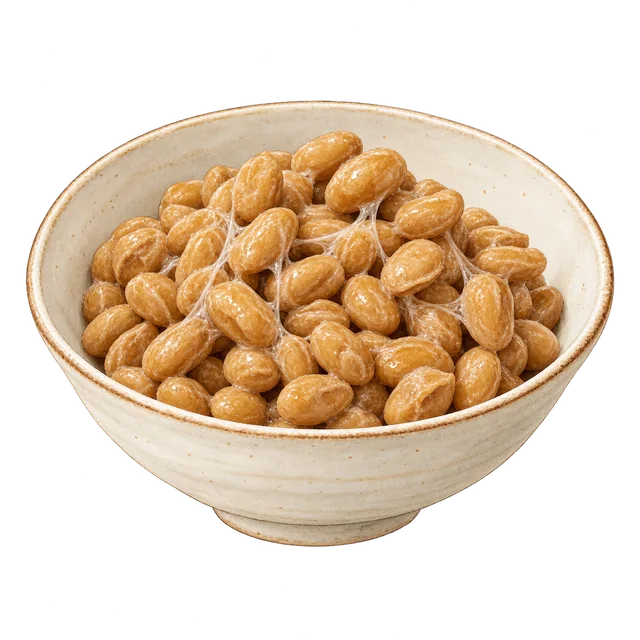
吃华法林等维生素 K 拮抗剂的人:应避免纳豆,这是真实的相互作用,务必听医生和抗凝门诊的指导。这是纳豆唯一一条必须严肃对待的注意事项大豆过敏的人:纳豆是大豆制品,过敏的人要避开(这是免疫问题,和谣言无关;大豆过敏和机制 见 大豆)嘌呤和痛风:纳豆是发酵豆,嘌呤不算特别高,适量一般没问题;急性痛风发作期仍建议先问医生肠胃敏感、不习惯发酵食物的人:第一次可以少吃一点,让肠道适应 对多数人,纳豆是一份机制清楚的维生素 冠军食物,外加一份活的发酵豆;唯一需要严肃对待的是华法林相互作用。这里只提供一般信息,个人用药和病情请听医生的判断。
参考文献 · 9
U.S. Department of Agriculture, Agricultural Research Service. (2019). FoodData Central: Natto (SR Legacy, FDC ID 172443). Fermented whole soybean; ~19.4 g protein, ~5.4 g dietary fiber, ~211 kcal per 100 g. fdc.nal.usda.gov/food-details/172443/nutrients
Tsukamoto, Y., Ichise, H., Kakuda, H., & Yamaguchi, M. (2000). Intake of fermented soybean (natto) increases circulating vitamin K2 (menaquinone-7) and gamma-carboxylated osteocalcin concentration in normal individuals. Journal of Bone and Mineral Metabolism, 18(4), 216-222. Ordinary natto contained ~775 µg MK-7 per 100 g; intake raised serum MK-7 and carboxylated osteocalcin. 10.1007/s007740070023
Schurgers, L. J., et al. (2007). Vitamin K-containing dietary supplements: comparison of synthetic vitamin K1 and natto-derived menaquinone-7. Blood, 109(8), 3279–3283. 10.1182/blood-2006-08-040709
Geleijnse, J. M., et al. (2004). Dietary intake of menaquinone is associated with a reduced risk of coronary heart disease: the Rotterdam Study. Journal of Nutrition, 134(11), 3100–3105. 10.1093/jn/134.11.3100
Vermeer, C. (2012). Vitamin K: the effect on health beyond coagulation - an overview. Food & Nutrition Research, 56, 5329. Cheese/curd K2 is from lactic-acid bacteria (mainly MK-8 and MK-9) and propionic-acid bacteria (mainly MK-10). MK-7 is almost exclusively Bacillus subtilis natto; MK-4 is from animal tissue (menadione conversion), not cheese lactic fermentation. 10.3402/fnr.v56i0.5329
Li, X., Long, J., Gao, Q., Pan, M., Wang, J., Yang, F., & Zhang, Y. (2023). Nattokinase supplementation and cardiovascular risk factors: a systematic review and meta-analysis of randomized controlled trials. Reviews in Cardiovascular Medicine, 24(8), 234. Pooled 6 RCTs (546 participants); nattokinase modestly lowered systolic BP (MD ~-3.45 mmHg) but lipid effects were inconsistent; small number of studies limits firm conclusions. 10.31083/j.rcm2408234
Kudo, T. (1990). Warfarin antagonism of natto and increase in serum vitamin K by intake of natto. Artery, 17(4), 189-201. In patients on warfarin after valve replacement, eating natto markedly weakened anticoagulation via natto's high vitamin K2 (MK-7); warfarin patients should avoid natto. pubmed.ncbi.nlm.nih.gov/2360879
Booth, S. L., & Centurelli, M. A. (1999). Vitamin K: A practical guide to the dietary management of patients on warfarin. Nutrition Reviews, 57(9 Pt 1), 288-296. & supporting AHA 2003 statement on warfarin + dietary vitamin K consistency. Note: the id says 2004 but this record is the 1999 paper; text that cites 'Booth 2004' means this record. Abstract: patients on warfarin are advised to keep dietary vitamin K intake constant, and a constant intake meeting the then-current recommendation of 65-80 µg/day is the most acceptable practice; a dose-response of vitamin K on warfarin anticoagulation had not been established; plant oils and foods prepared with them (baked goods, margarines, salad dressings) are also sources (abstract, PMID 10568341). 10.1111/j.1753-4887.1999.tb01815.x
Hill, C., Guarner, F., Reid, G., et al. (2014). The ISAPP consensus statement on the scope and appropriate use of the term probiotic. Nature Reviews Gastroenterology & Hepatology, 11, 506-514. A probiotic benefit is strain- and dose-specific, not a property of all fermented foods. 10.1038/nrgastro.2014.66