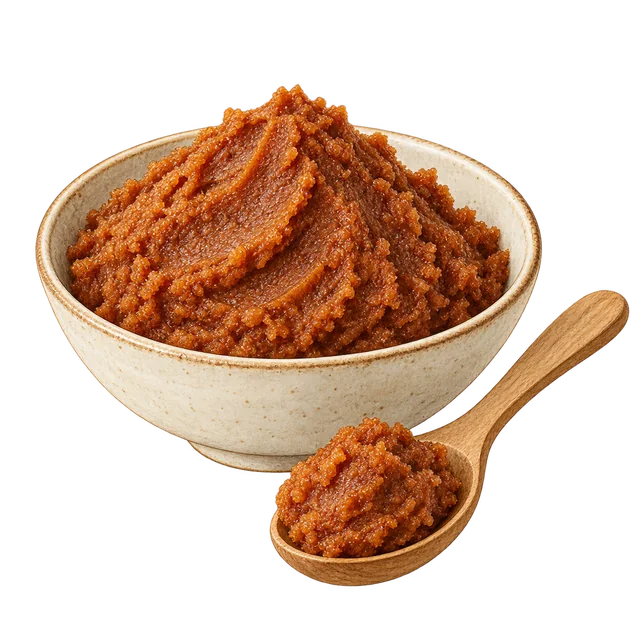
U.S. Department of Agriculture, Agricultural Research Service. (2019). FoodData Central: Miso (SR Legacy, FDC ID 172442). Fermented soybean paste; ~3,728 mg sodium, ~12.8 g protein, ~199 kcal per 100 g. fdc.nal.usda.gov/food-details/172442/nutrients
Yamaguchi, S., & Ninomiya, K. (2000). Umami and food palatability. Journal of Nutrition, 130(4S Suppl), 921S-926S. Reviews the independent umami taste pathway and glutamate's natural occurrence in foods. 10.1093/jn/130.4.921S
Raiten, D. J., Talbot, J. M., & Fisher, K. D. (Eds.). (1995). Analysis of adverse reactions to monosodium glutamate (MSG), report prepared by FASEB for the U.S. FDA. Journal of Nutrition, 125(11), 2891S-2906S. Concluded MSG is generally safe at normal dietary intake. PubMed indexes the executive summary (PMID 7472671) without an abstract and the report text could not be re-read (publisher page blocked, 2026-09-25); FDA's MSG Q&A (fda-msg-qa) summarises this report's finding of transient, mild symptoms in some sensitive people after 3 g or more without food. 10.1093/jn/125.11.2891S
Hamilton-Reeves, J. M., Vazquez, G., Duval, S. J., Phipps, W. R., Kurzer, M. S., & Messina, M. J. (2010). Clinical studies show no effects of soy protein or isoflavones on reproductive hormones in men: results of a meta-analysis. Fertility and Sterility, 94(3), 997-1007. Meta-analysis of 32 studies finding no significant effect of soy protein or isoflavone intake on testosterone, SHBG, free testosterone, or free androgen index in men. 10.1016/j.fertnstert.2009.04.038
Hill, C., Guarner, F., Reid, G., et al. (2014). The ISAPP consensus statement on the scope and appropriate use of the term probiotic. Nature Reviews Gastroenterology & Hepatology, 11, 506-514. A probiotic benefit is strain- and dose-specific, not a property of all fermented foods. 10.1038/nrgastro.2014.66
World Health Organization. (2012). Guideline: Sodium intake for adults and children. World Health Organization. Recommends a reduction to less than 2 g/day of sodium (5 g/day of salt) in adults - a strong recommendation. For children, the recommended maximum adult level of 2 g/day sodium should be adjusted downward based on the energy requirements of children relative to those of adults. www.who.int/publications/i/item/9789241504836
National Academies of Sciences, Engineering, and Medicine. (2019). Dietary Reference Intakes for Sodium and Potassium. National Academies Press. The PubMed book abstract (PMID 30844154) gives no reference values; it says the report updates the sodium and potassium DRIs with an expanded model that adds chronic-disease endpoints (the Chronic Disease Risk Reduction Intake). The numeric AIs and CDRRs were not re-read for this note (abstract). www.ncbi.nlm.nih.gov/books/NBK538102
Ito, K., Miyata, K., Mohri, M., Origuchi, H., & Yamamoto, H. (2017). The effects of the habitual consumption of miso soup on the blood pressure and heart rate of Japanese adults: a cross-sectional study of a health examination. Internal Medicine, 56(1), 23-29. Frequency of miso-soup intake was not clearly associated with hypertension despite higher sodium intake in heavier consumers; cross-sectional, confounded, cannot establish causation. 10.2169/internalmedicine.56.7538
Jinap, S., & Hajeb, P. (2010). Glutamate: its applications in food and contribution to health. Appetite, 55(1), 1-10. Reviews glutamate/umami in food and the use of MSG to reduce added sodium while maintaining palatability. 10.1016/j.appet.2010.05.002