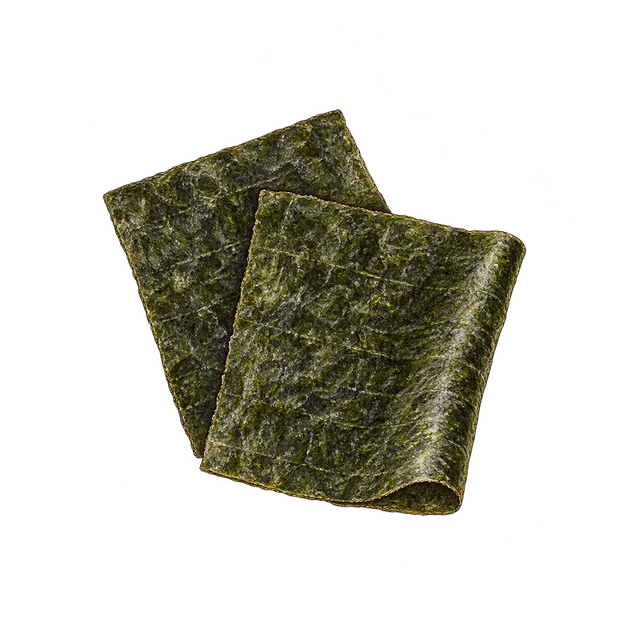
铁、镁、钙、钾:紫菜是植物和藻类里铁的不错来源;这是非血红素铁,和维生素 C 一起吃吸收更好(见 铁)碘:温和适量,不会一下子冲高维生素 A 的原料(β-胡萝卜素)和维生素 C:鲜紫菜里有一些,但烘烤和储存会损失可溶性纤维和多糖(比如紫菜特有的紫菜多糖),以及海藻特有的色素蛋白 这些成分的每 100 g 干重数字好看,但一餐几克的紫菜,对铁、镁这些营养素的实际贡献是点缀级的,不是主力。把它理解成在汤面、饭团、寿司里顺带添一点海洋矿物质和鲜味的配角就好。
U.S. Department of Agriculture, Agricultural Research Service. (2019). FoodData Central: Seaweed, laver (nori), raw / dried. A red seaweed (Porphyra/Neopyropia); protein ~30-50% of dry weight with all essential amino acids; iron, magnesium, calcium. fdc.nal.usda.gov
Watanabe, F., Takenaka, S., Katsura, H., Masumder, S. A., Abe, K., Tamura, Y., & Nakano, Y. (1999). Dried green and purple lavers (nori) contain substantial amounts of biologically active vitamin B12 but less of dietary iodine relative to other edible seaweeds. Journal of Agricultural and Food Chemistry, 47(6), 2341-2343. Dried nori iodine ~4-6 mg/100 g dry weight (far below kelp); contains active B12 rather than analogues. 10.1021/jf981065c
National Institutes of Health, Office of Dietary Supplements. (2022). Iodine — Fact Sheet for Health Professionals. Fact sheet (updated November 5, 2024; Wayback snapshot 16 September 2026): commercial seaweeds range from 16 to 2,984 mcg iodine per gram; dried nori, 2 tablespoons flaked (5 g), 116 mcg; US iodized salt is labelled 45 mcg iodine per gram (measured 47.5-50.7); two RCTs giving 150 or 200 mcg/day iodine from early pregnancy to delivery found no effect on child cognitive, language or motor scores at 1.5-2 years, and one found no benefit at 5-6 years either (fact sheet). ods.od.nih.gov/factsheets/Iodine-HealthProfessional
MacArtain, P., Gill, C. I. R., Brooks, M., Campbell, R., & Rowland, I. R. (2007). Nutritional value of edible seaweeds. Nutrition Reviews, 65(12 Pt 1), 535-543. Reviews protein, mineral, and micronutrient content of edible seaweeds; nori (Porphyra) is among the highest in protein by dry weight. 10.1111/j.1753-4887.2007.tb00278.x
Huang, Q.-N., Watanabe, F., Koseki, K., He, R.-E., Lee, H.-L., & Chiu, T. H. T. (2024). Effect of roasted purple laver (nori) on vitamin B12 nutritional status of vegetarians: a dose-response trial. European Journal of Nutrition, 63, 3269-3279. Open-label dose-response trial in 30 vegetarians; 4 weeks of nori improved serum B12, holoTC, homocysteine, and the 4cB12 score. Single small short-term trial. 10.1007/s00394-024-03505-9
National Institutes of Health, Office of Dietary Supplements. (2024). Vitamin B12 — Fact Sheet for Health Professionals. Fact sheet (updated July 2, 2025; Wayback snapshot 20 September 2026): multivitamin/mineral supplements typically contain 5 to 25 mcg B12, B-complex products 50 to 500 mcg, B12-only supplements typically 500 to 1,000 mcg; absorption is only about 2% at 500 mcg and 1.3% at 1,000 mcg; a 2018 Cochrane review of 3 RCTs (153 participants) compared very high oral doses (1,000-2,000 mcg) with intramuscular B12; high oral doses (e.g. 1,000 mcg/day) might be equally effective in Crohn's disease and appear as effective as hydroxocobalamin injections after Roux-en-Y bypass. These are product contents and trial doses; the sheet gives no recommended daily supplement range (fact sheet). ods.od.nih.gov/factsheets/VitaminB12-HealthProfessional
Watanabe, F., Yabuta, Y., Bito, T., & Teng, F. (2014). Vitamin B12-containing plant food sources for vegetarians. Nutrients, 6(5), 1861-1873. B12 is synthesized only by bacteria and archaea, not by plants or fungi, and most plant foods are unreliable sources that may carry inactive corrinoid analogs. ⚠️ The review's own conclusion, however, is that dried purple laver (nori) is the MOST SUITABLE naturally occurring vitamin B12 source presently available for vegetarians, and that it additionally supplies iron and n-3 fatty acids that vegetarian diets tend to lack. Do not cite this paper for the claim that nori B12 is inactive. Full text: supplements made from edible cyanobacteria (Spirulina, Aphanizomenon, Nostoc) often contain large amounts of pseudovitamin B12, which is biologically inactive in humans; chlorella tablets contain biologically active vitamin B12, but the authors' unpublished data show contents from zero to several hundred µg per 100 g dry weight, so users should check the label (full text, PMC4042564; abstract, PMID 24803097). 10.3390/nu6051861
The Vegan Society. (2023). What every vegan should know about vitamin B12; consistent with Academy of Nutrition and Dietetics guidance. Vegans should obtain B12 from reliable supplements or fortified foods; seaweeds including nori, spirulina, and gut bacteria are not reliable B12 sources. Current page (read 2026-09-24; the numbers are in the page's infographic): if relying on fortified foods, eat them at least twice a day, at least four hours apart, aiming for at least 3 micrograms a day; if relying on a daily supplement, at least 10 micrograms; if relying on a weekly supplement, at least 2000 micrograms; cyanocobalamin is the recommended form. The page gives 1.5 micrograms as the UK adult daily intake and says no upper limit has been set because no toxic effect has been identified (vegansociety.com page and infographic). www.vegansociety.com/resources/nutrition-and-health/nutrients/vitamin-b12