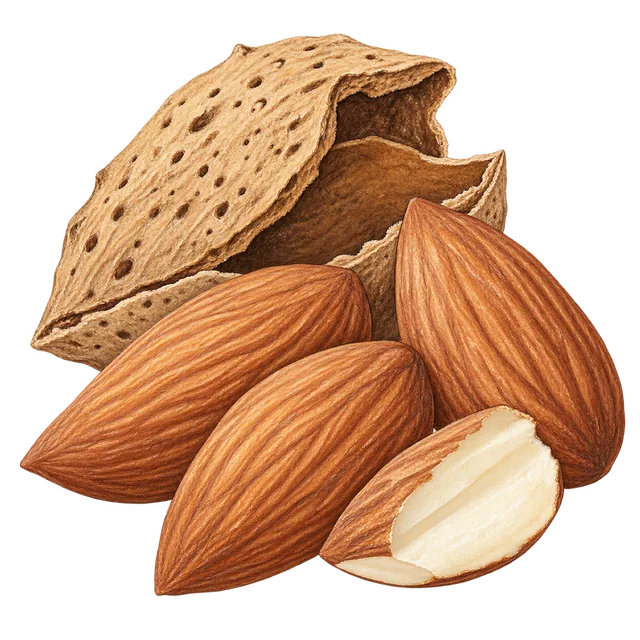
蛋白质 21 g / 100 g 在坚果里是很高的。9 种必需氨基酸都有,但属于不完全蛋白(精氨酸很高,赖氨酸偏低),与豆类搭配可互补纤维约 12.5 g / 100 g,在坚果里属于高纤维,可溶和不可溶两种都有脂肪那一栏决定了它的热量密度:热量的绝大部分来自脂肪,所以杏仁的热量高和它的营养好是同一件事的两面,不是两件相反的事 提醒一句口径:上面这些都是按百克算的,而现实里一次吃的远少于此。一份到底是多少、实际吸收的热量又是多少,在讲怎么挑、吃多少的一章。
杏仁配深色浆果(蓝莓、草莓):维生素 E 和维生素 C 各补一边杏仁和核桃混着吃:补上 omega-3 的缺口杏仁配豆类(豆腐、鹰嘴豆泥):蛋白互补,赖氨酸和精氨酸各自到位补铁那一餐别配大量杏仁:它的草酸会略微压低铁吸收 整体策略:把杏仁当作脂肪、维生素 E 和镁的来源,和不同颜色、不同类别的食物组合。
Novotny, J. A., Gebauer, S. K., & Baer, D. J. (2012). Discrepancy between the Atwater factor predicted and empirically measured energy values of almonds in human diets. American Journal of Clinical Nutrition, 96(2), 296-301. A randomized crossover study (n=18) measured actual metabolizable energy from almonds as ~24% lower than Atwater predictions, due to incomplete lipid digestion from intact cell walls. Abstract figures: 18 healthy adults ate 0, 42 or 84 g of almonds a day in 18-day crossover periods, with all urine and faeces collected over the last 9 days; measured 4.6 ± 0.8 kcal/g (129 kcal per 28 g) versus 6.0-6.1 kcal/g by the Atwater factors (168-170 kcal per 28 g), i.e. the Atwater factors overestimated by 32%. The abstract gives no mechanism; the cell-wall explanation is the usual interpretation, not an abstract finding (abstract, PMID 22760558). 10.3945/ajcn.112.035782
Estruch, R., Ros, E., Salas-Salvadó, J., Covas, M.-I., Corella, D., Arós, F., et al. (2018). Primary prevention of cardiovascular disease with a Mediterranean diet supplemented with extra-virgin olive oil or nuts. New England Journal of Medicine, 378(25), e34. PREDIMED RCT (~7,447 high-risk adults); a Mediterranean diet supplemented with mixed nuts (or EVOO) reduced major cardiovascular events versus a control low-fat diet. (First published 2013; retracted in 2018 over randomization issues and republished the same year with corrected data.). 7,447 adults aged 55-80 (57% women) at high cardiovascular risk; median 4.8 years. Events 3.8% (olive oil), 3.4% (nuts), 4.4% (control); adjusted HR 0.69 (0.53-0.91) and 0.72 (0.54-0.95). Results similar after omitting 1,588 participants whose assignments departed from protocol (household members enrolled without randomisation, some participants at 1 of 11 sites assigned without randomisation, inconsistent use of randomisation tables at another site) (abstract, PMID 29897866). 10.1056/NEJMoa1800389
Estruch, R., Martínez-González, M. A., Corella, D., Salas-Salvadó, J., Fitó, M., Chiva-Blanch, G., et al. (2019). Effect of a high-fat Mediterranean diet on bodyweight and waist circumference: a prespecified secondary outcomes analysis of the PREDIMED randomised controlled trial. Lancet Diabetes & Endocrinology, 7(5), e6-e17. Replaces the authors' 2016 report, withdrawn after the randomisation deviations (866 participants, 11.6%) came to light; the estimates do not rely only on the assumption that everyone was randomised. 7,447 older adults at high cardiovascular risk, diets unrestricted in energy and no physical-activity advice, median 4.8 years: all three groups had marginally reduced bodyweight and increased waist circumference. Adjusted 5-year difference versus the low-fat-advice control: bodyweight -0.410 kg (p = 0.056) with olive oil and -0.016 kg (-0.453 to 0.421; p = 0.942) with nuts; waist -0.466 cm (p = 0.154) and -0.923 cm (-1.604 to -0.241; p = 0.008). Funders included the California Walnut Commission and nut companies (abstract, PMID 31003626). 10.1016/S2213-8587(19)30074-9
Aune, D., Keum, N., Giovannucci, E., Fadnes, L. T., Boffetta, P., Greenwood, D. C., et al. (2016). Nut consumption and risk of cardiovascular disease, total cancer, all-cause and cause-specific mortality: a systematic review and dose-response meta-analysis of prospective studies. BMC Medicine, 14(1), 207. 20 prospective cohort studies (29 publications); per 28 g/day of nuts, summary RR for coronary heart disease 0.71 (0.63-0.80), stroke 0.93 (0.83-1.05), cardiovascular disease 0.79 (0.70-0.88), total cancer 0.85 (0.76-0.94) and all-cause mortality 0.78 (0.72-0.84); similar for tree nuts and peanuts. Observational: the 4.4 million attributable deaths are stated 'if the associations are causal' (abstract, PMID 27916000). Up to 819,448 participants and 85,870 deaths in the all-cause analysis; total cancer means cancer cases (18,490), not cancer deaths; most of the risk reduction was seen up to about 15-20 g a day (full text, PMC5137221). 10.1186/s12916-016-0730-3