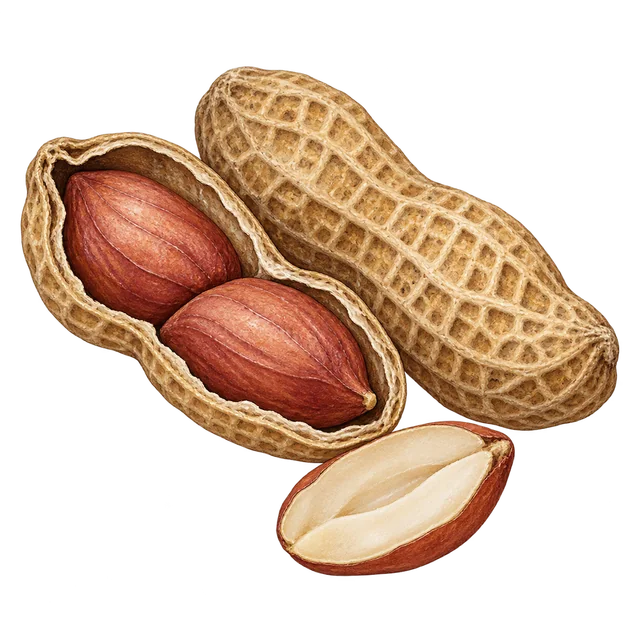
黄曲霉毒素的问题在于,这道处理的中间产物比它本身还活泼:那个中间体会直接抓住细胞核里的 DNA 结合上去。大多数这样的损伤会被修好,但每一次都有修错的机会,而修错的位置如果落在管细胞增殖刹车的那些基因上,这个细胞就少了一道刹车。这就是国际癌症研究机构(IARC)把它列为一类致癌物、且靶器官是肝的原因——不是它直接烧坏了肝,而是它把肝细胞的图纸改错了。
U.S. Department of Agriculture, Agricultural Research Service. (2024). FoodData Central: Peanuts, all types, raw (SR Legacy). Composition reference for peanuts (~25 g protein and ~50% mostly-monounsaturated fat per 100 g). fdc.nal.usda.gov/food-search?query=peanuts%20raw
Bao, Y., Han, J., Hu, F. B., Giovannucci, E. L., Stampfer, M. J., Willett, W. C., & Fuchs, C. S. (2013). Association of nut consumption with total and cause-specific mortality. New England Journal of Medicine, 369(21), 2001-2011. Two prospective cohorts (>118,000 people, 30-year follow-up); nut intake frequency — analyzed separately for tree nuts and peanuts — was inversely associated with total and cause-specific mortality. 10.1056/NEJMoa1307352
Du Toit, G., Roberts, G., Sayre, P. H., Bahnson, H. T., Radulovic, S., Santos, A. F., et al. (2015). Randomized trial of peanut consumption in infants at risk for peanut allergy. New England Journal of Medicine, 372(9), 803-813. The LEAP trial (640 high-risk infants 4-11 months); early regular peanut consumption reduced peanut allergy at age 5 (3.2% vs 17.2% with avoidance, ~80% relative risk reduction), reversing prior 'avoid early' guidance. Participants had severe eczema, egg allergy or both and were randomized at 4 to under 11 months; in the 530 skin-prick-negative infants, peanut allergy at 60 months was 13.7% with avoidance vs 1.9% with consumption; in the 98 skin-prick-positive infants, 35.3% vs 10.6%; no significant difference in serious adverse events; peanut-specific IgG4 rose mainly in the consumption group (abstract, PMID 25705822). 10.1056/NEJMoa1414850
NHS. (2026). Foods to avoid giving babies and young children. No added salt, stock cubes or gravy, as salt is not good for babies' kidneys; no sugar or sweeteners including honey, syrup, fruit juice and smoothies (tooth decay), though fruit is fine; honey occasionally contains bacteria that can produce toxins in a baby's intestines causing infant botulism, so no honey before 1 year; no whole nuts under 5 years (choking), but crushed or ground nuts and nut butter spread on food are fine from around 6 months, and talk to a GP first if there is a family history of allergies; avoid mould-ripened soft and unpasteurised cheeses (listeria); hens' eggs without the British Lion mark should be cooked until white and yolk are solid; no rice drinks instead of milk under 5 (arsenic); avoid raw shellfish and shark, swordfish and marlin (mercury); raw jelly cubes are a choking hazard (page last reviewed 18 February 2026). www.nhs.uk/baby/weaning-and-feeding/foods-to-avoid-giving-babies-and-young-children
Togias, A., Cooper, S. F., Acebal, M. L., Assa'ad, A., Baker, J. R., Beck, L. A., et al. (2017). Addendum guidelines for the prevention of peanut allergy in the United States: report of the National Institute of Allergy and Infectious Diseases-sponsored expert panel. Journal of Allergy and Clinical Immunology, 139(1), 29–44. Guideline 1: infants with severe eczema, egg allergy or both should have age-appropriate peanut-containing food as early as 4 to 6 months, with peanut-specific IgE and/or skin-prick testing strongly considered first; Guideline 2: mild-to-moderate eczema, around 6 months, may be at home; Guideline 3: no eczema or food allergy, introduce freely with other solids; other solids first to show developmental readiness; about 6 to 7 g of peanut protein a week over 3 or more feedings; whole nuts not under 5 years, peanut butter from a spoon or in lumps not under 4 years; home first feeding: give a small taste on the tip of a spoon, wait 10 minutes, then the rest at the usual pace, and stay with the infant for 2 hours; mild signs are a new rash or a few hives around the mouth or face; lip swelling, vomiting, widespread hives, face or tongue swelling, difficulty breathing, wheeze, repetitive coughing, pale or blue skin or sudden limpness need immediate medical attention (full text PMC5226648). 10.1016/j.jaci.2016.10.010