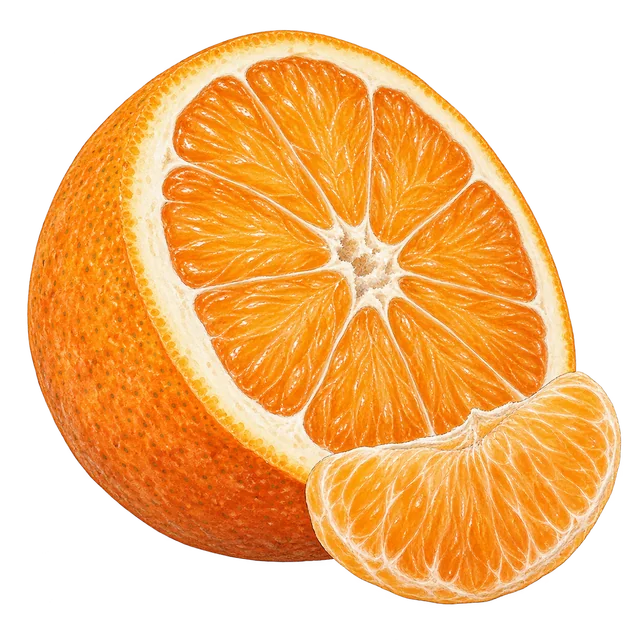
造胶原:造胶原的酶要靠维生素 C 才能持续工作。缺了它,胶原纤维拧不结实,坏血病(scurvy)里牙龈出血、伤口难愈就是这么来的帮植物里的铁吸收:植物里的铁多是难吸收的三价铁(Fe³⁺),维生素 C 在肠道里把它还原成容易吸收的二价铁(Fe²⁺)。它得和含铁的食物在同一餐里吃才起作用,所以吃植物性铁时配点橙子或彩椒更划算(见 铁)挡氧化:它在体液里替更要紧的分子挨氧化 除了维生素 C,橙子还提供叶酸(folate)、钾,以及柑橘类特有的类黄酮橙皮苷(hesperidin)。维生素 C 怕热也怕氧化,长时间加热、切开后久放都会让它流失,所以新鲜生吃保留得最好。
数字 · 哪种食物的维生素 C 更高
橙子和维生素 C 绑在一起,绑得太紧,以至于它成了一个称号。但哪种食物维 C 最高是个有标准答案的问题 —— 去查同一个数据库就行。
每 100 g 生重,抗坏血酸:
食物
维生素 C
相对橙子
橙(生)
53.2 mg
1×
红甜椒(生)
128 mg
2.4×
绿猕猴桃(生)
92.7 mg
1.7×
红甜椒不是水果,平时也不会被摆进补维 C的货架,但按重量算它是橙子的两倍多。
这不是在说别吃橙子 —— 橙子仍然是很好的维 C 来源,而且它同时带着叶酸、钾、纤维和柑橘特有的橙皮苷。
要说的是另一件事:某某之王这类说法,几乎总是可以被一张表推翻。 下次再看到某个食物被冠上某个营养素的头衔,你已经知道该做什么 —— 去查每 100 g 的数,再看看有没有别的食物默默地更高。答案往往就在那里,只是没人去看。
所以更准确的说法不是维 C 能防感冒,而是对普通人,它防不了感冒,规律吃顶多让病程短一点点;感冒了再猛补,没有证据支持。
参考文献 · 7
U.S. Department of Agriculture, Agricultural Research Service. (2019). FoodData Central: Oranges, raw, all commercial varieties. A medium orange supplies close to a day's vitamin C; folate, fiber, flavonoids. fdc.nal.usda.gov
National Institutes of Health, Office of Dietary Supplements. (2024). Iron — Fact Sheet for Health Professionals. Fact sheet (updated September 4, 2025; Wayback snapshot 21 September 2026): RDAs 8 mg/day for men and for women 51+, 18 mg women 19-50, 27 mg pregnancy; UL 45 mg/day from age 14; bioavailability about 14%-18% from mixed diets with meat, seafood and vitamin C and 5%-12% from vegetarian diets; serum ferritin below 30 mcg/L suggests iron deficiency and below 10 mcg/L IDA, but inflammation can raise ferritin; supplemental iron of 45 mg/day or more may cause nausea and constipation; people with hereditary hemochromatosis are at risk of iron overload (fact sheet). Heme vs nonheme: heme iron (lean meat and seafood are the richest sources) has higher bioavailability than nonheme iron, and other dietary components affect it less; calcium might reduce the bioavailability of both forms; heme iron is about 10%-15% of total iron intake in western populations. The sheet gives no separate heme and nonheme absorption percentages (fact sheet, Wayback 2026 snapshot). ods.od.nih.gov/factsheets/Iron-HealthProfessional
Muraki, I., Imamura, F., Manson, J. E., Hu, F. B., Willett, W. C., van Dam, R. M., & Sun, Q. (2013). Fruit consumption and risk of type 2 diabetes: results from three prospective longitudinal cohort studies. BMJ, 347, f5001. Across 187,382 participants in three cohorts, higher whole-fruit intake was associated with lower type 2 diabetes risk while higher fruit-juice intake was associated with higher risk; substituting whole fruit for juice was associated with lower risk. Abstract figures (NHS, NHS II, HPFS; 12,198 cases): per 3 servings a week, whole fruit HR 0.98; blueberries 0.74, grapes and raisins 0.88, apples and pears 0.93, bananas 0.95, cantaloupe 1.10; fruit juice 1.08 (1.05-1.11). Observational (abstract, PMID 23990623). 10.1136/bmj.f5001
Hemilä, H., & Chalker, E. (2013). Vitamin C for preventing and treating the common cold. Cochrane Database of Systematic Reviews, (1), CD000980. Regular vitamin C does not reduce cold incidence in the general population; it modestly shortens duration (~8% in adults), with no benefit when started at symptom onset. 10.1002/14651858.CD000980.pub4