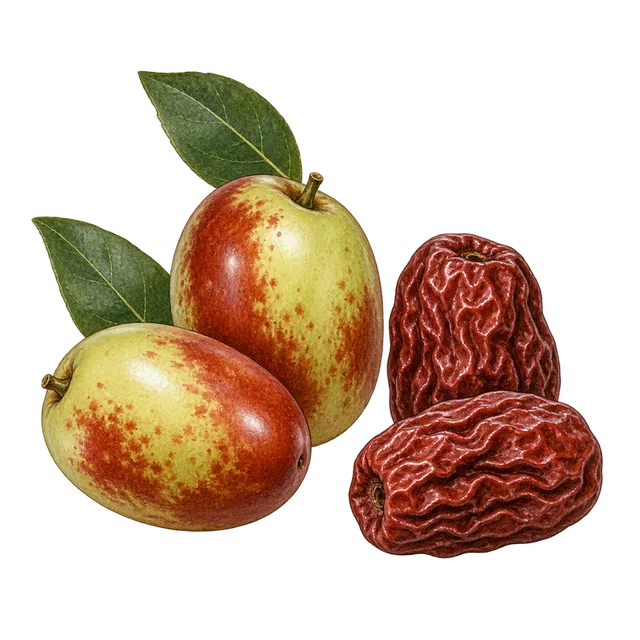
红枣是枣树的果实,在中文饮食和传统里地位很高,常被当作滋补的象征。要看懂它,先得分清鲜枣和干枣:鲜枣脆甜多汁,维生素 C 含量相当高;我们日常吃得最多的是晒干的干枣,干制把水分抽走、把糖浓缩,怕热的维生素 C 同时大量流失。所以同样叫枣,干枣本质上更接近一种浓缩的甜味干果,和葡萄变成葡萄干是同一个道理。
鲜枣的维生素 C 能帮助同一餐里植物性铁的吸收:维 C 把三价铁还原成更易吸收的二价铁(见 维生素 C 和 铁)。所以在一顿富含植物铁的饭里配上富含维 C 的鲜枣、蔬果,确实能让那顿饭的铁吸收好一点。但这是维 C 帮了铁的搭配效应,不是红枣本身在补血;而且干枣的维 C 已经流失大半,这层作用也跟着打折。
维 C 帮铁吸收这句话很常见,但它具体帮在哪一步值得讲清楚 —— 因为讲清楚之后,你会知道一个很实用的限制:它只在同一餐里有效。
维 C 干的是两件事,不是一件。
第一件是还原。植物铁大多是三价的,而肠壁往细胞里搬的那道门只认二价。维 C 把电子让出去,三价就被掰成二价 —— 这一步直接把铁送进了能被搬运的形态。
第二件更关键,也更常被漏掉:保持溶解。维 C 会和铁结合成一种在肠腔里仍然溶得住的复合物。这一层的意义在于抢先:植酸和多酚要锁住的是游离的铁,而已经被维 C 牵在手里的那部分,它们就抓不走了。换句话说,维 C 不只是在细胞门口帮忙,它在更早的肠腔阶段就已经在护送。
这两件事都发生在同一批食物同时待在肠腔里的那段时间。铁和维 C 得在同一个时间、同一个位置相遇,这场护送才成立。所以饭后隔两小时再吃个橙子帮不上忙 —— 那份维 C 在另一个时间段被吸收走了,那顿饭的铁早就各奔东西。
落到吃法上,这条链给出的建议很具体:
要帮的是植物铁那一餐:豆子、深绿叶菜、全谷、豆制品。肉里的血红素铁本来就走专门通道,不太需要这层帮忙维 C 的来源要和这一餐同时下肚:拌进去的青椒、番茄、柠檬汁,或者饭后立刻吃的柑橘、鲜枣同一餐里那杯浓茶或咖啡,作用方向正好相反。想喝就把它挪开,别和这一餐叠在一起 回到红枣身上,结论也就诚实了:鲜枣确实能在一顿植物铁丰富的饭里扮演维 C 那个角色;但干枣的维 C 已经损失大半,这层作用也跟着打折。这是维 C 帮了铁,不是红枣补了血 —— 两句话之间差着整整一条链。
U.S. Department of Agriculture, Agricultural Research Service. (2019). FoodData Central: Jujube / Chinese date (raw and dried). Fresh jujube is high in vitamin C but low in iron (about 0.5 mg/100 g raw and about 1.8 mg/100 g dried, non-heme); drying concentrates sugar and loses much of the vitamin C. fdc.nal.usda.gov
National Institutes of Health, Office of Dietary Supplements. (2024). Iron — Fact Sheet for Health Professionals. Fact sheet (updated September 4, 2025; Wayback snapshot 21 September 2026): RDAs 8 mg/day for men and for women 51+, 18 mg women 19-50, 27 mg pregnancy; UL 45 mg/day from age 14; bioavailability about 14%-18% from mixed diets with meat, seafood and vitamin C and 5%-12% from vegetarian diets; serum ferritin below 30 mcg/L suggests iron deficiency and below 10 mcg/L IDA, but inflammation can raise ferritin; supplemental iron of 45 mg/day or more may cause nausea and constipation; people with hereditary hemochromatosis are at risk of iron overload (fact sheet). Heme vs nonheme: heme iron (lean meat and seafood are the richest sources) has higher bioavailability than nonheme iron, and other dietary components affect it less; calcium might reduce the bioavailability of both forms; heme iron is about 10%-15% of total iron intake in western populations. The sheet gives no separate heme and nonheme absorption percentages (fact sheet, Wayback 2026 snapshot). ods.od.nih.gov/factsheets/Iron-HealthProfessional
Hallberg, L., Brune, M., & Rossander, L. (1989). The role of vitamin C in iron absorption. International Journal for Vitamin and Nutrition Research. Supplement, 30, 103–108. Short review: ascorbic acid has a key role in non-heme iron absorption by preventing insoluble, unabsorbable iron compounds and by reducing ferric to ferrous iron. The abstract gives no dose-response numbers (e.g. no mg of vitamin C or fold increase) (abstract, PMID 2507689).