Story
Kelp (Kombu)
Last updated
In one pass Too much iodine disrupts the thyroid just as too little does, and kelp concentrates the iodine in seawater so strongly that one serving can far exceed a day's need.
Educational content, not medical advice — consult a clinician.
Story path
Chapter 1
What is kelp · a brown seaweed
Kelp is a large brown seaweed of cold seas, not a land vegetable. Most vegetables you can eat freely; kelp you cannot, because both its good and its bad lie in the dose. It does have a good side: umami was discovered in kelp broth, and a small piece used as a soup base can help you use less salt. If you have thyroid disease or take thyroid medicine, ask your doctor before eating a lot of kelp or taking seaweed supplements.
A CLOSER LOOK
A broad blade of brown seaweed
This illustrates kelp form rather than a suggested portion; equal size does not guarantee equal iodine content.
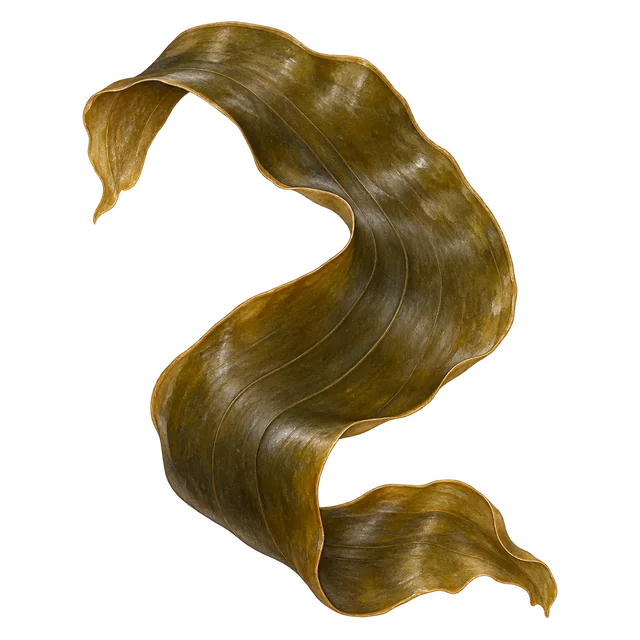
- Brown seaweed from the sea
- Kelp is a large brown seaweed, distinct from land vegetables and red seaweeds such as nori.
- Form is not nutrient content
- Width and thickness describe form; iodine depends on composition and intake, not inspection of this illustration.
Illustration for understanding; not to scale. Saved figures include explanations and sources.
Background · Three things to keep apart about kelp
East Asia has used kombu in soups, salads and braises for more than a thousand years. It is not an especially well-rounded vegetable; it is a rare textbook case where both the good and the bad lie in the dose. Its signature nutrient, iodine, is so concentrated that one serving can far exceed what a person needs in a day. So the point is not to eat more kelp but to understand how concentrated it is and learn to use it sparingly and wisely.Three things need to be kept apart: too much iodine harms the thyroid just as too little does; free glutamate is the savory backbone of the broth and can help you use less salt; and the seaweed contains cancer-causing arsenic headline is about hijiki, not kelp. Keep these three apart, and you can enjoy kelp without being scared off or harmed by it.
Chapter 2
How much iodine one serving holds
A small pinch of dried kelp or one bowl of kelp soup can carry tens to hundreds of times the recommended daily amount for US adults. So it is not a vegetable where more is better; it is a highly concentrated ingredient to be used in trace amounts. Where iodine is scarce it is a precious source, and for the same reason it is one of the easiest foods to overdo.
Numbers · How much iodine is in a gram of dried kombu
In measured data (Aakre 2021 and others), dried kombu averages about 2,276 μg of iodine per gram (about 2.3 mg per gram), and some brown seaweeds (oarweed, for example) are higher still, at about 7,800 μg/g. For comparison, the recommended dietary allowance () of iodine for US adults is just 150 μg. That means:Less than 0.1 g of dried kelp covers a day's iodineA small pinch (a few grams) of dried kelp or one serving of kelp soup can carry tens to hundreds of times the RDAAmong kelp and seaweed supplements on sale, a single serving above the tolerable upper intake level () for iodine is common: Aakre 2021 tested 96 products, and 54 went over the UL in one serving
Safety · How narrow iodine's safe range is
Iodine is not a nutrient where more is better; it has a safe range. The ceiling is called the tolerable upper intake level (): staying below it day after day is generally not harmful. For adults, the European Food Safety Authority (EFSA) sets the UL at 600 μg/day, and the US IOM/NIH at 1,100 μg/day. Kelp is concentrated enough to blow past that ceiling in a mouthful, which is almost unique among natural foods.Chapter 3
Too much iodine harms the thyroid
Iodine is the raw material for thyroid hormone. With too little, the gland swells to compensate and hormone runs short. With too much, the thyroid hits a self-protective brake and makes less hormone for a while (the Wolff-Chaikoff effect); in some people it is ignited instead, and iodine-induced overactive thyroid follows (the Jod-Basedow phenomenon). So kelp's risk is not that it is toxic; it is that its iodine is so concentrated that eating too much is easy.
Mechanism · Too little swells the gland, too much jams it
The thyroid assembles iodine with an amino acid (tyrosine) into thyroid hormones ( and ), which set the pace of the whole body's metabolism (full mechanism: see Iodine). So with too little iodine, raw material runs short: the gland swells to compensate (goiter) and hormone is too low (hypothyroidism). That is the half most people know.The half that is easy to miss: too much iodine also causes trouble.
A large load of iodine all at once triggers a self-protective brake called the Wolff-Chaikoff effect, and the thyroid temporarily stops making hormone. Most people escape within a few days and return to normal; some, especially people whose thyroid was already diseased, cannot adapt and slide into iodine-induced hypothyroidismIn the other direction, in certain people excess iodine can ignite iodine-induced hyperthyroidism (the Jod-Basedow phenomenon), with a racing heart, weight loss and trouble with heatIn population studies, long-term iodine excess is also associated with more autoimmune thyroiditis (Hashimoto's) (see Hashimoto's Thyroiditis)
Evidence · Daily kombu pushed TSH up and kept it there
Miyai 2008 tested this directly in healthy Japanese adults. Thyroid-stimulating hormone () is the marker that rises when thyroid hormone runs low. Eating 15–30 g of kombu a day (about 35–70 mg of iodine) for 7–10 days raised blood TSH, pushing some people beyond the normal range; eating 15 g a day for 55–87 days kept TSH high the whole time, while the thyroid hormones themselves ( and ) barely moved. The suppression was reversible, but people did not quickly adapt while still eating it: levels returned to where they started 7–40 days after stopping.Kelp's risk is not that it is poisonous; it is that its iodine is so concentrated that too much is easy. Iodine is a nutrient with a ceiling, and both too much and too little harm the thyroid. Once you see this two-way edge, it is clear why kelp should be eaten in small amounts with breaks in between, not as a big bowl of seaweed salad every day.
Chapter 4
Umami and kelp broth
Steep a small piece of kombu in water or warm it gently, and the savory taste dissolves into the broth. Add bonito flakes or shiitake, and the umami is amplified. With more umami, a dish needs less salt.
Background · That 1908 bowl of kombu broth
In 1908, Kikunae Ikeda of Tokyo Imperial University was sipping kombu broth and became convinced he tasted a rich flavor that was not sour, sweet, bitter or salty. He purified its source from kombu, glutamate, and named the taste umami. The next year he co-founded Ajinomoto with a partner and turned glutamate into , sold around the world. So the whole story of MSG begins with a piece of kelp (for whether glutamate itself is safe, see MSG / Glutamate).In practice · Using umami to cut salt
Kelp is rich in free glutamate: it is not bound up in protein but free, so the umami receptors on your taste buds can recognize it directly. Steep kombu in water or warm it gently, and the glutamate dissolves into the water, forming the savory backbone of Japanese broth (dashi). Add bonito flakes (which carry inosinate, IMP) or shiitake (which carries guanylate, GMP), and the umami is amplified together, the classic example of umami synergy.What matters is this: with enough umami, food tastes satisfying without extra salt. So a kombu-broth base is a practical kitchen way to cut sodium, and it is especially helpful for people with high blood pressure who need to limit salt (see Hypertension). Kelp's greatest value in the kitchen may be not its nerve-racking iodine but the umami a tiny amount delivers, which seasons your food and helps you eat less salt at the same time.
Chapter 5
Alginate · a gel-forming soluble fiber
That gel slows the stomach's emptying, slows the spread of sugar and fat, and can carry away some bile acids. But these effects come mainly from studies of purified alginate at fairly high doses, not from the few sheets of kelp in an everyday meal. And do not eat more kelp to get fiber: the iodine ceiling is still there.
Mechanism · three steps once it gels with water
Alginate (salts of alginic acid) is found only in brown seaweeds, not in red or green ones. In the stomach and gut it soaks up water and forms a thick gel, which has several effects by mechanism (for the full soluble-fiber story, see Carbs & Fiber):Slower stomach emptying and more fullness: the gel makes food leave the stomach more slowly, so you feel full more easilySlower absorption of sugar and fat: the thick layer in the gut slows the spread of nutrients, so blood sugar and blood fats rise less sharply after a mealBinding some bile acids and fat: the gel can wrap up part of the bile acids and fat in the gut and carry them out of the body, the usual route by which soluble fiber gently lowers cholesterol
The sodium alginate you see on ingredient lists is this same alginate extracted from brown seaweed, used widely as a thickener, gelling agent and stabilizer (the popping boba of molecular cooking depend on it too).
Evidence · A few sheets are not a purified supplement
To be clear: these effects come mainly from purified alginate supplements or from studies with fairly high intakes. The alginate in a little everyday kelp is limited, so do not expect a few sheets to noticeably lower cholesterol or help you lose weight. Think of it as kelp throwing in a bit of soluble fiber on the side; it is not the main selling point.Chapter 6
The arsenic risk is hijiki, not kelp
In the same survey, kombu, nori and wakame showed no inorganic arsenic worth worrying about. Kelp's real problem is too much iodine, not arsenic.
Evidence · Inorganic arsenic is in hijiki, not kombu
Hijiki (Sargassum fusiforme) is also a brown seaweed, commonly eaten in Japan and Korea. Its problem is that it concentrates inorganic arsenic, which the International Agency for Research on Cancer (IARC) classes as a Group 1 carcinogen (meaning it is certain to cause cancer, not that the risk is large).A 2004 survey by the UK Food Standards Agency (FSA) found that hijiki's inorganic arsenic was high, far above other common seaweedsThe key comparison: in the same survey, kombu (kelp), nori, wakame and arame showed no inorganic arsenic worth worrying about; the arsenic in these common seaweeds is mainly organic arsenic (arsenosugars), which is much less toxicOn that basis, the FSA in 2010 explicitly advised consumers not to eat hijiki
For nori as an everyday comparison, see Nori (Laver).
Safety · Does eating hijiki now and then matter?
So please keep two things apart.1. Hijiki: because of inorganic arsenic, food regulators advise not eating it. This is a clear safety recommendation.
2. Kombu (kelp), nori and other common seaweeds: arsenic is not their main problem; kelp's real problem is too much iodine.
The FSA also made clear that people who have eaten hijiki now and then need not panic: occasional eating is unlikely to noticeably raise lifetime cancer risk, but it should not become an everyday food. Separately, seaweeds in general may concentrate small amounts of other heavy metals (cadmium, for example), which is one more reason to eat kelp in small amounts rather than heavily over the long term.
This is general education; for safety advice, follow the latest notices from your local food regulator (such as the FSA or your national health authority), and if you have specific concerns, ask a doctor.
Chapter 7
Eating it, amounts, and cautions
The smartest use is as a broth base: steep a small piece of kombu or warm it gently for flavor, then lift it out instead of eating the whole sheet, so the umami stays and less iodine goes in. If you want iodine, iodized salt is easier to control and does not swing in concentration the way kelp does. People with thyroid disease are more sensitive to iodine's two-way risk and should ask a doctor first.
In practice · Broth base, then lift the sheet out
A broth base is kelp's smartest use: steep a small piece of kombu or warm it gently for flavor, then lift it out instead of eating the whole sheet, so you get the umami with less iodine. Kelp salad or kelp soup now and then is fine, but do not treat seaweed salad or shredded kelp as a big serving of vegetables every day. For iodine, the safer route is iodized salt: the dose is controlled, and it does not swing in concentration the way kelp does.How much to eat runs into an honest difficulty: kelp's iodine varies enormously (origin, species and processing all matter), so it is nearly impossible to work out how much iodine one serving delivers. Rather than chase a precise dose, keep a simple rule: use it as a very strong seasoning, in small amounts with breaks in between. People who eat kelp for years on a traditional Japanese diet often take in a lot of iodine, and most of them tolerate it, provided the thyroid itself is healthy.
Safety · Thyroid disease, pregnancy, kelp pills
People who already have thyroid disease (overactive or underactive thyroid, Hashimoto's, nodules): this is the group that most needs care. Your thyroid is more sensitive to iodine's two-way risk, and large amounts of kelp can trigger or worsen the condition. Whether you can eat it, and how much, is for your endocrinologist to advise (see Hashimoto's Thyroiditis).Pregnant or breastfeeding women and infants: they are more sensitive to iodine excess and should avoid large amounts of kelp and high-iodine seaweed supplements. Iodine needs do rise in pregnancy, but iodized salt and supplements taken on an obstetrician's advice are easier to control. People taking thyroid medicine: swings in iodine intake interfere with managing the condition, so talk with your doctor before eating a lot of kelp or taking seaweed supplements.
People taking seaweed supplements (kelp pills): case reports have linked thyroid dysfunction to these iodine, weight-loss and detox kelp pills, and how often it happens cannot be estimated. Taking high-dose seaweed supplements on your own is not advised.
This is general information only and cannot replace a doctor's judgment of your thyroid and your medicines.
References · 12
- U.S. Department of Agriculture, Agricultural Research Service. (2019). FoodData Central: Seaweed, kelp, raw. A brown seaweed (Laminaria/Saccharina); source of iodine, alginate soluble fiber, and free glutamate. fdc.nal.usda.gov
- Aakre, I., Solli, D. D., Markhus, M. W., Mæhre, H. K., Dahl, L., Henjum, S., Alexander, J., Korneliussen, P.-A., Madsen, L., & Kjellevold, M. (2021). Commercially available kelp and seaweed products – valuable iodine source or risk of excess intake? Food & Nutrition Research, 65, 7584. 96 commercial products; 54 exceeded the iodine UL in one portion/dose. Dried kombu mean iodine ~2,276 µg/g; oarweed ~7,800 µg/g. Highest listed portion 62,400 µg (~400× the 150 µg RDA, not 1000×). 10.29219/fnr.v65.7584
- National Institutes of Health, Office of Dietary Supplements. (2022). Iodine — Fact Sheet for Health Professionals. Fact sheet (updated November 5, 2024; Wayback snapshot 16 September 2026): commercial seaweeds range from 16 to 2,984 mcg iodine per gram; dried nori, 2 tablespoons flaked (5 g), 116 mcg; US iodized salt is labelled 45 mcg iodine per gram (measured 47.5-50.7); two RCTs giving 150 or 200 mcg/day iodine from early pregnancy to delivery found no effect on child cognitive, language or motor scores at 1.5-2 years, and one found no benefit at 5-6 years either (fact sheet). ods.od.nih.gov/factsheets/Iodine-HealthProfessional
- EFSA Panel on Dietetic Products, Nutrition and Allergies (NDA). (2014). Scientific Opinion on Dietary Reference Values for iodine. EFSA Journal, 12(5), 3660. Adult adequate intake 150 µg/day; EFSA sets the adult tolerable upper intake level at 600 µg/day. 10.2903/j.efsa.2014.3660
- Miyai, K., Tokushige, T., & Kondo, M. (2008). Suppression of thyroid function during ingestion of seaweed 'Kombu' (Laminaria japonica) in normal Japanese adults. Endocrine Journal, 55(6), 1103-1108. Short-term 15-30 g kombu/day (35-70 mg iodine) for 7-10 days raised TSH; daily 15 g for 55-87 days kept TSH elevated; values returned 7-40 days after stopping. 10.1507/endocrj.K08E-125
- Zimmermann, M. B. (2009). Iodine deficiency. Endocrine Reviews, 30(4), 376–408. Review: an estimated 2 billion people have insufficient iodine intake; about 50% of Europe remains mildly deficient; deficiency in pregnancy and infancy may impair growth and neurodevelopment; optimal intakes from iodized salt are about 150-250 micrograms/day for adults; the small risks of iodine excess are far outweighed by the risks of deficiency (abstract, PMID 19460960). 10.1210/er.2009-0011
- Ikeda, K. (1909/2002). New seasonings [translated]. Chemical Senses, 27(9), 847-849. Kikunae Ikeda identified glutamate in kombu dashi as the basis of the umami taste in 1908, founding the modern understanding of MSG. 10.1093/chemse/27.9.847
- Jinap, S., & Hajeb, P. (2010). Glutamate: its applications in food and contribution to health. Appetite, 55(1), 1-10. Reviews glutamate/umami in food and the use of MSG to reduce added sodium while maintaining palatability. 10.1016/j.appet.2010.05.002
- Brownlee, I. A., Allen, A., Pearson, J. P., Dettmar, P. W., Havler, M. E., Atherton, M. R., & Onsøyen, E. (2005). Alginate as a source of dietary fiber. Critical Reviews in Food Science and Nutrition, 45(6), 497-510. Alginate is a viscous gel-forming soluble fiber from brown seaweed that slows gastric emptying, raises satiety, and binds bile acids/lipids. 10.1080/10408390500285673
- U.K. Food Standards Agency. (2010, reiterating 2004 advice). Consumers advised not to eat hijiki seaweed. Hijiki (Sargassum fusiforme) contains high levels of inorganic arsenic; a 2004 FSA survey found inorganic arsenic in hijiki but not in kombu, nori, wakame, or arame. Occasional past consumption is unlikely to significantly raise cancer risk. www.food.gov.uk/news-alerts
- Rose, M., Lewis, J., Langford, N., Baxter, M., Origgi, S., Barber, M., MacBain, H., & Thomas, K. (2007). Arsenic in seaweed — forms, concentration and dietary exposure. Food and Chemical Toxicology, 45(7), 1263-1267. Hijiki carries high inorganic arsenic while other common edible seaweeds contain predominantly the less-toxic organic (arsenosugar) forms. 10.1016/j.fct.2007.01.007
- International Agency for Research on Cancer. (2012). Arsenic, metals, fibres, and dusts. IARC Monographs on the Evaluation of Carcinogenic Risks to Humans, Vol. 100C. Arsenic and inorganic arsenic compounds are classified as Group 1 (carcinogenic to humans). publications.iarc.fr/120