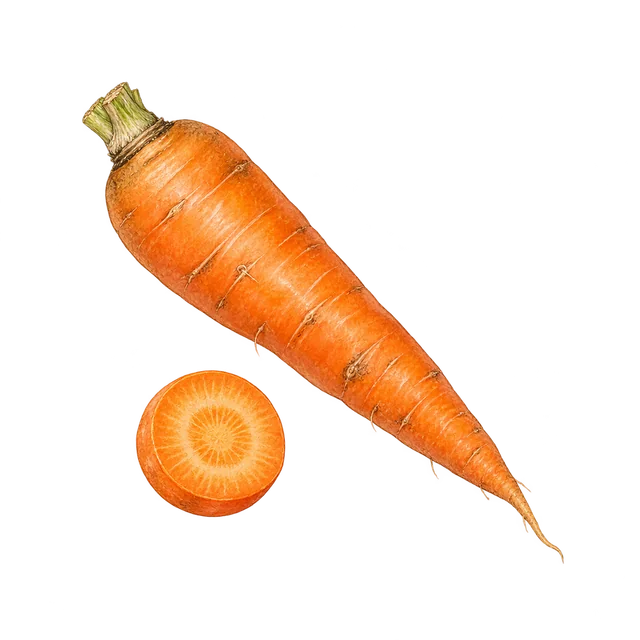
The orange in a carrot comes from beta-carotene. Once it reaches the small intestine, your body cuts it into vitamin A as needed: when you already have enough vitamin A, less gets cut. That step also depends on a little fat in the same meal. The chapter on how beta-carotene becomes vitamin A follows this route step by step.
What we eat is the carrot's taproot, the part that grows underground and stores nutrients. Its orange belongs to a family of plant pigments called carotenoids, led by beta-carotene; the deeper the orange, the more it usually holds.
So the way to get the most from a carrot is concrete: cut it up, cook it until just tender, and add a little fat. And if your palms turn orange after eating a lot of them, there is no need to panic: that is pigment stored in the skin, not poisoning.
A CLOSER LOOK
The orange root supplies raw material
This illustrates an orange variety; pigment amount and the body's conversion efficiency cannot be measured from the picture.
1The edible root
The carrot stores nutrients in this tapering taproot.
2Beta-carotene
Orange varieties provide beta-carotene that can become vitamin A, rather than ready-made retinol.
Illustration for understanding; not to scale. Saved figures include explanations and sources.
Background · Carrots were not always orange
Carrots were not always orange. Early cultivated carrots came in purple, yellow, and white, and today's familiar deep-orange varieties were bred later.
Each color points to a different pigment. Purple carrots carry more anthocyanins, and yellow ones lean toward lutein; neither of those pigments can become vitamin A. Beta-carotene can, so among carrots, a deeper orange usually means a bigger contribution to your vitamin A.
Besides beta-carotene, carrots bring some dietary fiber and potassium. They contain almost no fat and no ready-made vitamin A (retinol): a carrot supplies the raw material, and your body does the finishing.
Chapter 2
Fat and light cooking help absorption
Carrots contain almost no fat, yet fat is their most important partner. Beta-carotene does not dissolve in water. It first has to move into micelles — tiny droplets in which bile wraps up dietary fat and the pigment together — before the small intestine can take it up.
The same carrot delivers different amounts depending on how you eat it: gnawed plain or eaten with a little fat, raw or cooked until just tender. The pigment is locked inside tough cell walls, and heat is what lets it out (see Vitamin A & Carotenoids).
In practice · What fat and a little heat each do
The first lever is fat. Beta-carotene is fat-soluble. Without fat, micelles (the small droplets bile wraps up) cannot form in the gut, and the pigment passes straight through you. Brown 2004 measured this with salads: with a full-fat dressing, noticeably more carotenoids reached the blood than with a reduced-fat dressing. A drizzle of olive oil, a stir-fry with meat, avocado in the bowl — they all do the same job, supplying the raw material for micelles.
The second lever is heat. In a raw carrot, beta-carotene is locked inside tough plant cell walls. Light boiling, steaming, or sautéing breaks those walls and releases the pigment. That runs against the instinct that "raw is always more nutritious": with this vegetable, eating it raw means eating intact cells, not the molecule you can use.
Stack the two levers and you get: cut it up, cook until just tender, and add a little fat. That does not turn the carrot into a supplement. It lets the food's own structure open up.
Chapter 3
How it becomes vitamin A
A carrot does not give you ready-made vitamin A. It gives you beta-carotene, a provitamin A — raw material your body can turn into vitamin A itself. An enzyme in the cells of the small intestine cuts it down the middle, and the halves are then reduced to retinol, the vitamin A your body actually uses.
This step works on demand: when you have enough vitamin A, the cutting slows, so surplus beta-carotene does not keep turning into vitamin A. The ready-made vitamin A (retinol) in animal liver, fish-liver oil, and supplements has no such gate, and large doses can overshoot. High-dose beta-carotene supplements are another matter again: in two large randomized trials, smokers who took them got more lung cancer, not less. So people who smoke or used to smoke should not take high-dose beta-carotene supplements; the amounts you get from vegetables are not part of this warning.
Evidence · Why the extract is not the carrot
The enzyme in the intestinal cell cuts beta-carotene at its exact middle, in principle yielding two units of retinal, which are then reduced to retinol, the vitamin A your body actually uses (Harrison 2012). The step is feedback-regulated: when vitamin A is plentiful, conversion slows, and surplus beta-carotene is stored in fat and skin — the subject of the chapter on why skin can turn orange. Carrots themselves contain no retinol; the USDA food composition database places them as rich in beta-carotene (provitamin A), plus fiber and potassium.
So one molecule name covers three routes. Eat a carrot, and the gate is there. Eat ready-made vitamin A from animal sources, and you bypass the gate. Take a beta-carotene capsule, and the molecule is pulled out on its own and scaled up to amounts food never reaches.
The third route went wrong in trials. The ATBC trial (NEJM 1994) gave 29,133 male smokers in Finland 20 mg of beta-carotene a day for 5–8 years: lung cancer was 18% higher, and death from any cause 8% higher. The CARET trial (NEJM 1996) gave smokers and asbestos-exposed workers beta-carotene plus vitamin A; lung cancer was again higher, and the trial was stopped early. That is not the carrot's result. It is the result of a single nutrient at a dose far beyond food.
Why it backfired has no agreed answer. One plausible explanation: a smoker's lung is rich in oxygen and in oxidants from smoke, and in that setting large amounts of isolated beta-carotene may switch from catching free radicals to helping generate them. This has not been measured directly in people. In food, beta-carotene comes with other carotenoids, fiber, and fat; in a capsule it does not.
So cutting a carrot, adding a little fat, and cooking it lightly is using this vegetable. Buying a bottle of beta-carotene to "protect your lungs" is using a dose that never occurred in food. Same molecule name, not the same thing.
Chapter 4
Why skin can turn orange
Eat a lot of carrots (or pumpkin, or sweet potato) for a while and your skin can turn orange-yellow, most visibly on the palms, the soles, and the sides of the nose. This is called carotenemia: surplus beta-carotene that was not turned into vitamin A settles in the outer layer of the skin. It looks alarming but is harmless, fades over a few weeks once you eat less, and does not cause vitamin A poisoning.
The key is to tell it apart from jaundice. With carotenemia, the whites of the eyes stay white. Jaundice is a rise in bilirubin; the whites of the eyes turn yellow too, and it signals a liver or bile-duct problem. If yellow skin comes with yellow eye-whites or other symptoms, see a doctor promptly.
Mechanism · Why orange skin does not mean poisoning
Orange skin and poisoning travel two different roads. Beta-carotene only counts as vitamin A after that enzyme in the small intestine cuts it, and the enzyme checks the stock: when vitamin A is sufficient, it cuts less. Pigment that is not cut stays pigment. It is stored along with fat and ends up in the outer skin layer and the fat under the skin. The palms, soles, and sides of the nose have thick outer skin, so the color shows there first.
It is especially common in babies and toddlers who eat a lot of carrot puree. Orange palms with white eye-whites is usually just too many carrots, not a disease.
This settles only the poisoning question, though. It does not mean high-dose beta-carotene supplements carry no other risk: the chapter on how beta-carotene becomes vitamin A covers the two trials in which smokers taking such supplements got more lung cancer.
Chapter 5
Do carrots improve night vision?
"Eating carrots improves night vision" is only half true.
The true half: rhodopsin, the pigment in the retina that senses light in the dark, is built from vitamin A. Severe vitamin A deficiency causes night blindness, and in people who are deficient, getting enough vitamin A restores night vision.
The untrue half: if you are not deficient, eating more carrots will not push your night vision past normal. Once your body has enough vitamin A, surplus beta-carotene is stored in the skin and does nothing more for your eyesight. For the pair of pigments more closely tied to the macula at the back of the eye, see Lutein + Zeaxanthin.
Myth · Where the carrot night-vision story came from
This exaggeration has a famous origin, which is only background: during World War II, Britain wanted to hide its radar technology and put out propaganda that its pilots' night-fighting skill came from eating lots of carrots. That smokescreen planted "carrots are a night-vision superfood" in the public mind.
It has lasted so long because the half behind it is true. Rhodopsin is made of a protein plus retinal, a form of vitamin A. When light hits it, the retinal changes shape, rhodopsin breaks apart, and a signal goes to the brain. Back in the dark, rhodopsin has to be rebuilt, which takes a fresh supply of vitamin A. So when vitamin A runs short, seeing in dim light suffers first, and night blindness is one of the earlier signs of deficiency.
The accurate statement: vitamin A is required for normal vision, and deficiency causes night blindness; but if you are not deficient, taking more grants no superpower.
References · 6
U.S. Department of Agriculture, Agricultural Research Service. (2019). FoodData Central: Carrots, raw and cooked. Rich in beta-carotene (provitamin A); fiber and potassium. fdc.nal.usda.gov
Brown, M. J., Ferruzzi, M. G., Nguyen, M. L., Cooper, D. A., Eldridge, A. L., Schwartz, S. J., & White, W. S. (2004). Carotenoid bioavailability is higher from salads ingested with full-fat than with fat-reduced salad dressings as measured with electrochemical detection. The American Journal of Clinical Nutrition, 80(2), 396-403. Dietary fat markedly raises absorption of fat-soluble carotenoids. 10.1093/ajcn/80.2.396
Harrison, E. H. (2012). Mechanisms involved in the intestinal absorption of dietary vitamin A and provitamin A carotenoids. Biochimica et Biophysica Acta, 1821(1), 70-77. Beta-carotene is cleaved by BCO1 in enterocytes to retinal, then retinol — a feedback-regulated, on-demand conversion. 10.1016/j.bbalip.2011.06.002
The ATBC Cancer Prevention Study Group. (1994). The effect of vitamin E and beta carotene on the incidence of lung cancer and other cancers in male smokers. NEJM, 330(15), 1029–1035. 29,133 male smokers aged 50-69 in south-western Finland; alpha-tocopherol 50 mg/day, beta-carotene 20 mg/day, both, or placebo; follow-up 5-8 years. Lung cancer: alpha-tocopherol -2% (-14 to 12%), beta-carotene +18% (3 to 36%). Fewer prostate cancers with alpha-tocopherol, more deaths from haemorrhagic stroke; total mortality 8% higher with beta-carotene (abstract, PMID 8127329). 10.1056/NEJM199404143301501
Omenn, G. S., et al. (1996). Effects of a combination of beta carotene and vitamin A on lung cancer and cardiovascular disease (CARET). NEJM, 334(18), 1150–1155. 10.1056/NEJM199605023341802