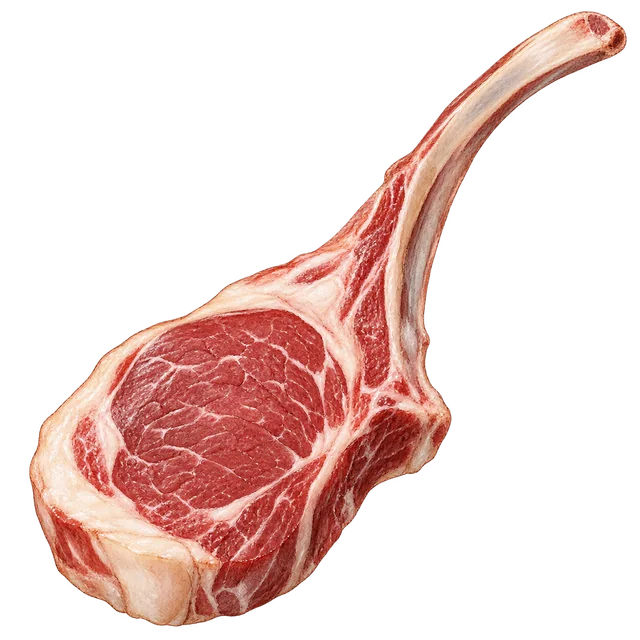
Most of the iron in lamb is heme iron. The gut can take it in together with the ring around it, and it is absorbed several times more efficiently than the iron in plants — lamb's most solid nutritional strength. The chapter on heme iron shows in detail how it gets in.
Like pork and beef, lamb is a red meat. The label is not a casual one based on color: these muscles hold more myoglobin (an iron-carrying pigment protein), which makes the raw meat reddish.
Lamb is eaten many ways in China: in hot pot, as skewers, stewed, or cooked on the bone and eaten by hand. Cuts differ a lot in fat — loin and hind leg are leaner, while ribs and belly are fatty. Lamb fat is fairly high in saturated fat, so which cut you eat and how you cook it usually does more to the fat and calories of a meal than lamb or beef does.
Two questions come up about lamb again and again: what it actually supplies, and how to think about the debate over whether red meat is safe to eat at all.
A CLOSER LOOK
Start with the lamb cut
The rib chop identifies a cut; colour does not establish doneness, and not all lamb is equally fatty.
1Red-meat muscle
More myoglobin makes the raw muscle reddish; lamb is a red meat.
2Rib-cut fat
Ribs and belly are fattier than loin or leg; the cut changes a meal's fat load.
Illustration for understanding; not to scale. Saved figures include explanations and sources.
Mechanism · What makes meat red or white
The words red meat and white meat sound like a casual split by color. What they actually describe is more interesting: what that muscle does for a living.
Myoglobin is the muscle's own oxygen tank
Hemoglobin carries oxygen in the blood and hands it off once it reaches muscle. What takes over is myoglobin — it stays inside the muscle cell, holds oxygen close, and feeds the mitochondria for steady burning.
A muscle that has to produce steady force for a long time (standing, walking, holding body temperature) must stock more myoglobin, or the oxygen will not keep up. And myoglobin itself carries iron and looks red. So how deep the muscle's color is directly reflects how much it depends on a continuous oxygen supply.
So the red-white split is something you can work out
Cattle and sheep muscles are mostly endurance-type; the whole animal leans redChicken breast is burst-type. A farm chicken barely flies, so that muscle almost never works; it relies on a fast, oxygen-free way of supplying energy, has little myoglobin, and so is whiteOn the same chicken, the leg that has stood all day is clearly redderDucks and geese fly, so their breast meat is red The same reasoning holds on a sheep: the legs and neck that carry load year-round are darker and have more connective tissue, and need a long stew; the loin that almost never works is tender, cooks fast, and also stands up worst to a long boil.
Two common kitchen misreads, while we are here
Vacuum-packed lamb looks dark purple and is often taken for not fresh. That is actually myoglobin's natural color when it has not met oxygen; leave the pack open a while and it turns the familiar bright redAfter heating, the meat turns gray-brown because myoglobin denatures with heat. So judging doneness by color is roughly reliable; judging freshness by color often goes wrong One last line that has to do with eating
More myoglobin also means more iron. This is the root of why red meat is a dense iron source — on this point, color and nutrition are two faces of the same cause.
Chapter 2
Rich in iron, B12 and zinc
Lamb's nutrition profile is close to beef's: high-quality complete protein (with all the essential amino acids), plus three micronutrients that animal foods are especially good at.
Iron: lamb is rich in heme iron, the most absorbable formVitamin B12: among natural foods, almost only animal foods contain it, and lamb is a reliable source; strict vegetarians need to add it separately (see Vitamin B12)Zinc: involved in immunity, wound healing, and hundreds of enzymes; red meat is a well-absorbed source of zinc One more thing worth knowing: the fat of grass-fed lamb has slightly more omega-3 and conjugated linoleic acid (CLA) than grain-fed lamb, but the absolute amounts are tiny. Do not treat it as an omega-3 source — that is the job of fatty fish such as salmon.
Mechanism · Why zinc is a structural part
Of lamb's three micronutrients, zinc is the one most easily waved past with a line about hundreds of enzymes. Here it is spelled out.
Zinc is not burned off; it is built in
Many nutrients are raw materials or fuel: once used, they are gone. Zinc is not. It is a structural part. A zinc ion sits in the active center of a large number of enzymes and pulls that short stretch of protein into the right shape; only then can the enzyme grip what it works on and act.
There is also a special class of proteins that use zinc to brace stretches of their structure into finger shapes, and only then can those fingers reach into the grooves of DNA to decide which genes turn on and which turn off. In other words, zinc is not only on the metabolic shop floor; it is also on the level that gives the orders.
That is why the symptoms of zinc shortage are so mixed
See zinc as a structural part and the list suddenly makes sense — the symptoms all appear where cells turn over fast and new protein has to be made nonstop:
Slow wound healing: repair needs a lot of new cells and new proteinDulled taste: the taste-bud cells on the tongue turn over extremely fastWeaker immune response: immune cells have to multiply fast to fightSlower growth in children: growing a body is itself continuous new tissue These symptoms look unrelated. They are the same bottleneck showing up at different work sites.
Why the zinc in red meat is easy to use
Zinc in plants is held by phytate — the same opponent iron runs into (the Millet story traces this chain). Meat has no phytate, and some of the amino acids released as meat is digested can even help carry zinc in.
So the gap between what the nutrition label lists and what you actually absorb is small for meat and large for whole grains and legumes. Red meat is a well-absorbed source of zinc does not mean it is high in zinc; it means little is lost.
How to read the grass-fed claim
The fat of grass-fed lamb really does have somewhat more omega-3 and conjugated linoleic acid than grain-fed lamb; that difference is real. But it is a percentage of an amount that was tiny to begin with. Calling grass-fed lamb an omega-3 source gets the direction right and the size wrong — if you really need to top up, that is the job of fatty fish such as salmon.
One boundary
Taking high-dose zinc supplements for a long time makes the cells of the gut lining produce more of a metal-grabbing protein (metallothionein). It holds copper even more tightly than zinc, traps the copper inside the cell, and the copper is lost when the cell is shed — so copper absorption drops. Zinc from food does not cause this; it applies only to high-dose supplements.
Chapter 3
Mechanism · why heme iron absorbs well
Iron in food comes in two forms, and their fates in absorption are completely different.
In animal foods (lamb, beef, liver, blood), the iron is mainly heme iron: the iron atom sits in the middle of a molecule called a porphyrin ring, and the cells of the gut lining can take it in together with the ring. It is absorbed several times more efficiently than the iron in plants, and it is hardly held back by tea or whole grains in the same meal (calcium is the exception and may lower it somewhat).
The iron in plants is non-heme iron (see Spinach · see Lentils). It first has to be converted into a form that can pass through before it is absorbed, so it is absorbed much less efficiently, and it is easily held back by tannins in tea and coffee and by phytate in grains. Vitamin C gives it a clear boost (see Vitamin C).
So if the goal is getting iron, the iron your body actually absorbs from a small portion of red meat is no less than from a big plate of spinach. That is why groups at high risk of iron deficiency (women with heavy periods, pregnancy, vegans) should pay particular attention to where their iron comes from and what they eat it with. But note: this is about how efficiently it delivers iron, not the more red meat, the better.
Mechanism · iron can get in, and almost cannot get out
Heme iron being well absorbed is only the first half of the story. The second half is what happens once it is in — because the most counterintuitive thing about iron is this: the body has almost no active way to get rid of it.
After heme iron comes through the door
Once that ring-shaped cage has been taken whole into a cell of the gut lining, an enzyme inside the cell opens the ring and releases the iron, which then joins the same pool as iron from plants. In other words, the two kinds of iron come in through two different doors, but once inside they are in the same room.
From the gut-lining cell into the blood, there is only one exit
To pass from the gut-lining cell into the blood, iron has to go through a dedicated exit protein on the far side of the cell. And that exit is controlled by a hormone the liver releases:
When the body has enough iron, or when it is inflamed, this hormone rises and pulls the exit off the cell membraneWith the exit gone, the iron stays in the gut-lining cell. These lining cells turn over fast anyway, and within a few days the cell and its iron are shed together in the stool So the gate the body uses to control iron sits at the entrance, not at an exit. That is the key to the points below.
And so these points all make sense
Why more iron is not better: the body has no routine way to get rid of surplus iron. Apart from bleeding, periods, and shed cells, iron that comes in basically stays. Adult men and postmenopausal women lack the exit that periods provide, so taking large amounts of iron long term is more likely to keep building upWhy inflammation and infection bring anemia: that hormone rises during inflammation, iron is held in the gut-lining cells and cannot get in, and the iron already in the blood is tucked away into storage. This is actually the body competing with bacteria for iron, because bacteria need iron to multiply too. The cost is that the raw material for making blood is locked away as well, so anemia appears. The key point: this kind of anemia often responds poorly to iron supplements; what needs treating is the inflammation itselfWhy iron deficiency always needs a cause found: iron deficiency in an adult often means iron is being lost somewhere. The thing to do is find that leak, not cover up the numbers by taking iron on your own Back to the table
The heme iron in lamb is efficient, and for people who need more iron that is a real advantage. But the same mechanism also points the other way: for someone whose iron is already sufficient, eating more red meat to get a bit more iron is pointless, because the entrance will turn itself down.
Does red meat cause cancer? is a question lamb cannot avoid, and answering it means first separating two things that are often lumped together: how certain the evidence is, and how big the risk is.
In 2015 the International Agency for Research on Cancer (IARC) placed red meat in Group 2A (probably carcinogenic, linked mainly to colorectal cancer) and processed meat (sausage, bacon, ham, and other cured or smoked meats; see Processed Meat) one level higher, in Group 1. IARC's groups answer how certain the evidence is, not how large the harm is: Group 1 only means the evidence that it causes cancer is sufficient. It does not mean that eating a sausage is as dangerous as smoking.
In practice: the risk with firmer evidence lies in processed meat, not in a moderate amount of fresh lamb, and meat cooked until charred is also worth avoiding. Fresh red meat is a good source of iron and B12, and eating it in moderation is reasonable. IARC itself did not give a figure for how much to eat.
What else this classification tells you, and where the commonly cited cancer leads come from, is covered in more detail; the Beef and Processed Meat stories give a fuller picture of the Red & processed meat evidence as a whole.
Myth · What the classification actually answers
This classification is one of the most misread products of science in the world. The misreading has just one root: the question it answers is not the question people think it answers.
What it answers: how certain this is
What IARC does is classify evidence, not rank risk. Its question is: how solid is the evidence that this thing causes cancer in people? The answers fall into a few bands — sufficient evidence, probable, possible, and inadequate evidence.
So things whose everyday harm differs enormously can stand side by side in the same band. The only thing they share is the same degree of certainty.
What it does not answer: how large the harm is
The widely repeated line "eating bacon is like smoking" goes wrong precisely by stacking the two axes on top of each other. The same degree of certainty does not mean the same harm per bite.
What actually describes the size of the harm is a different set of numbers: how much the risk goes up for each extra serving. And that "how much" has to be read against a baseline — raising a small risk by a notch and raising a large risk by a notch mean completely different things for a particular person.
The classification table has no such column. So ranking what to do by the class alone will get the order wrong.
Why suspicion falls on the colon and rectum
The lower gut is the only part of the body in long, direct contact with food residue. Three leads are commonly mentioned, and they come from different places:
Heme iron in the gut can promote a class of nitrogen-containing irritant compounds — this one comes from the meat itselfHigh-heat direct flame turns amino acids and creatine on the meat surface into heterocyclic amines — this one comes from how it is cookedNitrite used in curing can turn into nitrosamines in the gut — this one comes from how it is cured Two of the three come from processing and cooking; only one comes from the meat itself. That matches the direction of the classification: the evidence is most certain for processed meat.
So the order is
First cut back on processed meat (sausage, bacon, ham, cured and preserved meats); this gives the biggest returnThen change how you cook: less char, less direct flame, and do not eat the burnt partsOnly last, limit the total amount of fresh red meat: common dietary advice puts it within a few hundred grams a week (cooked weight), and that is a ceiling, not a target Doing it the other way around — fretting over how many grams of lamb you ate this week while still charring every meal and eating sausage every day — takes the most effort for the smallest return.
Chapter 5
How to choose & eat
At the market and in the kitchen, the conclusion is actually a positive one: lamb is an efficient source of quality protein plus iron, B12, and zinc. Pick the right cut, cook it gently, and keep the amount moderate.
Buying: for less fat, choose lean cuts (loin, hind leg). If you want the rich flavor, treat ribs and belly as an occasional indulgence, since they carry a lot more fat and calories. Lamb fat is fairly high in saturated fat, so which cut you pick usually matters more to the meal than agonizing over lamb versus beef.
Cooking: low and slow (stewing, simmering, hot pot, slow roasting) is safer than fierce high heat. Charcoal-grilled skewers and meat seared until blackened form substances such as heterocyclic amines, so skip the burnt parts and do not make heavy barbecue an every-meal habit.
How much: keep fresh red meat (lamb and beef combined) to roughly a few hundred grams a week at most, and keep processed meat (sausage, bacon, cured meats) as low as you can.
Two things lie behind how to pick and how to cook: the gamey smell travels with the fat, and the cuts that stand up to stewing are rich in collagen.
This is general science only and does not replace a doctor. If you have a specific condition or are preparing for pregnancy, follow your doctor's advice.
Mechanism · Where the gamey smell of lamb hides
On a nutrition table, lamb and beef are almost twins. Nobody confuses their taste. Where that smell comes from is lamb's own question — and the answer tells you which cut to buy.
The source is in the sheep's stomach, not in the meat
Sheep are ruminants: forage goes first into the rumen, where a huge community of microbes ferments it for the animal. The sheep absorbs the products of that fermentation, and when it builds its own fat, some of them end up as a class of branched-chain fatty acids — ordinary fatty acids are a straight chain, while a branched-chain fatty acid has an extra small fork on the chain.
That one structural difference makes these molecules especially quick to evaporate when heated, and their odor threshold is very low: a tiny amount is enough to smell.
Where they finally sit
These molecules are part of the fat, so they are deposited along with it, into fat tissue. On heating they evaporate out of the fat; that characteristic smell is them.
This sentence is the hinge of the whole page: the carrier of the gamey smell is the fat, not the lean muscle fiber.
So three conclusions follow directly
The gamey smell travels with the fat: trim the fat edge and take off the layer on the connective tissue, and most of the smell drops away. Conversely, lamb fat and tail fat are where the smell is most concentrated — a dish stir-fried in lamb fat tastes of it through the whole pan, and this is whyYoung lamb is milder than older sheep: deposit takes time, and a young animal has not stored up enough yet. So people who dislike the smell should pick young lamb, while people who come specifically for that smell should pick older sheepWhat it grazed on counts too: different pastures and feeds produce different rumen fermentation products, so sheep from different places and different farming methods can differ a lot in how gamey they are. This is not mysticism; it is that the microbes upstream were fed different things Kitchen de-gaming methods, ranked by whether they have a reason
Trim the fat, blanch and skim: directly reduces the fat that carries these molecules; the most fundamental fixA long uncovered stew: volatiles leave with the steam, which is why long-stewed lamb broth is less pungentCooking wine, vinegar, a yogurt marinade, scallion and ginger: some of the volatile fraction is carried off with alcohol and steam; some is covered upCumin, Sichuan pepper, baizhi (angelica dahurica), dried tangerine peel, and spices like them: not neutralizing — they fill the nose with an equally strong volatile smell. Effective, but the principle is masking, not removing One last trade-off
Taking the gamey smell all the way out means taking the fat all the way out. And fat is also the source of aroma, juiciness, and mouthfeel. So lamb with no gamey smell at all usually also means flat flavor — this is a trade-off, not a defect. Know where the knob is and you can turn it to your own taste, instead of following one fixed recipe.
Mechanism · Which cuts to stew, which to flash-cook
On the same sheep, some cuts are done in a single dip and go dry if boiled for long, while others are only good after a long stew. This is not just kitchen lore. Two processes running in opposite directions are racing the clock.
The structure of meat: fiber bundles, plus the net that wraps them
Muscle is made of fibers bundled together. Between the bundles and around them sits a layer of connective tissue, made mainly of collagen.
How much collagen a cut has depends on how much work it does: legs, neck, and shank that carry load all year have more connective tissue with tighter cross-links, while the loin, which does almost no work, has a very thin net.
On heating, two things happen at once, in opposite directions
The protein in the muscle fibers shrinks with heat and squeezes water out — the meat tightens and dries out. This starts the moment heating begins, and the longer it goes the more obvious it isCollagen, when enough heat, water, and enough time are all present together, breaks down into gelatin — the tissue loosens, the bite turns soft and sticky, and the broth thickens The second process takes far longer than the first. So whether a piece of meat tastes good depends on which of these two curves is winning.
So the method picks itself
Low-collagen cuts (loin, upper shoulder): there is no second process to wait for, only the first one happening. The longer it goes the drier it gets, so these suit a quick dip or a quick sear — take them off as soon as they are just doneHigh-collagen cuts (leg, lamb spine, shank): you have to ride out the stretch where the meat first dries out, and only once the collagen melts does it taste good. Hitting a dry patch in the middle is part of the normal process, not a ruined pot — many people give up at exactly this step and conclude the cut is no goodThe thin slices for hot pot: cut extremely thin, heat goes through them instantly, and they come out at the very start of the first process; and they come from a low-collagen cut to begin with Tied to the gamey smell
Chinese-style stewed lamb works for a reason: long moist heat does two jobs at once — the collagen melts, and the volatile molecules that carry the gamey smell leave with the steam. One method, two problems solved.
One more point that lines up with health
Low and slow has another benefit: high-heat direct flame and searing to char form substances such as heterocyclic amines, while stewing, simmering, and hot pot all stay well below that temperature range — so for flavor and for this boundary, they point the same way. No trade-off is needed.
Clinical · Who should eat more, who less
The same portion of lamb is worth very different amounts to different people. Put together the mechanisms of iron absorption, nutrient density, and the cancer classification, and this list can be worked out rather than memorized.
People who can lean on it more with confidence
People who are iron-deficient or need more iron: women with heavy periods, pregnant women, growing children, and people returning to meat after a long stretch as vegans. The reason lies in how heme iron is absorbed — the same amount of iron goes through the most efficient door, and it is hardly disturbed by phytate or tea polyphenols in the same mealPeople with small appetites who cannot eat much: older adults, people recovering from surgery, and people losing weight who need to keep their muscle. Lamb stands out for high nutrient density per bite; a small portion delivers quality protein, iron, B12, and zinc all at once. For someone with a limited appetite, density matters more than total amountPeople whose B12 intake has been low for a long time: this vitamin is found almost only in animal foods, and deficiency comes on slowly, with symptoms that are easy to miss People who should hold back more
People whose iron stores are already full: the body has no active way to get rid of iron. Adult men and postmenopausal women lack the exit that periods provide, so eating large amounts of red meat long term is more likely to keep building up ironPeople with a family history of colorectal cancer: in IARC's classification, the more certain evidence is for processed meat; but for someone whose baseline risk is already high, the same turns into a bigger absolute difference, so cutting back is more worthwhilePeople at high cardiovascular risk: lamb fat is fairly high in saturated fat, and fatty and lean cuts differ a lot. For these people, choosing the cut is more practical than deciding whether to give up lambPeople in a gout flare: red meat is in the category to work out with a doctor; it is not a problem a food list can settle Putting it together
Lamb is not an on-off switch of eat it or quit it. It has several knobs: cut, cooking method, how often, and how much. The list above is really saying one thing — different people should turn a different knob first.
For a specific disease or a medicine you are taking, decide with your doctor; do not apply a general suggestion to yourself.
References · 5
U.S. Department of Agriculture, Agricultural Research Service. (2019). FoodData Central: Lamb (leg/loin/rib, raw and cooked). A red meat dense in heme iron, vitamin B12, and zinc; nutrient profile close to beef. fdc.nal.usda.gov
National Institutes of Health, Office of Dietary Supplements. (2024). Iron — Fact Sheet for Health Professionals. Fact sheet (updated September 4, 2025; Wayback snapshot 21 September 2026): RDAs 8 mg/day for men and for women 51+, 18 mg women 19-50, 27 mg pregnancy; UL 45 mg/day from age 14; bioavailability about 14%-18% from mixed diets with meat, seafood and vitamin C and 5%-12% from vegetarian diets; serum ferritin below 30 mcg/L suggests iron deficiency and below 10 mcg/L IDA, but inflammation can raise ferritin; supplemental iron of 45 mg/day or more may cause nausea and constipation; people with hereditary hemochromatosis are at risk of iron overload (fact sheet). Heme vs nonheme: heme iron (lean meat and seafood are the richest sources) has higher bioavailability than nonheme iron, and other dietary components affect it less; calcium might reduce the bioavailability of both forms; heme iron is about 10%-15% of total iron intake in western populations. The sheet gives no separate heme and nonheme absorption percentages (fact sheet, Wayback 2026 snapshot). ods.od.nih.gov/factsheets/Iron-HealthProfessional
National Institutes of Health, Office of Dietary Supplements. (2024). Vitamin B12 — Fact Sheet for Health Professionals. Fact sheet (updated July 2, 2025; Wayback snapshot 20 September 2026): multivitamin/mineral supplements typically contain 5 to 25 mcg B12, B-complex products 50 to 500 mcg, B12-only supplements typically 500 to 1,000 mcg; absorption is only about 2% at 500 mcg and 1.3% at 1,000 mcg; a 2018 Cochrane review of 3 RCTs (153 participants) compared very high oral doses (1,000-2,000 mcg) with intramuscular B12; high oral doses (e.g. 1,000 mcg/day) might be equally effective in Crohn's disease and appear as effective as hydroxocobalamin injections after Roux-en-Y bypass. These are product contents and trial doses; the sheet gives no recommended daily supplement range (fact sheet). ods.od.nih.gov/factsheets/VitaminB12-HealthProfessional
Bouvard, V., Loomis, D., Guyton, K. Z., Grosse, Y., Ghissassi, F. E., Benbrahim-Tallaa, L., et al. (2015). Carcinogenicity of consumption of red and processed meat. Lancet Oncology, 16(16), 1599-1600. IARC classifies processed meat as Group 1 carcinogen, red meat as Group 2A. 10.1016/S1470-2045(15)00444-1