Story
Avocado
Last updated
In one pass Avocado is barely sweet and gets most of its calories from fat, mainly oleic acid, the same fat that dominates olive oil; in the same meal, that fat also helps you absorb the carotenoids in vegetables.
Educational content, not medical advice — consult a clinician.
Story path
Chapter 1
What is avocado · an unusual fruit
Botanically it is a single-seeded drupe, and the common variety is Hass, with a rough skin that darkens as it ripens. Its texture is more like butter than fruit, which is why its Chinese name means butter fruit.
A medium Hass has about 150 g of flesh; ripeness mainly changes the texture, not the nutrients.
Background · An unusual fruit
We picture fruit as sweet, mostly sugar and water. Avocado is the opposite: barely sweet, with most of its calories coming from fat. That identity, a fruit rich in fat, is exactly what makes it interesting nutritionally.Three things follow, and each has its own chapter: what kind of fat it is (mainly oleic acid); how that fat helps you absorb the carotenoids in vegetables; and why so much fat means the calories are not low and the portion has to be counted.
Chapter 2
Its fat is mostly oleic acid
When total calories are held steady and this unsaturated fat replaces some saturated fat, several have seen blood lipids improve (see Fat Types), especially a drop in low-density lipoprotein cholesterol (, often called bad cholesterol). Trials that tested avocado itself have been small and short, so eating avocado lowers LDL should be taken with a discount.
A CLOSER LOOK
Fat in the flesh, without sweetness
The cut face locates the edible flesh. Its color does not reveal grams of fat, and an illustration is not a composition measurement.
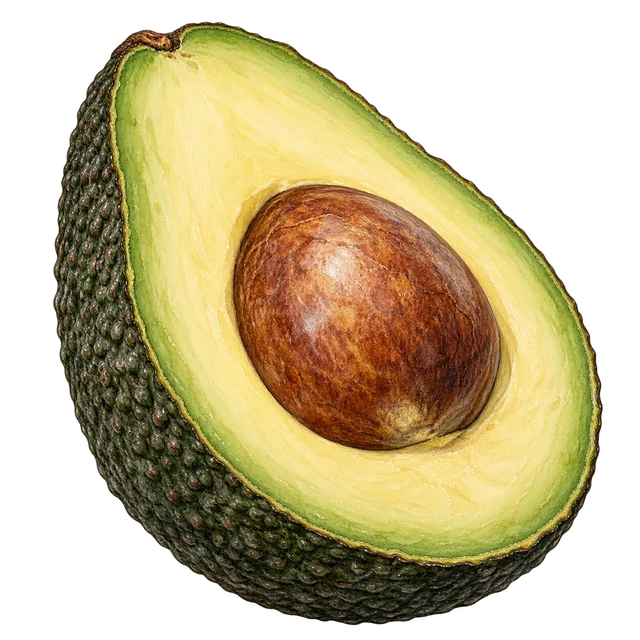
- Fat in the flesh
- Most avocado energy comes from fat, predominantly monounsaturated fatty acids, especially oleic acid.
- Think in replacements
- The value of unsaturated fat should be understood as replacing some saturated fat while keeping total energy in view.
Illustration for understanding; not to scale. Saved figures include explanations and sources.
Numbers · Macros in 100 g of flesh
On macros, 100 g of Hass flesh carries roughly 15 g of fat, 9 g of carbohydrate, and 2 g of protein, at around 160 kcal. About 7 g of those 9 g of carbohydrate is fiber, so there is very little net carbohydrate to raise blood sugar and almost no sugar, which is why avocado does not taste sweet.It also helps to be clear about what it is not: avocado has almost no omega-3. That is the strength of fatty fish, so do not count on avocado for omega-3 (see Fats & Omega-3).
Chapter 3
Potassium, fiber, and better absorption
Its real signature skill is in the fat: carotenoids such as lutein and beta-carotene do not dissolve in water, and the small intestine absorbs them much more easily when there is fat in the same meal. In a small human trial, adding avocado to a salad clearly raised how much of the meal's carotenoids were absorbed. What it raises is absorption, not the amount in the vegetables themselves (for the carotenoids themselves, see Lutein + Zeaxanthin). So avocado does not replace vegetables; it makes the vegetables you eat worth more.
Mechanism · how fat-soluble things get into the blood
Without fat in the same meal, they are hard to absorb — unpack that sentence and you get four steps, all of them in your small intestine.Step one · it does not dissolve in water at all. Pigments like lutein and beta-carotene are very long carbon chains, with almost no site on the chain that can hold onto a water molecule. The intestinal lumen is a water environment; once they go in, they only clump together and stick to food residue. Nothing can carry them.
Step two · fat and bile acids build it a ride first. Avocado oil is broken in the small intestine into fatty acids and monoglycerides; bile acids (bile salts) squeezed from the gallbladder are molecules with one water-loving end and one oil-loving end. The two gather and automatically line up into tiny spheres: oil-loving ends inward, water-loving ends outward. That is a mixed micelle — oil at the core, water at the surface, so it can drift freely in a water-like lumen. Only then do carotenoids have a place to sit: they dissolve into the core and get taken along.
Step three · dock and unload. The micelle drifts to the water film that sits tight against the cells on the small-intestine villi, releases the carotenoids inside, and the molecules then cross the epithelial-cell membrane into the cell. Without the ride from step two, they cannot even get through that water film — that is what hard to absorb without fat concretely means.
Step four · take the lymph, not the portal vein. Carotenoids that entered the cell are re-packed into a lipoprotein particle called a chylomicron, leave via lymph vessels into the blood, skip the liver's first checkpoint, and only then get distributed through the body.
So avocado in the salad is not a standalone research conclusion. It is one concrete example of this four-step chain: what you are adding is not a nutrient. It is the ride.
Mechanism · Swap the fat, swap the cooking method
Since the working part is the fat link, this chain can be pushed past avocado.A different fat works the same way. Olive oil, nuts, a whole egg, sesame paste — as long as the same meal has fat, the micelle can be built. In Unlu 2005, avocado oil alone, not just a whole avocado, also raised absorption. That itself shows the credit belongs to the oil, not to avocado's identityFat-free salad dressing has a hidden cost. A pretty plate of lettuce, tomato, and carrot salad, dressed with a zero-fat sauce: the amount of vegetables has not changed, but the ride from step two is gone, and many of the carotenoids leave unchanged — the salad looks lighter, yet you take home lessMethod sits on this chain too. The gap between a light stir-fry of carrot (oil, heat) and boiling it in plain water (no oil) is not in carotene content; it is in how much you can take. Heat helps step one (breaking the cell wall); oil helps step twoFat-soluble vitamins follow the same logic. Vitamins A, D, E, and K also travel the micelle-plus-chylomicron road. That take with a meal line on a supplement label is telling you to have the ride ready for it
Two honest boundaries. First, this chain is about the fraction absorbed, not the nutrient content of the vegetables themselves — oil does not conjure lutein out of nothing; you still have to eat the vegetables. Second, absorbing more is not the same as a better health outcome. That is a different question, and it needs a different body of evidence; this page explains the mechanism. It is not a promise.
Chapter 4
Its calories, and a few cautions
High potassium is good news for most people; but people with more advanced chronic kidney disease, or who take drugs that make the kidneys hold on to potassium (such as ACE inhibitors, sartan-type blood-pressure drugs, or spironolactone), should follow their doctor on how much high-potassium food to eat.
In practice · Choosing, eating, and a few cautions
Choosing: a ripe Hass has darkened skin and gives slightly to a gentle squeeze without collapsing.Eating: it barely needs cooking; eat it plain, spread it on toast, toss it in a salad, or mash it into a dip. To get its carotenoid-absorbing benefit, remember to eat it in the same meal as vegetables.
A few small things worth knowing:
Cut flesh browns in the air; this is enzymatic oxidation, not a safety problem, and a squeeze of lemon juice slows itAvocado contains a substance called persin that is toxic to some animals such as cats and dogs; that is a pet concern, and it is safe for people
For potassium intake related to kidney disease, follow your doctor's advice; this is education, not a substitute for medical advice.
References · 7
- U.S. Department of Agriculture, Agricultural Research Service. (2019). FoodData Central: Avocados, raw (Hass). ~160 kcal/100 g, mostly monounsaturated fat (oleic acid); high fiber and potassium; calorie-dense. fdc.nal.usda.gov
- U.S. Department of Agriculture & U.S. Department of Health and Human Services. (2020). Dietary Guidelines for Americans, 2020-2025 (9th ed.). www.dietaryguidelines.gov/sites/default/files/2020-12/Dietary_Guidelines_for_Americans_2020-2025.pdf
- National Institutes of Health, Office of Dietary Supplements. (2021). Potassium — Fact Sheet for Health Professionals. ods.od.nih.gov/factsheets/Potassium-HealthProfessional
- National Institutes of Health, Office of Dietary Supplements. (2022). Folate — Fact Sheet for Health Professionals. ods.od.nih.gov/factsheets/Folate-HealthProfessional
- National Institutes of Health, Office of Dietary Supplements. (2021). Vitamin K — Fact Sheet for Health Professionals. Fact sheet (updated March 29, 2021; Wayback snapshot 19 September 2026): free phylloquinone is about 80% absorbed, but absorption from food is much lower - the body absorbs only 4% to 17% as much from spinach as from a tablet; Table 2: natto, 3 ounces, 850 mcg (as MK-7); egg, hard boiled, 1 large, 4 mcg (as MK-4) (fact sheet). ods.od.nih.gov/factsheets/VitaminK-HealthProfessional
- National Institutes of Health, Office of Dietary Supplements. (2021). Vitamin E — Fact Sheet for Health Professionals. ods.od.nih.gov/factsheets/VitaminE-HealthProfessional
- Unlu, N. Z., Bohn, T., Clinton, S. K., & Schwartz, S. J. (2005). Carotenoid absorption from salad and salsa by humans is enhanced by the addition of avocado or avocado oil. The Journal of Nutrition, 135(3), 431-436. Avocado fat markedly raised absorption of lutein, beta-carotene, and lycopene from the same meal. 10.1093/jn/135.3.431