Story
Tomato
Last updated
In one pass The most useful thing to know about tomatoes: lycopene, the pigment that makes them red, is fat-soluble, so the body absorbs more of it when tomatoes are cooked and eaten with a little oil; vitamin C is the opposite, and raw tomatoes keep the most.
Educational content, not medical advice — consult a clinician.
Story path
Chapter 1
What is tomato · botanically a fruit
In the kitchen, tomato is a vegetable; botanically, it is a fruit, because it develops from the flower's ovary and holds the seeds. A deeper red usually means more lycopene.
As for claims that "eating tomatoes prevents prostate cancer", the evidence comes mainly from observational studies, which can show only an association.
A CLOSER LOOK
The seeds explain its botanical identity
Used as a vegetable in the kitchen, it is a botanical fruit; the later cooking-and-fat mechanism explains lycopene absorption.
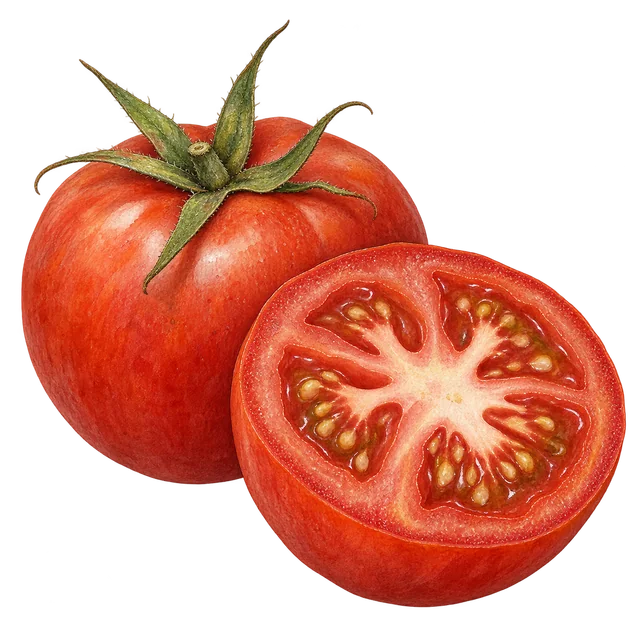
- Seeds inside the fruit
- A tomato develops from the flower's ovary and contains seeds.
- Red lycopene
- Lycopene is the main pigment behind a red tomato's colour; the illustration cannot measure its concentration.
Illustration for understanding; not to scale. Saved figures include explanations and sources.
Background · A botanical fruit, and its varieties
Botanically, a fruit is the part that develops from a flower's ovary and holds the seeds, and a tomato is exactly that. But it is not sweet and turns up in savory dishes, so at the table it has always been treated as a vegetable; in 1893 the U.S. Supreme Court actually ruled it a vegetable based on how it is used.Varieties differ quite a bit: beefsteak tomatoes are juicy and fleshy and good raw; Roma tomatoes are dense and low in water, the workhorse for sauce and canning; cherry tomatoes are small and sweet and often more concentrated in carotenoids. The star among those carotenoids is lycopene, and the next few chapters revolve around it.
Chapter 2
Mostly water; some C and potassium
Its highlights are a few water-soluble nutrients. Vitamin C: one medium tomato supplies roughly a tenth to a fifth of the daily reference amount (see Vitamin C). Potassium: most people eat too much sodium and too little potassium, and eating more vegetables and fruit helps make up the potassium (see Potassium & Sodium). And folate.
Vitamin C and folate are both sensitive to heat, and long cooking loses some of them, so raw tomato has the edge for vitamin C; lycopene is the opposite, and heat actually helps it. Tomato paste has had its water cooked off, so the calories, sugar, and lycopene in the same 100 g are concentrated several times over.
Mechanism · Why vitamin C fears heat
The point that vitamin C and folate both fear heat is worth opening up: it is the mirror image of lycopene, and once you understand the pair, you can work out for yourself how a dish should be cooked.Vitamin C is water-soluble: its surface has several places that hold on to water molecules, so it does not sit in the cell's oily structures but dissolves in the cell fluid. That location gives it two quite different ways to be lost.
It leaches out. Cut the tomato, add water, and simmer it for a long time, and the cells break open, sending the vitamin C in the cell fluid straight into the liquid. That share is not destroyed, just moved: drink the broth and you still get it; pour the broth away and it is goneIt gets oxidized. Vitamin C is useful precisely because it gives away its electrons so easily, which is what antioxidant means. Heat, contact with air, and copper or iron ions from the pan or the food speed up that handover, turning it into dehydroascorbic acid; the body can still convert that back, but with continued heating it breaks down for good
Folate is in almost the same position: it also dissolves in water and also dislikes heat and oxygen.
So the real test is not "raw is always better" but "which nutrient does this dish want to keep":
For vitamin C: eat it raw, stir-fry it quickly, or steam it briefly, with little contact with waterFor lycopene: boil it, stew it, add oil; a little longer actually helpsTomato soup is the compromise: most of the vitamin C moves into the liquid but is not lost, while heat and oil release the lycopene, so if you drink the soup too, you get some of both
Chapter 3
Lycopene · cooking boosts uptake
There are two reasons. First, lycopene is locked inside the plant's cell walls and is hard to release when you eat tomatoes raw; heat breaks those walls open. Second, lycopene is fat-soluble, so a little oil in the same meal (olive oil, a pasta sauce) noticeably raises the share that reaches the blood.
So for lycopene, tomato paste, canned tomatoes, and cooked tomato soup often beat a slice of raw tomato for absorption. Raw wins on vitamin C; cooked wins on lycopene. Tomato and egg stir-fry happens to cover both: the oil carries the lycopene, the heat releases it, and the egg adds protein.
Mechanism · How lycopene reaches the blood
Behind the phrase cooking improves absorption is the road lycopene travels from a mouthful of tomato into your blood. It takes four steps, all of them in the small intestine.Step 1 · It does not dissolve in water at all. Lycopene is a long carbon chain with nowhere along it that can hold on to a water molecule. The inside of the gut is a watery environment, so a molecule like this just clumps together and sticks to bits of food. Nothing can carry it.
Step 2 · Fat and bile acids build it a vehicle. The oil you eat in the same meal is broken down in the small intestine into fatty acids and monoglycerides, and the bile acids (bile salts) squeezed out by the gallbladder are molecules with one water-loving end and one oil-loving end. When the two come together, they arrange themselves into tiny spheres, with the oil-loving ends inward and the water-loving ends outward. That is a mixed micelle: oily at the core and watery on the surface, so it can drift freely through the watery gut. Only now does lycopene have somewhere to go: it dissolves into the core and gets carried along.
Step 3 · Unloading at the shore. The micelle drifts to the thin layer of water clinging to the surface of the intestinal villi, releases its lycopene, and the molecule then crosses the membrane of the lining cells into the cells. Without the vehicle from step 2, it could not even get through that water layer; "add a little oil" refers to exactly this step.
Step 4 · Out through the lymph, not the portal vein. Inside the cell, lycopene is repackaged into a lipoprotein particle called a chylomicron, which leaves through the lymph vessels and enters the blood, bypassing the liver's first checkpoint, and only then is spread around the body. So your blood lycopene level never reflects only how much tomato you ate; it also reflects whether that meal contained any fat.
This chain is not unique to tomatoes. Beta-carotene in carrots, the orange pigments in pumpkin and sweet potato, and lutein in spinach take the same road, because they are all fat-soluble carotenoids. Remember these four steps, and the next time you read that a dish "needs a little oil", you will know which step it means and be able to apply it to dishes nobody has written about.
Evidence · What the paste trial actually supports
Broken cell walls and fat in the same meal are already enough to explain what Gärtner 1997 found: lycopene from tomato paste gets into the blood more easily than lycopene from raw tomatoes.Both arms of that trial received the same 23 mg of lycopene, and the blood curve was higher in the tomato-paste group. The two samples had the same mix of molecular shapes (isomers), so what the trial supports is breaking the cell walls, not heat flipping the molecule from its trans form to its cis form. Heat changing the molecule's shape is a chemistry story often told in later literature; it is not what this trial measured.
Put the two layers together and cooking improves absorption holds up:
Heat breaks open the cell walls, releasing lycopene from the plant tissueOil in the same meal plus bile acids gives it a vehicle that can travel through water (the mixed micelle)
You can also reason backward: a slice of raw tomato has neither; a spoonful of tomato paste fried in olive oil has both. That is also exactly why the best way to eat for lycopene is the opposite of the best way to eat for vitamin C: one wants heat and oil, and the other is harmed by heat and water.
Chapter 4
Does lycopene prevent disease?
For prostate cancer, some observational studies found that people who eat more tomatoes and have higher blood lycopene have a slightly lower risk; but that is only an association and cannot prove that lycopene deserves the credit. Controlled trials of purified lycopene supplements have given inconsistent results. After reviewing the evidence, the US FDA allowed only weakly worded, heavily qualified health claims, which in itself shows that the evidence is not very certain.
The picture for the heart is similar: diets rich in tomatoes tend to be healthier overall, and they are associated with lower cardiovascular risk, but it is hard to give lycopene alone the credit. So it makes sense to treat tomatoes as a good everyday part of a healthy diet; counting on lycopene supplements to prevent cancer or protect the heart is not supported by the evidence. This page is general education only and is not medical advice.
In practice · Raw, cooked, and paste
Back to the most practical question: how should you actually eat tomatoes? The answer is it depends on what you want. Each of the three forms has its strength, and you do not have to pick one.Raw (salads, slices, cold dishes): keeps vitamin C and folate best; light, full of water, low in caloriesCooked with a little oil (tomato and egg stir-fry, tomato soup, pasta sauce): heat breaks the cell walls and the oil carries lycopene into the blood, so this is the best deal for lycopene absorptionTomato sauce, tomato paste, canned tomatoes: the water has been concentrated out, so a spoonful holds several times the lycopene of fresh tomato, making this the easiest source of lycopene (choose the kinds with fewer additives)
References · 5
- U.S. Department of Agriculture, Agricultural Research Service. (2019). FoodData Central: Tomatoes, red, ripe, raw / canned / paste. ~18 kcal/100 g raw; lycopene, vitamin C, potassium. fdc.nal.usda.gov
- National Institutes of Health, Office of Dietary Supplements. (2021). Vitamin C — Fact Sheet for Health Professionals. ods.od.nih.gov/factsheets/VitaminC-HealthProfessional
- National Institutes of Health, Office of Dietary Supplements. (2021). Potassium — Fact Sheet for Health Professionals. ods.od.nih.gov/factsheets/Potassium-HealthProfessional
- Gärtner, C., Stahl, W., & Sies, H. (1997). Lycopene is more bioavailable from tomato paste than from fresh tomatoes. The American Journal of Clinical Nutrition, 66(1), 116-122. Cooking and processing (cell-wall breakdown), plus fat, raise lycopene bioavailability above raw tomato. 10.1093/ajcn/66.1.116
- Brown, M. J., Ferruzzi, M. G., Nguyen, M. L., Cooper, D. A., Eldridge, A. L., Schwartz, S. J., & White, W. S. (2004). Carotenoid bioavailability is higher from salads ingested with full-fat than with fat-reduced salad dressings as measured with electrochemical detection. The American Journal of Clinical Nutrition, 80(2), 396-403. Dietary fat markedly raises absorption of fat-soluble carotenoids. 10.1093/ajcn/80.2.396