Story
Tea
Last updated
In one pass The polyphenols in tea grab the iron from plant foods in your gut, so tea drunk with a meal means much less iron is absorbed from that meal; if you are short of iron, simply drink your tea between meals.
Educational content, not medical advice — consult a clinician.
Story path
Chapter 1
Green and black tea: one leaf
Green, black and oolong tea all come from the same tea-bush leaf (Camellia sinensis); the only difference is how far the leaf oxidizes after picking. Herbal teas are not tea: peppermint, chamomile and chrysanthemum contain no tea leaf, so they have none of tea's polyphenols or theanine. What is really interesting in tea is its catechins and theanine (see L-Theanine), together with caffeine, which explains why tea wakes you up without coffee's jolt.
A CLOSER LOOK
Different teas start with the same tea leaf
Tea-bush leaves and one infusion are shown; green, oolong and black tea differ in processing, while herbal infusions are another category.
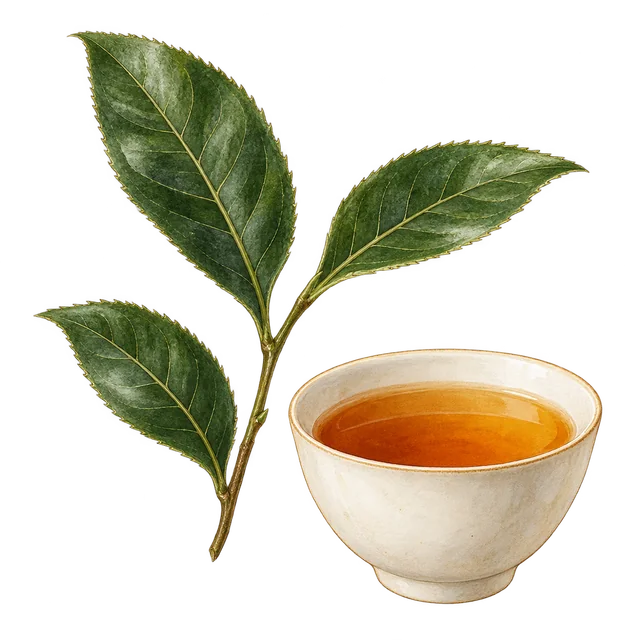
- The tea bush is the starting point
- Green, black and oolong tea all come from Camellia sinensis.
- Processing changes the brew
- Oxidation after picking affects colour and flavour; brew darkness cannot measure caffeine.
Illustration for understanding; not to scale. Saved figures include explanations and sources.
Mechanism · How one leaf becomes several teas
Many people assume green, black and oolong tea come from different plants. In fact they all come from one plant: the young leaves of the tea bush (Camellia sinensis). After the fresh leaves are picked, their cells are broken by rolling, and the polyphenols inside meet oxygen and are oxidized by the leaf's own enzymes, which darkens the color and mellows the flavor. How far that step is allowed to run gives you different teas:Green tea: heated right after picking (steamed or pan-fired) to switch off the oxidizing enzyme, so it barely oxidizes, keeps the most original catechins, and brews pale greenOolong: partly oxidized, in betweenBlack tea: fully oxidized, with most catechins turned into theaflavins and thearubigins, and a deep red brewWhite and yellow tea: lightly oxidized variants that come from differences in processing
Herbal infusions such as Chinese herbal cooling tea, chrysanthemum, peppermint and chamomile are not really tea: they contain no tea leaf, no tea polyphenols, and not the caffeine-plus-theanine pairing. They are drinks brewed from other plants.
Chapter 2
Polyphenols & catechins · tea's signature molecules
Green tea is rich in catechins, especially one called ; in black tea they have been oxidized into theaflavins and thearubigins, which does not mean the nutrition is gone, only that the molecules have changed shape. Antioxidant power in a test tube does not mean the same thing happens in your body. The likelier route is that they gently switch on the cell's own antioxidant and anti-inflammatory signals.
Evidence · Strong in a test tube, little reaches blood
Tea's signature ingredients are a class of polyphenols, and the most abundant ones in green tea are the catechins, especially epigallocatechin gallate ().Outside the body they are strong antioxidants: catechins carry several phenolic hydroxyl groups, so in a test tube they mop up free radicals and grab metal ions. That is where the claim tea is an antioxidant comes from, and where most of the exaggeration starts.
But two things need to be kept apart. Strong antioxidant power in a test tube or in cells does not mean the same thing happens in your body after you drink it. Catechins are poorly absorbed by mouth; most are broken down by gut bacteria and cleared quickly, so blood levels are far below those in the test-tube experiments (Khan 2013).
So this review leans toward the view that tea polyphenols' benefits in people may not come from directly neutralizing free radicals, and more likely come from gently switching on the cell's own antioxidant and anti-inflammatory signals.
Mechanism · Oxidation changes molecules, not nutrition
The degree of oxidation decides what form the polyphenols take: green tea is rich in catechins, while in black tea those catechins have been oxidized into theaflavins and thearubigins. That does not mean black tea has no nutrition; the active molecules have simply taken another form, and each has its own research.The point to keep: tea polyphenols really are an interesting class of active molecules, but what they do in your body is gentle adjustment, not the supplement-ad magic of one cup flushes all the toxins from your body.
Chapter 3
Why tea wakes you without jitters
Adenosine is the signal that makes you sleepy; caffeine occupies its receptor, and you stay awake (full mechanism: see Caffeine + L-Theanine). Theanine crosses the blood-brain barrier and brings a calm that is not drowsy. Pooled randomized trials show that taking the two together improves attention and how alert people feel. And cup for cup, tea usually carries only about half the caffeine of coffee.
Mechanism · Caffeine wakes, theanine steadies
Tea wakes you up, so why not with the racing heart and shaky hands coffee can bring? The key is an amino acid found almost only in tea: theanine (L-theanine).The two molecules do different jobs. Caffeine is an adenosine-receptor antagonist: it occupies the spot where adenosine, the molecule that makes you sleepy, would sit, and that keeps you alert (full mechanism: see Caffeine + L-Theanine). Tea has caffeine too, but cup for cup it usually has only about half as much as coffee.
The tea bush is almost the only plant with large amounts of theanine. Theanine crosses the blood-brain barrier and is linked to stronger alpha-wave brain activity, the kind associated with relaxed focus, which people feel as calm without drowsiness.
Evidence · Together they sharpen attention and alertness
Camfield 2014, a systematic review with , pooled several : taking theanine together with caffeine improved the accuracy of attention switching and raised how alert people felt within 1–2 hours of taking them. In other words, caffeine handles waking up and theanine handles staying steady, and together they give what many tea drinkers describe as calm alertness. That is also why theanine sold as a supplement on its own is so often paired with caffeine (for the single-ingredient evidence, see L-Theanine).Caffeine compared (USDA data; it varies with brewing): a cup of brewed black tea has about 40–50 mg of caffeine, and green tea usually less, while the same cup of brewed coffee is often 80–100 mg or more. So tea is gentler is not an illusion; part of it comes from this difference in dose. For people sensitive to caffeine, that is a practical difference.
Chapter 4
Tea and heart health
The size is modest, not miraculous. The mechanism points the same way: tea polyphenols are linked to better function of the blood-vessel lining (the endothelium) and slightly lower blood pressure (see Cardiovascular System). But people who love tea may live differently in other ways too, and that kind of can never be fully removed.
Evidence · What a half-million-person cohort found
Claims that tea protects the heart and helps you live longer do not come from nowhere, but association and cause have to be kept apart.The largest population evidence is Inoue-Choi 2022, a prospective cohort in the UK Biobank of about 500,000 people followed for about 11 years: people who drank 2 or more cups of tea a day had modestly lower death rates from all causes and from heart disease. Interestingly, the association hardly changed with whether people added milk or sugar, how hot the tea was, or their genetic type for processing caffeine, and the authors took this to suggest that the tea itself, rather than the way it is drunk, is more likely what matters.
This is an observational study and cannot prove cause and effect.
Evidence · What this study cannot tell you
Three things must be said plainly. First, people who love tea may live differently overall. The study adjusted as well as it could for smoking, exercise and other , but leftover confounding can never be fully ruled out. Second, the size is modest, not miraculous. Tea cannot cancel the harm of smoking, sitting all day or a high-sugar diet; it is a friendly part of a healthy lifestyle, not an antidote. Third, do not stretch the finding to full-sugar bubble tea: in this study the association was similar with or without sugar, but what it studied was the tea British people drink every day. The free sugar in a large full-sugar milk tea is another matter, and the study did not measure it (see Sugary Drinks).The mechanism makes sense: tea polyphenols are linked to better blood-vessel lining (endothelial) function, slightly lower blood pressure and better blood-vessel responsiveness, which fits the direction of a heart benefit.
So drinking unsweetened tea as a beverage worth having for the long run is supported by population evidence, but do not treat it as medicine or count on it to lengthen your life.
Chapter 5
Does green tea extract burn fat?
On weight, pooling the randomized trials gives almost no effect. On harm, the organ at risk is the liver: a concentrated capsule sends a large dose of (the most abundant catechin in green tea) into the gut all at once, and whatever the gut absorbs goes to the liver first, so the damage lands on the liver, not on fat.
Tea sipped a mouthful at a time and an extract capsule swallowed on an empty stomach are two completely different ways of taking a dose.
Evidence · Weight-loss trials pool to almost nothing
Jurgens 2012, a Cochrane review, pooled 6 from outside Japan (n = 532): compared with control, green tea preparations changed body weight by −0.04 kg (95% −0.5 to 0.4; the confidence interval, or CI, is the range the true effect most likely falls in). The authors' own words were statistically non-significant. That is not a small effect; it is essentially zero, and that zero comes with a range that crosses zero. There was no significant effect on keeping weight off either.Many single studies that looked positive also involved caffeine drunk at the same time, and a brief bump in metabolic rate may come from the caffeine rather than from any special fat-burning power of .
Detox has even less of a mechanism. Your liver and kidneys handle detoxification all the time, and tea does not flush out toxins (full takedown: see Detox & Cleanse).
So losing weight depends on overall energy balance and the shape of your diet, not on green tea capsules. Drinking tea as a beverage is fine; paying for an extract to burn fat shows nothing on the scale, while the liver may pay for it.
Mechanism · why the hit lands on hepatocytes
First, keep one general rule of thumb: an extract is not the food. An extract is a small part of that food, pulled out, dried and concentrated, and then swallowed all at once on an empty stomach.When you drink tea, is spread out: diluted in a lot of water, sipped a mouthful at a time, and entering the gut slowly along with the rest of the tea. Catechins are poorly absorbed by mouth to begin with; most are broken down by gut bacteria and cleared quickly, so blood levels are far below those in test-tube experiments (Khan 2013). In a capsule, the same molecule becomes one concentrated lump that floods the gut in a short time.
Then comes the key link: what the gut absorbs goes first to the liver, not to the rest of the body. The portal vein carries everything the gut takes in straight to the liver, where enzymes in the liver cells decide whether to let it pass, change it or get rid of it. Normally this is protection, standing between you and everything you swallow. But protection has a cost: liver cells face a higher concentration than anywhere else in the body.
The signal found by EFSA (the European Food Safety Authority) in 2018 sits exactly at this layer: EGCG taken as a food supplement at ≥ 800 mg a day was associated with raised transaminases ( and ). Transaminases are enzymes that work inside liver cells and leak into the blood only when the cell membrane breaks, so a rise in these two on a lab report means liver cells are leaking, not that fat is burning. The same opinion is blunt: brewed tea and a concentrated extract are not the same thing, and it could not set a clearly safe dose for EGCG in supplement form. So 800 is where the evidence is strongest, not a safe floor.
A few cups of tea a day are a completely different way of taking it in, and they are safe. The problem is concentrating the active ingredient into a pill and swallowing it as a weight-loss miracle. If you are taking green tea extract and notice yellowing of your skin or the whites of your eyes, dark urine or marked tiredness, stop taking it and see a doctor soon.
Chapter 6
Tea can block iron absorption
The iron affected is the kind in plants, eggs and fortified foods (non-heme iron); the heme iron in meat takes a different route and is barely affected (see Iron). People who are iron-deficient, anemic, pregnant or vegetarian should care most, and the fix is simple: drink tea between meals.
Numbers · How much iron a cup of tea with a meal blocks
How big is the effect? Look at Hurrell 1999, a classic study. Adults ate the same bread meal with one of several polyphenol-containing drinks or with water, and their absorption of non-heme iron was measured. The result: black tea with the meal cut that meal's non-heme iron absorption by 79–94%; the same paper also tested peppermint tea at 84%, cocoa at 71% and chamomile at 47%. The more polyphenols a drink had, the harder it pushed absorption down. Green tea was not tested.This was a single-meal test. In an everyday diet of many varied meals, effects like this usually shrink, so it matters for each meal more than for your long-term iron status.
In practice · How to keep tea away from meals
Who should care: people who are iron-deficient or anemic, who have heavy periods, who are pregnant, or who are vegan or vegetarian. They already depend on non-heme iron, so tea's effect deserves the most attention. Healthy people with normal iron stores who eat meat hardly need to worry about everyday tea.What to do is simple: drink tea between meals, not with an iron-rich meal and not with iron supplements, and do not sip strong tea with your food. Also, pairing the meal with vitamin C-rich vegetables and fruit (citrus, bell peppers, tomatoes) helps non-heme iron get absorbed and partly offsets the tannins.
Tea is not off limits; just do not drink it with the meal meant to supply your iron. Drink it between meals and this concern mostly disappears.
Chapter 7
Drinking it, amounts, and cautions
No type among green, black and oolong is magic; pick the one you enjoy and will keep drinking. Tea still has caffeine: to sleep well, stop caffeinated tea at least 6 hours before bed, so if you usually go to bed at 22–23, skip it after 2 pm (see Melatonin and All-Nighter). If you want tea's benefits, do not cancel them out with sugary milk tea (see Sugary Drinks).
In practice · Brewed and unsweetened, not an extract
A few cups of unsweetened tea a day is a healthy habit backed by population evidence (in the large British cohort, the association showed up in people drinking 2 or more cups a day). Unsweetened is the key: if you want tea's benefits, do not cancel them with sugary milk tea (see Sugary Drinks). Green, black and oolong differ only in how oxidized they are, and none is magic, so pick the one you enjoy and will keep drinking. Do not buy high-dose fat-burning extracts: they do not take weight off and may harm the liver. Brewed tea is enough.Caffeine and sleep: tea contains caffeine (about 40–50 mg in a cup of black tea, usually about half as much as coffee). Caffeine's half-life is about 4–6 hours. In Drake 2013, healthy adults took 400 mg of caffeine (a sizable dose) 0, 3 or 6 hours before bed, and all three timings disrupted sleep; the authors advise stopping caffeine at least 6 hours before bedtime. If you want something to drink in the evening, choose an herbal tea that truly has no caffeine (these are not brewed from tea leaves).
Safety · Iron, pregnancy, strong tea when fasting
People who are iron-deficient, anemic, pregnant or vegetarian: tea polyphenols drag down non-heme iron absorption, so keep tea apart from meals. Pregnancy and breastfeeding: limit caffeine. The American College of Obstetricians and Gynecologists (ACOG) advises less than 200 mg of caffeine a day in pregnancy (roughly a few cups of tea), counting tea, coffee and chocolate together rather than just one. People who are sensitive to caffeine or who have anxiety, an irregular heartbeat or insomnia: tea is gentler than coffee but still contains caffeine, and a lot of it, or late in the day, still has an effect, so adjust to how you respond. Strong tea on an empty stomach: some people get an upset stomach or acid reflux, so have it with some food or brew it weaker.This is general information only and cannot replace a doctor's judgment of your own situation.
References · 9
- U.S. Department of Agriculture, Agricultural Research Service. (2019). FoodData Central — Tea, brewed (black/green), and caffeine component data. Brewed black tea ~40-50 mg caffeine per ~240 mL cup, green tea lower. fdc.nal.usda.gov
- Khan, N., & Mukhtar, H. (2013). Tea and health: studies in humans. Current Pharmaceutical Design, 19(34), 6141-6147. Review of tea catechins/polyphenols (EGCG), low oral bioavailability, and cell-signaling rather than direct radical-scavenging as the likely in-vivo basis of effects. 10.2174/1381612811319340008
- Camfield, D. A., Stough, C., Farrimond, J., & Scholey, A. B. (2014). Acute effects of tea constituents L-theanine, caffeine, and epigallocatechin gallate on cognitive function and mood: a systematic review and meta-analysis. Nutrition Reviews, 72(8), 507-522. L-theanine + caffeine improved attention-switching accuracy and subjective alertness 1-2 h post-dose. 10.1111/nure.12120
- Inoue-Choi, M., Ramirez, Y., Cornelis, M. C., et al. (2022). Tea consumption and all-cause and cause-specific mortality in the UK Biobank: a prospective cohort study. Annals of Internal Medicine, 175(9), 1201-1211. ~498,000 adults, ~11 y; >=2 cups/day associated with modestly lower all-cause and cardiovascular mortality, independent of milk/sugar/temperature/caffeine-metabolism genotype. 10.7326/M22-0041
- Jurgens, T. M., Whelan, A. M., Killian, L., Doucette, S., Kirk, S., & Foy, E. (2012). Green tea for weight loss and weight maintenance in overweight or obese adults. Cochrane Database of Systematic Reviews, (12), CD008650. Pooled non-Japan studies (6 RCTs, n=532): mean difference -0.04 kg (95% CI -0.5 to 0.4), statistically non-significant. 10.1002/14651858.CD008650.pub2
- EFSA Panel on Food Additives and Nutrient Sources added to Food (ANS). (2018). Scientific opinion on the safety of green tea catechins. EFSA Journal, 16(4), e05239. EGCG >=800 mg/day as a food supplement associated with increased risk of hepatotoxicity (raised ALT/AST); no clearly safe supplement dose could be defined; brewed tea differs from concentrated extracts. 10.2903/j.efsa.2018.5239
- Hurrell, R. F., Reddy, M., & Cook, J. D. (1999). Inhibition of non-haem iron absorption in man by polyphenolic-containing beverages. British Journal of Nutrition, 81(4), 289-295. Black tea reduced non-heme iron absorption 79-94% vs a water-control bread meal; peppermint 84%, cocoa 71%, camomile 47%. Dose-dependent with total polyphenols. Green tea was not tested. 10.1017/S0007114599000537
- American College of Obstetricians and Gynecologists Committee on Obstetric Practice. (2010, reaffirmed). Committee Opinion No. 462: Moderate caffeine consumption during pregnancy. Obstetrics & Gynecology, 116(2 Pt 1), 467-468. Recommends limiting caffeine to <200 mg/day in pregnancy. 10.1097/AOG.0b013e3181eeb2a1
- Drake, C., Roehrs, T., Shambroom, J., & Roth, T. (2013). Caffeine effects on sleep taken 0, 3 or 6 hours before going to bed. Journal of Clinical Sleep Medicine, 9(11), 1195-1200. Randomized, double-blind, placebo-controlled Latin-square crossover in 12 healthy normal sleepers: one fixed 400 mg dose of caffeine (the authors call it moderate) at 0, 3 or 6 h before habitual bedtime vs placebo, sleep measured at home by diary and a portable monitor. All three timings disrupted sleep vs placebo (P < 0.05). By the objective monitor, even at 6 h caffeine reduced sleep by more than 1 hour; by diary, the 6-h reduction in total sleep time (41 min) only approached significance (p = 0.08). The authors conclude that substantial caffeine should be avoided for a minimum of 6 hours before bedtime, and that afternoon caffeine should at least be restricted to before 17:00 (abstract, PMID 24235903; full text, PMC3805807). 10.5664/jcsm.3170