Whether a potato is good for you depends largely on what temperature does to its starch. Cooked and then cooled, part of the starch becomes hard to digest and blood sugar rises a little more gently; fried or roasted until deep brown, it forms a byproduct called acrylamide. A later chapter, on the upside of cooling and the risk of frying, takes these two apart.
The potato is the underground tuber of a nightshade plant and the world's fourth-largest staple crop. Many people file it under "starch, not a vegetable," yet a whole potato with its skin is a fairly complete natural food: rich in potassium, with vitamin C and fiber, much of it concentrated in the skin that so often gets peeled away.
This story is about the whole potato itself. Fries, chips, and buttered mash are a different matter; their nutrition picture is so far from a boiled potato's that they are almost different foods.
Sprouted or greened potatoes build up a natural toxin (solanine). Cut those parts away, and throw out potatoes that have sprouted heavily.
A CLOSER LOOK
The whole potato, skin and tuber
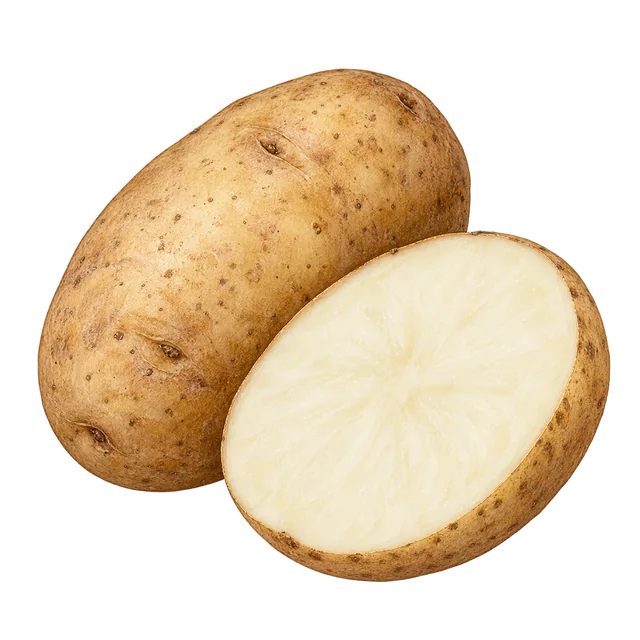
A whole potato has a different nutrition picture from fries or chips; this raw-tuber illustration does not show whether a potato is cooked.
1The outer skin
The skin, and whether it is eaten, are part of understanding the whole potato.
2An underground tuber
A potato is a swollen underground stem whose cells store starch; it is not a taproot like a carrot.
Illustration for understanding; not to scale. Saved figures include explanations and sources.
Background · Floury and waxy potatoes
By starch content, potatoes fall roughly into two groups:
Floury (more starch, such as brown-skinned russets): fall apart into a fluffy texture when cooked, good for mashing and bakingWaxy (less starch, such as small red-skinned potatoes): hold their shape when boiled, good for salads and stews The difference comes from how many starch granules the cells hold. Starch granules swell as they absorb water in the heat; cells packed full of them are pushed apart and separate from one another, so the texture turns mealy and fluffy. Cells with less starch are not pushed apart and stay stuck together, so the potato comes out of the pot in pieces.
That difference matters a lot in the kitchen. For nutrition, two other things matter more: how you cook it, and whether you eat the skin.
Chapter 2
Rich in · more potassium than a banana
The potato's standout nutrient is potassium: potato with skin holds about 420-540 mg per 100 g, which is more than a banana (about 358 mg) gram for gram. Many people get too little potassium and too much sodium, and potassium helps balance sodium and keep blood pressure steady (see Potassium & Sodium).
The second surprise is vitamin C. People assume only citrus has it, but potato with skin supplies about 13-20 mg per 100 g, which is notable for a staple food.
One thread runs through the whole story: the potato's nutrients are heavily concentrated in the skin and the thin layer just beneath it. Peeling it and eating only the white center throws away the most valuable part.
In practice · How to keep those nutrients
Other highlights: fiber (mostly in the skin — peeling throws away much of it, which is the core reason to eat the skin), vitamin B6, and some magnesium, manganese, and plant polyphenols.
Why its vitamin C stands out among staples: the amount per 100 g is not high, but people eat potatoes in large portions, so it adds up. Historically, potatoes were an important source of vitamin C for some populations.
How to keep the nutrients: potassium and vitamin C both dissolve in water. Peel the potato, cut it small, then soak it or boil it for a long time, and they leach into the water; steam, boil, or bake it whole with the skin on, and the skin acts like a wrapper, so less is lost. Vitamin C is also sensitive to heat, so the shorter the cooking time, the better.
A reminder in the other direction: for people who need to limit potassium (for example, with chronic kidney disease, or on certain medicines that make the body hold on to potassium), potatoes are one of the foods to count. How much you can eat should be set by your doctor and dietitian from your lab results.
Chapter 3
Cooling helps, frying adds risk
The potato has two big stories tied to temperature, one good and one bad.
The good one is resistant starch. In a freshly cooked potato, the starch has soaked up water and swollen (gelatinized), so it is loose and easy to digest. Once the potato cools, some starch chains pack back together tightly and crystallize (a process called retrogradation). The digestive enzymes of the small intestine cannot break this starch down, so it travels on to the large intestine, where gut bacteria ferment it, and it behaves more like fiber.
The bad one is acrylamide. When potatoes are fried or roasted above 120°C until they turn deep brown, an amino acid in them (asparagine) reacts with sugars in a browning reaction (the Maillard reaction), and acrylamide is one of the byproducts; the darker the color, the more there is. Boiling and steaming make almost none.
So the direction is simple: for a gentler rise in blood sugar, cook potatoes and let them cool before eating; when frying or roasting, stop at golden, not deep brown.
Evidence · How much cooling helps, how risky browning is
The cooling effect is real, but small. What has been measured directly is rice: in a small randomized crossover trial, white rice that was cooked, refrigerated, and reheated had more resistant starch, and healthy adults who ate it had a slightly lower blood-sugar rise after the meal than with freshly cooked rice — a modest effect. Potato starch goes through the same retrogradation, so the mechanism predicts that cooled potatoes (in a potato salad, say) will also raise blood sugar a little more gently, but that does not turn them into a low-glycemic food. To get more of the effect, eating the skin and pairing potatoes with protein and vegetables does more than worrying about temperature.
Resistant starch has a second act in the large intestine: gut bacteria ferment it and produce short-chain fatty acids, a favorite fuel of the cells lining the large intestine.
Acrylamide: it causes cancer in animal experiments; how large the risk is for people is not yet clear. Based on the animal studies, the European Food Safety Authority (EFSA) treats acrylamide in food as a public-health concern. It is not an additive someone puts in; starchy foods make it themselves at high temperatures, so the fix lies in the cooking: stop frying or roasting at golden, not deep brown; cut away charred parts; and when boiling or steaming will do, there is no need to fry. No need to panic — what deserves attention is deeply browned food eaten often.
This is general information and does not replace specific guidance from a doctor or a food-safety authority.
Choosing: pick potatoes that are firm and smooth-skinned, with no sprouts or green patches.
Sprouted or greened potatoes build up natural toxins such as solanine, concentrated in the eyes and the green skin. Dig out the sprouts and cut away the green parts, and throw out potatoes that have sprouted heavily.
Cooking methods, ranked for health: boiling, steaming, and baking with the skin on use almost no oil and are the safest bets; cooking and then cooling adds a bonus of resistant starch; fries and chips are an occasional treat and are, at heart, high in fat and calories.
The claim that potatoes make you fat puts the blame for the cooking method on the potato. What makes people gain weight is almost never the boiled potato itself, but the oil, butter, frying, and sauces.
How much: boiled or steamed potatoes with the skin on are fine in moderate amounts as a staple. People with blood-sugar problems should favor them cooled and skin-on, and watch the portion. For personal medical questions, consult a doctor.
In practice · Storing it, and why it fills you up
How to store them: keep potatoes somewhere cool, dark, and well ventilated. Dark, because potatoes turn green in light, and the greened parts tend to carry more solanine too. Traditional advice also says not to refrigerate them, on the grounds that cold turns some of the starch into sugar, and such potatoes may form more acrylamide when fried.
Why they fill you up: in the classic satiety index study, volunteers ate equal-calorie portions of a range of common foods and then recorded how full they felt afterward. Boiled potatoes scored highest of all the foods tested, far above white bread. A food that is very filling and carries almost no fat got labeled fattening — the fault lies with the cooking method, not the potato.
Where it belongs on the plate: potatoes belong in the staple column. Use them to replace some rice or noodles, rather than adding a plate of them beside a full bowl of staples, and the total amount in the meal will not quietly creep up.
References · 7
U.S. Department of Agriculture, Agricultural Research Service. (2019). FoodData Central: Potatoes, flesh and skin, boiled / baked; french fries; chips. Boiled ~87 kcal/100 g; potassium higher per 100 g than banana, with notable vitamin C and skin fiber. fdc.nal.usda.gov
Sonia, S., Witjaksono, F., & Ridwan, R. (2015). Effect of cooling of cooked white rice on resistant starch content and glycemic response. Asia Pacific Journal of Clinical Nutrition, 24(4), 620-625. Randomized single-blind crossover in 15 healthy adults; refrigerating cooked white rice at 4°C for 24 h then reheating raised resistant starch from 0.64 to 1.65 g/100 g and significantly lowered the postprandial glycemic response vs freshly cooked rice. pubmed.ncbi.nlm.nih.gov/26693746
EFSA Panel on Contaminants in the Food Chain (CONTAM). (2015). Scientific opinion on acrylamide in food. EFSA Journal, 13(6), 4104. Acrylamide forms via the Maillard reaction (asparagine + sugars) above ~120 °C in fried/roasted starchy foods; a public-health concern given animal carcinogenicity. 10.2903/j.efsa.2015.4104
Holt, S. H. A., Brand-Miller, J. C., Petocz, P., & Farmakalidis, E. (1995). A satiety index of common foods. European Journal of Clinical Nutrition, 49(9), 675-690. Boiled potato scored the highest satiety index of all foods tested, far above white bread. pubmed.ncbi.nlm.nih.gov/7498104