Story
Nori (Laver)
Last updated
In one pass Nori is far lower in iodine than kelp, so it is a seaweed you can eat every day.
Educational content, not medical advice — consult a clinician.
Story path
Chapter 1
What is nori · a sheet of red seaweed
Nori is the dark-green, crisp, sea-scented sheet wrapped around sushi; onigiri wraps and seasoned nori snacks are the same thing. It is a red seaweed, a different class from kelp, which is a brown seaweed.
One more thing about it is often oversold: by dry weight its share of protein is striking, but a sheet weighs only a few grams.
A CLOSER LOOK
A large-looking sheet is paper-thin
These are roasted nori sheets; a large surface area does not mean a large weight is eaten.
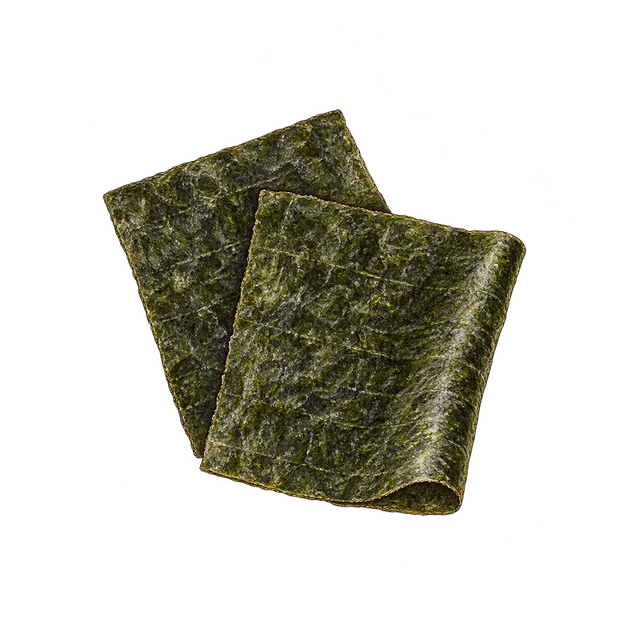
- Dark green after roasting
- Nori belongs to the red seaweeds and takes its familiar dark-green appearance after roasting.
- The weight behind a thin sheet
- Its dry-weight protein proportion is high, but a thin sheet weighs only a few grams.
Illustration for understanding; not to scale. Saved figures include explanations and sources.
Background · Its name, its color, and kelp
Nori's scientific name is Porphyra, though modern taxonomy has moved many species to Neopyropia; in Japanese it is called nori. It is as thin as paper, purplish-red when fresh, and turns the familiar dark green only after toasting.It is easiest to understand next to kelp: same sea, very different nutrition. Kelp's problem is that its iodine is too concentrated, so eat it sparingly (see Kelp (Kombu)); nori is the opposite.
Three things are worth remembering about nori:
Dense in protein: by dry weight its share of protein is unusually high for a natural food, but you eat very little at a timeIts B12 is real, but unreliable: the most widespread claim is that "vegetarians can get their vitamin B12 from nori", and the truth is more subtle than either yes or noEveryday seasoning: its most practical use is adding a little savory depth to soups, noodles, and rice balls
Chapter 2
Far lower iodine than kelp · safer day to day
Mild is not the same as no ceiling. Eating a whole pack of seasoned nori in one go still adds up, and people with thyroid disease who are strictly limiting iodine should still count nori toward their daily total.
Numbers · How far nori and kelp differ in iodine
Watanabe 1999 (published in J Agric Food Chem) measured dried nori's iodine at about 4-6 mg/100 g, or roughly 40-60 μg per gram. Dried kombu, by comparison, averages about 2,276 μg/g (2.3 mg per gram). Gram for gram, then, kelp carries roughly 30-50 times the iodine of nori.Here is what that means at a meal:
A standard sushi sheet weighs about 3 g and holds about 120-180 μg of iodine, in the same range as an adult's daily recommended intake (150 μg)The same weight of kelp could hold tens to hundreds of times the recommended intake (see Kelp (Kombu) for that comparison)Watanabe's own conclusion was therefore that eating a lot of nori is unlikely to push iodine intake to a harmful level
Nori is still a decent source of iodine, which matters in iodine-poor regions; you just do not need to ration it as carefully as kelp.
Chapter 3
High protein, but tiny portions
But one sheet weighs only about 3 g, so the protein you actually eat at a meal is a sliver. High density is not high supply, and the same reasoning applies to most superfood nutrition headlines.
Numbers · You really eat only a few grams
Dried nori is about 30-50% protein by dry weight (averaging about 40%, depending on species and season), among the highest of the edible seaweeds and behind only microalgae such as spirulina. It also contains all 9 essential amino acids, which make up about 40-50% of its total amino acids, a proportion close to reference proteins such as egg and milk.Headlines like "nori has more protein than steak" compare percent of dry weight, while the amount you actually eat is tiny: one sheet is about 3 g, and a whole pack of seasoned nori is barely a dozen grams. So:
On protein density (per 100 g dry weight), nori really is strikingOn actual supply (the few grams you eat at a meal), its contribution to your daily protein is small
Treat nori as a supporting player that adds a little good-quality protein and savory flavor, and do not expect a few sheets to replace a chicken breast; for your main protein sources, see the Protein story (for tofu, see Soybeans & Tofu).
The habit of asking whether high density means high supply works on many superfood nutrition headlines (see Superfoods).
Chapter 4
Does nori's B12 count?
But containing B12 is not the same as reliably supplying enough. The amount varies widely with species, drying, and storage, and very few trials have tested it in real people. So it is a bonus, not a replacement for a supplement or fortified foods.
Evidence · Real B12, but few human trials
Vitamin B12 (cobalamin) is found almost only in animal foods, because only bacteria and archaea can make it; plants do not. The catch is that many algae contain cobalamin analogues: molecules shaped like B12 that the body cannot use. What is measured in cyanobacteria such as spirulina is mainly this "pseudo-B12" (see Vitamin B12 for the full mechanism). Whether pseudo-B12 gets in the way of absorbing real B12, or makes a blood B12 test read high, has not been measured directly in people.Nori deserves its own discussion precisely because it is different. Watanabe 1999 measured it two ways, with a microbiological assay and an intrinsic-factor chemiluminescence assay, and found that dried nori contains a substantial amount of active B12, the most of any edible seaweed. The Watanabe 2014 review went further and judged dried nori the most suitable natural B12 source currently available to vegetarians.
But the question that decides whether a source is good enough is this: does it reliably prevent and correct B12 deficiency in real people? On that, the evidence is still thin:
Content varies severalfold with species, drying, and storage, and in some samples the B12 breaks down into inactive analoguesThe UK Vegan Society and other bodies still list seaweeds, nori included, as unreliable B12 sourcesA small dose-response trial in 2024 (Huang and colleagues, 30 vegetarians, open-label) found that after 4 weeks of roasted nori, serum B12, holotranscobalamin (holoTC, the share of blood B12 actually delivered to cells), and all improved. That is a positive signal, but it is one small, short trial and needs to be repeated
So nori really does contain real B12 and is far more trustworthy than spirulina, but it has not been shown that vegetarians can reliably meet their B12 needs from nori alone.
Chapter 5
How vegans should get B12
The UK Vegan Society offers three approaches; pick one and stick with it:
Eat fortified foods at least twice a day, at least 4 hours apart, for a total of at least 3 μg a dayTake one supplement of at least 10 μg a dayTake one 2000 μg supplement once a week
In practice · Checking your status, and what to ignore
B12 deficiency causes megaloblastic anemia and, more seriously, nerve damage (numb hands and feet, poorer balance, problems with thinking), which can be permanent. That is why, for vegans who eat no animal foods at all, B12 cannot be treated as "close enough".The UK Vegan Society's advice matches the position of the Academy of Nutrition and Dietetics in the US: the only reliable sources are supplements and fortified foods (fortified plant milks, nutritional yeast, and the like), while seaweeds (nori included), spirulina, and gut bacteria cannot be counted on.
How to put it into practice
1. Vegans and strict vegetarians: choose one of the three approaches and treat it as a foundation you do not skip. Keep eating nori if you like it; it does add a little real B12, but it cannot stand in for this step.
2. If you want to know whether you are getting enough: a blood test beats going by how you feel. You can check serum B12 and, if needed, holotranscobalamin (holoTC), (MMA), or , and have a doctor interpret the results.
3. Do not be swayed by seaweed-for-B12 marketing: be especially wary of spirulina products that claim to supply B12, because what is measured in them is mainly inactive pseudo-B12. Chlorella is different: it contains real B12, but products range from almost none to a great deal, so check the label.
This page is general education; whether you need to supplement, how to test, and how much to take are questions for your doctor or a registered dietitian.
Chapter 6
Minerals · micronutrients from the sea
Its more practical value is flavor: like kelp, nori carries a fair amount of free glutamate, so it is naturally savory, and using it for flavor can help you use less salt (see Hypertension). The portions are also small enough that iodine is not a worry.
Background · What else is in nori
By dry weight, nori also offers:Iron, magnesium, calcium, potassium: nori is a decent plant or algal source of iron; this is non-heme iron, which is absorbed better when eaten with vitamin C (see Iron)Iodine: mild and moderate, with no sudden spikeProvitamin A (beta-carotene) and vitamin C: fresh nori has some, but toasting and storage cause lossesSoluble fiber and polysaccharides (such as porphyran, which is specific to nori), plus pigment proteins found only in seaweeds
The per 100 g dry weight figures look good, but the few grams of nori in a meal make a garnish-level contribution to iron, magnesium, and the rest, not a main one. Think of it as a supporting player that adds a little marine mineral content and savory flavor to noodle soup, rice balls, and sushi.
Chapter 7
How to eat it, and cautions
Three groups should pay more attention: people with thyroid disease on strict iodine limits should count nori toward their total iodine; vegans should not treat it as B12 insurance; and people cutting down on salt or oil should go easy on heavily seasoned, oily nori snacks.
In practice · How to use it, and who should count it
How to use itSushi and rice balls: toasted sheets wrapped around rice, the classic useSoups and noodles: tear it into miso soup, egg-drop seaweed soup, or ramen for savory flavor and a few mineralsSeasoned nori as a snack: convenient and low in calories, but some products add a fair amount of oil, salt, and sugar, so read the label and do not finish a whole pack in one go
Portions: for everyday side dishes and seasoning, moderate amounts are fine. But moderate still has a boundary: eating a whole pack of seasoned nori as a meal adds up both iodine and, in the flavored kinds, sodium.
Who should pay attention
People with thyroid disease: nori has less iodine than kelp, but if you are on strict iodine limits (for certain thyroid conditions or during treatment), count all seaweeds, nori included, toward your total iodine and follow your doctor's plan (see Hashimoto's Thyroiditis)Vegans and strict vegetarians: do not treat nori as B12 insurance; a supplement or fortified foods are the baselineSodium and oil in seasoned nori: if you are cutting salt or oil, choose plain toasted nori with nothing added rather than the oily, salty flavored kindsHeavy metals in seaweed generally: like all seaweeds, nori may carry trace amounts of cadmium and similar metals. Normal amounts are no cause for concern, but it is one more reason not to eat very large amounts long term (for kelp's arsenic and the hijiki question, see Kelp (Kombu))
This page provides general information only and does not replace a doctor's or registered dietitian's judgment about your thyroid, your B12 status, and your diet.
References · 8
- U.S. Department of Agriculture, Agricultural Research Service. (2019). FoodData Central: Seaweed, laver (nori), raw / dried. A red seaweed (Porphyra/Neopyropia); protein ~30-50% of dry weight with all essential amino acids; iron, magnesium, calcium. fdc.nal.usda.gov
- Watanabe, F., Takenaka, S., Katsura, H., Masumder, S. A., Abe, K., Tamura, Y., & Nakano, Y. (1999). Dried green and purple lavers (nori) contain substantial amounts of biologically active vitamin B12 but less of dietary iodine relative to other edible seaweeds. Journal of Agricultural and Food Chemistry, 47(6), 2341-2343. Dried nori iodine ~4-6 mg/100 g dry weight (far below kelp); contains active B12 rather than analogues. 10.1021/jf981065c
- National Institutes of Health, Office of Dietary Supplements. (2022). Iodine — Fact Sheet for Health Professionals. Fact sheet (updated November 5, 2024; Wayback snapshot 16 September 2026): commercial seaweeds range from 16 to 2,984 mcg iodine per gram; dried nori, 2 tablespoons flaked (5 g), 116 mcg; US iodized salt is labelled 45 mcg iodine per gram (measured 47.5-50.7); two RCTs giving 150 or 200 mcg/day iodine from early pregnancy to delivery found no effect on child cognitive, language or motor scores at 1.5-2 years, and one found no benefit at 5-6 years either (fact sheet). ods.od.nih.gov/factsheets/Iodine-HealthProfessional
- MacArtain, P., Gill, C. I. R., Brooks, M., Campbell, R., & Rowland, I. R. (2007). Nutritional value of edible seaweeds. Nutrition Reviews, 65(12 Pt 1), 535-543. Reviews protein, mineral, and micronutrient content of edible seaweeds; nori (Porphyra) is among the highest in protein by dry weight. 10.1111/j.1753-4887.2007.tb00278.x
- Huang, Q.-N., Watanabe, F., Koseki, K., He, R.-E., Lee, H.-L., & Chiu, T. H. T. (2024). Effect of roasted purple laver (nori) on vitamin B12 nutritional status of vegetarians: a dose-response trial. European Journal of Nutrition, 63, 3269-3279. Open-label dose-response trial in 30 vegetarians; 4 weeks of nori improved serum B12, holoTC, homocysteine, and the 4cB12 score. Single small short-term trial. 10.1007/s00394-024-03505-9
- National Institutes of Health, Office of Dietary Supplements. (2024). Vitamin B12 — Fact Sheet for Health Professionals. Fact sheet (updated July 2, 2025; Wayback snapshot 20 September 2026): multivitamin/mineral supplements typically contain 5 to 25 mcg B12, B-complex products 50 to 500 mcg, B12-only supplements typically 500 to 1,000 mcg; absorption is only about 2% at 500 mcg and 1.3% at 1,000 mcg; a 2018 Cochrane review of 3 RCTs (153 participants) compared very high oral doses (1,000-2,000 mcg) with intramuscular B12; high oral doses (e.g. 1,000 mcg/day) might be equally effective in Crohn's disease and appear as effective as hydroxocobalamin injections after Roux-en-Y bypass. These are product contents and trial doses; the sheet gives no recommended daily supplement range (fact sheet). ods.od.nih.gov/factsheets/VitaminB12-HealthProfessional
- Watanabe, F., Yabuta, Y., Bito, T., & Teng, F. (2014). Vitamin B12-containing plant food sources for vegetarians. Nutrients, 6(5), 1861-1873. B12 is synthesized only by bacteria and archaea, not by plants or fungi, and most plant foods are unreliable sources that may carry inactive corrinoid analogs. ⚠️ The review's own conclusion, however, is that dried purple laver (nori) is the MOST SUITABLE naturally occurring vitamin B12 source presently available for vegetarians, and that it additionally supplies iron and n-3 fatty acids that vegetarian diets tend to lack. Do not cite this paper for the claim that nori B12 is inactive. Full text: supplements made from edible cyanobacteria (Spirulina, Aphanizomenon, Nostoc) often contain large amounts of pseudovitamin B12, which is biologically inactive in humans; chlorella tablets contain biologically active vitamin B12, but the authors' unpublished data show contents from zero to several hundred µg per 100 g dry weight, so users should check the label (full text, PMC4042564; abstract, PMID 24803097). 10.3390/nu6051861
- The Vegan Society. (2023). What every vegan should know about vitamin B12; consistent with Academy of Nutrition and Dietetics guidance. Vegans should obtain B12 from reliable supplements or fortified foods; seaweeds including nori, spirulina, and gut bacteria are not reliable B12 sources. Current page (read 2026-09-24; the numbers are in the page's infographic): if relying on fortified foods, eat them at least twice a day, at least four hours apart, aiming for at least 3 micrograms a day; if relying on a daily supplement, at least 10 micrograms; if relying on a weekly supplement, at least 2000 micrograms; cyanocobalamin is the recommended form. The page gives 1.5 micrograms as the UK adult daily intake and says no upper limit has been set because no toxic effect has been identified (vegansociety.com page and infographic). www.vegansociety.com/resources/nutrition-and-health/nutrients/vitamin-b12