Story
White Fish · Cod & Seabass
Last updated
In one pass White fish such as cod and sea bass are low in mercury because, compared with big predators, most of them are smaller and eat lower on the food chain, so they store up less mercury over a lifetime.
Educational content, not medical advice — consult a clinician.
Story path
Chapter 1
What white fish is · the lean meat of the sea
White fish is not one species but a class: low-fat, white-fleshed fish, including cod, sea bass, flounder, tilapia, and snapper, with hairtail counting as medium-fat. Most of the steamed fish on a Chinese table is white fish.
White fish and fatty fish (salmon, tuna, sardines, eel) sit at the two ends of the fish spectrum. White fish store almost all their fat in the liver and very little in the muscle. Fatty fish store fat in the muscle, which is why their flesh is darker and oilier.
So the two play completely different roles. White fish is a high-protein, low-calorie, low-fat lean fish; fatty fish is the source of omega-3 ( and , two long-chain fatty acids). Cod carries about 0.18 g of EPA plus DHA per 100 g, and salmon about 2.0 g — an order of magnitude apart. To get enough of these fats from fish, look to fatty fish. That takes nothing away from white fish as a protein source.
The figures in this story use cod as the example. Hairtail has more fat than typical white fish, so do not treat it as the model of a lean fish.
Mechanism · Why white fish is white
White fish is low-fat, white-fleshed fish. So start with the most basic question: why is the flesh white?Color is added. White is what was not added
The color of fish flesh comes mostly from three things:
Myoglobin: the red protein in muscle cells that holds a short-term store of oxygen. Muscles that need a long, steady oxygen supply have more of it, and the flesh looks redMitochondria: the workshops that burn oxygen. The denser they are, the darker the fleshFat droplets: fuel kept close at hand, which makes the flesh look moist
White fish is short of all three, so raw it is a translucent white. That is not a white pigment; it is no pigment at all. Once it hits the pan, the protein denatures and scatters light, and only then does it turn opaque white.
Three sea fishes get their color from three completely different molecules
This is worth remembering, because "darker fish is more nutritious" means something completely different from one fish to the next:
The white of white fish is a shortage of myoglobinThe deep red of tuna is myoglobin itself — tuna cruises long distances at speed, and its muscle needs oxygen without a breakThe orange-red of salmon is neither blood nor myoglobin. It is a carotenoid pigment the fish stored up from its food (see Astaxanthin / salmon)
So the same dark color can mean this muscle burns a lot of oxygen, or it can mean this fish ate something colorful. Before you use color as a nutrition score, ask where the color came from.
White comes with a whole set of traits
Many traits of white fish follow from being short of all three: it is low in omega-3 (the chapter on fish oil goes into this), it is low in iron (heme iron sits in molecules like myoglobin), and it dries out as soon as it is overcooked (there is no fat in the muscle to cushion it).
White is not a flaw. It is the single source of a whole set of traits.
Chapter 2
Almost all its calories are protein
To put numbers on it: a 150 g serving of cooked cod gives about 30 g of protein for about 130–150 kcal. The same protein from lean pork costs more than 200 kcal, and from chicken thigh even more. For anyone trying to eat more protein while keeping calories down (while cutting or building muscle), white fish is close to a first choice.
Protein quality: it is complete protein, with all nine essential amino acids and plenty of leucine (see Protein & Amino Acids).
Compared with chicken breast: by weight, chicken breast has a little more protein. But white fish is lower in fat and calories, so per calorie its protein density is just as good. White fish also brings some seafood micronutrients, iodine among them. Keep raw and cooked weights apart: cooking drives off water, so the protein per gram goes up.
A CLOSER LOOK
White fish is a lean protein source
Cod is the example; white fish is a category, and cooking changes the final calories.
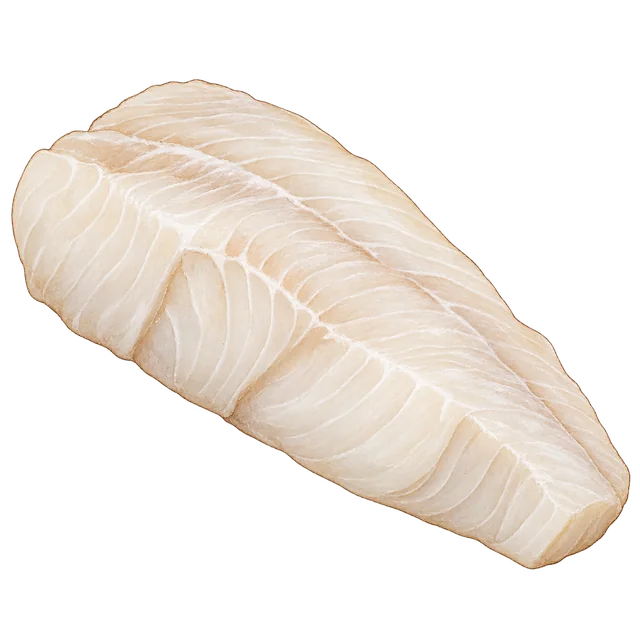
- Muscle provides protein
- Cod is a high-protein, low-fat white fish; most of its calories come from protein.
- Separate raw and cooked weights
- Cooking removes water, concentrating protein per unit weight rather than creating more protein.
Illustration for understanding; not to scale. Saved figures include explanations and sources.
Mechanism · Why its calories are nearly all protein
White fish is often described as one of the most protein-dense animal foods per calorie. That is easy to read as it is especially high in protein. The truth is more interesting.The protein itself is only middling. What is special is the denominator
A food's calories have only three sources: carbohydrate, fat, and protein. White fish has almost no carbohydrate (animal muscle never had much to begin with) and almost no fat — so protein is the only thing left to fill the calorie column.
So "protein-dense" does not mean a big numerator. It means a small denominator: for the same serving of protein, very few calories come along with it. That is exactly what you want while cutting, and it is why white fish can sit beside chicken breast.
What complete protein actually means
To build protein, the body needs all nine essential amino acids on hand at once. Whichever one is shortest sets the limit, and the surplus of the others can only be broken down and burned for energy. Animal proteins — fish, eggs, milk, meat — have amino-acid ratios close to the body's own, with enough of all nine. That is what complete protein means. A single grain (short on lysine) or a single legume (short on methionine) has to be paired with the other to fill the set (see Protein & Amino Acids).
Raw versus cooked — the easiest place to miscount
What cooking mostly does is drive off water. Before and after the pan, the total grams of protein in a piece of fish barely change. What changes is its weight.
So cooked fish looks higher in protein by weight not because it grew protein, but because the denominator shrank. The same piece of fish has the same total protein raw or cooked.
A practical habit: shop by raw weight and log by raw weight. Mix them — buy by raw weight, then look up the cooked value — and you will consistently overestimate the protein you ate.
Against chicken breast, the difference is not really protein
Per calorie, the two land in the same range for protein. The real difference lies elsewhere: fish brings seafood specialties such as iodine, along with a fair amount of B12 and selenium.
Chapter 3
Why white fish is low in fish oil
A fish stores its reserve oil in one of two places. Fish that cruise the open water all year (salmon, sardines) need fuel they can draw on inside the muscle at any moment, so the oil is laid down strand by strand in the muscle itself, and the flesh turns dark and rich. Fish that lie on the sea floor waiting to pounce (cod, flounder) live on a single burst, not on endurance, so they have no need to stock oil in the muscle — they store it in the liver. That is where cod-liver oil comes from: the oil was always there, just not in the piece you eat.
and travel with fat. So the accurate statement is not that white fish has no omega-3. It is that white fish's omega-3 does not sit in the part you eat.
This rule is more useful than any list of fish. The next time you meet a fish you have never heard of, ask whether it cruises or lies on the bottom, and whether its flesh is dark or white, and you will mostly have the answer. For EPA and DHA, look to fatty fish (see Salmon · see Sardines · see Fats & Omega-3).
Numbers · How big the omega-3 gap really is
Exactly how much less omega-3 does white fish have? It deserves a real number, not a shrug of "none."Raw cod carries about 0.18 g of plus per 100 g; farmed Atlantic salmon carries about 2.0 g — roughly an order of magnitude apart.
On the plate
A 150 g serving of cod supplies about 0.27 g of EPA plus DHA, just reaching the low end of a common daily target of 250–500 mg. Salmon delivers the same amount of EPA plus DHA in little more than a dozen grams.
Put those two sentences side by side and the conclusion is clear. It is not that white fish has no omega-3. It is that its omega-3 is so thin that relying on it would mean eating an unrealistic amount.
This is where a common mistake comes from
Many people treat fish as one thing, so steamed sea bass gets counted as topping up omega-3. But on this measure, the gap between one fish and another is larger than the gap between fish and chicken.
White fish is valuable for protein, low fat, and micronutrients; omega-3 is the job of fatty fish. Eat both — it is not one or the other.
The limits of these numbers
These are typical values for each species. The same fish from different waters, in different seasons, wild or farmed, varies in fat — and when fat varies, omega-3 varies with it, because it travels with the fat.
So the figures are reliable for comparing orders of magnitude (a tenfold gap will not flip with the season). They are not meant for precise bookkeeping: nobody needs to eat fish to two decimal places.
Mechanism · How a fish swims decides where oil sits
Where a fish stores its oil depends on how it lives. That rule can be traced one level further — into the muscle itself.Every fish has two kinds of muscle. What differs is the ratio
Red muscle (slow-twitch) burns fat with oxygen, steadily. To do that it needs four things at once: blood vessels that deliver oxygen, myoglobin that stores it, mitochondria that burn it, and fuel kept close by — fat droplets. It does not produce much force, but it can keep going. It is built for cruising.
White muscle (fast-twitch) does not wait for oxygen. It breaks down the glycogen stored in the muscle on the spot. The burst is powerful, but it runs out within tens of seconds and takes a long time to recover.
So a fish's way of life is written straight into its flesh
A fish that cruises the open water all year has a high share of red muscle: dark flesh, oily, high in omega-3.
A fish that lies on the bottom waiting for prey to pass, then finishes the job in one lunge, uses almost nothing but white muscle. And because white muscle hardly runs on fat, there is no reason to stockpile fat in it — the oil is sent to the liver for safekeeping. That is where cod-liver oil comes from.
So on a fish, flesh color and omega-3 are not two separate facts. They are two faces of the same thing.
You can see both kinds of muscle on the same fish
Many fish have a strip of noticeably darker flesh along the lateral line, just under the skin. That is the red-muscle band: it handles slow cruising, while the white flesh that makes up most of the fish handles the burst. That dark strip usually tastes stronger and turns fishy sooner, because fat and myoglobin are both concentrated there.
A patch the rule needs
Use the rule carefully on salmon: its orange-red comes from pigment in its food, not from myoglobin (see Astaxanthin). It is high in omega-3 because it is a cruising fish, not because it is orange.
So name the fish
That is why "eat more fish for omega-3" has to say which fish. Without that, it is often wrong — and the steamed fish most common on a Chinese table happens to fall on the wrong side.
Myth · low fat does not imply low cholesterol
White fish also invites a reasoning error that is easy to make — worth a page of its own, because the habit behind it applies everywhere.Cholesterol is not a part of fat
Many people assume that low fat means low cholesterol, because the two rows sit next to each other on a nutrition label. But they are different kinds of molecule. are stored fuel; cholesterol is a building material for cell membranes and the raw material for hormones and bile.
How much cholesterol a food has depends on how many cell membranes it has, and how much of certain tissues — not on how much oil it stored. So the two rows have no fixed relationship.
Shrimp is the counterexample
Shrimp has almost no fat, yet its cholesterol is not low. If low fat really implied low cholesterol, shrimp could not look like that.
White fish is in fact low in cholesterol by the numbers, but that is measured, not inferred. The distinction does not change the conclusion for white fish. For other foods it will.
A habit to take with you
Every row on a nutrition label is measured separately. One row cannot be derived from another. If you want to know a row, look at that row.
It sounds too obvious to say, but inferring one row from another is exactly the move nutrition marketing uses most: natural, so it is healthy; low-fat, so it helps you slim down; sugar-free, so it will not raise blood sugar — the same move every time. To see the whole range of fat in fish, compare the Salmon and Tuna stories.
Chapter 4
Also vitamin B12 and selenium
Vitamin B12: raw cod has about 0.9 µg per 100 g (more per gram once cooking drives off water), so one serving covers more than half a day's need. Both blood formation and nerves depend on itSelenium: a core part of a family of antioxidant enzymesPhosphorus, potassium, and niacin (B3): moderate amountsIodine: sea fish are one source of iodine (the amount varies with species and waters)
Overall its micronutrients trail shellfish (oysters have more zinc, clams more B12) and fatty fish (more vitamin D). But as an everyday protein eaten a few times a week, it makes a steady contribution.
Vitamin D deserves its own mention: white fish has a little, but not much (raw cod about 0.9 µg per 100 g, salmon about 11 µg — another order of magnitude). If you want vitamin D from food, do not count on white fish; look to fatty fish such as salmon and to egg yolks. The mechanism is covered under Vitamin D.
So the nutrition profile of white fish is mainly protein, with B12 and selenium alongside; do not expect omega-3 or vitamin D from it.
Mechanism · why B12 and iodine are a seafood specialty
Of the micronutrients in white fish, two are worth tracing to their source, because once you do, you can see why seafood is especially good at them.B12: only microbes make it
The ability to make vitamin B12 exists only in bacteria and archaea — plants cannot make it, and neither can animals. All the B12 in an animal was collected from its surroundings and its food chain.
The sea is rich in B12-making microbes, and the vitamin is passed up the chain level by level, so seafood is generally a good source of B12, while plant foods have almost none. That is the root of why a vegan diet has to add B12: not that plants are not good enough, but that this production line does not exist in plants at all (see Vitamin B12).
Once eaten, B12 still has a winding road. Stomach acid first frees it from food protein; then a protein made by the stomach lining, called intrinsic factor, picks it up and escorts it all the way to the end of the small intestine, where it is absorbed. So people who have had stomach surgery, have atrophic gastritis, or take acid-suppressing drugs long term may eat enough and still fail to absorb it. In those cases, ask a doctor.
Iodine: it is dissolved in seawater, so sea foods have far more
Most of the earth's iodine has been washed into the sea by rain. Sea algae concentrate it from the water and pass it up the food chain — so sea fish, kelp, and nori have iodine, and freshwater fish have far less.
Iodine has one very specific job: it is a raw material built into the thyroid-hormone molecule, and without it the hormone cannot be made. Thyroid hormone, in turn, sets how fast cells throughout the body run (see Iodine).
This also explains why the iodine in fish varies with species and waters: a fish's iodine comes from the water it lived in and what it ate, and neither is fixed. So iodine is a poor thing to count off one particular fish. It is better covered by the habit of eating seafood often.
Selenium's role deserves precise wording too
Selenium is not an antioxidant in itself. It is a part fitted into the active site of a family of enzymes — the enzymes do the work, and selenium is the screw that lets them work (see Selenium).
Why white fish, then
None of these three is unique to white fish; they are shared traits of seafood as a class. White fish is not the standout in that class, but it is mild, fairly cheap, and easy to eat every day — and in nutrition, something you can eat for the long run is worth more than the highest content.
Chapter 5
What it lacks · how to pair
A few practical pairings:
Pair it with oil, herbs, or lemon: white fish is lean and dries out easily when steamed or poached. A little good oil (olive oil) or a sauce brings the texture back and helps the fat-soluble nutrients on the same plate get absorbedPair it with dark leafy greens: they add calcium, iron, and folate and balance the platePair it with whole grains: they add fiber and carbohydrate — white fish with brown rice and leafy greens is a textbook meal for cutting
If you need to gain weight and want more calories and omega-3, add fatty fish and nut oils alongside white fish. White fish suits cutting; it is not a tool for bulking.
For how to balance the whole plate, see Fruit & vegetables and Carbs & Fiber.
Mechanism · that spoon of oil is not just for taste
Of the pairings for white fish, a little good oil is the one most easily taken as a pure texture tip. It is actually doing two jobs at once.First: it rescues the texture
White-fish muscle has almost no fat. And fat in the mouth is not only about flavor; it also keeps things moist, so the flesh does not feel dry as you chew. Once the juice is squeezed out of meat with almost no fat, all that is left in your mouth is fiber.
So white fish depends on added oil more than fatty fish does. A drizzle of olive oil or a spoonful of sauce puts back exactly the part it lacks.
Second: it decides whether the nutrients on the same plate get in
Vitamins A, D, E, and K are fat-soluble — they have to dissolve into fat first, then get emulsified and absorbed along with it. With a plate of nearly oil-free steamed white fish and boiled greens, a good share of the fat-soluble nutrients in the greens passes straight through.
A little oil changes more than the calories; it changes the absorption rate. That is a whole-plate matter, not just a matter of this fish.
Why iron is low — you can read it off the color
Fish flesh is low in iron to begin with, and white fish is lower still. The reason is the same as its color: heme iron sits inside molecules like myoglobin, and White Fish muscle has very little myoglobin.
So white flesh being low in iron is no coincidence. It is another face of the same structure. For iron, look to red meat and animal liver (see Iron).
Calcium has a structural reason too
The calcium store is in the bones, and you picked the bones out. That is why canned small fish eaten with their bones are in a completely different league for calcium from a fillet — the difference is not the fish, but whether you ate the bones.
Fill each gap on purpose
Nothing white fish lacks means the fish is not good enough. It means its body is built so that those things are not stored here. Once you know why, the pairing is natural: short on fat, add oil; short on iron, add red meat or dark leafy greens; short on fiber and carbohydrate, add vegetables and whole grains.
Chapter 6
Why white fish is low in mercury
Once methylmercury gets into a fish's muscle, it leaves extremely slowly — so most of the mercury a fish eats over its life stays in its body. When a big fish eats small fish, it adds each small fish's lifetime load to its own, and one level up the chain it happens again. So the closer a fish sits to the top of the food chain and the longer it lives, the more mercury it carries (the Tuna story walks through this build-up in more detail).
Compared with big predators such as tuna, swordfish and shark, most common white fish (cod, sea bass, flounder, tilapia) are smaller and sit lower on the chain, so their mercury is generally lower. The fish advice from the US Food and Drug Administration (FDA) and Environmental Protection Agency (EPA) says that during pregnancy and breastfeeding you can eat 2–3 servings of low-mercury fish a week, and most white fish are on the low-mercury list.
But keep one thing in mind: white flesh and low mercury are two separate facts that often happen to line up. A large, long-lived deep-sea fish can have white flesh and still not be low in mercury.
Myth · White flesh does not mean low mercury
Most white fish are low in mercury. That statement is true, but the reason it is true is easy to remember wrongly — and the cost of getting it wrong is that when an exception turns up, your judgment flips.Two facts got tied together, but neither causes the other
The flesh is white says that this fish's muscle is mostly burst-type white muscle. That is a result of how it movesThe mercury is low says where it sits on the food chain and how long it lived. That is a result of what it eats and how long it lives
In small and mid-size coastal fish, the two happen to point the same way, because a fish that ambushes from the bottom is often also not very large and does not eat high on the chain. But pointing the same way is not the same fact.
The exceptions turn up at the deep-sea, long-lived end
Once you meet a large, long-lived deep-sea fish, the coincidence breaks. Its flesh can still be white, but its place on the food chain and the years it has lived are a different story.
So when you judge whether a fish is one to eat often, the question is always what it eats and how long it lives, not whether its flesh is white. National advice tables are likewise ranked by measured mercury, not by flesh color — the fish advice from the US Food and Drug Administration and Environmental Protection Agency works this way.
The name is a second trap
Many fish sold as cod are not cod at all (the chapter on choosing fish covers "silver cod"). A fish with "cod" in its name does not automatically inherit cod's mercury tier, fat content, or price tier — the trade name was chosen by the seller; the mercury was collected by the fish.
So what you take away is a way of asking, not a list
When you meet a fish you do not know, ask three questions: What does it eat? How big can it grow? How long does it live?
If all three answers come out low, small, and short, it will usually fall in the low-mercury tier. If any one comes out big or long, look it up in the table instead of trusting the impression that white flesh gives.
Background · Why farmed or wild barely matters here
Why this question is loud for salmon and quiet for codThe farmed-versus-wild argument over salmon is almost entirely about fat: the oil in the feed decides the oil in the flesh, and fat-soluble pollutants travel with that oil (see Salmon).
White-fish flesh has almost no fat to begin with — so the chain from feed oil to flesh oil is broken in this fish. Ask the same question about white fish and the answer is much quieter: the nutritional gap between farmed and wild is far smaller than for salmon. Fat was never what white fish is about, so the topic hardly matters here.
Then where do farmed and wild white fish differ
In things that are not on the nutrition label: flavor, texture, price, supply stability, and how well the water and the farm are managed. These are real differences. They are just not written on the label, and they should not be dressed up as a nutrition advantage.
So when you pick white fish, look at other things
Freshness, an unbroken cold chain, and whether the scientific name is the fish you think it is (the chapter on choosing fish). Each of those affects this meal far more than the wild-or-farmed tag.
Cook it through
As with other seafood, cook the fish through to the center: the flesh turns white and opaque and flakes easily with a fork.
Chapter 7
Choosing, cooking and how much to eat
Buying: fresh white fish has clear, bright eyes, bright red gills, firm and springy flesh, and no off smell. For frozen fish, look for an unbroken cold chain and no thick frost in the bag (a sign it has thawed and refrozen). When buying cod, note that "silver cod" is not true cod: it is actually sablefish or toothfish, with a different price and fat content, so check the scientific name on the package.
Cooking: white fish is lean, so steaming, poaching, and baking keep its flavor best. Frying soaks up oil and turns a low-fat fish into a high-fat dish. Season with lemon, herbs, and soy sauce rather than batter and deep-frying. It is done when the flesh turns white and opaque and flakes easily with a fork.
How much: the general advice is 2–3 servings of fish a week, and it is fine for white fish to make up most of them (this is advice from the US Food and Drug Administration and Environmental Protection Agency; see the chapter on mercury). Children should have smaller servings according to age.
Who can lean on it more: people cutting, building muscle, or watching calories; pregnant women and children (low mercury is an advantage). Who should hold back: anyone allergic to fish; people with gout should watch the purines in all seafood (see Crab, which discusses purines). For specific medical questions, ask a doctor.
Mechanism · Why frozen fish can turn mealy
When you pick frozen fish, look for an unbroken cold chain and no thick frost in the bag. Both come down to the same event, and it decides whether a piece of frozen fish is tender or mealy once thawed.When fish freezes, what matters is speed, not temperature
Most of the water in fish flesh is inside the cells. For water to freeze, it first has to gather into a seed crystal, then grow onto it. The slower the freeze, the fewer the seeds and the larger each crystal grows — and large ice crystals punch through the structure between cell membranes and muscle fibers.
On thawing, those holes become leaks: the melted water is no longer held by the cells and runs off. The puddle on the tray is the tenderness this piece of fish has lost.
So frozen fish is not necessarily worse than fresh
Blast-freezing on a distant-water fishing boat takes the other road. The temperature drops so fast that the water has no time to gather into large crystals and forms a mass of tiny ones instead, which punch through far less structure.
A fish frozen hard the moment it is caught is often better than a "fresh" fish that has sat on ice for two days. The fresh one never froze, but its own enzymes and bacteria have been slowly breaking it down the whole time.
What hurts most is thawing and refreezing
Each thaw redistributes the water; on the next freeze it tends to gather onto crystals that already exist, so the crystals grow larger every time. This does not even need a full thaw — temperature swings in the freezer are enough.
The white frost in the bag is the evidence: it is water that left the fish as vapor and settled on the bag wall as frost. Thick frost means the bag has been through temperature swings, and the ice crystals inside have probably grown.
Thawing takes some care too
Thawing slowly in the fridge beats thawing at room temperature or in water. At a low temperature, the tissue has time to take back some of the water that melts out. The faster the thaw, the more juice leaks away.
White fish loses more here than fatty fish
Salmon muscle is laced with fat, so if it loses some water, the oil still holds up the texture. White fish has almost no fat, so its juice is all the tenderness it has — however much leaks out, the texture drops by that much.
That is also why the same brief overcooking dries out white fish more noticeably than salmon: it has no cushion. So the doneness test (the flesh turns white and opaque and flakes with a fork) means taking it off the heat the moment it is reached, not waiting a little longer to be safe.
Chapter 8
Do all fish help the brain
"All fish feed the brain, white fish included." Half true. The link between fish and the brain runs mainly through omega-3s such as (an important part of brain cell membranes), and white fish carries an order of magnitude less omega-3 than fatty fish (the Fish Oil chapter explains why). Whether eating more fish actually makes people smarter rests mainly on observational studies. White fish is valuable for protein and B12; if you want omega-3 from fish, first check whether it is a fatty fish.
"The pricier the fish, the more nutritious." Price is set by supply and demand, scarcity, and texture — not nutrition. "Silver cod" is expensive because it is fatty and melts in the mouth. Its nutrition profile is different from true cod or sea bass, not better — and for someone watching calories, it is actually a worse fit.
"White fish has no nutrition, so skip it." This is the opposite mistake. White fish is an excellent high-protein, low-fat protein source; it just is not an omega-3 source. Not being an omega-3 source is not the same as having no nutrition.
There is one method for judging claims like these: split a fish's nutrition into three columns — protein, omega-3, and micronutrients — and ask which column this fish is good at.
In practice · Split a fish into three roles
First, the one methodIn nutrition, a fish is really playing three roles that have nothing to do with each other:
Protein: complete, easy to digest, low in calories for the amountOmega-3 ( and ): only fish that store fat in their muscle provide much of it (the Fish Oil chapter explains why)Micronutrients: B12, selenium, iodine, vitamin D — different seafoods are strong in different ones
The three roles are independent. Being strong in one column says nothing about the other two.
So "is this fish good?" is the wrong question. The right one is: which column do I want from this meal?
For protein with few calories: white fish, shrimpFor omega-3 and vitamin D: salmon, sardines, mackerelFor a dense dose of zinc, iron, and B12: shellfish
There is no fish that does everything, and there does not need to be. Rotate through the week and all three columns get covered.
Then, why price has nothing to do with nutrition
Seafood prices are driven by four things: how hard the fish is to catch, how scarce it is, the cost of shipping and keeping it fresh, and a premium for texture and culture. Nutrition is not one of the four.
So an expensive fish and a cheap one can be completely inverted on nutrition. "Silver cod" is the textbook case: it is expensive for its texture — fatty and melting on the tongue — and for someone watching calories, that is exactly the trait to avoid. The same trait is a virtue for a food lover and a cost for nutrition.
The two claims are really the same mistake
"All fish feed the brain" squashes three roles into one; "pricier means more nutritious" squashes price and nutrition into one. Both times, something with many dimensions is flattened into one.
Once you get into the habit of first asking which column a claim is about, claims like these mostly fall apart on their own — they all live in the blur where nobody separated the columns.
References · 5
- U.S. Department of Agriculture, Agricultural Research Service. (2019). FoodData Central: Fish, cod, Atlantic, raw (SR Legacy, FDC ID 171955). Per 100 g raw: 82 kcal, 17.8 g protein, 0.67 g fat, 43 mg cholesterol, 0.91 µg vitamin B12, 33.1 µg selenium, 0.9 µg vitamin D, EPA 0.064 g + DHA 0.12 g. For contrast in the same database, farmed Atlantic salmon (FDC ID 175167) carries EPA 0.862 g + DHA 1.1 g and 11.0 µg vitamin D per 100 g. fdc.nal.usda.gov
- Abdelhamid, A. S., Brown, T. J., Brainard, J. S., Biswas, P., Thorpe, G. C., Moore, H. J., et al. (2020). Omega-3 fatty acids for the primary and secondary prevention of cardiovascular disease. Cochrane Database of Systematic Reviews, (3), CD003177. 86 RCTs (162,796 participants), mostly capsule supplementation. High-certainty evidence that increasing long-chain omega-3 has little or no effect on all-cause mortality and cardiovascular events — which is about pills, not whole fish. 10.1002/14651858.CD003177.pub5
- National Institutes of Health, Office of Dietary Supplements. (2024). Vitamin B12 — Fact Sheet for Health Professionals. Fact sheet (updated July 2, 2025; Wayback snapshot 20 September 2026): multivitamin/mineral supplements typically contain 5 to 25 mcg B12, B-complex products 50 to 500 mcg, B12-only supplements typically 500 to 1,000 mcg; absorption is only about 2% at 500 mcg and 1.3% at 1,000 mcg; a 2018 Cochrane review of 3 RCTs (153 participants) compared very high oral doses (1,000-2,000 mcg) with intramuscular B12; high oral doses (e.g. 1,000 mcg/day) might be equally effective in Crohn's disease and appear as effective as hydroxocobalamin injections after Roux-en-Y bypass. These are product contents and trial doses; the sheet gives no recommended daily supplement range (fact sheet). ods.od.nih.gov/factsheets/VitaminB12-HealthProfessional
- National Institutes of Health, Office of Dietary Supplements. (2021). Selenium — Fact Sheet for Health Professionals. Table 2: Brazil nuts, 1 ounce (6-8 nuts), 544 mcg selenium (989% DV); the text says Brazil nuts contain 68-91 mcg per nut and could cause selenium toxicity if consumed regularly, and that values from other analyses vary widely. The version read carries 'Updated: April 15, 2024' (Wayback Machine snapshot of 31 December 2024), newer than the 2021 date above (fact sheet, read 2026-09-24). The September 4, 2025 update (Wayback snapshot 19 September 2026) adds: the body absorbs up to about 90% of selenium from selenomethionine, selenium-enriched yeast, selenite and selenate; selenium-only supplements typically contain 100 to 400 mcg; Keshan disease, an endemic cardiomyopathy first identified in 1935 in low-selenium parts of China, fell dramatically after selenium intervention trials in the 1970s-1990s; in 2017 the American Thyroid Association issued a weak recommendation against selenium supplements for TPOAb-positive pregnant women (fact sheet). ods.od.nih.gov/factsheets/Selenium-HealthProfessional
- U.S. Food and Drug Administration & U.S. Environmental Protection Agency. (2022). Advice about eating fish: For those who might become or are pregnant or breastfeeding and children ages 1-11. Salmon, sardines, shrimp, and light canned tuna are 'Best Choices' (lower mercury); 2-3 servings/week recommended for adults, including those pregnant or breastfeeding (1 serving = 4 oz); children 1-11: 2 servings/week of Best Choices, with serving size by age (1 oz at 1-3, 2 oz at 4-7, 3 oz at 8-10, 4 oz at 11). www.fda.gov/food/consumers/advice-about-eating-fish