Story
Chicken
Last updated
In one pass Raw chicken often carries Salmonella and Campylobacter, and cooking the thickest part to 74°C at the center kills them — that is the most important thing about eating chicken.
Educational content, not medical advice — consult a clinician.
Story path
Chapter 1
What chicken is · white and dark meat
Chicken is one of the most widely eaten meats in the world. It is poultry, a white meat, and it was not part of the International Agency for Research on Cancer (IARC) evaluation that classified red and processed meat as cancer hazards. Its headline trait is high protein and low fat, especially in skinless breast.
Different cuts of the same bird differ a lot, because what a muscle does decides its color and makeup:
Breast: rarely works for long stretches, has little myoglobin (the protein that stores oxygen in muscle), is pale, low in fat and high in protein. It is the leanest cut.Drumstick and thigh: work all day holding the bird up and walking, have more myoglobin, are darker, and carry more fat, iron and zinc.Skin: most of the fat is here, so leaving it on or taking it off changes the calories a lot.
So "chicken is healthy" is too vague. Whether it is lean, and whether it gives you much iron, depends on whether you eat breast or thigh, and whether the skin stays on.
A CLOSER LOOK
One chicken, different muscles
Cut and skin change the nutrient profile; use a food thermometer to establish doneness.
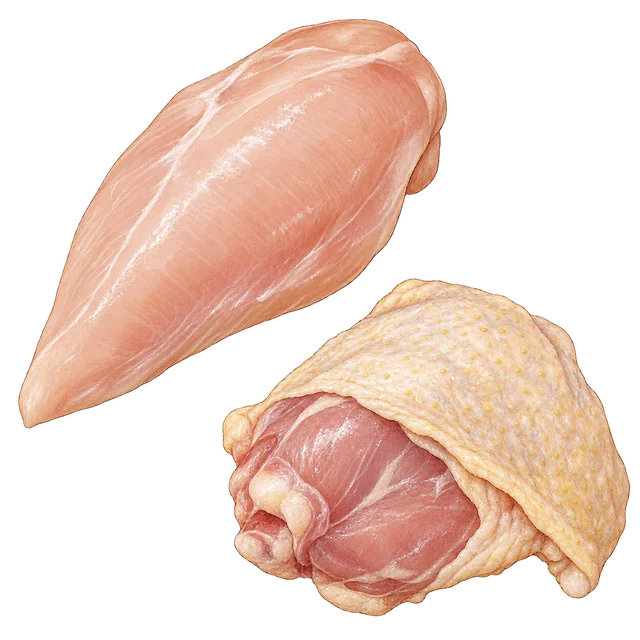
- Skinless breast
- It does less sustained work, so it has less myoglobin, paler colour and little fat.
- Thigh and skin
- The legs work often, making darker meat; much of the fat is concentrated in the skin.
Illustration for understanding; not to scale. Saved figures include explanations and sources.
Mechanism · A muscle's job decides its color
Breast is pale, thigh is dark. That color difference is not a breed problem and not a freshness problem. It is the mark left by what this muscle does day to day. Once you have this chain whole, any unfamiliar cut of meat will tell you what color it ought to be.Start with how these two muscles work differently
Domestic chickens do not fly long distances. Breast muscle only flaps a few times when the bird is startled — short, violent, over in seconds. That kind of work can run on fuel already stored in the muscle; it does not have to wait for oxygen to arrive. Legs and thighs hold the body up and walk around from morning to night. That is work without a break, and it can only be powered by burning oxygen continuously.
Endurance muscle has to store a little oxygen inside itself
Blood delivers oxygen to the muscle's door, but there is always a lag between arrival and use. So endurance muscle cells carry a protein made for storing oxygen — myoglobin. It is a close relative of hemoglobin, the oxygen carrier in blood; both grab oxygen with an iron ion at the center. The difference is the job: hemoglobin hauls oxygen through the vessels; myoglobin stockpiles it inside the muscle cell and releases it on the spot the moment that muscle fires.
That iron ion itself has color. The more myoglobin, the deeper red the meat looks. So the color of meat is a reading — it reads how much this muscle depends on a continuous oxygen supply.
Stored oxygen still needs a workshop that burns it
Storing oxygen is useless without somewhere to burn it. Endurance muscle cells therefore pack more mitochondria — the workshop inside the cell that burns fuel and oxygen together into energy. And the fuel mitochondria handle best is fat, so this kind of muscle has to keep fat nearby; the chain of enzymes that pass electrons inside the mitochondrion also uses a lot of iron and zinc.
At this point three things have become one thing:
Darker color — because there is more myoglobinHigher fat — because there are more mitochondria, so fuel has to sit nearbyHigher iron and zinc — because myoglobin and the mitochondrial enzymes both use them
These are not three parallel traits. They are three consequences of the same cause (this muscle has to keep oxygen flowing for a long time). The breast, thigh and skin comparison, read from here, is no longer a table to memorize. It is a chain you can walk.
Once the chain is complete, you can push it outward yourself
Ducks and pigeons actually fly, and they fly for a long time — their breast is endurance muscle, so duck breast and squab breast are deep red, the opposite of chicken breast.Tuna swim without stopping for a lifetime, and the flesh is deep red; flounder lie on the seafloor and ambush, one strike and it is over, and the flesh is white.On the same chicken, the small muscles that fire more often are darker.
Next time you pick up a cut you do not recognize, you do not need a table: ask first whether, while the animal was alive, that muscle did endurance work or burst work — the answers for color, fat, and iron-and-zinc come out together.
Chapter 2
Breast and thigh compared
Per 100 g of cooked meat:
Skinless breast: the most protein and very little fat — the classic high-protein, low-calorie food when you are cutting weight.Skinless thigh: nearly as much protein as breast, but clearly more fat and more calories.With skin: breast or thigh, fat and calories step up a level, because the skin is almost pure fat.
Carbohydrate is essentially zero, so nearly all of chicken's calories come from protein and fat. When you are eating fewer calories to lose weight, breast gives you a lot of protein for very few calories, which helps keep muscle; for the mechanism, see Protein During a Deficit.
Mechanism · What complete protein means
Complete protein is often treated as a compliment. What it actually names is something specific, something you can check yourself.The body does not move protein over and use it as-is
The protein you eat is broken in the stomach and small intestine into individual amino acids, then rebuilt to the body's own blueprint. The blueprint uses about twenty amino acids; some of them the body cannot make and must take from food — those are the essential amino acids.
The catch is that assembling a protein chain happens in order. Whichever step is missing whichever amino acid, the whole chain stalls there. So how much usable protein a food gives you is not how much it has in total, but how much it has of the essential amino acid it is shortest on — like how much water a barrel can hold, decided by the shortest stave.
Complete protein therefore means something plain: every stave on this food is tall enough; there is no obvious short board. Meat, eggs, milk, and soy belong in this class; most grains are short on one or two staves and need pairing to fill the barrel. That is also why traditional pairings like beans with rice are nutritionally sound — the two short boards are not the same one.
Leucine is not only a building material; it is also the signal to start work
Chicken goes a step further here: it is high in leucine. Besides serving as material, leucine also carries a message — the body uses the leucine concentration in blood to judge whether there are raw materials on hand right now to start building muscle. In experiments that measure muscle building over a few hours, a meal with more leucine pushes synthesis higher after that meal.
From this, people often conclude that piling a whole day's protein into dinner is worse than spreading it over several meals. In the few-hour experiments that is true; but in training trials that measure how much muscle people gained after several weeks, how the protein was spread made little difference, and getting the day's total right mattered more. How the switch itself works is covered in the Protein & Amino Acids story.
Back to the difference between breast and thigh
Once the protein side is clear, the calorie gap between breast and thigh is easy to explain: both cuts are complete protein, and the amount of protein per hundred grams is very close — they are both muscle, and the main building material is the same to begin with. What differs is almost entirely fat, and why the fat sits on the thigh was already covered in the chapter on why cuts differ in color.
So choosing breast in a calorie deficit does not get you better protein. It gets you the same protein with fewer calories. That distinction matters: if you are not short on calories, thigh protein is not worse at all, and it also gives extra iron and zinc. Breast or thigh is a calorie-budget choice, not a protein-quality choice.
Chapter 3
Most of the fat is in the skin
Most of the fat is in the skin, not the meat, so taking the skin off removes a large share of the fat and calories:
Skinless breast: very little fat, almost negligible.Skinless thigh: moderate fat, still mostly unsaturated.Skin on (any cut): clearly more fat.
Some cohort studies found that people who replaced part of their red meat with white meat had a lower risk of death; this is an observed association. Poultry is not risk-free either: in a study that pooled several US cohorts, eating more poultry was also linked to a small rise in cardiovascular disease.
Chicken is not a good source of omega-3. Its polyunsaturated fat is mostly omega-6, and the mix depends on the feed; for omega-3, look to fish (see Fat Types). On cholesterol, chicken is similar to most meats, and for most people the cholesterol you eat affects blood lipids less than your total saturated fat does.
Mechanism · Why fat sits under the skin
Most of the fat is in the skin is a very useful line, but the reason behind it is more worth knowing — because that reason explains why the move removing the skin works on chicken and does not work on beef.Storing fat also means picking a place
Animals store leftover energy as fat, and where they store it has its own rules. A bird's main warehouses are under the skin and that mass in the body cavity; very little is stored between the muscle fibers. For an animal whose ancestors had to fly, this is reasonable: fat laid against the body surface doubles as insulation, and it does not loosen the working muscle itself.
Cattle store it differently. They put a substantial share of fat between the muscle fibers — that is the snowflake, the marbling. So the fat and lean of a steak are mixed together; you cannot tear them apart. Chicken fat is a layer of skin; one tear and you have the whole piece.
That is why on chicken, skin on or off is a switch-level move, not a detail — what you can take off in one go is an entire warehouse, not a scatter of bits.
Then look at whether this fat itself is soft or hard
Chicken fat is softer than red meat's. That soft is not an adjective. It is something you can see directly in the fridge.
A fatty acid is a long carbon chain. The saturated kind of chain is straight; the strands can pack tight like chopsticks laid side by side, so at room temperature they tend to set into a hard block. The unsaturated kind has a kink on the chain; once kinked they cannot pack tight, they pile up loose, and they stay soft or even fluid more easily.
Chicken fat comes out of the fridge as a paste; beef tallow and lamb tallow are hard blocks you can tap — that kitchen difference is the direct consequence of their different saturated-fat shares. And chicken's unsaturated share is mainly oleic acid, the same molecule that stars in olive oil. You do not need to memorize a ratio table; feel the fat after it has set and you already have a rough answer.
Why this softness may run all the way to the blood vessels
If swapping chicken in for red meat helps, the mechanism points to a middle step that is often skipped: what you swapped out is not only this piece of meat, but the total saturated fat it brought with it. Saturated fat raises (the so-called bad cholesterol) in the blood more than dietary cholesterol itself does, so what actually got swapped out is that push.
This also explains why eating chicken does not automatically equal cardiovascular-friendly: if what you swapped in is skin-on fried chicken, that saturated fat and the extra oil come back, and the swap's benefit is canceled. What does the work has always been what you replaced, not which animal ended up on the plate.
An honest boundary
A higher unsaturated share only says its fat makeup differs from red meat's. It does not mean eat as much as you like. Fat's calorie density has no difference here; the skin-on portion still drives a meal's calories up. The benefit of swapping chicken for red meat, and the cost of eating the skin with it, are two accounts that have to be kept separate.
Chapter 4
Rich in protein and B vitamins
Complete protein: all the essential amino acids and plenty of leucine, making it a mainstay for building and keeping muscle.Niacin (vitamin B3): chicken is a good dietary source. It is the raw material for , the molecule cells use to carry hydrogen when they pull energy out of food.Vitamin B6: a good amount. It helps remodel amino acids and make neurotransmitters.Selenium: poultry is a common source, and selenium is a part of antioxidant enzymes.Phosphorus and choline: phosphorus goes into bone and energy molecules, and choline matters for the liver and nerves.
The cut matters here too: dark meat such as thigh has more iron and zinc than breast. If you want more iron and zinc from chicken, thigh is the better deal; if you only want the most protein with the least fat, breast still wins.
Mechanism · which posts B3 and B6 hold in the body
Involved in energy metabolism, or involved in amino-acid metabolism — phrases like these, once read, equal not having read them. Put these two B vitamins back at their posts and look once, and you will know where a shortage shows its first crack.Niacin (vitamin B3): the hydrogen-handoff clerk inside the cell
When the body takes energy from food, what it actually does is something plain: it pulls the hydrogens off the fuel molecule one by one and sends them into the mitochondria to meet oxygen. Between the pulling and the sending, a middleman is needed — catch the hydrogen, carry it over, hand it off, then turn back for the next one.
The skeleton of that middleman is made from niacin. It has two faces: empty-handed it is called ; once it has caught hydrogen it is called NADH; after it hands it off it becomes NAD again. This cycle turns countless times a day, and the molecule in the cycle has to have its raw material supplied by niacin.
So niacin is not giving you energy. It is the tool that lets energy be taken out. A part that runs at high speed every day and must be restocked from outside will, once short, pull many posts at once — that is exactly why, in a severe shortage, symptoms show up together on the skin, the gut, and the nervous system. The common point of those three is not a coincidence. It is cells that turn over fast and burn a lot of energy: the workshops that turn fastest are the first to fail when the tool runs short.
Vitamin B6: the general-purpose handle in the amino-acid workshop
Once inside the body, B6 is remade into an active form and mounted on a large batch of enzymes as a handle. The work those enzymes do all turns around amino acids:
Move an amino group from this chain onto that chain — so the body can remodel a surplus amino acid into the one it is short onCut one end off an amino acid — so an amino acid becomes a messenger molecule
The second job connects directly to nerves: several key neurotransmitters in the brain have amino acids as their raw material, and the cut that turns raw material into finished product uses exactly this handle. The first step of heme synthesis also depends on it.
So B6's position is clear: it does not make energy. It remakes amino acids into what the body needs right now. From that you can also derive one more thing — people who eat a lot of protein have more raw material to remodel, and demand for it rises with that. That is also why it always shows up together with high-protein foods, and chicken is one of them.
Selenium: the one atom mounted on the enzyme's cutting edge
Selenium is used sparingly. The body makes it into a special amino acid, then mounts it in the active center of antioxidant enzymes as the cutting edge. As cells use oxygen they keep leaking some highly reactive molecules; this class of enzyme takes them apart on the spot. Without this one atom of selenium, the enzyme is a pair of pliers that was never sharpened — the shape is still there, the work cannot be done.
Cut differences echo here too
Thigh is higher in iron and zinc than breast. The reason was already covered in the chapter on why cuts differ in color: that is the supporting kit of endurance muscle. The micronutrient difference by cut, and the color and fat differences by cut, grew on the same chain — you do not need a separate rule for each.
Chapter 5
What it lacks · how to pair
Almost no vitamin C or dietary fiber: add vegetables, legumes and whole grains.Not a source of omega-3: keep a few meals a week for oily fish (salmon, sardines).Very little vitamin D or calcium: cover these with sunlight, dairy, egg yolks and fortified foods.Breast is not high in iron or zinc: menstruating women, and people who get most of their protein from breast, can eat more dark meat, legumes and leafy greens.
One practical point about pairing: chicken protein makes you feel full, and with vegetable fiber added the meal keeps you satisfied longer and keeps blood sugar steadier. Breast tends to be dry, so a little unsaturated fat from olive oil, avocado or nuts also makes it taste better.
When you are cutting weight, a plate of breast, plenty of vegetables and a little good fat is the classic high-protein, high-fiber, calorie-controlled combination.
Mechanism · Iron in meat versus iron in plants
Breast is not high in iron or zinc, so people who get most of their protein from breast are often told to eat more dark meat, legumes, and leafy greens. Under that suggestion sits something many people do not know: the same iron number on a nutrition label, in meat versus in vegetables, is taken up by the body at very different rates.Iron in meat is wrapped; iron in plants is bare
Most of the iron in animal muscle is locked in the middle of a ring-shaped molecule — that is the iron in myoglobin. It is absorbed by the intestinal cell as a whole package, ring and all, through a dedicated channel. Because the iron stays wrapped the whole way, nothing it meets along the route can easily snatch it.
Iron in plants is another matter: it exists as an ion, with no shell. And the gut happens to be full of things that like to grab ions — phytate in grains and legumes, polyphenols in tea and coffee, calcium in the same meal. Iron that gets grabbed is excreted with them. It never made it through the door.
So the same iron number on the label: one is a direct ticket, the other is squeezing through a crowded corridor. That is why iron in dark meat is worth more, and why it is worth more loops back to what the muscle does again: that is the myoglobin that comes with endurance muscle.
What vitamin C does here is very specific
Pairing plant iron with vitamin C helps, but it is not a vague boosts absorption. It does two things: it changes the iron into the form the gut can move more easily, and it grabs the iron ahead of phytate and polyphenols and escorts it to the door. In other words, it hired a bodyguard for the iron in that corridor.
From that you can derive a few practical moves yourself, with nothing to memorize:
Leafy greens and legumes paired with a little bell pepper, tomato, or citrus go further than eating them alone — the bodyguard has to arrive in the same meal as the iron to be of use.Move strong tea and coffee to an hour or two after the meal, instead of drinking them with the food.A little animal food can help too: the iron it brings walks the dedicated channel, and it also incidentally improves the situation of the plant iron in the same meal.
Back to pairing itself
The benefit of chicken with vegetables is often phrased as nutritional balance, a line you hear and forget. Swap in the mechanism and it is much more concrete: vegetables fill in the fiber and vitamin C chicken does not have, and that vitamin C in turn lifts the usability of the iron that belongs to the vegetables themselves. On a well-paired plate, the gain is more than the two sides added together.
For menstruating women, people who use breast as their main protein, and people who eat vegetarian, the thing most worth taking from this line is not eat more iron. It is pay attention to what the iron is eaten with.
Chapter 6
Cook it to 74°C in the center
The core rule: cook chicken to 74°C (165°F) at the center and both bacteria are killed (the standard set by the USDA Food Safety and Inspection Service, FSIS). A food thermometer pushed into the thickest part is more reliable than judging by color.
A few habits keep the risk very low:
Do not rinse raw chicken under the tap: the splashes carry bacteria onto the sink and counter and spread the contamination.Keep raw and cooked apart: wash the cutting board, knife and plates that touched raw chicken thoroughly before they touch cooked food.Thaw chicken in the fridge, not on the counter at room temperature for long periods.Wash your hands before and after handling raw chicken.
None of this is meant to scare you. It just makes a food that is already quite safe even safer.
Mechanism · why it is temperature times time, not one number
Bring the center to that temperature is a good rule — it is useful precisely because it compresses something that is two-dimensional into one number. You only use the rule steadily once you know what dimension was squeezed out.Killing bacteria is not a switch. It is a speed
Bacteria do not vanish as a group the moment a certain temperature is reached. What heating does is make the proteins inside the bacteria unfold and fail, and that happens at a speed: the higher the temperature, the larger the share inactivated per unit of time. In other words, what decides safety has always been the combination of how hot and how long it stayed hot — not either number on its own.
A food-safety rule has to be written as a sentence anyone can carry out, so it picks the most convenient point on that curve: a temperature high enough that you are essentially there in an instant. Once you are there, the time dimension shrinks to something you can ignore, and the rule is left with one number. That is a simplification, not the whole truth — a slightly lower temperature held long enough can reach the same effect, and that is exactly what low-temperature slow cooking is built on. But that needs precise temperature control and timing, and it does not belong in a household general rule.
So the correct use of this rule is: you do not need to hit that temperature exactly. You need to reach it at least. Going a little past it has no downside for safety, only a cost in texture — and the texture cost can be made up with the methods in the chapter Choosing, cooking and portions, while a safety cost cannot be recovered.
Why you cannot go by color
The reason color is unreliable was already buried in the chapter on why cuts differ in color: what makes meat look red is myoglobin, and what color myoglobin shows is affected by acidity, freeze history, and the age of the bird. The result is that errors happen in both directions — meat that has been heated enough can still look pink near the bone, and meat that looks all white can still be short of heat at the center. A thermometer into the thickest part is a direct reading of the quantity you actually care about; going by color is reading a related but not equivalent proxy.
Why rinsing raw chicken is helping the wrong side
Water hitting the meat kicks up fine droplets, and those droplets carry colonies onto the rim of the sink, the counter, nearby bowls and cloths. You did not wash anything off — the bacteria on the surface would have been killed by heating anyway — but you sent them to places that will not be heated.
The substance of cross-contamination is this sentence: the danger is not in the piece you are going to cook. It is on the things you do not intend to cook. The cutting board, the knife, the sink, the tap you just twisted, and the handful of vegetables that will be eaten raw next — those are the real risk points.
Campylobacter especially deserves a sentence of its own
It has two traits that make it especially suited to the cross-contamination route: it does not take a large amount to make someone ill, and it does not need to multiply on the food first — a smear, then straight into the mouth, is enough. Many bacteria have to sit at room temperature for a few hours and grow before they are dangerous. This one does not.
So for it, separating matters more than cooking through: cooking through only covers the piece in your pan; separating covers everything that piece has touched.
Chapter 7
Choosing, cooking and portions
Breast dries out easily, so the key is not to overcook it; thigh has more fat and holds up to long braising. Either way, the center has to reach 74°C. As with red meat, very hot grilling or frying until the surface is charred forms a class of compounds called heterocyclic amines (HCA), so do not aim for a blackened crust.
For portions, a palm-sized piece of chicken (about 100-150 g) is a reasonable amount of protein for one meal for most people.
About hormone-free chicken: this is meaningless marketing. In the US, giving hormones to chickens has been banned by federal rules since 1959, and the EU bans it too. So chicken sold there is not allowed to have added hormones in the first place, and a hormone-free label describes something the law already requires. Modern broilers grow fast mainly because of breeding, formulated feed and farm management, not hormones. If what you care about is antibiotics, the label to look for is raised without antibiotics, not hormone-free.
Mechanism · Why breast dries out and thigh does not
On the same bird, the right direction of doneness for the two cuts is opposite. The reason is still the muscle-job chain: whether this muscle did burst work or endurance work while the bird was alive.Why meat goes dry
Most of the water in muscle is locked between the fibers. Heat makes the proteins in the fibers denature and shrink, squeezing the water out like wringing a towel — the higher the temperature and the longer the time, the harder the squeeze. What we call dry is the handful of dry fibers left after the water has been driven out.
Breast has no buffer at all
Burst-type breast fibers are thick, connective tissue is scarce, and fat is almost absent. Once the water is squeezed out, there is no fat to moisten the bite and nothing else to catch it, so there is almost no room between just right and gone too far.
The only direction of response: let it pass through high heat quickly and leave early. Slice it thinner to shorten the heat path, sear hard and fast, or simply use a slow cook that can hold temperature precisely; after it leaves the pan, rest it a moment before slicing, which also lets some of the juice that was squeezed to the edge seep back.
Thigh has two buffers
Endurance thigh muscle already carries fat. That is the first. The second is more important: a muscle that works year-round needs tougher connective tissue to bind the fibers, and the main material of connective tissue is collagen. After collagen is heated continuously at a high enough temperature, it loosens, takes on water, and becomes gelatin — the stuff that makes a well-stewed chicken broth set a little as it cools.
So thigh takes another road: in a short heat it tightens from water loss the same way breast does; but if you keep stewing, the gelatin that collagen became props the texture back up, and it gets silkier the longer it goes.
The worst-tasting moment is turning the heat off in that middle stretch of tightness — it is not that stewing too long is bad. It is that you stopped halfway. A lot of people's experience that stewed thigh is dry too is stuck exactly there.
An easy way to remember it: breast fears too long; thigh fears stopping halfway. And both lines have the same root — what that muscle did for a living.
Why to avoid that blackened layer
There is one more thing about heat, pointing a different way: when the temperature is pushed very high and the surface starts to char, amino acids and creatine in the meat recombine into a class of substances called heterocyclic amines (HCA).
The key is that this has nothing to do with done or not: getting the center there depends on heat walking inward, and charring happens on the surface. So cooking through and burning the outside are two different jobs; chasing the first does not require producing the second — don't turn the heat up until it smokes, don't leave the same face on high heat too long, and a brief marinade or cutting smaller to shorten total heat time can all drop that charred layer without giving up doneness.
Myth · Why the hormone-free label says nothing
The hormone-free chicken label is worth unpacking one more layer. Once it is open you will find it is not only useless. It is also quietly implying something that does not exist.Level one: the law already left no option
In the US and the EU, giving hormones to chickens is banned by law. The key is what that means: this is not this producer does it better than the others. It is everyone has to. A label that describes the same fact whether it is stuck on or not carries no information — its only effect is to make you think the ones without it might have hormones.
This kind of line is everywhere on food labels. The way to recognize it is one question: ask is a product without this label allowed to be otherwise? If the answer is no, the label is selling the law, not quality.
Level two: even without the law, the mechanism does not work, at least for growth hormone
The growth hormone people usually imagine, the kind that makes an animal put on meat, is a protein. And protein does not work by the oral route — the digestive tract's job is to take protein apart into amino acids, so mixing it into feed is sending it straight into the disassembly shop. To make it work you have to bypass the gut, which means injection.
So the problem becomes arithmetic: a flock is thousands upon thousands of birds, and they go from hatch to slaughter in only a few weeks. The labor cost of injecting each bird again and again far exceeds the value of the extra meat grown. A thing that is obviously a bad deal economically will not happen quietly just because no one is watching.
This reasoning is more useful than the law forbids it, because it does not depend on your trusting the regulator.
Level three: then why does it grow so fast
The answer is not mysterious, and it is more persuasive than hormones. Three things stacked:
Selective breeding: every generation, keep the individuals that grow fastest and eat most efficiently. This has gone on for decades; the accumulated effect is very large — today's broiler and the chicken of a few decades ago are already not the same animal in growth speed.Formulated feed: the amino-acid, energy, and mineral ratios at each growth stage have been calculated. Too little limits growth; too much is waste. An exact match lets every bite go into growing meat.Environmental management: temperature, light, density, and drinking water are all held. A chicken that does not have to work to hold body temperature or wander looking for food puts the energy it saved into muscle.
Notice what the three have in common: their effect is cutting waste, not adding extra acceleration. Once you have that, you no longer need a hormone to explain what you are seeing — the phenomenon has already been explained.
Then which label to look at
If what you actually care about is drugs used in farming, the matching label is raised without antibiotics. It describes something the law does not require, so a real difference exists — which means it carries information.
Move your attention from a label that describes the law to a label that describes a choice. That is the correct use of reading labels, and this way of asking still holds when you take it to any other food category.
References · 8
- U.S. Department of Agriculture, Agricultural Research Service. (2019). FoodData Central: Chicken (breast and thigh, meat only, cooked roasted; skin). fdc.nal.usda.gov
- Zhong, V. W., Van Horn, L., Greenland, P., Carnethon, M. R., Ning, H., Wilkins, J. T., et al. (2020). Associations of processed meat, unprocessed red meat, poultry, or fish intake with cardiovascular disease and all-cause mortality. JAMA Internal Medicine, 180(4), 503-512. 6 US cohorts, 29,682 adults, median 19.0 years. Per 2 servings a week: incident CVD HR 1.07 for processed meat, 1.03 unprocessed red meat, 1.04 poultry, 1.00 fish (non-significant); all-cause death 1.03 processed, 1.03 unprocessed red meat, 0.99 poultry and 0.99 fish (both non-significant). Observational (abstract, PMID 32011623). 10.1001/jamainternmed.2019.6969
- National Institutes of Health, Office of Dietary Supplements. (2022). Niacin — Fact Sheet for Health Professionals. ods.od.nih.gov/factsheets/Niacin-HealthProfessional
- National Institutes of Health, Office of Dietary Supplements. (2022). Vitamin B6 — Fact Sheet for Health Professionals. Fact sheet (updated June 16, 2023; Wayback snapshot 17 September 2026): plasma PLP is the most common status measure; PLP above 30 nmol/L has been the traditional adequacy indicator in adults, but the FNB used 20 nmol/L as the major indicator when it calculated the adult RDAs; the FNB halved the dose used in the underlying studies to set an adult UL of 100 mg/day (fact sheet). ods.od.nih.gov/factsheets/VitaminB6-HealthProfessional
- National Institutes of Health, Office of Dietary Supplements. (2021). Selenium — Fact Sheet for Health Professionals. Table 2: Brazil nuts, 1 ounce (6-8 nuts), 544 mcg selenium (989% DV); the text says Brazil nuts contain 68-91 mcg per nut and could cause selenium toxicity if consumed regularly, and that values from other analyses vary widely. The version read carries 'Updated: April 15, 2024' (Wayback Machine snapshot of 31 December 2024), newer than the 2021 date above (fact sheet, read 2026-09-24). The September 4, 2025 update (Wayback snapshot 19 September 2026) adds: the body absorbs up to about 90% of selenium from selenomethionine, selenium-enriched yeast, selenite and selenate; selenium-only supplements typically contain 100 to 400 mcg; Keshan disease, an endemic cardiomyopathy first identified in 1935 in low-selenium parts of China, fell dramatically after selenium intervention trials in the 1970s-1990s; in 2017 the American Thyroid Association issued a weak recommendation against selenium supplements for TPOAb-positive pregnant women (fact sheet). ods.od.nih.gov/factsheets/Selenium-HealthProfessional
- U.S. Department of Agriculture, Food Safety and Inspection Service. (2020). Safe minimum internal temperature chart. Whole pork 63 °C (145 °F) + 3-min rest; ground meat 71 °C (160 °F); poultry 74 °C (165 °F). www.fsis.usda.gov/food-safety/safe-food-handling-and-preparation/food-safety-basics/safe-temperature-chart
- Centers for Disease Control and Prevention. (2024). Campylobacter (campylobacteriosis). Raw poultry is a common source; cooking to 74 °C and avoiding cross-contamination control it. www.cdc.gov/campylobacter
- U.S. Department of Agriculture, Food Safety and Inspection Service. (2024). Poultry labeling terms — hormones are prohibited in poultry production by federal regulation (since 1959), so a 'no hormones' label describes a legally mandated fact. www.fsis.usda.gov/food-safety/safe-food-handling-and-preparation/food-safety-basics/meat-and-poultry-labeling-terms