Story
Century Egg
Last updated
In one pass A century egg is a duck egg that strong alkali has reworked over several weeks: the alkali sets the white into a translucent gel and turns the yolk dark green, with no heating and no preservative.
Educational content, not medical advice — consult a clinician.
Story path
- 1What century egg is · a chemically transformed duck egg
- 2Protein and fat, and a lot of sodium
- 3Fat & cholesterol · the yolk concentrates both
- 4Rich in what · the yolk's nutrients survive
- 5What it lacks · how to pair
- 6Key knowledge · how alkali turns an egg into a century egg
- 7Choosing, serving and how much
- 8What about lead and nitrite
Chapter 1
What century egg is · a chemically transformed duck egg
The eggs soak for weeks to months in a mix of sodium hydroxide (NaOH), salt, tea, and other ingredients, and the surface often grows crystal patterns that look like pine branches. Century-egg congee with lean pork, century egg with ginger, and century egg with tofu are common ways to eat it.
Traditional curing mixes once used lead-containing metal salts; modern regulated production mostly uses copper or zinc instead. What really needs managing day to day is its sodium.
A CLOSER LOOK
The white can set without cooking
Alkaline curing changes colour and texture; this cannot establish sodium content or food safety.
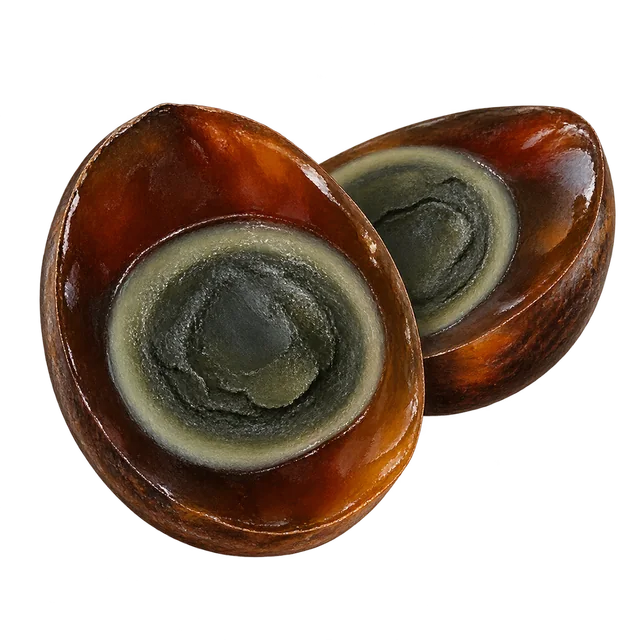
- Translucent white gel
- Alkali changes the proteins, setting the white into a translucent amber-brown gel.
- Changed yolk colour
- The yolk becomes grey-green to dark green, rather than the yellow of a boiled egg.
Illustration for understanding; not to scale. Saved figures include explanations and sources.
Numbers · The duck egg underneath
Nutritionally, a century egg is built on a duck egg (per 100 g, about 185 kcal, 12-13 g of protein, and 14 g of fat). Curing breaks the protein down into smaller pieces, but the total amount stays about the same, while sodium rises clearly because of the salt and alkali in the mix. It is one of the most chemically transformed foods in Chinese cooking, and nearly all of that chemistry shows up in texture, color, and sodium, not in calories.Chapter 2
Protein and fat, and a lot of sodium
Curing really changes two things:
Protein is broken down: the alkali and the egg's own protein-cutting enzymes hydrolyze large proteins into peptides and amino acids. The total stays about the same, but it digests more easily and tastes more savorySodium is clearly higher than in a fresh egg: salt in the curing mix seeps in along with the alkali, and this is the number that really needs managing
Carbohydrate is very low. One century egg (about 60-70 g in the shell) gives about 50-60 g you can eat. It is an occasional side dish, not something to eat by the half dozen for breakfast (see Eggs).
Numbers · Where these figures come from
Start with where the data come from, because that decides how far to trust every number below. Century egg itself is not in the USDA food-composition database. What the authoritative tables list is its raw material, the fresh duck egg (per 100 g: 185 kcal, 12.8 g of protein, 13.8 g of fat, 884 mg of cholesterol, 146 mg of sodium). So read a century egg's nutrition as the duck-egg baseline plus the direction of the changes curing makes; for exact figures, read the nutrition panel on the box in your hand.Compared with chicken eggs (about 155 kcal and 13 g of protein per 100 g), century egg has similar protein, somewhat more calories and fat, and clearly more sodium.
Sodium is the one number here you must read off the package. Someone else's typical figure will not help you: every maker's balance of alkali and salt is different, and so is the curing time, and the sodium in the egg is a direct result of those two settings. No general figure can speak for the box in your hand.
Mechanism · The process itself brings the sodium in
A century egg's saltiness is not someone sprinkling a handful of salt at the end. It is brought in by the same chemistry that makes it a century egg.For the alkali to work, it first has to get inside the egg. The shell is covered in pores too small to see. During the weeks the egg soaks, the mix outside is concentrated and the inside is dilute, so the alkali seeps inward along that gradient. The problem is that the alkali is not the only thing dissolved in the mix; there is salt too. Both travel the same road, pushed by the same difference in concentration. However many days the alkali seeps in, the salt seeps in with it. Getting the alkali in deeper, so the white sets more fully, means getting the salt in deeper too.
There is a more basic layer. The alkali that sets the white is sodium hydroxide, and sodium is right there in the name. So even if the mix held not a single grain of table salt, as long as this alkali does the setting, sodium comes into the egg with it. Sodium is not an additive to this process. It is a built-in product of it.
So a low-sodium century egg is not something makers refuse to make; the process itself stands in the way. To get that translucent gel, the alkali has to go in, and once the alkali is in, so is the sodium. What can be adjusted is how long the egg cures and how strong the mix is. What cannot be adjusted away is the cause and effect.
Once you see the chain, what to do becomes concrete. Rather than hoping to find a century egg that is not salty, manage how often you eat it, then manage the other salty things in the same meal: dipping sauce, soy sauce, pickles, and soup. The egg is often not all of that meal's sodium, just the spoonful that tips an already full cup over.
Chapter 3
Fat & cholesterol · the yolk concentrates both
Fresh duck egg is high in cholesterol (about 884 mg per 100 g, as measured by USDA), and century egg inherits that. But for most people, eating cholesterol raises blood lipids only slightly, less than saturated fat does, because the liver makes a bit less to compensate.
What to watch is still sodium and frequency: the egg's sodium, plus the salty condiments it usually comes with, can push a meal's sodium over the limit, and high salt is the variable linked to cardiovascular risk (see salt). For the full story on dietary cholesterol, see Eggs and shrimp; for fats overall, see Fats & Omega-3.
Mechanism · How the liver offsets dietary cholesterol
The body compensates by making less of its own: this line is often passed over in a sentence, but it is the key to the whole matter. Take it apart.Step one: most of the cholesterol in your blood is not what you ate but what you made, mainly in the liver. The body has to make it, because every cell's outer membrane needs cholesterol to stay neither too stiff nor too soft, and a group of hormones use it as raw material. It is not optional; running short is far more trouble than having extra.
Step two: precisely because it matters so much, the body does not let the amount jump around with whatever you ate today. The liver keeps track of how much cholesterol is arriving from the gut and adjusts its own production: when more arrives, it makes a bit less; when less arrives, it makes a bit more. For most people, this compensation cancels out most of what was eaten, so a plate of yolk raises blood cholesterol only slightly, not by an equal amount.
Step three, the one most often skipped: since most of the cholesterol you eat is compensated away, something else does more to push blood lipids up. A science advisory from the American Heart Association states that saturated and trans fats affect (low-density lipoprotein cholesterol, the so-called bad cholesterol) more than cholesterol in food does. That is why expert advice in recent years has shifted from watching the cholesterol number to watching saturated fat.
Notice the premise hidden in the word compensate: it applies to most people, not everyone. A minority really do respond more strongly to dietary cholesterol. That is individual variation, not a rule for the whole population.
Applied to century egg, the conclusion is simple: the yolk's cholesterol figure is not this food's main problem. Sodium and frequency are.
Chapter 4
Rich in what · the yolk's nutrients survive
Complete protein: easier to digest after hydrolysis, with the full range of amino acidsCholine: the yolk is a good source, and choline matters for nerves and for liver metabolism (see Choline)Lecithin and the fat-soluble vitamins (A, D, E, K): all in the yolkVitamin B12 (Vitamin B12): eggs are one source of B12Phosphorus, selenium, and iron (non-heme iron): moderate amounts
Honestly, a century egg's value comes first from flavor, then from convenience, and only last from nutrition. Alkali does limited damage to minerals, but it does not add vitamins, so the claim that century egg is more nutritious does not hold. In Century Egg congee, the lean pork adds protein, the rice porridge adds carbohydrate, and the egg itself brings the base nutrition of an egg.
Mechanism · Alkali cannot destroy minerals or add vitamins
The marketing line that century egg is more nutritious and the scare line that alkali curing wipes out the nutrition go wrong in the same place: both treat minerals and vitamins as the same kind of thing. Separate them once, and you can judge any processed food for yourself.Minerals are elements. Iron is iron and calcium is calcium. A chemical reaction can change what they are bound to and what form they take, but not which element they are. The iron in a century egg's yolk goes off to bind with sulfur and becomes that dark green iron sulfide; not a single atom of iron is lost, it has just changed partners. So alkali curing does not make minerals vanish. The only real way to lose them is for them to leave with water and the curing liquid, not to be destroyed by a reaction.
Vitamins are molecules. They are compounds with specific structures, and their function lives in that structure; take the structure apart and the function is gone. So for vitamins, a chemical treatment can go only two ways: stay level, or go down. It cannot go up.
Put the two together and why century egg is more nutritious fails becomes something you can reason out yourself. For a food to gain vitamins, something has to add them: either fortification, or living microbes making them during fermentation. The changes in a century egg come mainly from the chemistry of the alkali, which does only three things: it takes apart (cutting large proteins into peptides and amino acids), rearranges (linking proteins into a gel), and brings in (letting alkali and salt seep in). None of those steps adds vitamins.
So the right expectation is this: a century egg keeps the duck-yolk baseline and gains flavor, texture, and a longer shelf life, at the cost of sodium. It is a trade with clear terms, not a nutritional upgrade.
Chapter 5
What it lacks · how to pair
Some practical pairings:
Congee or whole grains: add carbohydrate and put the egg back in its place as a seasoning rather than the main dishDark leafy greens or tofu: add fiber, potassium, and calcium; potassium helps offset part of sodium's effect (for how potassium and sodium push against each other, see salt and Potassium & Sodium)Go easy on extra seasoning: keep the soy sauce and salt in ginger century egg and Century Egg tofu modest, because the egg is salty enough alreadyTomatoes or leafy greens: add the vitamin C the egg lacks
Century egg works best as the star of flavor and a supporting player in nutrition: it makes congee and tofu taste better, but it is not a nutrient source you need every day.
In practice · Building a meal around one century egg
What century egg lacks is everything mild and fibrous beyond its sodium. When you build it into a meal, think in this order:Start with the staple: congee, rice, or whole grains, so the egg is a side dish rather than a plate one person eats aloneThen add vegetables: dark leafy greens, tomatoes, or tofu for fiber, potassium, calcium, and vitamin CFinally, look at the seasoning: the egg is already salty, and dipping sauce, soy sauce, pickles, and soup are the meal's other sources of sodium, so cut them where you can
In short: once a meal has a century egg in it, the other salty things should step aside.
Chapter 6
Key knowledge · how alkali turns an egg into a century egg
The alkali gives the protein molecules a negative charge on their surface and partly unfolds their tightly wound chains, exposing spots that can hook onto each other. The molecules then link into a network, and the runny egg becomes a gel that will not fall apart, all without heat.
Over the same weeks, the protein is also cut into short pieces, which brings both the savory taste and the ammonia smell. Sulfur-containing gas released by that breakdown seeps into the yolk, combines with the yolk's iron, and dyes it dark green. The jelly-like white, the pine-branch patterns, and the green yolk are all products of alkali plus time, a repeatable, controlled food process, not spoilage.
Mechanism · The three chemical steps, with numbers
The curing chemistry comes in three steps:1. Alkali sets the white into a gel: sodium hydroxide pushes the white's pH from about 7.6 to 9-12. At that pH, hydrogen bonds and disulfide bonds in the protein are broken and re-formed as new cross-links, and the white turns from a clear liquid into a translucent gel. That is why a century egg's white looks like jelly. At the same time, the alkali and the egg's own protein-cutting enzymes break large proteins into peptides and amino acids, so century egg tastes savory (from the amino acids) and digests more easily.
2. The pine-branch patterns: the usual explanation is that amino acids released by protein breakdown crystallize under alkaline conditions, growing branching patterns on the surface of the white. Metal salts in the curing mix (traditionally containing lead, now mostly copper or zinc) take part in gel formation and crystallization, which is why traditional recipes could not do without that bit of metal: it is not just decoration, it also affects the texture of the protein gel.
3. The yolk changes color: iron in the yolk reacts with hydrogen sulfide released by protein breakdown, forming iron sulfide (FeS), which tints the yolk dark green or gray-green. The color is a product of the reaction, not a sign of spoilage. The green ring around an overboiled chicken egg's yolk comes from the same reaction.
This chemistry explains every odd feature of a century egg: the jelly-like white, the pine-branch patterns, and the green yolk are all products of alkali, time, and metal ions working together, a repeatable, controlled food process, not spoilage.
With this chemistry in hand, the lead claim is easy to follow. The process needs metal ions to help form the patterns and the gel, not lead in particular. Traditional mixes once used lead-containing oxides; modern regulated production mostly uses copper or zinc. Lead that enters the body goes into the blood and harms the nerves and blood-making, and that is where the danger lies; the chapter on the lead claim goes into it.
Mechanism · Set by alkali, not cooked
The word gel is easy to treat as something mysterious. It is actually quite concrete, and it is a completely different process from boiling an egg. Once you separate the two, the texture, the color, and even why you should not put century egg back on the heat all follow on their own.Why egg white is runny to begin with: the proteins in egg white are small rolled-up balls, with their water-loving parts facing out and their sticky parts carefully tucked inside. None of them can grab another, so they simply float in water, each going its own way. That is a liquid.
Strong alkali does two things. First, it strips hydrogen off the surface of these balls one by one, so they all carry a negative charge and push each other away. Second, it opens the most loosely wound stretches of chain (the helical segments), flipping the sticky patches that were hidden inside, the ones that can attract each other, out onto the surface. Each protein molecule becomes a ball with patches: its broad surface pushes others away, while its patches hook on.
Then the network forms. Because the broad surfaces repel, the molecules do not crowd into a clump and sink; because the patches attract, they still have to link up. Pushed and pulled by the two forces, they form a loose network running through the whole cup of egg white, with water trapped in the mesh. That is a gel: solid to the touch, yet almost entirely water.
The key point is that none of this needs heat: in strong alkali, egg-white proteins can set on their own within minutes.
Set this beside a boiled egg and the difference is obvious. Heat works by shaking apart: the molecules are jostled so hard that their folded structure collapses, and they stick wherever they bump into each other, producing a dense, tangled network that light cannot pass through, which is why boiled white is opaque and firm. Alkali setting works by hooking at set points: the backbone mostly stays intact and links only at particular spots, so the mesh is large and regular, light can pass through, and the result is a translucent, springy gel.
That also explains a kitchen rule: century egg cooked too long in the pot turns rubbery, because you are laying a second, heat-driven tangle on top of a network that was already complete. A century egg is done by curing, not by cooking; in a hot dish, add it after the heat is off.
Mechanism · One breakdown, three results
A century egg's savory taste, its ammonia smell, and its green yolk are often treated as three unrelated oddities. They are actually three exits from the same event: protein being taken apart, piece by piece, in alkali.Why it comes apart in alkali: a protein is a long chain of amino acids. The enzymes that cut this chain are already in the egg, but in a fresh egg's near-neutral conditions they work slowly. Once the alkali pushes conditions far to the alkaline side, they become active, and the alkali breaks chains too, so over a few weeks the large proteins are cut into short peptides and free amino acids.
Exit one, savoriness: the receptors for savory taste respond not to intact large proteins but to free amino acids and short peptides. When the protein is whole you cannot taste it; once it is cut, you can. So the savoriness of century egg is not an added flavor enhancer. It was locked inside the duck egg's own protein all along, and the alkali only released it. As a side effect, the shortened proteins are also easier for your gut to keep breaking down, which is why the egg digests easily.
Exit two, the ammonia smell: as the chains are cut, nitrogen-containing groups are stripped from some amino acids and escape as ammonia, the sharp smell that hits your nose. So the ammonia smell and the savoriness are two products of the same reaction, and getting one without any of the other is chemically impossible. That is also why an acid such as vinegar can tone down the egg's sharp taste: the acid neutralizes some of the alkali and ammonia.
Exit three, the green yolk: some amino acids contain sulfur. When they are broken down, the sulfur is released as hydrogen sulfide, a gas that can spread through the egg and work its way into the yolk. The yolk contains iron, which grabs the hydrogen sulfide on contact and forms dark green to gray-green iron sulfide across the yolk's surface. That is where the color comes from: a reaction product, not spoilage. The green ring on an overboiled chicken egg's yolk follows exactly the same path.
Join the three exits and you get a useful inference: how deep the yolk's green is records how long the breakdown ran, that is, how long the egg cured and how strong the alkali was. It works like the hand of a clock and has nothing to do with whether the mix contained lead. The chapter on the lead claim uses this chain when it takes apart the darker the color, the more lead.
Chapter 7
Choosing, serving and how much
Serving: peel and eat. In congee or with tofu, add it after the heat is off, because heating makes the white rubbery.
How much: sodium is the hard limit. One egg at a time (about 50-60 g you can eat) is enough, not a plate of several. People with high blood pressure or kidney disease should be more restrained still. People allergic to eggs may also react to century egg.
In practice · How to pick one, and who should be careful
When choosing: the shell should be intact and feel springy when tapped lightly; once peeled, the white should be a translucent gel with clear patterns and no off smell.A soft center (a yolk that has not fully set) is normal, not undercooked: a century egg is done by curing, which is different from a raw egg.
Who should be careful: people sensitive to sodium (high blood pressure, kidney disease) should limit it as their doctor advises. People with egg allergies should also be careful: century egg carries the same allergens as fresh egg, so people allergic to eggs may react to it too. For personal medical questions, consult a doctor.
Chapter 8
What about lead and nitrite
The risk is real: absorbed lead enters the blood and harms the nerves and blood-making, and children are especially vulnerable.
The process needs metal ions, not lead as such: traditional curing mixes once used lead-containing oxides as the metal source, and lead exposure was a real problem then. Modern regulated production mostly uses copper or zinc to get the same crystals and gel. So look at the source: buy from a regulated maker, with a lead-free process on the label.
The darker the color, the more lead is false: the dark green comes from iron sulfide and records how long the egg cured, not how much lead it has.
Also, century egg is cured with alkali, not with nitrate or nitrite (that is how cured bacon and sausage are made; see Leftovers & Nitrite), so do not mix the two up. What a modern regulated product really needs managing over the long run is sodium.
Mechanism · How lead gets into the body
Lead enters the blood and harms the nerves and blood-making, but if the sentence stops there, you still do not know how it gets in. Fill in the first half of the chain first.Lead is dangerous not because of some unique poison of its own, but because it looks too much like calcium and iron. A lead ion's size and electric charge are close to those of calcium and iron ions.
Your gut wall is not a wall anything can walk through. It is fitted with a set of transport proteins whose job is to carry calcium and iron, like a row of gates that check the cargo by shape and charge before letting it in. That is the problem: lead happens to fit those gates. It does not force its way in; it rides in on the calcium and iron trucks.
Following this mechanism gives a counterintuitive but important inference: people who are short of iron or calcium absorb more lead, not less. When the body runs short, it opens more of these transporters, and opens them wider, trying to pull in more calcium and iron, and the trucks have no defense against lead. Children who are short of iron are in the worst position: they are growing, their need for calcium and iron is high, the gates open wider, and so they absorb lead most efficiently.
Once in the blood, most lead rides on red blood cells, and another part is sent into storage in bone. Bone is the body's calcium warehouse, and because lead looks like calcium, it is taken in as if it were calcium.
That is the most troublesome thing about lead: it is not something you eat and then excrete. Lead stored in bone can stay for many years and is released back into the blood when bone is broken down on a large scale (rapid growth, pregnancy, breastfeeding). Lead exposure is charged now and paid later, which is why it is judged by long-term build-up rather than by any single meal.
Mechanism · Where lead hits blood-making and nerves
Once lead is in the body and stored in bone, what it runs into there is what turns the outward signs into those two phrases: harm to blood-making and harm to nerves.Harm to blood-making: it jams the assembly line, not the supplies
The part of a red blood cell that actually holds oxygen is called heme, and the body has to assemble it step by step: first it joins small molecules end to end into a ring, and last it fits an iron atom into the exact center of the ring. Each step on this assembly line is run by its own enzyme.
Lead jams two of those enzymes: one at an early step, whose job is to join the first small pieces, and one at the very end, whose job is to fit the iron into the center of the ring. The result is that the parts are there and the iron is there, but the assembly cannot be finished.
So the anemia caused by lead is distinctive, and the contrast is worth remembering: iron-deficiency anemia is no supplies; lead-poisoning anemia is supplies that cannot be assembled. Iron alone will not fix the second, because what is broken is the assembly machine, not the warehouse.
Harm to nerves: it takes calcium's seat
Two nerve cells pass a message by means of calcium. When an electrical signal reaches the end of a nerve, calcium ions rush in at that moment and push small sacs packed with neurotransmitter to empty into the gap, and only then does the next cell receive the message. The precision of the whole action depends on when calcium comes in and how much.
Because lead looks like calcium, it can occupy the places where calcium should dock. The calcium that should arrive cannot, interference that should not be there gets in, and both the timing and the strength of the message go wrong. A developing brain is wiring and pruning on a large scale, and which connections stay and which are removed depends on the strength of exactly these signals. So the same exposure affects a child far more than an adult.
Put the two chains together, and children are a high-risk group for lead exposure is no longer just a warning but a conclusion you can reason out yourself: they absorb more (they are growing, the gates are wide open, and more so if they are short of iron), store it longer (their bones are growing and being rebuilt), and are harmed more deeply (their brains are wiring up).
And because the chain is this specific, the point of debunking century eggs contain lead is not whether those words sound scary but whether this exposure route is still open today. Regulated modern production uses copper or zinc in place of lead, which narrows the route at its source; traditional workshop products of unknown origin are where caution is still warranted. If you are worried that a child has had long-term lead exposure, ask a doctor about a blood lead test.
References · 9
- U.S. Department of Agriculture, Agricultural Research Service. (2019). FoodData Central: Egg, duck, whole, fresh, raw (SR Legacy, FDC ID 172189). Per 100 g: 185 kcal, 12.8 g protein, 13.8 g fat of which 3.68 g saturated, 884 mg cholesterol, 146 mg sodium, 5.4 µg vitamin B12, 194 µg RAE vitamin A, 1.7 µg vitamin D. This is the raw starting material of a century egg, before any alkali processing — the cured product is a different food and is not in FDC. fdc.nal.usda.gov
- Wang, J., & Fung, D. Y. C. (1996). Alkaline-fermented foods: a review with emphasis on pidan fermentation. Critical Reviews in Microbiology, 22(2), 101-138. The standard review of pidan chemistry: alkali penetrating the shell raises egg pH into the alkaline range, hydrolyses protein into peptides and amino acids and releases ammonia and hydrogen sulfide, the sulfide reacting with yolk iron to give the characteristic dark green colour; metal salts in the curing mix participate in gel formation and surface crystallisation. 10.3109/10408419609106457
- Dietary Guidelines Advisory Committee. (2015). Scientific report of the 2015 Dietary Guidelines Advisory Committee. USDA & HHS. Removed the prior 300 mg/day dietary-cholesterol limit; cholesterol no longer treated as a nutrient of concern for overconsumption. health.gov/our-work/nutrition-physical-activity/dietary-guidelines/previous-dietary-guidelines/2015/advisory-report
- Carson, J. A. S., Lichtenstein, A. H., Anderson, C. A. M., Appel, L. J., Kris-Etherton, P. M., Meyer, K. A., et al. (2020). Dietary cholesterol and cardiovascular risk: A science advisory from the American Heart Association. Circulation, 141(3), e39-e53. Saturated and trans fats raise LDL more than dietary cholesterol itself. 10.1161/CIR.0000000000000743
- National Institutes of Health, Office of Dietary Supplements. (2022). Choline — Fact Sheet for Health Professionals. Fact sheet (updated June 2, 2022; Wayback snapshot 21 September 2026): AIs 550 mg/day men, 425 women, 450 pregnancy, 550 lactation; premenopausal women might need less dietary choline because estrogen induces the gene (PEMT) for choline biosynthesis, although at least 40% of women of childbearing age carry a polymorphism that makes it insensitive to estrogen; prenatal supplements typically contain little if any choline; Table 2: beef liver, 3 ounces, 356 mg; egg, 1 large, 147 mg; beef top round, 3 ounces, 117 mg (fact sheet). ods.od.nih.gov/factsheets/Choline-HealthProfessional
- National Institutes of Health, Office of Dietary Supplements. (2024). Vitamin B12 — Fact Sheet for Health Professionals. Fact sheet (updated July 2, 2025; Wayback snapshot 20 September 2026): multivitamin/mineral supplements typically contain 5 to 25 mcg B12, B-complex products 50 to 500 mcg, B12-only supplements typically 500 to 1,000 mcg; absorption is only about 2% at 500 mcg and 1.3% at 1,000 mcg; a 2018 Cochrane review of 3 RCTs (153 participants) compared very high oral doses (1,000-2,000 mcg) with intramuscular B12; high oral doses (e.g. 1,000 mcg/day) might be equally effective in Crohn's disease and appear as effective as hydroxocobalamin injections after Roux-en-Y bypass. These are product contents and trial doses; the sheet gives no recommended daily supplement range (fact sheet). ods.od.nih.gov/factsheets/VitaminB12-HealthProfessional
- Cai, J., Hsiao, B. S., & others; Bianchi, E., et al. (2018). The proof is in the pidan: generalizing proteins as patchy particles. ACS Central Science, 4(7), 840-853. Physical-chemistry study of the alkaline egg-white gel: in strong alkali ovalbumin gels within minutes without heat, retaining beta-sheet structure while alpha-helical regions unfold into attractive patches — a cold, alkali-driven gelation distinct from the heat-set gel of a boiled egg. 10.1021/acscentsci.8b00187
- Needleman, H. (2004). Lead poisoning. Annual Review of Medicine, 55, 209–222. Narrative review in Annual Review of Medicine (not Pediatrics, whatever the id says): the least observable effect level of lead has fallen until it approaches zero; removing lead from gasoline cut environmental lead; the remaining major source is older housing (lead paint). The abstract gives no blood-lead thresholds or IQ figures (abstract, PMID 14746518). 10.1146/annurev.med.55.091902.103653
- EFSA Panel on Food Additives and Nutrient Sources added to Food (ANS). (2017). Re-evaluation of potassium nitrite (E 249) and sodium nitrite (E 250) as food additives. EFSA Journal, 15(6), 4786. Derived an ADI of 0.07 mg nitrite ion/kg bw per day based on increased methaemoglobin. 10.2903/j.efsa.2017.4786