Story
Miso
Last updated
In one pass Miso's savory taste is what is left after koji mold snips soy protein, bit by bit, into free glutamate; the chapter on where the umami comes from explains how.
Educational content, not medical advice — consult a clinician.
Story path
- 1What is miso · a soybean paste brewed by koji mold
- 2The source of umami · natural glutamate made by fermentation
- 3Do its isoflavones act like estrogen
- 4Probiotics fear a boil · add miso off the heat
- 5Sodium really is high · look at it honestly
- 6How much the Japanese data can tell
- 7How to use it and who should take care
Chapter 1
What is miso · a soybean paste brewed by koji mold
It is made by mixing steamed soybeans with rice or barley grown over with koji mold, adding salt, and sealing it for months to years. It sits with natto, soy sauce, and tempeh on soy's fermented branch (the soybean itself: see Soybeans & Tofu; natto, another fermented bean: see Natto). How much koji goes in and how long it ferments decide which kind you buy, and darker miso is usually saltier.
Background · How koji, time, and color set the type
Koji is the engine of this craft: a layer of rice or barley grown over with Aspergillus oryzae — a mold humans have domesticated for a thousand years. It has no mouth and cannot swallow solids, so it can only secrete digestive enzymes outside itself, first breaking soy protein and starch into small molecules in the vat, then absorbing those small molecules back. Miso's salty savor, aroma, and color are all byproducts this external digestion leaves behind.So miso splits into many kinds, and what they are really split by is how much koji went in, and how long it fermented:
White miso (shiro): short fermentation, more rice koji, pale color, sweet and mild, relatively lower saltRed miso (aka): long fermentation, dark color, strong flavor, usually higher saltMixed, barley miso, and the like: in between, with varied flavors
Read this classification as a clue: fermentation time and salt amount are tied together — to let a vat of beans sit safely at room temperature for years, the thing you rely on is salt, so longer-fermented miso is usually saltier, and darker too. So how dark it is is roughly a saltiness clue: people watching sodium who pick from the pale end usually will not go wrong. What salt is actually guarding against here is unpacked in the sodium chapter.
Chapter 2
The source of umami · natural glutamate made by fermentation
The glutamate that occurs naturally in food and the glutamate in are chemically the same molecule, and the body cannot tell where it came from (for the MSG myths, see MSG / Glutamate). Fearing MSG while loving miso treats one molecule as two different things. At normal dietary amounts, the US FDA lists MSG as generally recognized as safe, and the claim that MSG gives you headaches has not been reliably reproduced in double-blind trials.
Myth · How far the MSG-scare evidence has gotten
The authority's position: the U.S. FDA lists as generally recognized as safe (GRAS); the FASEB review commissioned by the FDA concluded that at normal dietary intake, MSG is safe for the general population (FASEB 1995). The so-called Chinese restaurant syndrome has never been stably reproduced in rigorous double-blind trials.Why double-blinding is the key here: umami is something you can taste. In unblinded trials, subjects know they just ate MSG, and self-reported symptoms like headache, flushing, and palpitations then follow expectation; once MSG is hidden in a control food that is equally savory and equally salty, the difference between groups disappears. You only react when you know what you ate — one of the most common false signals in nutrition, and why a pile of firsthand I get a headache whenever I eat MSG stories never became a piece of evidence.
This does not mean nobody will ever feel unwell no matter how much they eat. Glutamate is still an amino acid; a large amount at once, on an empty stomach, has been reported by a minority as brief discomfort. The point is that has nothing to do with whether it is MSG — the same amount of free glutamate from a big bowl of rich miso soup has the same effect, because what the body receives was the same molecule all along.
On the shelf: marketing labels like no added MSG sell scare, not safety — the free glutamate in that bottle of soy sauce, that piece of cheese, that spoon of miso is not one molecule less. When you enjoy miso's savoriness, what you enjoy is precisely a touch of natural glutamate.
Chapter 3
Do its isoflavones act like estrogen
In men, pooled results from dozens of studies found no change in testosterone from soy foods or isoflavones. In population studies of breast cancer patients, those who ate more soy did not do worse than those who ate less (an observed association). So fermented soy feminizes men and soy triggers breast cancer both fail on the human evidence (full mechanism: see Soybeans & Tofu). Besides, miso is mainly a seasoning, and a spoonful carries only a small amount of isoflavones; fermentation changes how well they are absorbed, not how much there is.
Mechanism · Why fermented isoflavones absorb better
Fermentation does one very concrete thing to isoflavones: it swaps them from the bound form to the free form.Most isoflavones in soy have a sugar molecule hanging on them (the glycoside form). That sugar is like an opened umbrella: the molecule gets bigger and more water-loving, while the membrane of a small-intestine epithelial cell is a layer of oil, and an oil film will not let something both large and water-loving pass straight through. So glycoside isoflavones must first have the sugar snipped off by gut bacteria or enzymes on the gut wall; only the remaining aglycone is the form that can actually enter the blood.
Fermented foods like miso and natto are equivalent to finishing that sugar-snipping step in the vat ahead of time: enzymes secreted by koji mold and fermenting microbes have already stripped some of the sugar, so when you eat it, a higher share is the directly absorbable portion. Note the boundary of that sentence — it is the same amount of isoflavones absorbed more smoothly, not fermentation creating more isoflavones out of thin air.
Take this one step further and you see the general shape of fermented foods: microbes do a stretch of digestion for you outside the body, and what you receive is the same batch of molecules, better absorbed, not new nutrition. Natto's vitamin , and lactose pre-cut in yogurt, travel the same road. That also happens to explain why fermented-food benefits are usually a mild bonus, not a different food.
For a systematic look at soy isoflavones, return to Soybeans & Tofu.
Evidence · What studies of men's testosterone show
Hamilton-Reeves 2010 asked whether soy protein or isoflavones change men's testosterone. The finding: no significant effect. It is not a miso paper, but miso is a soy product, and a spoonful is a smaller dose than soy milk or tofu, still less able to carry eating fermented soy feminizes men.The breast-cancer claim likewise does not hold. Full mechanism and debunking live on Soybeans & Tofu; here miso only needs to be put back on a seasoning scale: the same weak key as soy — neither to be feared nor mythologized.
Chapter 4
Probiotics fear a boil · add miso off the heat
But do not expect too much. Much of the miso on the shelf has already been pasteurized, so there are few live microbes to keep in the first place, and probiotic is a label earned by a specific strain, dose, and group of people, not a property every fermented food shares. For the definition of probiotics and the strength of the evidence, see Probiotics.
Evidence · How much live microbes can really do
Two limits, so this step does not become superstition.First, the jar you bought may have no live microbes to begin with. Pasteurized miso was already heat-killed as a whole before bottling, so there is little live culture left to keep — then this fuss only affects flavor, not probiotics. To keep live microbes, look on the label for words like unpasteurized / raw; it usually also needs refrigeration.
Second, even if you kept the live microbes, do not treat miso as a gut-healing drug. The word probiotic is counted by strain: a specific strain, at a specific dose, producing a specific effect in a specific group of people, is what earns the name; it is not a property shared by all fermented foods (Hill 2014). The microbes in miso are a mixed community that fermentation naturally brought along; nobody has run a clinical trial on them by strain, so nobody can tell you what drinking miso soup will improve.
One more layer often skipped: for live microbes to do anything, they first have to pass the stretch of stomach acid and bile alive. Most microbes in fermented foods are only passing through — they spend a few days in the gut and then get excreted; they do not settle in. So even if they all arrive alive, the more reasonable hope is doing a little something while passing through, not replacing your gut microbiome. For the gut microbiome overall, see Gut microbiome.
So the right expectation is: this is one link in a beneficial dietary pattern, not a spoon of miso that cures everything. Still, since one extra step preserves them, why not.
Chapter 5
Sodium really is high · look at it honestly
One bowl of miso soup uses up about a third of the daily sodium recommended for healthy adults. Eating a lot of sodium over the long term is linked to higher blood pressure and cardiovascular risk (sodium and potassium: see Potassium & Sodium; blood pressure: see Hypertension). So treat miso as a salty seasoning you measure, and count it toward your day's salt.
A CLOSER LOOK
This spoonful also counts toward daily sodium
This is one form of miso, and the spoon is not a standardized measure. Sodium depends on the label and amount used, rather than color.
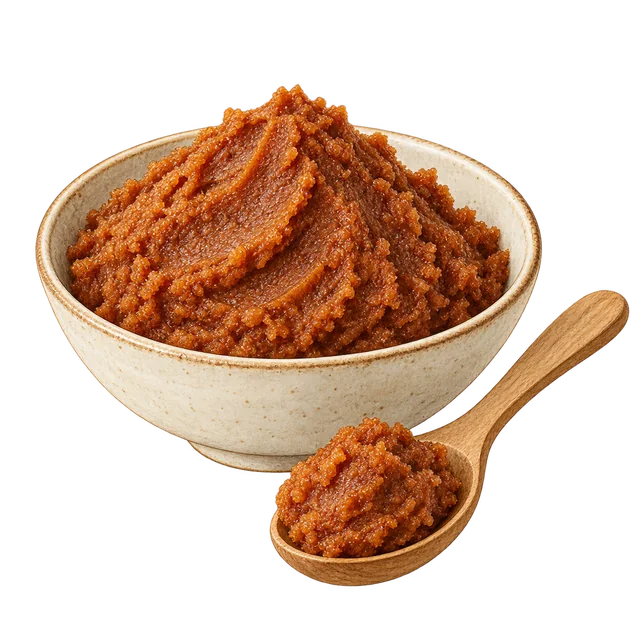
- Savory salty paste
- Miso contains salt and is high in sodium. Its savory taste does not remove that sodium.
- Seasoning counts
- Miso used in soup or seasoning counts alongside salt, soy sauce and other sodium sources.
Illustration for understanding; not to scale. Saved figures include explanations and sources.
Mechanism · Salt in miso is a safety gate, not seasoning
In miso fermentation salt is not seasoning but a safety gate — high salt suppresses contaminating and spoilage microbes, letting only the target koji and salt-tolerant microbes safely finish the fermentation. So traditional miso naturally contains a lot of salt.How does salt do that? By stealing water. For a microbe to divide, the cell needs enough free water. Once the vat is heavy with salt, water is gripped tight by the salt; most spoilage bacteria and wild molds have water pulled out of their cells the other way, shrink, and stop dividing; Aspergillus oryzae and a few salt-tolerant yeasts and lactic-acid bacteria can keep their internal balance in that high-osmotic environment and keep working. So what happens in the vat is never anything can grow, but only the target microbes can grow — months later you open the vat and get miso, not a vat of spoiled beans.
This mechanism explains one uncomfortable thing: miso's saltiness and miso's goodness come from the same source. It is not like the salt added to processed food for taste, which you can just cut — cut the salt and that gate loosens, so reduced-sodium miso usually has to make it up by other means (tighter temperature control, refrigeration throughout, shorter fermentation), and the flavor fades with it.
How to bring the sodium down in practice (ranked by how much they help):
Treat miso as a salty seasoning, not a soup base: what you can control was never its salt content, but how many spoons you put inChoose lower-salt white miso, or types labeled reduced sodiumUse less miso in the soup and more vegetables, kelp, and tofu, letting the ingredients' natural umami share the salty loadCount miso into your whole-day sodium budget, not just this one bowl
The last line matters most: however you tally one bowl of soup, its sodium is finite; what really decides the day's sodium is the total of soy sauce, pickles, processed meat, and eating out added together.
Numbers · One bowl, about a third of the daily limit
USDA: miso contains about 3,700 mg sodium per 100 g (roughly 9 g of salt). Nobody eats 100 g of miso at once — a bowl of soup uses about 15-18 g, supplying roughly 600-700 mg sodium, already a sizable portion.Why sodium matters: chronically excessive sodium intake is linked to higher blood pressure and cardiovascular risk. WHO recommends adults take <2,000 mg sodium per day (<5 g salt), yet many people (especially on East Asian diets) far exceed this (WHO 2012; NASEM 2019). A single bowl of miso soup can use up about a third of the daily recommended amount.
Chapter 6
How much the Japanese data can tell
One plausible explanation is that potassium from the vegetables, kelp, and tofu often added to the soup offsets the sodium, but that is still a hypothesis, not a conclusion (see Potassium & Sodium). The World Health Organization's (WHO) advice to cut sodium has not been overturned. People who already have high blood pressure, or whose doctor has told them to limit sodium, should still count miso in their sodium budget and follow their doctor's advice (see Hypertension). This is general education and does not replace a doctor's judgment.
Evidence · What this observation can and cannot say
That study: a cross-sectional study of Japanese adults (Ito 2017, Internal Medicine) found that the frequency of drinking miso soup was not clearly positively associated with the occurrence of hypertension — even though heavier drinkers did have higher sodium intake. In other words, the intuitive chain high-sodium miso → blood pressure must be high is not so direct in the data.The strongest mechanistic hypothesis is potassium offset: vegetables, kelp, and tofu commonly added to miso soup are potassium-rich. When potassium intake is high, the kidney is more inclined to let sodium go, and vessel-wall tension is lower — so the same sodium may push blood pressure less in a potassium-replete meal than in a potassium-poor one. That is still a hypothesis, not something Ito proved.
What cross-sectional means: at the same time point, it measures a group's eating habits and blood pressure together, and sees whether the two line up. There is no before and after — you cannot tell whether it is how the blood pressure of people who often drink miso soup looks, or people whose blood pressure was already high being told by a doctor to drink less. Data that cannot give you time order cannot give you causation.
: people who love miso soup may already have a healthier overall diet and lifestyle (more fish, vegetables, walking), all of which can distort the result. The trouble is that these factors affect both whether you drink miso soup and whether blood pressure is high, so their credit gets booked to miso. Statistics can adjust for some of them, but only the ones you thought of and measured.
The second, and weaker, hypothesis — a whole bowl of soup ≠ pure salt: miso is not simply sodium chloride; it is a complex mix of fermentation products (peptides, minerals, and the like). Some animal or small-sample studies suggest its pressor effect is weaker than an equal amount of table salt — but this is far from settled. The reason it sits behind potassium is that potassium lowering blood pressure has a large body of independent human evidence, while fermentation products weakening the pressor effect is still mostly animals and small samples; the two are not in the same weight class.
So the correct use of this observation: treat it as a clue worth chasing — a hint that sodium's push on blood pressure may be changed by the overall dietary background — not as a conclusion. To actually test it you need a randomized intervention trial, not more cross-sectional surveys of the same kind.
A general lesson along the way: when you see a claim like population X ate a lot of Y and was fine, ask three questions first — was it measured at the same time point? What else were the high-Y eaters also doing? Is there reverse causation (they changed diet because they were already ill)? Those three questions will block most over-read nutrition news.
So the right reading is: against a potassium-rich, overall-healthy dietary background, the net effect of moderate miso soup on blood pressure may be milder than its sodium content makes it look; but that means don't panic and don't overindulge, not that miso's sodium can be ignored. This is general education and does not replace a physician's judgment of your blood pressure and sodium restriction.
Chapter 7
How to use it and who should take care
Using it is simple: add it off the heat just before serving and stir it in without boiling, so the live microbes and the aroma survive; about a tablespoon per bowl of soup is a common amount. People with high blood pressure, chronic kidney disease, or a sodium limit should treat it as a salt source to measure and count it in their day's sodium; people allergic to soy should avoid it.
In practice · A spoonful for savor, not a soup base
Add miso off the heat just before serving, stir to dissolve, and do not boil — to keep live microbes and aroma.Miso is not only for soup: marinate meat and fish, dress vegetables, make sauces, season dishes. Use its natural glutamate to add savoriness so you can use less other salt and — the practical value of fermented umami (Jinap 2010).
Portion: about a tablespoon of miso per bowl of soup is a common amount. Because sodium is high, treat it as a savory salty seasoning, not a soup base to pour freely. For lower sodium: choose white or reduced-sodium miso, and add more potassium-rich vegetables, kelp, and tofu to the soup.
Safety · Sodium limits, kidney disease, and allergy
High blood pressure, heart failure, or a sodium limit: miso is high in sodium, so count it in your whole-day sodium budget, and do not let a Japanese study that seemed to say it is fine talk you into drinking it freely. That survey's surprising finding is observational and , so it is not an exemption from limiting sodium (see Hypertension and Potassium & Sodium).Chronic kidney disease (): when kidney function is impaired, sodium (and sometimes potassium and phosphorus) needs strict management. Miso is both high in sodium and contains potassium, so people with CKD should follow the individual limits set by their kidney doctor or dietitian and not add it freely as a healthy food.
People taking warfarin: miso has nowhere near as much vitamin K as natto (natto is the one with a striking amount of vitamin ; see Natto), but anyone on blood thinners with questions about diet should still ask their doctor.
People with a soy allergy: miso is a soy product, so people who are allergic should avoid it (this is an immune issue, unrelated to the myths; see Soybeans & Tofu).
Overall, miso is a fermented umami seasoning with an interesting mechanism — using it to replace some salt and is smart, but it is itself high in sodium, so people with high blood pressure, kidney disease, or a sodium limit should take it seriously as a salt source to measure. This is general information only and does not replace a doctor's judgment of your condition and diet.
References · 9
- U.S. Department of Agriculture, Agricultural Research Service. (2019). FoodData Central: Miso (SR Legacy, FDC ID 172442). Fermented soybean paste; ~3,728 mg sodium, ~12.8 g protein, ~199 kcal per 100 g. fdc.nal.usda.gov/food-details/172442/nutrients
- Yamaguchi, S., & Ninomiya, K. (2000). Umami and food palatability. Journal of Nutrition, 130(4S Suppl), 921S-926S. Reviews the independent umami taste pathway and glutamate's natural occurrence in foods. 10.1093/jn/130.4.921S
- Raiten, D. J., Talbot, J. M., & Fisher, K. D. (Eds.). (1995). Analysis of adverse reactions to monosodium glutamate (MSG), report prepared by FASEB for the U.S. FDA. Journal of Nutrition, 125(11), 2891S-2906S. Concluded MSG is generally safe at normal dietary intake. PubMed indexes the executive summary (PMID 7472671) without an abstract and the report text could not be re-read (publisher page blocked, 2026-09-25); FDA's MSG Q&A (fda-msg-qa) summarises this report's finding of transient, mild symptoms in some sensitive people after 3 g or more without food. 10.1093/jn/125.11.2891S
- Hamilton-Reeves, J. M., Vazquez, G., Duval, S. J., Phipps, W. R., Kurzer, M. S., & Messina, M. J. (2010). Clinical studies show no effects of soy protein or isoflavones on reproductive hormones in men: results of a meta-analysis. Fertility and Sterility, 94(3), 997-1007. Meta-analysis of 32 studies finding no significant effect of soy protein or isoflavone intake on testosterone, SHBG, free testosterone, or free androgen index in men. 10.1016/j.fertnstert.2009.04.038
- Hill, C., Guarner, F., Reid, G., et al. (2014). The ISAPP consensus statement on the scope and appropriate use of the term probiotic. Nature Reviews Gastroenterology & Hepatology, 11, 506-514. A probiotic benefit is strain- and dose-specific, not a property of all fermented foods. 10.1038/nrgastro.2014.66
- World Health Organization. (2012). Guideline: Sodium intake for adults and children. World Health Organization. Recommends a reduction to less than 2 g/day of sodium (5 g/day of salt) in adults - a strong recommendation. For children, the recommended maximum adult level of 2 g/day sodium should be adjusted downward based on the energy requirements of children relative to those of adults. www.who.int/publications/i/item/9789241504836
- National Academies of Sciences, Engineering, and Medicine. (2019). Dietary Reference Intakes for Sodium and Potassium. National Academies Press. The PubMed book abstract (PMID 30844154) gives no reference values; it says the report updates the sodium and potassium DRIs with an expanded model that adds chronic-disease endpoints (the Chronic Disease Risk Reduction Intake). The numeric AIs and CDRRs were not re-read for this note (abstract). www.ncbi.nlm.nih.gov/books/NBK538102
- Ito, K., Miyata, K., Mohri, M., Origuchi, H., & Yamamoto, H. (2017). The effects of the habitual consumption of miso soup on the blood pressure and heart rate of Japanese adults: a cross-sectional study of a health examination. Internal Medicine, 56(1), 23-29. Frequency of miso-soup intake was not clearly associated with hypertension despite higher sodium intake in heavier consumers; cross-sectional, confounded, cannot establish causation. 10.2169/internalmedicine.56.7538
- Jinap, S., & Hajeb, P. (2010). Glutamate: its applications in food and contribution to health. Appetite, 55(1), 1-10. Reviews glutamate/umami in food and the use of MSG to reduce added sodium while maintaining palatability. 10.1016/j.appet.2010.05.002