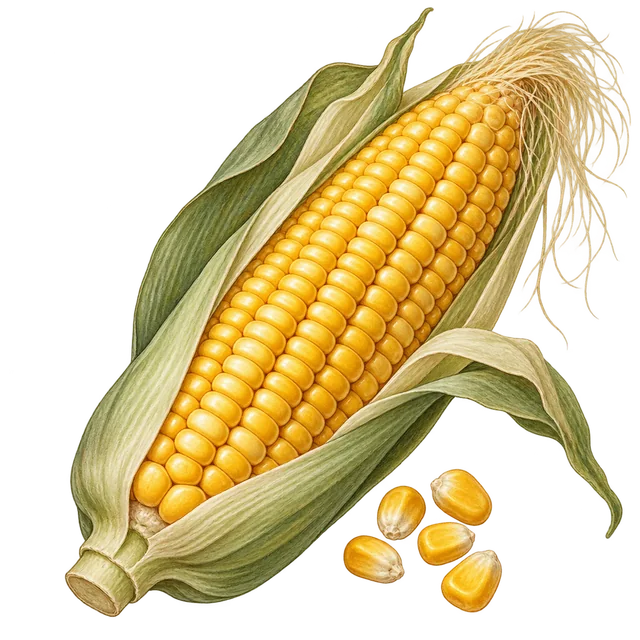
Most of the niacin (vitamin B3) in corn is bound to other molecules, and the body does not absorb it well. Cooking the corn in an alkaline solution such as lime water releases it. That old Mesoamerican practice is how people there avoided pellagra, and the later chapter on alkaline processing and pellagra is devoted to it.
The same crop means very different things for your body depending on how far it has been processed. At one end is the whole kernel with its bran and germ, which counts as a whole grain. At the other are refined cornstarch and corn syrup, with the fiber and germ gone.
Juicy sweet corn is often eaten as a vegetable and dried, milled corn is a staple grain, but both are kernels with plenty of starch. So when talking about corn, the first question is which form you are eating.
A CLOSER LOOK
Start with the form: whole kernel or processed
Corn's whole-grain structure is in its kernels. Whole kernels differ from refined corn starch and syrup.
1Individual kernels
Whole corn kernels retain their outer layers and germ. Tender sweet corn is still a starchy grain.
2Intact form
Refining into starch or syrup removes the whole kernel's fiber and germ. The name corn alone is not enough.
Illustration for understanding; not to scale. Saved figures include explanations and sources.
Background · Vegetable or grain
Corn is a crossover food. Juicy sweet corn is picked while the kernels are still young, with lots of water and sugar, and is usually eaten as a vegetable, although it has far more starch than most vegetables. Dried, milled mature corn (dent corn) is one of the world's staple grains.
The distinction matters because corn runs along a chain from whole kernel to processed product that strips away benefits at each step: first the bran and germ go, then it is milled into refined starch, and finally it becomes syrup. The two things most worth knowing about corn sit at the two ends of that chain: its nutrition as a whole grain, including a famous niacin mechanism, and what it turns into as syrup.
Chapter 2
Whole corn · fiber and eye pigments
Whole corn is a whole grain: mostly complex carbohydrate, bringing fiber and fullness, plus some B vitamins and magnesium.
Yellow corn also contains two carotenoids (yellow and orange plant pigments), lutein and zeaxanthin. They collect in the macula at the center of the retina and act like a yellow filter, blocking part of the blue light before it reaches the light-sensing cells. In observational studies, people with a thinner layer of this pigment more often had age-related macular degeneration, but that is an association and does not show the thin layer is the cause (the eye story is told in full in Lutein + Zeaxanthin).
Mechanism · Resistant starch after cooling
Like rice and potatoes, corn that is cooked and then cooled has part of its starch repack more tightly into resistant starch. Small-intestine enzymes cannot break it down, so it travels to the colon intact and becomes food for gut bacteria, and blood sugar after the meal rises a little more slowly.
That is why the key to eating corn is whole, with the bran, not over-processed: the fiber, the germ and those pigments are all in the whole kernel, and the finer it is milled and the more it is refined, the closer what is left gets to pure starch.
Chapter 3
Mechanism · alkaline processing and pellagra
Most of the niacin (vitamin B3) in corn is bound to other molecules in a bound form the body has trouble absorbing, and corn is also low in tryptophan, an amino acid the body can use to make a little niacin of its own. So populations that ate almost nothing but corn have, historically, suffered outbreaks of pellagra, the niacin deficiency that causes dermatitis, diarrhea and dementia, and is fatal without treatment.
Indigenous peoples in Mesoamerica long ago began soaking and cooking corn in lime water (which is alkaline) before making tortillas. This is called nixtamalization. The alkali releases the bound niacin into a form the body can absorb, so although they also lived on corn, they rarely got pellagra (niacin mechanism in Niacin).
Background · When corn left the Americas
When corn reached Europe and the American South, nixtamalization did not travel with it. Regions that came to rely on corn as their only staple later saw pellagra spread widely; the American South in certain periods is one example.
It is a good example of a traditional way of processing food solving a nutrition problem without meaning to: the people making tortillas did not know what niacin was, yet that step filled exactly the gap.
For you today the practical bearing is small: modern diets get niacin from many sources, and in some countries, such as the United States, flour is fortified with niacin. But it shows one thing: how a food is processed can matter as much as the food itself.
Chapter 4
The processing trap · kernel to syrup
Corn shows another face once it is heavily processed. Industry first breaks it down into cornstarch and then converts that into high-fructose corn syrup (), a cheap, easy-to-use sweetener found in sugary drinks, sauces and snacks. By this point the fiber, germ and eye pigments of the whole kernel are all gone, and what is left is highly refined sugar (for how liquid sugar affects metabolism, see Sugary Drinks).
So whether corn is healthy depends on its form. A boiled cob or a bowl of kernels is good carbohydrate; a drink sweetened with HFCS no longer has anything to do with corn's health benefits.
In practice · How to eat corn
In practice, the trick is to eat the end that is closest to whole.
Whole cobs: boiled, steamed or grilled and eaten off the cob, they are a complete whole grain, with the fiber, lutein and zeaxanthin still intactKernels: tossed into salads, soups or mixed-grain rice as a complex carbohydrate that raises blood sugar more gently than refined staplesCooked, then eaten cool (a chilled kernel salad, next-day corn rice): some starch turns into resistant starch, which is more filling and better food for gut bacteria There is also a safety floor. Like peanuts, corn that gets damp and moldy can grow molds that make aflatoxins. The International Agency for Research on Cancer (IARC) puts aflatoxins in its top category, carcinogenic to humans (the category means the evidence that they cause cancer is certain, not that the risk is large), and they mainly damage the liver. Heat does not break down toxin that is already there, so throw away moldy or discolored corn and cornmeal rather than eating it.
An easy rule: if it still looks like corn, you can eat it without worry; once it has turned into a syrup you cannot recognize, that is what to watch.
iarc-2012-aflatoxins-100f
References · 2
U.S. Department of Agriculture, Agricultural Research Service. (2019). FoodData Central: Corn / maize (sweet, raw and cooked; whole-grain). Whole corn supplies fiber and the carotenoids lutein and zeaxanthin; most of its niacin is in a bound form. fdc.nal.usda.gov