Story
Bread
Last updated
In one pass What a loaf of bread means for your body starts with whether the bran and germ are still there.
Educational content, not medical advice — consult a clinician.
Story path
- 1What is bread · not all bread is the same
- 2How whole wheat and white bread differ
- 3What sets how fast bread raises sugar
- 4Rich in what · whole wheat's B vitamins and minerals
- 5What it lacks · how to pair
- 6What gluten is and who must avoid it
- 7How to choose · read the ingredient list
- 8Is brown or gluten-free bread better
Chapter 1
What is bread · not all bread is the same
Bread is grain milled into flour, mixed with water, yeast (or another starter), and salt, then fermented and baked. It is one of the most common processed grain foods in the world.
Whole-wheat flour keeps the bran and germ, and the bread comes out darker and denser. Refined wheat flour (ordinary white flour, bread flour, cake flour) has both layers milled off, leaving almost only starch and a little protein (gluten); the bread comes out white, fluffy, and long-lasting.
The catch: many shop loaves look brown and say multigrain or mixed grain, yet the first ingredient is refined wheat flour. The color can come from caramel coloring, and the grains can be a light sprinkle.
A CLOSER LOOK
Color and air pockets cannot replace the label
This is one example of bread's appearance. Brown color, grain flecks and airy crumb cannot prove the whole-wheat proportion or fermentation time.
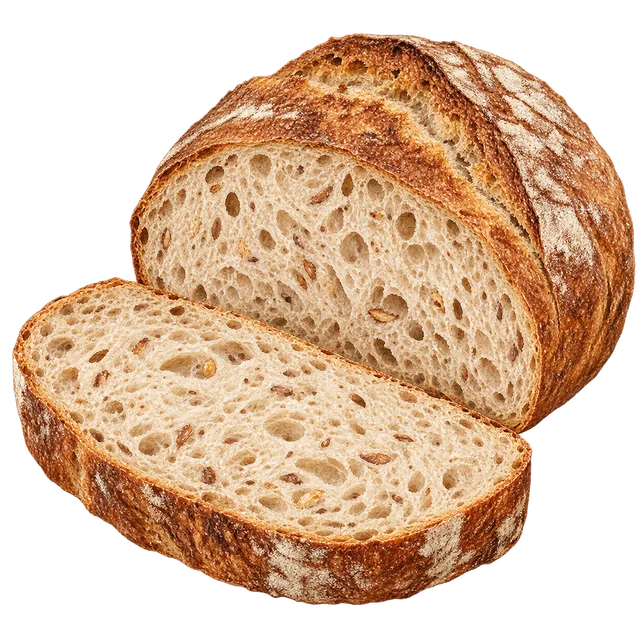
- Brown appearance
- Brown color can come from ingredients or coloring. Read the ingredient list to see whether whole-wheat flour comes first.
- Baked crumb
- Bread goes through milling, mixing with water, fermentation and baking. This cut face does not reveal how much bran and germ remain.
Illustration for understanding; not to scale. Saved figures include explanations and sources.
Mechanism · What a wheat kernel loses at the sieve
A wheat kernel is a little warehouse with a husk, in three layers.Outside is the bran, a tough coat: fiber, minerals, and most of the polyphenols live here. A small pad near the base is the germ — the embryo that would become a plant — so it kept the expensive stuff for itself: oil, vitamin E, B vitamins. The largest piece is the endosperm, the ration left for the germ when it sprouts. Almost all of it is starch plus a batch of storage protein; gluten is that protein.
Refining does one simple job: sieve off the bran, pick out the germ, mill only the endosperm.
So refined flour is not missing a vague nutrition. It is missing two specific packs — the bran pack of fiber, minerals, and polyphenols, and the germ pack of oil and B vitamins.
The same structure explains why white flour keeps: the oil that goes rancid is all in the germ. Once the germ is gone, almost only starch remains, and it sits for a long time without going off. Whole-wheat flour keeps the germ, so it spoils sooner — buy small bags, and refrigerate after opening.
Hold this layer and you barely need to memorize the later gaps. Why whole wheat is higher in fiber, magnesium, B vitamins, and polyphenols is one sentence: the bran and the germ are still there.
Chapter 2
How whole wheat and white bread differ
Per 100 g (about 3–4 regular slices), whole-wheat bread has about 7 g of fiber and white bread only about 2.3 g. More fiber, though, does not necessarily mean a much slower rise in blood sugar; that also depends on how finely the flour was milled and how long the dough fermented.
Both breads share one weak spot: sodium. Bread does not taste salty, yet it is often the steadiest source of sodium in a day — not because any one slice is very salty, but because people eat it every day, several slices at a time.
Numbers · How far apart whole wheat and white are
First, the fiber gap is large. Whole-wheat bread has about 3 times the fiber of white bread, which affects fullness and post-meal blood sugar. People who eat more whole grains have lower risk of type 2 diabetes and cardiovascular disease. That association shows up consistently across a large body of observational studies, but those studies alone cannot show that the whole grains are the cause. see Carbs & Fiber.Second, protein is a little higher. Whole-wheat bread has about 12 g of protein per 100 g (intact gluten protein included), more than white bread. But bread protein is low in lysine, so it is not a complete protein.
Third, sodium is the shared problem. Commercial bread tends to be salty: one regular slice of white bread (about 30 g) carries about 130–180 mg of sodium. Eat 4 slices a day and bread alone uses up roughly 30% of the WHO's daily sodium limit (2000 mg). Eating a lot of sodium is linked to higher blood pressure. see Potassium & Sodium.
Fourth, calories are about the same. Swapping white bread for whole wheat buys fiber and nutrient density, not fewer calories.
Mechanism · three jobs fiber does in the gut
Fiber itself gives you no energy — human digestive enzymes cannot cut it, so it passes through the small intestine almost intact. What it is worth is that, along the way, it changes how fast other things get absorbed.The first job is in the stomach. Soluble fiber takes up water and turns into a thick gel, so the whole mass of food thickens and slows. The stomach empties into the small intestine more slowly, and sugar arrives in batches instead of all at once.
The second job is in the small intestine. Starch must be cut into glucose by amylase before it can enter the blood, and the enzyme has to actually touch the starch to do it. Once the food mass is sticky, those meetings get rarer, so the same amount of carbohydrate enters the blood more slowly. Blood sugar still rises, but it rises more slowly, peaks lower, and falls less steeply, and the feeling of getting hungry again early after a meal may be milder too.
The third job is in the large intestine. Fiber that has still not been cut meets the gut microbes and becomes their food. They ferment it and make short-chain fatty acids, which the cells of the gut wall use on the spot.
Applied to bread, this needs a discount. Most of the fiber in whole-wheat bread comes from bran and is mainly the kind that does not dissolve in water. It forms gels far less readily than the fiber in oats and beans, so its power to flatten the blood-sugar curve is often limited. Its steadier benefit is on total fiber and in the large intestine, not on calories — the calories barely drop.
Mechanism · why bread's salt is hard to drop
Bread does not taste salty, but the salt is in there — and it is not only there for flavor.Salt in the dough does two jobs. It pulls gluten protein chains closer, so the dough has more strength and does not collapse in the oven. It also holds the yeast back, so fermentation slows and the loaf has time to grow a fine, even crumb. Unsalted dough is hard to shape and easy to overproof. That is why low-sodium bread is not as simple as taking the salt out; the formula has to be rewritten.
Once sodium is in the body it walks another path. Most of it stays in the fluid outside cells, and water follows sodium — more sodium, a little more water in the vessels, a little more pressure on the wall. You will not see this in one day. It stacks every day.
So bread's sodium problem is not concentration. It is frequency: it is the food many people eat every day, several slices at a time, without ever tasting salt. If the meal already has pickles, sauces, and cheese, the bread's sodium is the layer on top.
Chapter 3
What sets how fast bread raises sugar
The flour sets the starting point: are the bran and germ still there? But whole wheat does not automatically mean a slow rise. White bread's glycemic index (, how fast the same amount of carbohydrate raises blood sugar) is about 70–80, close to white rice, and a soft whole-wheat loaf made from very finely milled flour, with a very open crumb, can land not far from it. The clearly slower ones are breads that carry whole or coarsely cracked grains, and sourdough that fermented for a long time.
Fermentation is usually thought of as just making bread rise, but it also pretreats the ingredients for you. The longer microbes stay in the dough, the more they break down in advance — some of the phytate that locks up iron and zinc, and some of the short-chain carbohydrates that would ferment and make gas in your large intestine. That is why some people feel fine on a slowly risen sourdough loaf and bloated on a quickly risen soft loaf made from the same wheat.
Mechanism · what fermentation actually does in dough
When you knead, two wheat proteins meet water, get pulled apart, then hook onto each other: one for extensibility (it can stretch without breaking), one for elasticity (it snaps back). The longer you knead, the tighter they join, until they weave a continuous net. That net is gluten.Then the microbes arrive. Yeast eats the sugar in the flour and gives off carbon dioxide. Gas itself does not make dough rise — the net catches each bubble, and the dough balloons. Batter without a gluten net lets the gas slip out as soon as it forms. That is the physical problem Gluten-Free bread has never fully solved.
The oven is the finish. Heat expands the gas in the bubbles and the dough rises one last time; temperature keeps climbing, gluten protein sets, starch takes water and gelatinizes, and the flowing net becomes a fixed frame. The holes on a cut face are the fossils of those bubbles.
A short, fast rise only walks this stretch. What long fermentation adds is not loft; it is breakdown: enzymes the flour already carries, plus enzymes the lactic bacteria bring, have hours or even a day or two to chew molecules people handle poorly — phytate that locks iron and zinc, and the short-chain carbohydrates that would ferment and gas in the large intestine. Those extra hours on the board are a job done for your gut in advance.
Mechanism · why sourdough flattens the glucose curve
Traditional sourdough does not rely on commercial yeast. It relies on a starter, a mass of old dough that keeps lactic acid bacteria and wild yeasts alive, and it usually ferments for 12–48 hours. That stretch does two jobs; this page covers the first: it makes organic acids (lactic and acetic acid) that push the post-meal blood-sugar rise down. In several small crossover trials, sourdough bread produced a lower post-meal blood-sugar response than bread of the same recipe risen with fast yeast.Walk the chain one step finer. Lactic acid bacteria eat the sugar in the flour and give off lactic and acetic acid, and the whole dough turns sour. The acid has two downstream effects. Starch-cutting enzymes are picky about their surroundings and work more slowly when it is acidic, so the same loaf is broken into glucose more slowly. The acid also slows how fast the stomach empties into the small intestine, so sugar arrives in batches rather than in one rush.
There is another layer from the bran. Long fermentation lets more arabinoxylan (a soluble fiber in the bran) dissolve into the dough. That dissolved part makes the gut contents stickier, so starch and enzyme meet a little less often.
So the result is not that this loaf holds less sugar — the sugar did not shrink. What changed is the speed at which it enters the blood: a lower peak, a gentler curve, and possibly a slower return of hunger after the meal.
Mechanism · why a long rise lets some people skip the bloat
A long sourdough ferment does a second job: while the dough is still on the board, it breaks down some of the carbohydrate that would otherwise reach the large intestine and make gas.These carbohydrates go by the name (short-chain carbohydrates that ferment easily in the gut). The one in wheat is called fructans, and it is a common trigger of irritable bowel syndrome (). A long sourdough ferment can break down a substantial share of the fructans, so some people with IBS, and some who consider themselves gluten-sensitive, are fine with sourdough yet feel unwell after ordinary bread.
Why do fructans bloat? They are a short chain of fructose, and the small-intestine wall has no enzyme that can cut that chain. Uncut means unabsorbed, so they walk intact to the large intestine. Bacteria there feed on them and give off gas after a feast; the sugar itself is osmotic and pulls water into the lumen. Gas plus water is bloat, rumbling, and a run to the toilet.
Sourdough's move is direct: the lactic bacteria in the dough carry the enzyme that cuts that chain, and they take some of the fructans apart on the board. What they cut will not go on to make gas — so the same person is fine on a slow-risen sour loaf and miserable on a fast-risen wheat loaf.
That also explains a common misread: many people blame gluten, switch to Gluten-Free bread, feel better, and conclude they do not tolerate gluten. Another possible reason: they also stopped eating high-fructan wheat products. Gluten and fructans live in the same loaf. It hurts when I eat it cannot tell you which one.
None of this holds for celiac disease. The trigger there is the gluten protein itself. Fermentation cuts carbohydrate; it does not take gluten away, and sourdough still contains gluten.
Mechanism · the finer the grind, the faster the rise
Loaves from the same batch of whole-wheat flour can raise glucose by very different amounts. The reason is often not the formula; it is how fine the grind is.Starch becomes blood glucose only after amylase cuts it, bite by bite, and the enzyme starts from the surface. How many sites can work at once depends on how much surface the starch has exposed. A whole kernel, boiled, still has starch wrapped in cell wall and protein matrix; the enzyme has to queue. Mill it fine and bake, and the starch granules are fully freed, surface area multiplies, and the enzyme can spread out and work.
So the order is roughly: whole kernels, then cracked grain, then coarse whole-wheat flour, then fine whole-wheat flour, then refined white flour — glucose rise climbing the whole way. A soft loaf labeled whole wheat, with whole-wheat flour honestly first, can still sit close to white bread after a meal if the flour was milled very fine and the crumb is very open.
This also explains why the same food's jumps across sources: they measured different forms. See a GI number, ask first — which version did they cook?
Myth · The whole-grain label trap
The whole-grain label trap: when you buy bread, read the first ingredient. Genuinely whole wheat means the first item is whole wheat flour or whole grain flour. These phrases are not the same as whole wheat:wheat flour: defaults to refined wheat flourmultigrain: can be several refined flours blendedmade with whole grains: a pinch is enough to say thisbrown bread: color from caramel coloring or molasses, unrelated to whole wheatmixed-grain bread: read the actual list; the category is not a guarantee
Chapter 4
Rich in what · whole wheat's B vitamins and minerals
Two points run against intuition and are worth saying first.
The first is fortification. Many countries add synthetic folic acid and several B vitamins back into flour, so on those few vitamins white bread does not necessarily lose to whole wheat. What can be added back is a few vitamins. What cannot be added back is the fiber, the polyphenols, and the whole bran layer.
The second is phytate. Whole wheat really does hold more minerals, but the bran also carries a lock that grabs iron and zinc, so a lot in the food does not mean a lot reaching the body. A long fermentation can open that lock, which is one more thing sourdough has going for it.
Numbers · The micronutrients whole wheat adds
Compared with refined white bread, here is whole-wheat bread's micronutrient picture, item by item:Thiamin (vitamin B1): whole-wheat bread has about 0.4–0.5 mg per 100 g, and unfortified white bread about 0.2 mg. Fortified white bread gets some of it back, so the gap shrinks or disappears. Thiamin is a coenzyme the body needs to turn sugar into energy; running short harms the nerves and heart. see Thiamin.
Niacin: clearly higher in whole-wheat bread; it feeds the energy-metabolism line.
Iron: plants carry non-heme iron, about 3–4 mg per 100 g in whole-wheat bread (part of it from fortification). Phytate holds its absorption back; a little vitamin C in the same meal helps.
Zinc: higher in whole wheat, and held back by phytate in the same way. A long sourdough ferment breaks down some of the phytate and makes the minerals easier to absorb.
Magnesium: whole wheat keeps the germ and bran, so it has more magnesium.
Folate: many commercial breads add synthetic folic acid under fortification schemes, so white bread's folate is not necessarily lower than whole wheat's. Fortified flour is a public-health measure many countries use to prevent neural-tube defects, and in countries that fortify, neural-tube defects have fallen.
Plant polyphenols: whole-wheat bread carries polyphenols from the bran layer, mainly ferulic acid, most of which is attached to a fiber called arabinoxylan. They show antioxidant and anti-inflammatory activity in cell and animal experiments; whether they bring a measurable health benefit in people has not been shown.
Mechanism · phytate is the lock, fermentation the key
Phytate is the seed's warehouse for phosphorus. For the seed that is a good design — phosphorus is for later sprouting, and locking it is safest. For the person eating the seed, the trouble is that the lock does not pick its target: the phytate molecule wears a ring of negative sites, and positively charged minerals — iron, zinc, calcium — get grabbed as soon as they come close, packed into an insoluble complex that walks the gut unabsorbed.So whole-wheat minerals need two ledgers: how much is in the food, and how much the body actually takes. Bran brings more minerals and more locks at once; those two columns do not move the same way.
The way to open the lock is old — soak, sprout, ferment. Enzymes in the dough (phytase the flour already carries, plus what lactic bacteria bring) cut phytate; cut, it cannot hold the minerals. The enzymes need two conditions: time, and an acidic setting. A long sourdough ferment gives both — that is why, same whole wheat, the slowly risen loaf is easier for the body to collect minerals from.
A practical corollary: eat whole-wheat bread with something rich in vitamin C (tomato, pepper, citrus). Vitamin C reduces non-heme iron into a form the gut wall takes more readily, and partly offsets phytate's drag — which is why whole-wheat toast with tomato is a better deal than it looks.
Mechanism · why folate went into the flour
Folate and flour is the cleanest way to understand fortification.The fetal neural tube — the future brain and spinal cord — closes in the first weeks after conception. If folate is short in those weeks, closure can fail; and at that moment many people do not yet know they are pregnant. In other words, start a supplement after the test and the window has already closed.
So another idea: stop chasing individuals, and put folate into something almost everyone eats every day — flour. That covers not only people planning a pregnancy, but everyone who might become pregnant, including those who have not planned and do not yet know.
The cost: white bread's folate is therefore not always lower than whole wheat, so white is always worse does not hold on this one line. That does not change the rest of the conclusion: fortification can put a few vitamins back. It cannot put back fiber, magnesium, and polyphenols — those cannot be poured in from a packet.
Chapter 5
What it lacks · how to pair
Low lysine: lysine is the first amino acid to run out in wheat protein. Eggs, cheese, hummus, or peanut butter fill it in, and whole-wheat toast with a boiled egg is the classic complementary breakfast.High sodium: when a meal already has pickles, sauces, or cheese, count the bread's share too. Bake your own and you decide how much salt goes in.No vitamin B12 and no vitamin D: these two have to come from other foods.Little fiber in refined white bread: living on white bread while eating few vegetables and beans makes it easy to fall short on fiber. The Dietary Guidelines for Americans (DGA) set adult targets of about 25–28 g a day for women and about 31–34 g for men, and bread is only one of the sources.
Pairing ideas: whole-wheat toast with avocado or peanut butter for fat, and the peanut butter adds lysine; bread with vegetable soup or salad for fiber and vitamin C; tomato and lettuce inside a sandwich. see Fruit & vegetables for how to build the whole meal.
Mechanism · what a limiting amino acid means
The body builds protein by adding amino acids one by one to a drawing. The order cannot skip. If the next step needs lysine and there is none on hand, the chain stops there — it does not make a protein missing a part; that chain simply never finishes.So a protein's quality is not how much. It is which item hits empty first. Extra of the others cannot fill the missing one; the surplus is broken down and burned as energy, or turned into something else. The amino acid that empties first is this protein's limiting amino acid.
Wheat protein's limiting amino acid is lysine. That is not a defect in wheat; it is how grass-family seeds store protein. Their storage proteins are mainly prolamins and glutelins, two classes that are low in lysine by nature — and gluten is the network those two form.
So complement has a precise meaning: let another protein fill the empty cell in yours. A general rule of thumb: grains run short of lysine; legumes run short of methionine and cysteine. What matters is that the two short boards sit in different cells — not eat more protein.
One more thing people skip: you do not have to complement every bite. The body keeps a short-term amino-acid pool that can cover a few hours — sources that fill each other in the same day are enough. You do not have to write an equation for every meal.
Mechanism · why bread cannot give you B12 or vitamin D
Bread holds no vitamin B12 and no vitamin D. That is not a formula problem; it is a category problem — swap in any purely plant staple and the result is the same.In nature only bacteria make vitamin B12. Plants neither synthesize it nor have a reason to store it. Animal foods have it because the animal (or the bacteria in its gut) already collected it for us. So a loaf with no B12 has nothing to do with whole wheat versus refined.
Vitamin D walks another path: it is mostly not eaten. Skin makes it under ultraviolet light, then liver and kidney finish it into a working form. The food share comes mainly from fatty animal foods and fortified products — grain itself does not make it.
So when you see bread lacks these two, the right move is not a better loaf. Hand the two jobs to other sources: B12 to animal foods or a supplement (especially if the diet is fully plant), vitamin D to sun and, when needed, a supplement.
Chapter 6
What gluten is and who must avoid it
The people who must strictly avoid gluten are those with celiac disease, an autoimmune condition in which the immune system attacks the lining of the person's own small intestine. It is not on the scale of this food disagrees with me. Wheat allergy is a different thing, an allergic reaction, and it also means avoiding wheat. And there is a group with real symptoms whose mechanism is still disputed, called non-celiac gluten sensitivity.
Outside those three groups, people do not need to avoid gluten: in bread it is a building material, not a health risk. If you suspect celiac disease, get tested by a doctor before deciding whether to cut gluten — giving it up on your own beforehand can make the tests inaccurate.
This is general information only and does not replace a diagnosis or advice from a doctor or dietitian.
Clinical · Who actually needs gluten-free bread
Who actually needs Gluten-Free bread:People with celiac disease: an autoimmune condition in which eating gluten damages the villi, the tiny projections lining the small intestine that do the absorbing, and absorption suffers. Diagnosis takes a blood test (serology) plus a small-intestine biopsy. These people must strictly avoid every gluten-containing food, bread included.Non-celiac gluten sensitivity (NCGS): tests show it is not celiac disease, yet gluten-containing foods still cause discomfort. The mechanism is still debated; in double-blind trials, the symptoms of people in this group were more likely caused by fructans in wheat (a carbohydrate that ferments easily and makes gas in the gut) than by gluten itself.Wheat allergy: not the same as celiac disease; an allergic reaction that comes on soon after eating wheat, driven by an antibody called IgE.
Mechanism · How celiac disease flattens the villi
The celiac chain is worth walking in full. After you walk it, why a trace is still too much stops being a slogan.Step one is in the gut. The gliadin chain is packed with proline and glutamine, and human digestive enzymes cannot cut the bond next to proline. Other food proteins are cut into short fragments and absorbed; this one leaves a batch of peptides that are still quite long.
Step two is at the gut wall. Those long peptides get through the gut lining into the tissue beneath it. An enzyme there, called tissue transglutaminase (tTG), makes a small chemical change to them; after that change, the immune system sees the peptide unusually clearly.
Step three is a case of mistaken identity. In people with a particular immune-recognition gene, immune cells treat this peptide as an invader and attack. The peptide is not alive — you cannot kill it or drive it out. What actually takes the beating is the place it sits: the patient's own small-intestine mucosa.
Step four is the consequence. The inner wall of the small intestine is normally carpeted with villi, a dense rug that stretches absorptive surface to an extreme. Long immune attack wears the villi flat; the rug becomes a board; absorptive area collapses.
Only here do the two earlier sentences stand.
Why a trace still fails: once the immune system has locked onto this peptide, a very small amount is enough to set the reaction off again, while the villi grow back far more slowly. Repeated traces keep the gut in a state of just starting to repair, then being interrupted. Damage is ongoing, not one-off.
Why it often shows up first as anemia: iron and folate are absorbed mainly in the front stretch of the small intestine — exactly where villi flatten first. Many people are found to have iron-deficiency anemia, then chased all the way to celiac — the belly may not hurt at all.
That is why, for a person with celiac disease, Gluten-Free is not a taste preference. It is treatment adherence. That is a different kind of act from someone without celiac trying gluten-free.
Myth · Everyone else, and how far fermentation goes
For people outside celiac disease, wheat allergy, and non-celiac gluten sensitivity, there is no evidence that avoiding gluten brings a health benefit. In a large prospective cohort study by Lebwohl and colleagues in the BMJ, people without celiac disease who ate little gluten over the long term did not end up with a lower risk of coronary heart disease, and the researchers warned that cutting gluten may mean eating fewer whole grains. So gluten-free bread is healthier is an unfounded claim for these people. Gluten-free bread usually swaps wheat for refined rice flour, tapioca, and similar starches — often less fiber, and sometimes more fat and sugar to fix the texture.On fermentation reducing fructans and similar easily fermented carbohydrates: a traditional long sourdough ferment can break down a substantial share of the fructans, so some people who are sensitive to them can eat sourdough (even when it is made from ordinary wheat). This does not apply to celiac disease — the gluten is still there.
Read the two stretches side by side and you see fermentation's limit: it cuts carbohydrate, specifically short-chain sugars like fructans, so what it can improve is gas and bloat. Gluten is a protein; fermentation will not take it away — so no rise, however long, rescues celiac disease. What a method can solve depends on which class of molecule it acts on. That is more useful than memorizing the conclusion.
Chapter 7
How to choose · read the ingredient list
True whole wheat has only one sign: the first ingredient is whole-wheat flour (on English labels, whole wheat flour or whole grain flour). If the first ingredient is listed as plain wheat flour, just flour, or wheat flour (enriched), it is refined bread, no matter how brown it looks or how fancy the name.
Why the first ingredient is enough: ingredients are listed by weight from most to least, so whatever comes first is what the bag holds most of. The name on the front, the color, and the slogans can all be designed. That order cannot.
In practice · Color, fiber, sodium, fake sourdough
Do not trust the color: brown does not mean whole wheat. The color can come from caramel coloring, molasses, or cocoa. A brown loaf whose first ingredient is ordinary wheat flour is not really different from white bread.Check the fiber: a genuine whole-wheat slice (about 30 g) should have 2 g of fiber or more; refined bread usually has under 1 g a slice.
Check the sodium: among similar loaves, compare the sodium per 100 g on the nutrition label and pick the lower one.
Tell real sourdough from fake: see whether the ingredients list a starter culture, meaning lactic acid bacteria actually fermented the dough, or just ordinary yeast plus an acidulant (vinegar or lactic acid added for a sour taste, with no real long fermentation). Some supermarket loaves labeled sourdough are this kind of quick sour-flavored bread.
Bake your own: you set the recipe — less salt, whole-grain flour, no additives you do not need.
How much: the Dietary Guidelines for Americans (DGA) recommend making at least half of each day's grains whole grains. Two to three slices of genuine whole-wheat bread a day (along with other food) is reasonable. When bread is the staple, put vegetables and protein in the same meal.
Why quick sour-flavored bread deserves its own line: sourdough's two gains — flattening glucose, cutting some fructans — are bought with time. Microbes do that work slowly on the board. Vinegar or lactic acid copies only the taste; the enzymatic breakdown of those hours never happens.
Mechanism · stale bread is not water leaving
When bread goes hard, the first guess is that water left. The main reason is that the water was moved.A loaf just out of the oven is soft because, in the bake, starch took water, swelled, and its tight crystal structure was broken — gelatinization. As it cools, those scattered starch chains slowly line back up. That is retrogradation. Lining back up squeezes water out of where it sat, so the crumb hardens and crumbs.
That explains two kitchen facts. Reheating softens the loaf again — heat breaks the newly lined structure once more. The fridge hardens it fastest, because fridge temperature sits in the fastest retrogradation window; freezing holds the process down. So leftover bread, sliced and frozen, is better than the fridge.
A glucose corollary: the starch formed by retrogradation is harder for amylase to cut again, behaves more like fiber, and some of it walks all the way to the large intestine to feed microbes. A loaf that has cooled and been reheated may give a flatter post-meal curve than the softest bite straight from the oven, though not by much — same bread, and temperature and time change how fast it enters the blood, just only so far.
Chapter 8
Is brown or gluten-free bread better
Myth one: brown or multigrain bread is whole-wheat bread. Brown is only a color and says nothing about nutrition — caramel coloring and molasses can both dye a refined white loaf that appealing dark shade, and many people automatically read a darker color as healthier.
Myth two: gluten-free bread is healthier than ordinary bread. For people without celiac disease, wheat allergy, or non-celiac gluten sensitivity, Gluten-Free bread brings no nutritional advantage and is often a step down. Without wheat, a loaf is hard to hold together, so makers switch to refined starches; the fiber drops, and extra fat and sugar often go in for texture.
The two questions that actually matter when choosing bread: is whole-wheat flour the first ingredient, and does each slice carry about 2 g of fiber? Get those two right and you can trust them more than any Gluten-Free or multigrain label.
Myth · How color and gluten-free get sold
Color: many makers know that shoppers automatically equate brown with healthy, so they dye refined white bread brown with caramel coloring. Only the ingredient list settles it: whole wheat flour must come first.Gluten-free: for people without celiac disease, wheat allergy, or non-celiac gluten sensitivity, Gluten-Free bread has no nutritional advantage. Instead:
It usually swaps wheat flour for refined rice flour, tapioca starch, or potato starch, so it has less fiberTo improve the texture, some versions add more fat, sugar, and gums (such as xanthan gum)And it costs much more
Over the past decade, Gluten-Free eating became a fashionable health trend and drew a large number of people with no medical need into buying Gluten-Free products. For them the Gluten-Free label is a marketing idea, not a health upgrade. The question to ask is not does it have gluten, but is it whole grain, and is there enough fiber.
Mechanism · why gluten-free bread is hard to make fibrous
The nutrient disadvantage of Gluten-Free bread is not laziness at the plant. It is what a physical constraint pushes out.A loaf rises because gluten is a net that can catch gas. Take wheat away, and no common plant protein weaves that same net on its own. So the formula has to switch to high-purity starches — rice flour, tapioca, potato starch — plus a gum to fake viscoelasticity, plus oil and sugar to buy back texture and moisture.
Every link in that swap chain pushes the same way: refined starch never had bran, so fiber starts low; gums give texture, not nutrients; oil and sugar are for mouthfeel, not nutrient density. Stack the three and you get less fiber and, sometimes, a higher energy density as well.
So for someone with no medical need, switching to Gluten-Free bread is not standing still. It is usually a step back. The question that always mattered is not does it have gluten, but is the bran still there.
The other side is worth saying: for someone who actually needs it, these costs are worth paying — that is not a nutrient choice; it is part of treatment. Whether a product is good depends on who you are judging it for.
References · 11
- U.S. Department of Agriculture, Agricultural Research Service. (2019). FoodData Central: Bread, whole-wheat versus white (commercially prepared). Whole-grain bread carries several times the fiber of refined white bread. fdc.nal.usda.gov
- U.S. Department of Agriculture & U.S. Department of Health and Human Services. (2020). Dietary Guidelines for Americans, 2020-2025 (9th ed.). www.dietaryguidelines.gov/sites/default/files/2020-12/Dietary_Guidelines_for_Americans_2020-2025.pdf
- World Health Organization. (2012). Guideline: Sodium intake for adults and children. World Health Organization. Recommends a reduction to less than 2 g/day of sodium (5 g/day of salt) in adults - a strong recommendation. For children, the recommended maximum adult level of 2 g/day sodium should be adjusted downward based on the energy requirements of children relative to those of adults. www.who.int/publications/i/item/9789241504836
- Lappi, J., Selinheimo, E., Schwab, U., et al. (2010). Sourdough fermentation of wholemeal wheat bread increases solubility of arabinoxylan and protein and decreases postprandial glucose and insulin responses. Journal of Cereal Science, 51(2), 152-158.
- Scazzina, F., Del Rio, D., Pellegrini, N., & Brighenti, F. (2009). Sourdough bread: starch digestibility and postprandial glycemic response. Journal of Cereal Science, 49(3), 419-421. Lactic-acid sourdough fermentation lowers the postprandial glycemic response versus yeast-leavened bread.
- National Institutes of Health, Office of Dietary Supplements. (2021). Thiamin — Fact Sheet for Health Professionals. ods.od.nih.gov/factsheets/Thiamin-HealthProfessional
- National Institutes of Health, Office of Dietary Supplements. (2024). Iron — Fact Sheet for Health Professionals. Fact sheet (updated September 4, 2025; Wayback snapshot 21 September 2026): RDAs 8 mg/day for men and for women 51+, 18 mg women 19-50, 27 mg pregnancy; UL 45 mg/day from age 14; bioavailability about 14%-18% from mixed diets with meat, seafood and vitamin C and 5%-12% from vegetarian diets; serum ferritin below 30 mcg/L suggests iron deficiency and below 10 mcg/L IDA, but inflammation can raise ferritin; supplemental iron of 45 mg/day or more may cause nausea and constipation; people with hereditary hemochromatosis are at risk of iron overload (fact sheet). Heme vs nonheme: heme iron (lean meat and seafood are the richest sources) has higher bioavailability than nonheme iron, and other dietary components affect it less; calcium might reduce the bioavailability of both forms; heme iron is about 10%-15% of total iron intake in western populations. The sheet gives no separate heme and nonheme absorption percentages (fact sheet, Wayback 2026 snapshot). ods.od.nih.gov/factsheets/Iron-HealthProfessional
- National Institutes of Health, Office of Dietary Supplements. (2022). Folate — Fact Sheet for Health Professionals. ods.od.nih.gov/factsheets/Folate-HealthProfessional
- EFSA Panel on Dietetic Products, Nutrition and Allergies (NDA). (2015). Scientific opinion on the safety of oats in people with celiac disease. EFSA Journal, 13(11), 4317. Most people with celiac disease tolerate uncontaminated oats; cross-contamination is the main concern. 10.2903/j.efsa.2015.4317
- Lebwohl, B., Sanders, D. S., & Green, P. H. R. (2018). Coeliac disease. The Lancet, 391(10115), 70-81. A strict gluten-free diet is the established treatment for celiac disease; diagnosis requires serology and biopsy. 10.1016/S0140-6736(17)31796-8
- Lebwohl, B., Cao, Y., Zong, G., et al. (2017). Long term gluten consumption in adults without celiac disease and risk of coronary heart disease: prospective cohort study. BMJ, 357, j1892. Restricting gluten in people without celiac disease was not associated with lower cardiovascular risk and may reduce whole-grain intake. 10.1136/bmj.j1892