Story
Sweet Potato
Last updated
In one pass Whether sweet potato raises blood sugar fast depends mostly on how it is cooked: the same sweet potato raises it fast when roasted and slowly when boiled — during slow roasting, more of the starch is broken down into sugar before it leaves the pan.
Educational content, not medical advice — consult a clinician.
Story path
Chapter 1
Not a potato, not a yam
Sweet potato (Ipomoea batatas) is the swollen root of a plant in the morning-glory family. First, separate three things that often get mixed up:
It is not a potato: a potato is the swollen underground stem of a nightshade plant, a different kind of thing altogether;It is not a yam either: Chinese yam (shanyao) belongs to the Dioscorea family, and so do the yams the English word originally names; yet much of what is labeled "yam" in Western markets is actually orange-fleshed sweet potato, and the naming has always been a mess;Different flesh colors carry different pigments: orange flesh is rich in beta-carotene (which the body can turn into vitamin A), purple flesh is rich in anthocyanins, and white and yellow flesh have little pigment and lean toward starch.
Nutritionally, sweet potato combines carbohydrate with fiber, potassium, and pigments, and it is an important food crop in China and around the world. It often wears two opposite labels — weight-loss miracle and spikes blood sugar — and both need to be calibrated against the evidence.
A CLOSER LOOK
A storage root, shown in an orange variety
Sweet potatoes have different flesh colours; this orange example represents neither every variety nor its glycemic response after cooking.
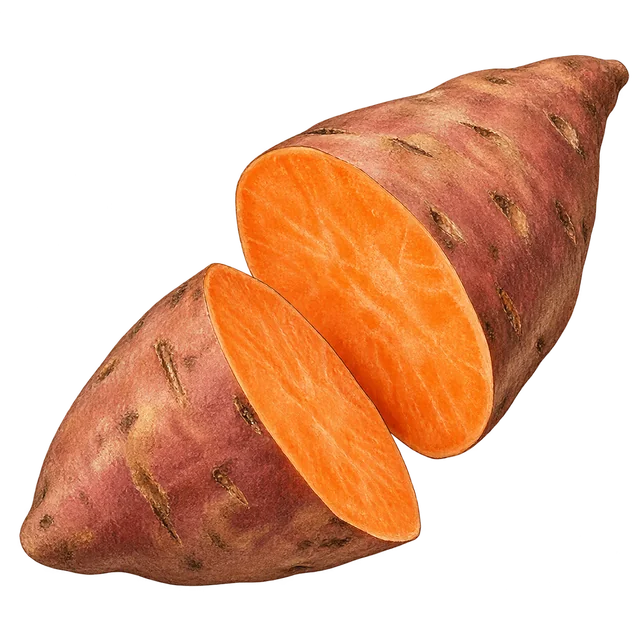
- A swollen root
- Sweet potato stores nutrients in a swollen root, a different structure from a potato's underground stem tuber.
- Orange flesh
- Orange-fleshed varieties contain beta-carotene; white and purple varieties have different pigment profiles.
Illustration for understanding; not to scale. Saved figures include explanations and sources.
Mechanism · Why root versus stem matters in the kitchen
Separating sweet potato from potato and yam by name is not enough. The distinction that actually helps is which organ of the plant they are, because different organs make a whole chain of later things different.Potato is a stem. Sweet potato is a root.
A potato is an underground stem that swelled. Stems have eyes, so one potato can sprout a new plant on its own; planting potatoes is cutting them into pieces and burying them. Nightshade stems and leaves also come with a class of defensive bitter compounds, and those pile up when the tuber greens in the light or sprouts — so a greened, sprouted potato has to be peeled deep enough, and a badly affected one thrown away whole.
A sweet potato is a storage organ made from a swollen root. Roots have no eyes. It first grows adventitious buds on the tuber into vine slips, then those slips are cut and planted. So a sprouted sweet potato does not make the same kind of toxin; cut the sprouts off and you can still eat it.
But sweet potato has a red line of its own
A sweet potato that tastes bitter, has a hard core when cut, or carries brown-black patches should be thrown away whole. That is a bitter toxin that forms after mold has infected the root. It survives steaming and boiling temperatures, and it will not stay politely inside the spots you can see — cutting one patch off and eating the rest is not safe. The judgment is simple: if it tastes bitter, stop. That bitterness itself is the signal.
Three flesh colors are three different chemistries
Orange flesh: the lead is beta-carotene, fat-soluble, sitting in chromoplasts inside the cell that exist to stack pigmentPurple flesh: the lead is anthocyanin, water-soluble, sitting in the cell's vacuoleWhite and yellow flesh: little pigment, basically starch's home ground
This is not a taxonomic flourish. It directly decides how to cook: one set cannot do without oil; the other does not need oil but will run into the water. The chapter on orange flesh and beta-carotene walks both roads to the end.
Chapter 2
Orange flesh's beta-carotene
One practical detail: beta-carotene is fat-soluble, so eating it with a little fat clearly raises absorption — steamed sweet potato with a drizzle of olive oil, or eaten alongside a dish with some fat, is used better than sweet potato eaten dry.
Purple sweet potato takes another road: its color comes from anthocyanins (polyphenols of the same class as in blueberries), which the body does not turn into vitamin A. White and yellow flesh have little pigment and lean toward starch.
Mechanism · How on-demand conversion works
Beta-carotene is converted into retinol on demand. Those two words are the most valuable part of this mechanism, and they are usually waved past in one sentence.A pair of scissors that cuts in the middle
Beta-carotene looks like a long stick, symmetric at both ends. It arrives in the small intestine with food, is absorbed into the epithelial cells of the gut wall, and a dedicated enzyme in the cell cuts it at the exact middle of the stick, splits it in two — each half becomes retinal, then is reduced to retinol, the form of vitamin A the body can use directly.
On demand sits on this pair of scissors
The key is that the scissors are regulated: when the body already has enough vitamin A, the cell turns the enzyme's production down; when it is short, it turns it up. So incoming carotene is no longer converted in bulk. It is stored as-is or excreted.
This one valve explains something often treated as a contradiction: you cannot get vitamin A toxicity from eating orange-red vegetables, but you can from swallowing a high-dose vitamin A supplement. The former has a valve in the body; the latter does not — what a supplement carries is vitamin A already formed, which enters body stores directly and never passes this pair of scissors.
Where does the leftover carotene go
Some of it is stored as-is in adipose tissue and in the stratum corneum of the skin. Store enough and the skin turns slightly yellow, most obvious on the palms and soles. A practical distinction: this yellowing does not tint the whites of the eyes, and jaundice does. Stop for a while and the color fades on its own — that is accumulation, not toxicity. Do not mix the two.
The same serving of sweet potato converts to different amounts in different people
The gene for this pair of scissors has common variants in the population, so the same serving of orange sweet potato yields clearly less vitamin A in some people than in others. That means claims about how much of a day's need one sweet potato can cover are only true in the average sense. Landed on any one person, they will drift.
One boundary
The valve above only holds for the precursor. Animal liver, fish-liver oil, and supplements carry vitamin A already formed. There is no such gate, and that is the class whose ceiling you need to watch — especially when trying to conceive or during pregnancy. Orange sweet potato is not in that class. The color can be eaten with confidence.
Mechanism · Two pigment systems, two ways to cook
Sweet potato color is not a matter of lighter or darker. It is two completely different molecules. Separate them and you will not treat every sweet potato the same way.The orange set: what it fears is no oil
Beta-carotene is purely fat-soluble, locked in chromoplasts inside the cell that exist to stack pigment. To use it, three gates have to be passed:
Out of the cell first: outside is a cell wall people cannot digest. Cutting, chewing, and heating all break it open, and only then is the pigment releasedThen dissolve into oil: if the same meal has fat, that fat is broken into small droplets in the small intestine; the pigment is oil-loving, so it dissolves in — it finally has a place that is not waterThen catch a ride: when fat enters the small intestine, bile is released; bile salts are water-loving at one end and oil-loving at the other, and they wrap the oil droplets and the pigment dissolved in them into tiny spheres. The outside of the sphere is water-loving, so it can move freely in intestinal juice and deliver the cargo all the way to the gut-wall handoff
Without the oil step, what stalls is the third gate: the pigment has already left the cell, but it has no transport, and it leaves unchanged in the stool. So drizzling oil on steamed sweet potato, pairing it with an egg, or with a few nuts, is not fussiness. It is a required step on this road. Every step of this road is covered in more detail in Bell Pepper.
The purple set: this oil trick does not apply, but it fears water and alkali
Anthocyanin is water-soluble, sitting in the cell's vacuole. It does not need oil's help, but it will run into the water — boil purple sweet potato and the pot liquid changes color. That is direct evidence of the loss. So purple sweet potato is better steamed in the skin, cooked with little water, not cut up and boiled.
It is also sensitive to acid and alkali: more acid, the color is redder and more stable; more alkali, it drifts toward blue-green. Purple-sweet-potato steamed buns that went gray-green after alkali was added are this; a squeeze of lemon juice in the dough can pull the color back.
Which gives a conclusion you can work out yourself
The deeper the color, the more nutrition holds roughly inside one kind of sweet potato. Across colors it goes wrong. Deep orange and deep purple are not even the same set of molecules: one can be remade by the body into vitamin A; the other gives not one bit, and walks a completely different antioxidant ledger.
Chapter 3
Blood sugar depends on cooking
One study cooked ten common sweet potato varieties in different ways and measured their glycemic index (: how fast and how high a food raises blood sugar for the same amount of carbohydrate):
Boiled: the lowest GI, about 41–50, which counts as low GI;Baked or roasted: the highest GI, about 79–94, which counts as high GI.
During slow roasting, more of the starch is already broken down into sugar in the pan, and what is left is more thoroughly gelatinized, so there is almost nothing left to digest once it reaches the gut — and blood sugar rises fast. On top of that, the glycemic load (, which also counts how much you actually eat) depends on the portion: a fist-sized steamed sweet potato does not carry a high load.
To keep blood sugar steady: choose steaming or boiling, roast less, and watch the portion. For people with diabetes, sweet potato can absolutely be part of the diet; set the portion with a dietitian and a doctor.
Mechanism · Why roasted is sweeter and raises sugar faster
Boiled sweet potato has a glycemic index (: how fast a food raises blood sugar for the same amount of carbohydrate) of about 41–50, and baked or roasted about 79–94. Those numbers come from Bahado-Singh 2011, which tested ten varieties commonly eaten in Jamaica, but they only give the result. What follows is the reason — once you know it, you can judge cooking methods nobody has measured. It is a food-chemistry explanation that makes sense; the GI study itself did not measure the enzyme.Sweet potato comes with enzymes that cut starch into sugar
Sweet potato has a class of amylases. Their activity has a temperature window: too cold and they barely move; too hot and they are destroyed and shut down completely.
The key is that they need conditions to meet the starch. In a raw sweet potato, starch is locked in dense granules and the enzymes cannot get at it; the moment heating starts to gelatinize the starch and the granules loosen, the enzymes have not yet been inactivated — and in that overlapping window the enzymes cut the spread-out starch, segment by segment, into maltose.
So how sweet it is depends on how long that window stays open
A slowly heating oven: temperature climbs from low to high, and spends a long time in the enzyme's active range. Enough sugar is cut out to seep through the skin and set into caramel-colored syrup. That is where roasted sweet potato's sweetness comes from — not simply the roast driving water off and concentrating the sweetFast steaming, or boiling in a pot: the food rushes through that window and the enzymes inactivate quickly. Far less sugar is cut out; more starch stays as starch
So the glucose-rise difference can be worked out without memorizing a table
Roasting: more starch has already been taken apart into sugar in the pot, and what remains is more thoroughly gelatinized; once it reaches the gut there is almost no work left to do — blood glucose rises fast.
Boiling: less is taken apart, gelatinization is gentler, and more of the parts digestive enzymes cannot chew remain — blood glucose rises slowly.
The part they cannot chew has a name
Starch packed too tight for digestive enzymes to take apart is called resistant starch. It is not absorbed in the small intestine. It walks all the way to the large intestine, is eaten as food by the bacteria there, and fermented into short-chain fatty acids — equivalent to feeding the gut microbiota, and it does not count on the blood-glucose ledger.
And one free point
After cooking and cooling, some of the starch molecules that had already spread out draw back together and re-pack into a tight structure (retrogradation), so a little more resistant starch appears. A cooled steamed sweet potato therefore raises glucose a little more slowly than one just off the stove, and the bite is firmer. Reheating partly reverses this, but does not return all the way to the starting point.
The same holds for potato: boiled potato that has cooled gains resistant starch, and that is this same event.
Background · How GI is measured and where it stops
The glycemic index () is a useful number, but its range of use is narrower than most people think. Know how it is measured and you know when to trust it.This is how it is measured
A group of people, fasting, eat one food alone, and what they eat is that much of a fixed amount of available carbohydrate — not a fixed weight, a fixed amount of carbohydrate. Blood is then drawn continuously to draw a glucose curve, compared with a reference of the same carbohydrate amount, and a ratio comes out.
That design has three premises, and not one of them holds at a real table:
Fasting, eaten alone: in real life the sweet potato has vegetables, meat, and oil beside itFixed carbohydrate, not a fixed portion: a high GI does not mean the serving you actually ate raises glucose a lot, because you may have eaten very littleIt is an average: the same food's curve differs quite a bit across people; variety, ripeness, and storage time also let the number for the same food drift
So what you should actually look at is the load
GI only describes how fast it rises at the same amount of carbohydrate. What you actually carry is that speed multiplied by how much. A fist-sized steamed sweet potato, even if its GI is not low, has limited total carbohydrate, so the load is not high; a whole platter of roasted sweet potato as dinner pulls both factors to the top at once.
So portion is often more decisive than method — and it is the one most easily ignored, because it is on no GI table.
A few moves that can rewrite the curve
Choose steaming or boiling over roasting: less starch is turned into sugar in the panPair protein and fat in the same meal: gastric emptying slows, and the sugar arrives in batchesPair vegetables and fiber in the same meal: the environment in the gut lumen is stickier, and sugar reaches the gut wall more slowlyDo not eat sweet potato alone as a snack: eating it alone is the case closest to the GI test conditions, and the steepest curveControl how much you eat in one sitting, and count it into that day's staple share, not as an extra vegetable
One boundary
The above is a way for ordinary people to adjust a glucose curve. People already diagnosed with diabetes or taking glucose-lowering drugs should set the kind and portion of staples with a dietitian and a doctor. Do not take a GI table and fit it onto yourself.
Chapter 4
Sweet potato or potato?
Sweet potato's advantages: usually more fiber; the beta-carotene in orange flesh, which potato lacks; a lower range overall (especially steamed or boiled); and a sweetness that means it rarely needs added sugar.Potato is not bad either: it is high in potassium, holds its own on vitamin C, and gives a fair amount of fiber when eaten with the skin; boiled potato that has cooled also carries a good amount of resistant starch. Potato takes the blame mostly because it is so often made into fries and chips — that is frying's fault, not the potato's.
What decides whether a meal is healthy was never sweet potato or potato. It is how it is cooked (steamed and boiled, or fried), what it is paired with, and how much you eat. Eating either one in large amounts every day as a monotonous weight-loss miracle, or frying it into chips for dinner, both miss the point.
In practice: alternating the two, keeping the skin on, and preferring steaming, boiling, or roasting over frying all matter more than agonizing over which one to pick.
Myth · Sweet potato versus potato is the wrong question
Which is healthier, sweet potato or potato; which to pick, brown rice or quinoa — this kind of question always has an answer online, and the answers always contradict each other. The reason is not that the sources are thin. The question itself is asked wrong.What actually decides this meal is four variables
How far it is gelatinized: the same sweet potato, the more thoroughly roasted, the more finely mashed, the easier the starch is to take apart. A sweet potato roasted until it weeps sugar and a steamed one that still has a little firm core differ more than sweet potato and potato differHow intact the pieces are: eaten whole, cut, mashed, or ground to flour, the surface area digestive enzymes can reach scales up the whole way. Mash raises glucose faster than chunks, and this holds for bothWhat else is in the same meal: fat and protein slow gastric emptying; fiber makes the gut-lumen environment stickier. Whether those are there matters far more than swapping the staple varietyHow much was eaten: this is the only variable that can cover the first three
Of the four variables, the species itself occupies none. So the sweet-potato-or-potato question treats the least important dimension as the main axis from the start.
Why fries are a different matter
Most of the blame potato carries comes from fries and chips, and that process pushes all four variables above to an extreme at once:
Cut into thin strips, surface area explodesHigh-temperature frying drives surface water off and oil in, so the energy density of the same bite goes upSalty, fragrant, and crisp, so you eat more without noticing
Swap in sweet potato fries and not one of those three changes. So this really is frying's fault, not potato's — but it is also not a fault sweet potato is exempt from.
So how to actually choose
Change the question from which one to how you handle it, and the answer becomes executable at once: alternate the two to get a wider nutrient spectrum (sweet potato gives the orange pigment set; potato gives potassium and vitamin C), keep the skin on, prefer steaming and boiling over frying, and count the portion as a staple.
Alternating is itself worth a sentence: eat one staple for a long time and what you usually miss is not one particular component, but the things other foods would have brought along. Variety is the least fussy kind of insurance.
Chapter 5
How to eat it, and cautions
Prefer steaming or boiling: lower and more resistant starch; roasted now and then is fine, but not roasted every day in large portions.Eat the skin: the skin and the layer just under it carry more fiber and polyphenols (just wash it).Add a little fat: it helps beta-carotene absorb (especially for orange flesh).Use it as a staple swap: replacing part of your refined white rice or noodles with steamed sweet potato is usually an upgrade in fiber and fullness; but sweet potato is still a carbohydrate staple, not a zero-calorie vegetable, and when you are losing weight it counts toward your staple portion.
Who should be careful: sweet potato is high in potassium, so people with chronic kidney disease () or anyone told to limit potassium should control the amount and follow their doctor's advice; its oxalate is not low either, so people prone to calcium-oxalate kidney stones should not eat a large amount at once (see Kidney Stones).
This page is general education and does not replace individual nutrition or medical advice.
Clinical · Where potassium and oxalate each get stuck
Two reminders — limit potassium in kidney disease; be careful with oxalate if you form stones — are easy to use backwards if you only memorize them. Know which step each one stalls at, and you will not get it wrong.Potassium: the problem is not how much you eat, but whether it can get out
Potassium is the main ion of intracellular fluid. Heart-muscle and nerve cells keep their potential by the potassium difference inside versus outside the cell — in other words, blood potassium is a number that directly moves heart rhythm, not a nutrient where more is better.
The body regulates blood potassium almost entirely through the kidney: eat more, excrete more; eat less, excrete less. So people with normal kidney function have no risk from high-potassium foods; for blood pressure it is actually a benefit.
When kidney function falls, that exit narrows. The same serving of a high-potassium food, the part that cannot get out stays in the blood. That is why the limit-potassium advice only holds for people whose kidney function is impaired, and runs the opposite way for everyone else. Sweet potato is high in potassium, so in these two groups' eyes it is two completely different things.
Oxalate: the key is where it meets calcium
In the gut, oxalate binds calcium into insoluble calcium oxalate. The bound share leaves in the stool; unbound oxalate is absorbed into the blood and finally excreted by the kidney into urine.
When urine oxalate is concentrated, meeting calcium in the kidney and urinary tract can precipitate crystals, and crystals that gather are calcium-oxalate stones.
Which gives a counterintuitive but clearly directed inference: eating something with calcium in the same meal actually lowers oxalate absorption. Because calcium grabs the oxalate in the gut first and sends it down the stool road, not into blood then urine. So people who form stones are often wrongly told to limit calcium — that reverses the two steps. What should be controlled is the amount of oxalate and the concentration in urine, not calcium.
Two more moves in the same direction: drink enough water (dilute the urine so the concentration never reaches the precipitation line), and do not eat a large amount of high-oxalate food in one sitting. For stone type and medication, see Kidney Stones.
Back to sweet potato
Neither of these is a reason not to eat sweet potato. They are reasons not to treat sweet potato as the only staple and eat large amounts every day. For the great majority of people it is simply a good staple swap; people with kidney disease or a history of stones should set amount and pairing with a doctor.
References · 2
- U.S. Department of Agriculture, Agricultural Research Service. (2024). FoodData Central: Sweet potato, raw, unprepared. USDA. Complex carbohydrate with fiber and potassium; orange-fleshed varieties are rich in beta-carotene (provitamin A). fdc.nal.usda.gov
- Bahado-Singh, P. S., Riley, C. K., Wheatley, A. O., & Lowe, H. I. C. (2011). Relationship between processing method and the glycemic indices of ten sweet potato (Ipomoea batatas) cultivars commonly consumed in Jamaica. Journal of Nutrition and Metabolism, 2011, 584832. Boiling produced the lowest glycemic index (41-50); baking (82-94) and roasting (79-93) the highest, across ten cultivars. 10.1155/2011/584832