Story
Pumpkin / Winter Squash
Last updated
In one pass The orange in pumpkin is beta-carotene.
Educational content, not medical advice — consult a clinician.
Story path
Chapter 1
What pumpkin is · many types, don't mix them up
Everyday pumpkin can be read as three things stacked together:
Water is most of it: a bowl holds much less carbohydrate than your eye guessesWhat remains is mostly carbohydrate: protein and fat are both low, so it belongs in the staple column, not with the greensThe orange itself is a nutrient: it is the raw material your body uses to make vitamin A
So "pumpkin spikes blood sugar, and people with diabetes can't eat it" is a mix-up — it is about nine-tenths water. "Pumpkin is a weight-loss food" oversimplifies too — it is still carbohydrate, and whether it saves calories depends on what it replaces.
There are several varieties, all in the squash genus of the gourd family. As long as the flesh is orange, the three points above hold; the varieties differ mainly in sweetness and in how floury they are.
A CLOSER LOOK
Orange flesh carries precursors, and water
One orange-fleshed pumpkin is shown; varieties differ in water and starch, and the pictured size is not a suggested meal portion.
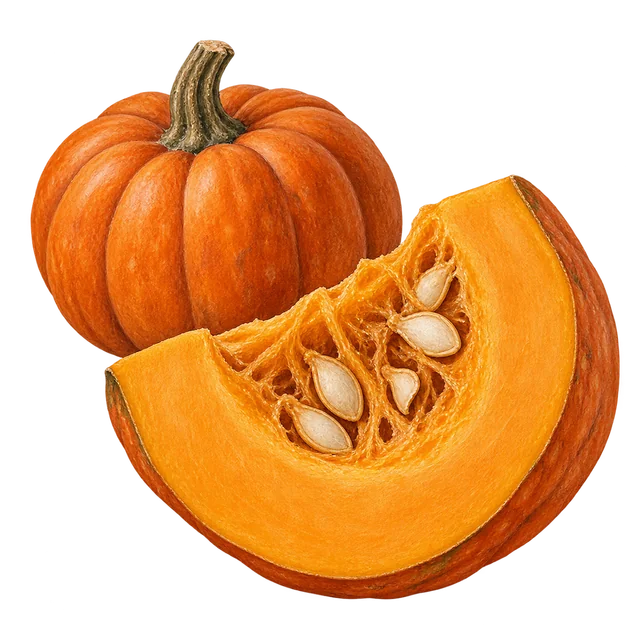
- Orange flesh
- Beta-carotene is an orange-flesh pigment and a raw material for the body's vitamin A.
- Flesh is not pure starch
- Pumpkin flesh holds substantial water; carbohydrate intake depends on variety, portion and what it replaces.
Illustration for understanding; not to scale. Saved figures include explanations and sources.
In practice · How to tell the common varieties apart
The ones you will actually meet at the market and in the supermarket are mainly these. Learning their faces is more useful than memorizing names:Japanese pumpkin, chestnut pumpkin (kabocha squash): the most common variety in Asian cooking; green skin, orange flesh, floury and sweet; high nutrient densityButternut squash: common in Western supermarkets, also called ox-leg pumpkin in Chinese; orange flesh, rich in beta-caroteneSugar pumpkin: the edible cousin of the Halloween pumpkin; sweeter than decorative pumpkins and better for cookingAcorn squash: a small dark-green squash with paler flesh
How do you judge by eye? One rule is enough: orange is the color of beta-carotene. Once you cut it open, the deeper and more orange the flesh, the more beta-carotene it holds. Varieties whose flesh runs pale or whitish (acorn squash, for example) still have their other nutrients; only the vitamin A column is weaker. This rule roughly holds across orange vegetables, so you do not need to memorize each variety's nutrition table — just look at the color when you cut it. Red vegetables are a different story: the red of a red bell pepper comes mainly from another pigment, one that cannot become vitamin A.
What separates floury from watery? The ratio of starch to water. Floury varieties (kabocha and its kin) carry more starch and less water per unit of weight, so they taste drier and sweeter, and the same chunk also carries more carbohydrate; watery varieties run the other way. In other words, texture is reporting carbohydrate density to you, which comes in handy when you work out glycemic load.
The big decorative pumpkin is edible too. Its edible cousin is simply sweeter and better in the pot. For pumpkin pie or pumpkin soup, picking the cousin saves a lot of trouble.
In practice · Replacing rice or sitting beside it
"Mostly carbohydrate, low in protein, low in fat" sounds like one line on a composition table, but it decides where pumpkin should stand in the meal.Sort foods by what they replace at the table, and pumpkin belongs with rice, sweet potato, and potato, not with leafy greens and broccoli. That grouping has a very practical consequence:
If pumpkin replaces half a bowl of rice, the meal's total carbohydrate goes down, because in the same amount, pumpkin is more than half water and rice is not. In that case it really is helping you, and the help is plain: water takes up volume that carbohydrate would otherwise have taken.
If pumpkin is a side dish next to a full bowl of rice, the meal is two servings of carbohydrate stacked together. Same food, same amount, opposite result — the only difference is where it stands. That is the root of why "pumpkin is a weight-loss food" is half right and half wrong: whether it saves calories depends on what it replaced, not on what it is.
Low protein and low fat have a second consequence: a meal of pumpkin alone is incomplete. Protein has to come from somewhere else, and fat is not only there for taste — the orange pigment needs fat to get into your blood. So pumpkin's best partner is not something "light and plain." It is "some meat and some fat."
Chapter 2
How the orange becomes vitamin A
That orange molecule is beta-carotene, a half-finished form of vitamin A. After you eat it, cells in the small-intestine wall hold a pair of scissors (an enzyme) that recognizes only this molecule. It cuts the molecule down the exact middle, one becomes two, and one more step turns each half into the vitamin A your body actually uses.
These scissors check the stock: when your body already has enough vitamin A, they cut less. So no amount of pumpkin will give you vitamin A poisoning. At most, uncut pigment builds up in the skin and your palms look a little yellow; eat less for a while and it fades. It is harmless.
One more thing to remember: this pigment does not dissolve in water, only in fat. Steamed and eaten dry, much less of it is absorbed. The bit of oil in a stir-fry, or a little cream or coconut milk in a soup, is the vehicle that carries the orange into your blood.
Mechanism · From one bite of orange to seeing
Between eating it and having vitamin A, there are six moves, and any one of them can stall.Step one: get the pigment out of the cell. Beta-carotene is not dissolved in the juice of the flesh. It is locked in small pigment-storing compartments inside plant cells, and each cell is wrapped in a tough wall. Chew it raw or swallow it in chunks, and most of those compartments stay intact; the pigment rides through the gut unchanged. Heating and mashing both do one job: break the wall and open the compartment.
Step two: find a ride made of oil. The freed pigment does not dissolve in water, and your small intestine is a watery place. Bile salts, together with the fat from this meal, wrap the pigment into tiny oil droplets called mixed micelles — the only form in which it can get close to the gut wall. So whether this meal contains fat decides whether this step happens at all.
Step three: into the small-intestine lining cell. The droplet delivers the pigment to the door of the gut-wall cell, and the pigment is taken inside. Up to this point it is still the same orange molecule, unchanged.
Step four: the cut. The cell has an enzyme (BCO1) that grips beta-carotene at its exact middle and cuts. One cut splits one molecule into two halves, called retinal. One more reduction step and you have retinol — what the textbook means by vitamin A.
Step five: packed and shipped. Retinol is wrapped into a chylomicron, the particle the gut uses to ship fat. It does not enter a blood vessel directly; it travels through the lymph first and only joins the blood after that detour.
Step six: stored, then sent out on demand. Most of it goes to the liver for storage. When needed, it is released: to the retina, where it becomes the light-sensing pigment that lets you see, and to the skin, airways, and gut — linings that renew themselves every day.
The most useful line on this chain: step two is where it stalls most easily. A plate of pumpkin boiled in plain water, or a glass of fat-free vegetable juice, delivers the pigment but not the ride. You ate the color; you did not get the vitamin A.
Safety · Why turning yellow is not toxicity
Many people hear that too much vitamin A is toxic and then hold back on pumpkin too. In the body, these two things travel two completely different roads.Eating the pigment: the gate sits at the entrance. Beta-carotene has to be cut by that enzyme before it counts as vitamin A. And the enzyme checks the stock: when the body already has plenty of vitamin A, the gut-wall cells make less of it, and cutting slows down on its own. Notice where this gate sits — at the absorption and conversion end, not at the excretion end. The body does not let surplus vitamin A in and then try to get rid of it. It simply does not turn the surplus pigment into vitamin A.
Where does the uncut pigment go? It stays as orange pigment and is stored with fat. If enough builds up, the skin turns slightly yellow. This is called carotenemia; it is harmless, and the color fades on its own if you eat less for a while. It is a signal, not a disease.
Eating ready-made vitamin A: there is no such gate. Animal liver, fish-liver oil, and supplements carry retinol that is already cut. It skips the whole conversion chain, is absorbed as is, and goes straight to the liver. The body has no "that's enough, absorb less" switch to stop it, so this is the kind that can actually cause toxicity — not pumpkin.
The rule can be short: for vitamin A that comes from a color, your body brakes on its own; for vitamin A that comes from pills or liver, you have to do the braking.
This rule cannot simply be carried over to other nutrients, but it gives you a good question: when a supplement label lists two forms of the same nutrient, ask which one the body has to convert itself, and whether the body will brake on its own.
Numbers · What one serving of pumpkin gives you
In numbers: 100 g of cooked orange-fleshed pumpkin (kabocha or butternut, for example) supplies a large share of the daily vitamin A recommendation, and deep-orange varieties can supply more than a full day's worth (counted as retinol activity equivalents, ).Why do nutrition tables use RAE instead of just listing how much pigment there is? Because the road from beta-carotene to vitamin A loses some at every step: the pigment has to break out of the cell wall, catch a ride on fat, and be cut, and each step drops a little. RAE means converted to retinol activity equivalents — the amount that can actually serve as vitamin A once those losses are counted in. So the number on the label has already been discounted for you; you do not need to discount it again. It also explains why the same serving of pumpkin, steamed and eaten dry versus eaten with oil, does not deliver the same amount: RAE is calculated for a typical case, and the way you cook your meal can push it up or pull it down.
The rest of the nutrition: a moderate amount of vitamin C, some potassium and B vitamins (especially B5, pantothenic acid), and a decent amount of dietary fiber (~3 g per 100 g cooked).
None of these is pumpkin's strong suit on its own. Together with all that water, though, they produce a useful effect: the same calories take up much more volume. That is the same fact, told another way, as why pumpkin does not really spike blood sugar.
Chapter 3
Why pumpkin doesn't spike blood sugar
To see why, first separate two terms that look alike:
Glycemic index () is about speed: how fast the carbohydrate in this food turns into blood sugarGlycemic load () is about amount: how much carbohydrate on your plate will actually turn into blood sugar
Pumpkin's GI really is not low. But GI describes only the character of the carbohydrate itself; it ignores how much carbohydrate is on your plate. And most of the weight of a plate of pumpkin is water, so the digestible carbohydrate is far less than its size suggests.
The result is fast but little: speed is on the high side, total amount is low, and multiplied together, a normal serving of pumpkin has only a modest real effect on blood sugar. People with diabetes can generally eat it if they count the portion toward that meal's carbohydrate; follow your doctor's and dietitian's advice for the details.
Numbers · Working out the glycemic load
Pumpkin's fast but little can be worked out on the spot.Pumpkin's really is on the high side: about 65-75 (medium to high).
But pumpkin is extremely watery. A 150 g serving holds only about 12-15 g of digestible carbohydrate.
Glycemic load simply multiplies speed by amount: = GI × digestible carbohydrate in the serving / 100.
Plug in the numbers: GL = 75 × 15 / 100 ≈ 11, right at the bottom edge of the medium band (GL ≤ 10 is low, 11-19 is medium, ≥ 20 is high). That sounds less flattering than "low," but set it next to a bowl of rice and the gap is obvious at a glance.
For comparison: a bowl of white rice (200 g cooked) holds about 45-50 g of carbohydrate, with a GL of about 40-45.
Put the two numbers side by side: which column does the gap come from? Not from the speed column — both foods sit in the medium-to-high GI range. The several-fold difference is entirely in the amount column: in the same serving on the table, almost every bite of white rice is carbohydrate, while most of the pumpkin plate is water.
So "pumpkin spikes blood sugar" is not completely baseless. It just takes the conclusion from the GI column and applies it to the whole plate, skipping the multiplication in between.
This "speed times amount" method comes from the international table of GI and GL values compiled by Foster-Powell and colleagues in 2002, and it is a standard tool in clinical nutrition.
Mechanism · How the GI number is measured
A high with nothing to fear sounds like a dodge. One look at how the number is measured shows it is not.Here is how GI is tested: volunteers eat a portion of the food that contains a fixed number of grams of digestible carbohydrate, their blood is drawn repeatedly, a blood-sugar curve is plotted, and that curve is compared with the curve after the same number of grams of pure glucose.
The key is a fixed number of grams: every food first has to gather the same amount of carbohydrate before it is allowed to compete.
For white bread that is easy — one small slice does it. For pumpkin, gathering the same amount of carbohydrate means serving up a huge bowl, far more than anyone would actually eat in one meal.
So the question the GI number really answers is: if you ate the same amount of carbohydrate, which one would push blood sugar up faster? It never set out to answer what your actual plate will do. Only can answer that second question.
Once you see this, the GI table becomes much easier to read. Many of the foods on it that look scary but are actually mild share one shape: watery squashes and fruits whose carbohydrate is not dilute in itself, but which carry very little carbohydrate per serving. They rank high on the GI table because the test compares foods at a fixed amount of carbohydrate; at the amount people really eat in one serving, the effect is much smaller.
The other half is overlooked even more often: eat two servings of the same food and the GI does not change at all, while the GL doubles. Portion is the knob you can actually turn; the GI table is not.
In practice · Judging the next food yourself
Once this chain is in your head, you do not have to look foods up one by one. You can work out many cases yourself.First, look at how much water is in the bite. Water supplies no carbohydrate; it only takes up volume. For the same food, the wetter version carries less carbohydrate per bite and the drier version carries more. Push that to the extreme and you get dried fruit versus fresh fruit: the same food with the water removed, and the carbohydrate per bite is in a different league.
Second, any cooking method that drives out water pushes the number up. Roasting, baking, reducing, air-drying — they all do the same thing: evaporate water. Not one gram of carbohydrate is lost, but it is now packed into a smaller volume. The chapter on choosing and cooking pumpkin traces the difference between roasted and steamed pumpkin along this same chain.
Third, portion multiplies directly; speed does not. You cannot make pumpkin's lower, but you can always decide how much goes on the plate. is the result of a multiplication, and portion is the one factor you are free to turn.
Fourth, do not add it beside the staple. Pumpkin already belongs in the carbohydrate column. When it replaces half a bowl of rice, the meal's glycemic load goes down; when it is added next to a full bowl of rice, the load goes up. Same food, same amount, two opposite results — the only difference is where it stands.
Fifth, one number cannot speak for a whole meal. GL is calculated for a single food, but what you actually eat is a whole meal. The carbohydrate from every food in the meal adds up, so what to watch is not whether one food is on a blacklist, but how much the whole meal adds up to. For a food like pumpkin, what matters is not good or bad, but portion and pairing.
Chapter 4
Lattes, canned pumpkin and seeds
A pumpkin latte often contains little pumpkin. The "pumpkin flavor" that cafés sell so well in autumn and winter comes mainly from a set of spices — cinnamon, nutmeg, and clove — and many recipes use little or no pumpkin puree. What you drink is mainly sugar, fat, and spice; the beta-carotene and fiber mostly do not come along. Whether the ingredient list includes pumpkin puree is what tells you.
Canned pumpkin puree is the reverse: the real thing. As long as the only ingredient is pumpkin, its nutrition matches fresh pumpkin. Choose plain puree with no added sugar.
Pumpkin seeds are a different food, not a concentrate of the flesh. They hold minerals, protein, and oil, and their nutrients barely overlap with the flesh.
Myth · Flavor copied is not nutrition copied
The pumpkin latte deserves one more word, because it demonstrates a judgment tool that works on many foods.The impression a food leaves in your mind comes mainly from smell and sweetness; what it does in your body comes from its ingredients. Those two are assembled separately: spices handle the first, the raw ingredient handles the second. Copying the first is fast and cheap. Copying the second means actually putting the food in.
So "X-flavored" is never a promise on an ingredient list. The same pattern is everywhere: strawberry-flavored, matcha-flavored, vegetable-flavored. There is only one way to judge: turn to the ingredient list and see whether that food's name is on it.
What this drink really contains in quantity is sugar and fat. It can be a perfectly tasty sweet drink — just do not log it under "ate pumpkin today." Keeping the two apart is not about spoiling the fun. If you count it as a vegetable serving, the vitamin A you meant to get from pumpkin quietly never arrives, and you still think you have it.
A check you can use on the spot: when something is described as "containing X," first ask how much it contains and where it sits in the ingredient list. "Contains" is a word with no lower limit.
In practice · Why canned puree loses little
Canned pumpkin puree sounds like a processed food, but for pumpkin, processing happens to leave its most valuable part alone.The reason lies in what that orange molecule fears and what it does not. It does not dissolve in water, so steaming and boiling do not wash it into the water the way they do vitamin C. It is also fairly heat-stable, so heat sterilization mostly spares it. And what mashing and heating do is exactly the first step of beta-carotene absorption: break the cell walls and release the pigment locked inside.
So as long as the only ingredient is pumpkin, canned puree has already done the wall-breaking step for you by the time you open it, and it is less work than a whole pumpkin: stir a spoonful into oatmeal, soup, or baking batter — just make sure that bite has a little fat.
There is a more general point here: processed is not a word that can tell good from bad. It is a label for a set of actions, and each action affects each nutrient differently — the same heating shaves off vitamin C and helps beta-carotene. So the right question is never whether this has been processed, but what it went through, and what that did to the nutrient I want.
The one thing to watch: the condition as long as the only ingredient is pumpkin matters. The shelf also has cans of pumpkin pie filling — a dessert base already loaded with sugar and spices, and not the same thing as plain pumpkin puree.
Background · Pumpkin seeds are a different food
Pumpkin seeds (pepitas) grow in the same squash as the flesh, yet nutritionally they barely overlap.The flesh: water, carbohydrate, beta-caroteneThe seeds: zinc, magnesium, iron (the non-heme kind), and plant protein (~30% protein), plus unsaturated fat
The contrast has a very plain reason: the flesh is the part the squash uses to hold water and sugar; the seed is the part it uses to leave offspring, and it has to cover all the costs of a new seedling until the seedling can photosynthesize on its own. So minerals, protein, and oil are all stored in the seed. The handful you crack open was food packed for the next generation.
So their roles in your diet differ too: a bowl of pumpkin belongs in the staple column; a handful of pumpkin seeds belongs in the nuts-and-seeds column. Do not swap one for the other. Eating the seeds when you want vitamin A, or eating more flesh when you want minerals, will miss either way — their nutrients hardly ever sit in the same box.
The cost is calories. The oil in the seeds is energy-dense; a small handful and a big plate of flesh are in different leagues, and seeds are especially easy to keep eating without noticing. Roasted plain, with no salt and not much added oil, a small handful as a snack is fine; eaten without limit as a "healthy snack," it adds up to a lot.
A tip on choosing: seeds still in the shell are slow to crack, and the slowness itself works as a brake; hulled green kernels are a big mouthful in one grab and easier to overeat. If you want to control how much you eat, the in-shell kind actually helps more.
Chapter 5
Choosing, cooking, and cautions
For cooking, one line is enough: steaming and boiling keep the water in; roasting drives it out.
Steaming, boiling: some vitamin C leaches into the water, but beta-carotene holds up well; the water stays, so the same chunk carries a little less carbohydrateRoasting, baking: water evaporates, so the same weight carries more concentrated carbohydrate and a serving's glycemic load goes up; it tastes sweeter and more fragrant, and beta-carotene stays just as stableSoup: beta-carotene seeps into the broth, so drink the broth to get all of it; a little cream or coconut milk in the soup helps absorption
Whatever the method, make sure the bite has a little fat — that is the vehicle that carries the orange into your blood.
Who should pay more attention: people who need to limit potassium (for example, with chronic kidney disease) and people who need to count carbohydrate strictly should both weigh their pumpkin and log it.
This is general information and does not replace individual nutrition or medical advice.
Mechanism · Roasted and steamed are different plates
The same pumpkin, roasted or steamed, gives two different numbers in the blood-sugar column. The reason is not in the pumpkin but in where the water went.Roasting is dry heat. Hot air keeps driving water off the surface, and a tray of pumpkin comes out of the oven noticeably lighter — almost all of what left was water. Not one gram of carbohydrate is gone, but it is now packed into a smaller volume and a lighter weight. So the same chunk in your mouth carries more carbohydrate, and the same plate on the table carries more too. The "nine-tenths water" dilution effect has been partly removed by you, in the oven. In the glycemic-load formula, it is the amount column that changes: a serving now holds more carbohydrate, so its glycemic load goes up with it. The sweeter, more fragrant taste of roasted pumpkin is the same fact experienced on the tongue.
Steaming and boiling are wet heat. The water stays, so the dilution stays. The cost is that water-soluble nutrients such as vitamin C partly run off with the water, but the orange pigment does not dissolve in water, so it stays. So steaming and boiling give up some vitamin C and keep the vitamin A line intact — if you eat pumpkin mainly for its orange, that trade is a good one.
Soup is a third case. The pigment seeps into the broth. That is not a loss, provided you drink the broth; eat only the pieces and leave the broth, and that share stays at the bottom of the pot. If the soup already has cream or coconut milk in it, it is actually the ideal combination: pigment freed from the cell walls plus fat already present, so the first two steps of beta-carotene absorption (breaking the walls and catching a ride on fat) are done in one go.
So how do you choose? To keep blood sugar steadier, steaming and boiling are the easier choice. For that caramelized aroma, roast it — just remember to count it in the staple column, not the greens column.
Clinical · Who needs to count it
Two groups of people need to count pumpkin carefully, and they are keeping two different ledgers.People with chronic kidney disease () or others who need to limit potassium: pumpkin holds about 350-450 mg of potassium per 100 g (cooked), so anyone limiting potassium should watch the portion. How much you can eat should be set by your doctor and dietitian based on your lab results; do not add and subtract from a table you found online.
People with type 1 diabetes or others who need tight blood-sugar control: as worked out earlier, a serving of pumpkin does not carry a high glycemic load — but not high is not zero. It is still a carbohydrate-column food, so count pumpkin in the carbohydrate you track, and do not treat it as a vegetable you can eat freely.
Both ledgers point to the same action: weigh it and log it. Pumpkin is especially easy to log wrong because of its double identity: it looks like a vegetable and arrives at the table like a vegetable, but what you eat is a staple. Eyeball estimates are especially poor here, and these two groups are exactly the people who can least afford to estimate.
One more reminder: roasting drives out water. For anyone counting carbohydrate, that means the same weight of roasted pumpkin carries more carbohydrate than steamed pumpkin. When you switch cooking methods, the number in your notebook has to change with it; you cannot keep the old one.
References · 4
- U.S. Department of Agriculture, Agricultural Research Service. (2019). FoodData Central: Pumpkin / winter squash (cooked, boiled, drained; butternut squash, baked; kabocha). Orange-fleshed varieties provide beta-carotene (provitamin A) exceeding 100% RAE / 100 g cooked; moderate carbohydrate (~12 g / 100 g cooked), high water content (~90%), low fat, ~26-45 kcal / 100 g. fdc.nal.usda.gov
- National Institutes of Health, Office of Dietary Supplements. (2025). Vitamin A and Carotenoids — Fact Sheet for Health Professionals. ods.od.nih.gov/factsheets/VitaminA-HealthProfessional
- Harrison, E. H. (2012). Mechanisms involved in the intestinal absorption of dietary vitamin A and provitamin A carotenoids. Biochimica et Biophysica Acta, 1821(1), 70-77. Beta-carotene is cleaved by BCO1 in enterocytes to retinal, then retinol — a feedback-regulated, on-demand conversion. 10.1016/j.bbalip.2011.06.002
- Foster-Powell, K., Holt, S. H. A., & Brand-Miller, J. C. (2002). International table of glycemic index and glycemic load values: 2002. The American Journal of Clinical Nutrition, 76(1), 5-56. Comprehensive reference table of GI and GL values for 750 foods tested in human subjects; GL = GI × available carbohydrate per serving / 100, providing an integrated measure of blood-glucose impact per realistic portion. 10.1093/ajcn/76.1.5