Story
Kale
Last updated
In one pass The most useful thing to know about kale is that it is very rich in vitamin K1, and the liver needs vitamin K to fit clotting factors with the parts that grab calcium.
Educational content, not medical advice — consult a clinician.
Story path
Chapter 1
What kale is
Kale itself is a cabbage that refuses to form a head. Cabbage, broccoli, cauliflower, and kale are the same species; they differ only in where the plant puts its effort. Cabbage wraps its leaves into a ball, broccoli bunches its flower buds into one big head, and kale wraps nothing — every leaf opens outward.
Pigments such as chlorophyll and carotenoids build up only in light. The inner leaves of a cabbage sit in the dark, so they are pale and thin; every kale leaf gets sun, so the whole plant keeps storing pigment. That dark, dusky green is the thickness of that pigment.
Kale is also the vegetable the superfood wave lifted highest. Checked item by item, its vitamin K1, calcium, and carotenoids really do stand out; beyond those, it is simply a good ordinary vegetable.
A CLOSER LOOK
Open curly leaves reveal their veins
This is a curly variety; leaf colour helps explain pigment but cannot measure a vitamin K dose.
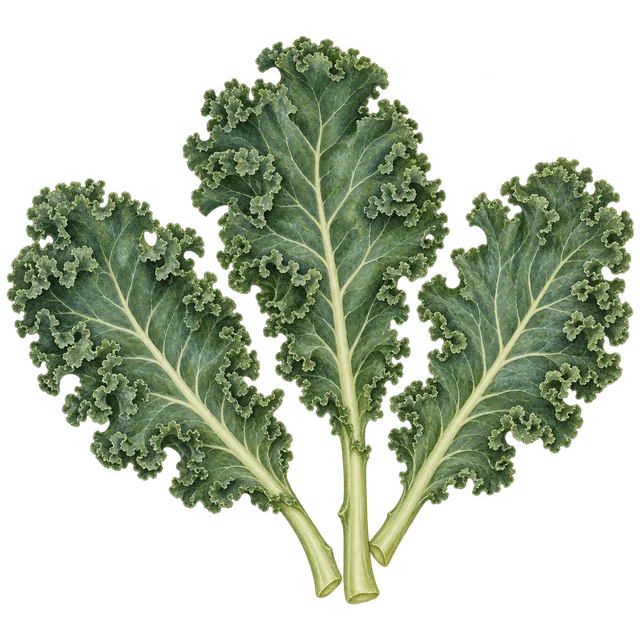
- Leaves form no head
- Kale and headed cabbage belong to the same species, bred into different shapes.
- Dark leaf, pale veins
- Curly leaves are dark green with paler midribs; form is visible, but vitamins and minerals require composition data.
Illustration for understanding; not to scale. Saved figures include explanations and sources.
Background · Name, varieties, and relatives
The scientific name is Brassica oleracea var. acephala, and acephala means headless — exactly the trait the botanists named it for. Within the one species Brassica oleracea, people bred in different directions and got cabbage, broccoli, cauliflower, Brussels sprouts, and kale: the same set of genes grown into completely different shapes.There are three common varieties. Curly kale is the most common, with ruffled edges and a fibrous bite; lacinato (dinosaur) kale has flat, near-black-green leaves and a finer texture; red Russian kale has purple-red veins. Nutritionally they differ little, so choose by the texture you like and what you can find.
All of them are crucifers and share the same set of sulfur compounds — the source of the pungency and bitterness this family has in common. That chemistry explains both why blanching takes away the bitterness and where the thyroid caution comes from.
Mechanism · What that deep green is telling you
Deep green is not only pretty. It is a gauge of how thick the contents are.A leaf is a solar workshop, and at the heart of the workshop is the chloroplast. Chlorophyll's job is to catch light, but it cannot catch every wavelength, and catching too much causes accidents: the light reactions spill out some highly reactive molecules that, left alone, would burn the workshop itself. Carotenoids (beta-carotene and lutein are two of them) do two jobs here at once: they catch the part of the light that chlorophyll misses, and they quench the spilled high-energy molecules. The longer a leaf has been in the sun, the thicker this protective kit becomes — which is why older outer leaves are usually darker than tender inner ones.
The interesting part is that once you eat them, the two go completely different ways.
Beta-carotene is cut down the middle by an enzyme in the cells of your small-intestine wall, split in two, and turned into vitamin A. That is why it is called a vitamin A precursor: it is not vitamin A itself but raw material the body cuts as needed. This also answers a common question — why is it so hard to get too much vitamin A from vegetables? Because whether to cut, and how much, is set by the body's need, while ready-made vitamin A swallowed as is has no such gate.
Lutein cannot become vitamin A. It has another destination: it is carried all the way to the back of the eye and laid down on the small central patch of the retina that handles fine detail (the macula), where it forms a colored filter that blocks part of the highest-energy blue light.
Notice what just happened. The same chemical property — absorbing high-energy light and quenching high-energy molecules — protects chloroplasts in the leaf and light-sensing cells at the back of your eye. It has not switched jobs; it is doing the same job in two places. Keep this in mind, and when you see claims about eye-protecting ingredients, you will at least know what they are based on. How much lutein you would need to eat to actually protect your eyes is a separate question, one that only trials can answer.
Chapter 2
Nutrient profile · the real highlights
Four highlights:
1. Very high vitamin K1: raw kale holds about 450-817 µg per 100 g; the figure shifts a little once cooked but stays high. The adequate intake () for adults is about 90-120 µg a day (the lower end for women, the upper end for men), and gram for gram kale is among the vegetables highest in K1.
2. High vitamin C: raw leaves hold about 93-120 mg per 100 g, more than citrus.
3. Beta-carotene and lutein: beta-carotene is the raw material for vitamin A, and lutein is carried to the center of the retina.
4. Folate, manganese, calcium: all at decent levels, and what makes the calcium special is that it is well absorbed.
The most practical point: K1 and carotenoids do not dissolve in water, so they have to hitch a ride on fat before they can get into the gut wall. The difference between a plate of boiled kale and a plate stir-fried with garlic and olive oil is not how much is in it, but whether it got on the boat.
Mechanism · How fat-soluble nutrients get a boat
Fat-soluble sounds like chemistry class, but in your gut it corresponds to a very concrete picture.The contents of your small intestine are basically a pot of water. Things that dissolve in water (vitamin C, folate) float in it and are picked up as soon as they touch the gut wall. Things that do not — vitamin K, beta-carotene, lutein — clump together in water, and nothing can pick them up.
Bile exists to solve this. When you eat fat, the gallbladder gets the signal and squeezes bile into the gut. Bile-salt molecules have one water-loving end and one fat-loving end. They line up around oil droplets and break big droplets into tiny micelles. The water-insoluble molecules hide in the oily core of each micelle and ride its water-friendly shell to the gut wall, and only then are they absorbed.
So the chain runs like this: with fat, bile comes out; with bile, micelles form; with micelles, fat-soluble molecules have a boat, and only then can they get in. Leave out the fat and everything downstream fails: the vitamin K and carotenoids are still in the leaf, but they leave with the residue, unchanged. That is the real weight of the advice to stir-fry it or dress it with a little olive oil: it is not just about taste, it decides whether you get the most valuable items on this plate.
Heat does one more thing. Carotenoids are not loose in the leaf. They are wrapped inside the membranes of the chloroplasts, with a plant cell wall outside that. The wall is tough, and chewing raw leaves may not open it. Chopping, massaging, and heating all break that wall and release the pigments, so carotenoids in cooked dark vegetables are often easier to absorb than in raw ones.
But this ledger is not one-sided. The same heating is a net loss for vitamin C: it dissolves in water (it runs into the cooking liquid when boiled), and it is sensitive to heat and oxygen (long roasting breaks it down). So there is a pattern: no single method gets the most of both sides. Eating it raw keeps vitamin C; eating it cooked keeps carotenoids and fat-soluble vitamins; blanching removes bitterness and oxalate, at the cost of losing water-soluble nutrients along with them. So is raw healthier? is the wrong question. The real question is which side you want from this meal.
One last line to keep: the number in a food composition table tells you how much is in this food, not how much you can get. Between the two sit fat, bile, cell walls, cooking method, and your own digestion.
Chapter 3
Its calcium absorbs as well as milk's
The difference comes down to whether the calcium stays free. To be absorbed, calcium has to stay dissolved as separate ions in the gut fluid the whole way. Once another molecule clamps onto it and forms an insoluble solid, the gut wall cannot move it, and it leaves unchanged. The oxalate in spinach is that clamp: it locks spinach's own calcium up in the gut, which is why only about 5% of spinach calcium is absorbed. Kale is low in oxalate, so its calcium stays dissolved and can get into the absorption pathways.
Quantity also has to be spelled out. Raw kale holds about 150-250 mg of calcium per 100 g; milk holds about 120 mg per 100 g. By weight, kale is not short on calcium. The difficulty is bulk: a glass of milk goes down in a few gulps, while the same weight of raw kale is a very large plateful.
Mechanism · Calcium content versus calcium absorbed
First get a clear picture of how the small intestine absorbs calcium; every claim about oxalate needs that to stand on.Calcium has two roads into the body. One is around the duodenum and is the active route: the gut-wall cell opens a dedicated calcium gate on the side facing the gut; once a calcium ion is in, a binding protein escorts it across the cell (so it does not bang around inside), and on the far side a calcium pump pushes it into the blood. This road costs energy, but it can move calcium against a concentration gradient, which matters most when you eat little, and every part on it is made under the control of active vitamin D. The other road is farther down the small intestine and is passive: calcium seeps through the gaps between cells down the concentration gradient. It costs no energy and does not need vitamin D, but it only becomes noticeable when calcium in the gut is concentrated enough.
Both roads share one requirement: the calcium must be free ions dissolved in water. The gate recognizes an ion's size and charge, and the gaps between cells only let dissolved things through. Any molecule that locks calcium into an insoluble solid does not make absorption slower — it means that calcium never gets into play at all.
Why oxalate is so good at this. Oxalate is a very small molecule with a negative charge at each end; a calcium ion carries two positive charges. Clamp both ends and the charges balance, forming calcium oxalate, a salt that barely dissolves under the conditions in the gut. The moment it forms, that bit of calcium turns from a nutrient into grit as far as you are concerned, and it passes through the gut unchanged. Spinach calcium is absorbed so poorly not because spinach calcium is bad, but because its own oxalate grabs it before it reaches the gate.
So the absorption rate answers a very specific question: what share of the calcium in this food is still free when it reaches the absorption site. For kale the answer is most of it; for spinach, almost none. The kale-versus-milk comparison comes from an isotope study by Heaney and Weaver in 1990.
Follow the chain and you can work out two things yourself.
First, a high-oxalate food does not only waste its own calcium. Once oxalate is dissolved in the gut, it does not care whose calcium it meets — calcium from milk or tofu in the same meal gets clamped too. Kale is low in oxalate, so it does not do this; put it in the same meal as other calcium sources and they do not drag each other down.
Second, absorption rate is not a property of the food alone. Every part of the active route is controlled by active vitamin D, so the same plate of kale delivers different amounts of calcium to someone with enough vitamin D and someone who has been short for a long time. The composition table gives the ceiling; your body decides how much you actually get.
In practice · Can it replace milk?
Put those two points together and you can answer the question people ask most about kale and calcium.What really decides how much calcium you get is calcium content multiplied by absorption rate. Kale holds its own on rate, and by weight its content is not low either. Where it loses is the amount you can eat at one time: a glass of milk goes down in one go, while the same weight of raw kale piles up into a very large plate that shrinks to a small clump once it hits the pan, and it is hard to eat that much every day. So the practical conclusion is: replacing dairy calcium entirely with kale is not realistic.
That does not mean kale is useless; it means its place is different. The right use is to count it as one of the day's calcium sources, not as a substitute. For people who do not drink milk, the sound approach was never to find one miracle vegetable that stands in for milk, but to stack several sources: low-oxalate dark leafy greens, tofu set with calcium, small fish eaten with their bones, and plant milks fortified with calcium. None is enough alone; stacked together, they are.
One more layer is often missed: bones need more than calcium. Once calcium is in the blood, it still has to be put into bone, and that takes vitamin D to bring the calcium in, vitamin K to fit osteocalcin in the bone matrix with its calcium-grabbing claws, and everyday weight-bearing activity to tell the bone that this spot needs reinforcing. Kale supplies both calcium and vitamin K on this chain — which may be more worth remembering than the few percentage points of difference in absorption rate.
A last note on direction: this chapter is about how foods compare with each other, not about how much you personally should take. Individual calcium needs depend on age, sex, , medications, and kidney function, and that calculation belongs to your doctor and dietitian.
Chapter 4
If you take warfarin
The point people most often get backwards: the right move is not to stop eating kale. The standard advice from doctors and pharmacists is to keep K1 intake steady — eat about the same amount every day — so the dose and the diet settle into a stable balance. What really makes the (a blood test that shows how fast blood clots, which doctors use to set the warfarin dose) swing up and down is going a week without it and then eating a large amount in one meal.
Why is the answer steadiness rather than avoidance? Because warfarin and vitamin K compete at the same step: the dose your doctor set was tuned to the way you usually eat.
For any change to your medication, follow your doctor and pharmacist; do not adjust it on your own.
Mechanism · Warfarin and kale fight for one seat
To see why steady matters more than avoiding it, you first need to know what vitamin K actually does in the body.It is a consumable for a machine that fits claws. Your liver makes several clotting factors, but what first comes off the line is unfinished: the factors lack one thing, a row of small claws that can grab calcium. Vitamin K takes part in exactly this claw-fitting step (the technical name is gamma-carboxylation). Once the claws are on, the factors can use calcium to dock on damaged cell membranes at a wound, line up one after another, and run the clotting line to the end. Without the claws, the factors are still made, but they cannot dock or line up, so blood clots slowly.
The same claw-fitting step is used in two other places. Osteocalcin in the bone matrix can lock calcium into bone only after its claws are fitted; matrix Gla protein in the blood-vessel wall can hold calcium in place, and keep it from settling into the wall, only after its claws are fitted. So vitamin K is far more than a clotting vitamin.
Now see which step warfarin blocks. Each time vitamin K finishes fitting a set of claws, it is itself oxidized, and an enzyme has to reduce it back to its usable form before it can work again. This is a recycling line, and the small pool of vitamin K in the liver mainly turns over on this line rather than relying on a constant stream of new supply. Warfarin blocks exactly this recycling line. Recycling stalls, usable vitamin K drops, claw-fitting slows, fewer finished clotting factors are made, and blood clots less readily — that is the drug's effect.
Now why swinging high and low is dangerous becomes clear. Suddenly eating a large plate of kale is like air-dropping a fresh batch of vitamin K into the system: it bypasses the blocked recycling line and goes straight to work, the drug's effect is pushed back, and the on your lab report drops (blood clots more easily than intended). The other way around, a week without a single bite of leafy greens cuts off new supply, the drug acts stronger than when the dose was set, and the INR shoots up (bleeding risk rises). Neither end is what you want.
The key point: the dose your doctor set was tuned to the way you usually eat. A steady diet is not a compromise; it is what keeps that dose meaningful.
You can push the logic one step further yourself: it holds for every leafy green — spinach, broccoli, and lettuce work the same way. So what needs to stay steady is the overall rhythm of how many leafy greens you eat, not one particular vegetable; and any change to the medication or to how often you are tested has to be decided by the doctor who prescribed it.
Safety · Raw kale, smoothies, and the thyroid
Raw kale and irritable bowel syndrome (): a person with IBS who eats a large serving of raw kale at once may feel bloated. Raw leaves are coarse and high in fiber, and cruciferous vegetables may also carry some carbohydrates the human small intestine cannot break down, such as fructans — plainly put, chains of fructose units linked together. The human small intestine has no enzyme that can take these chains apart, so whether or not your gut is sensitive, they pass unchanged into the large intestine, where bacteria feed on them, ferment them, and make gas, while also drawing water into the gut. For most people this is ordinary fermentation they never notice; but in people with IBS, the sensory nerves in the gut wall are already tuned too sensitive, and the same gas and stretching are reported as bloating and pain. So fructans are not a bad thing: everyone ferments them, and only some people hurt from it. Fructans dissolve in water, so blanching and discarding the water removes some of them; smaller portions and cooked kale are usually easier on the gut too.Large green smoothies: blending a large amount of raw kale every day builds up a very high K1 intake, and the total oxalate climbs too. An occasional smoothie is fine, but a large one every day is not recommended. The real variable here is portion, not the vegetable itself. Chewing used to set a limit for you: faced with a big bowl of raw leaves, you could chew for half an hour and still not finish. The blender removes that limit, and you can drink it in a minute. Once the portion is scaled up, things that barely mattered — total vitamin K, total oxalate, total fructans — are all scaled up together. What gets scaled up is the amount, not the nature of the vegetable. For someone on warfarin, drinking one every day for a stretch and then none at all creates exactly the high-and-low swing in K1 that unsettles the dose.
Thyroid: cruciferous vegetables contain compounds that can interfere with how the thyroid takes up iodine, called goitrogens. But it only becomes a problem when three things come together — eating it raw, eating a lot, and already being short of iodine — and cooking destroys most of these compounds. The mechanism is worth knowing, because it explains why none of the three conditions can be dropped. When cruciferous cells are crushed, their sulfur compounds are cut by an enzyme the plant itself carries, and the products include a kind of small ion whose size and charge are close to iodide's. The thyroid cell membrane has a dedicated iodine door (the sodium-iodide symporter), and these small ions queue up at that door and crowd iodine out. Less iodine gets in, and the raw material for making thyroid hormone runs short.
Notice that this is a competition for a seat, not a poisoning mechanism. Who wins depends on the amounts on both sides: with enough iodine, these ions cannot win; only when iodine is already low does the crowding have an effect. And heat inactivates the cutting enzyme, so even fewer competing ions are made. So the real risk takes all three conditions at once: eaten raw, in large amounts, by someone already short of iodine. Eating cooked kale in everyday amounts never completes this chain.
Chapter 5
Choosing, cooking, less bitterness
Preparing kale really comes down to two actions: softening and washing out. Softening means breaking the cell walls so the leaf is no longer tough and scratchy; massaging it by hand, stir-frying it, and scalding it in boiling water are all ways of doing the same thing. Washing out means letting water carry off the water-soluble group: bitter compounds, oxalate, and gas-producing carbohydrates such as fructans leave with the blanching water — but so does vitamin C.
So no single method is the healthiest. Each time you are trading one side against the other: massaging, blanching, a light stir-fry, and baked chips each sit at a different point between these two actions.
Overall, kale is a very good dark leafy green. Put it in your everyday vegetable rotation; there is no need to make it a miracle food, and no need to avoid it.
In practice · What each of four methods does
Raw massage: when eating kale raw, add a little oil, salt, or lemon juice and knead it by hand for 1-2 minutes. What you are really kneading is the cell walls: once they break, the leaves collapse and soften, water seeps out, and the bitterness drops noticeably — a standard step for salads. Having the oil in place at this step has a side benefit: the fat-soluble pigments and vitamin K now have a boat to ride.Blanching: 30-60 seconds in boiling water, then straight into cold water. Heat loosens the cell walls and sets the green color, while the water carries off some of the bitter compounds, oxalate, and fructans; the cold water stops the cooking at once so leftover heat does not wilt the leaves. Of the four methods, this one washes out the most, and its cost is just as clear: water-soluble nutrients leave with the water.Light stir-fry: a quick fry over medium-high heat with garlic and olive oil. The fiber softens, the texture changes a lot, and the oil helps fat-soluble nutrients absorb. It is the only method that softens without washing anything out: whatever dissolves stays in the pan, and you eat it with the juices.Kale chips: dry the leaves slowly in an oven at 150-170°C. Vitamin C losses are larger (it is sensitive to both heat and oxygen), but the chips do taste good. Watch the oil and salt, and remember that chips shrink a lot, so it is easy to eat a large plate's worth of raw leaves without noticing.Young leaves versus mature leaves: young leaves are less bitter and finer in texture, good for eating raw; mature leaves are tougher but just as nutritious, better stir-fried or in soup. Mature leaves are tough because their cell walls are thicker and more woody, so they depend more on the softening step: from the same bunch of kale, young leaves can be eaten raw after a quick massage, while mature leaves are much harder to chew unless blanched or stir-fried.
Mechanism · Where the bitterness comes from
The pungency and bitterness of crucifers come from a class of sulfur compounds (glucosinolates). Inside an intact cell they are locked away, with little taste and little activity. The plant stores them and a dedicated enzyme (myrosinase) in two separate compartments that normally never meet. The moment an insect bites, a knife cuts, or your teeth crush the cell, the compartments break, the enzyme meets the compounds on the spot, and cuts them into sharp-tasting products: the nose-tingling heat and the bitter aftertaste are the products of that cut. The whole setup was the plant's self-defense weapon; we treat it as flavor.Once you know this, several kitchen facts that seemed unrelated line up.
Why blanching removes bitterness most thoroughly: it works on two fronts at once. High heat inactivates the enzyme, so the cutting stops; and these sulfur compounds dissolve in water, so some of them leave with the cooking water. With both at work, bitterness drops the most. The cost is that vitamin C and other water-soluble nutrients leave too.
Why massaging also works, but on something else: kneading does not inactivate the enzyme. It mainly changes texture and how the kale tastes to you. The leaves soften, the rough, scratchy feel disappears, and the bitterness seems less sharp; the acid and salt you add also dampen your perception of bitterness. So massaged raw leaves taste better, but their chemistry has barely changed.
Tasting sweeter after a frost is the same kind of thing: with more sugar, part of the bitterness is masked in perception; the bitter compounds themselves have not decreased. Telling apart a change in composition from a change in what you taste is the key to reading a lot of cooking advice.
This same chemistry is where the thyroid caution comes from. The products of the cut include a kind of small ion that competes with iodine for the entrance on thyroid cell membranes, and heat inactivates the enzyme, so fewer competing products are made. That is why the caution always comes with three conditions — eaten raw, in large amounts, by someone short of iodine — and why cooked kale in everyday portions is never part of the discussion.
References · 4
- U.S. Department of Agriculture, Agricultural Research Service. (2019). FoodData Central: Kale, raw and cooked. Raw kale ~450-817 µg vitamin K1 / 100 g; also high in vitamin C (~93-120 mg/100 g), beta-carotene, lutein, folate, manganese, and calcium. ~35 kcal / 100 g. fdc.nal.usda.gov
- National Institutes of Health, Office of Dietary Supplements. (2021). Vitamin K — Fact Sheet for Health Professionals. Fact sheet (updated March 29, 2021; Wayback snapshot 19 September 2026): free phylloquinone is about 80% absorbed, but absorption from food is much lower - the body absorbs only 4% to 17% as much from spinach as from a tablet; Table 2: natto, 3 ounces, 850 mcg (as MK-7); egg, hard boiled, 1 large, 4 mcg (as MK-4) (fact sheet). ods.od.nih.gov/factsheets/VitaminK-HealthProfessional
- National Institutes of Health, Office of Dietary Supplements. (2021). Vitamin C — Fact Sheet for Health Professionals. ods.od.nih.gov/factsheets/VitaminC-HealthProfessional
- Heaney, R. P., & Weaver, C. M. (1990). Calcium absorption from kale. The American Journal of Clinical Nutrition, 51(4), 656-657. Isotope-tracer study in healthy adults: fractional calcium absorption from kale was ~40.9% versus ~32.1% from milk, demonstrating that kale calcium is more bioavailable than dairy calcium. Absolute calcium per serving remains lower than dairy. 10.1093/ajcn/51.4.656