Story
Broccoli
Last updated
In one pass What makes broccoli special is an enzyme lock.
Educational content, not medical advice — consult a clinician.
Story path
Chapter 1
What is broccoli · a flower that never bloomed
The big head we eat is unopened flower buds clustered on their stalks. Broccoli is a crucifer, a close relative of cauliflower, cabbage, and kale. The stalk is fibrous and crunchy; peel off the tough outer layer and it is just as edible, so do not throw it away.
A CLOSER LOOK
The flower you eat before it blooms
Look from the crown to the stalk; the cooking chapter explains what changes when its cells are cut open.
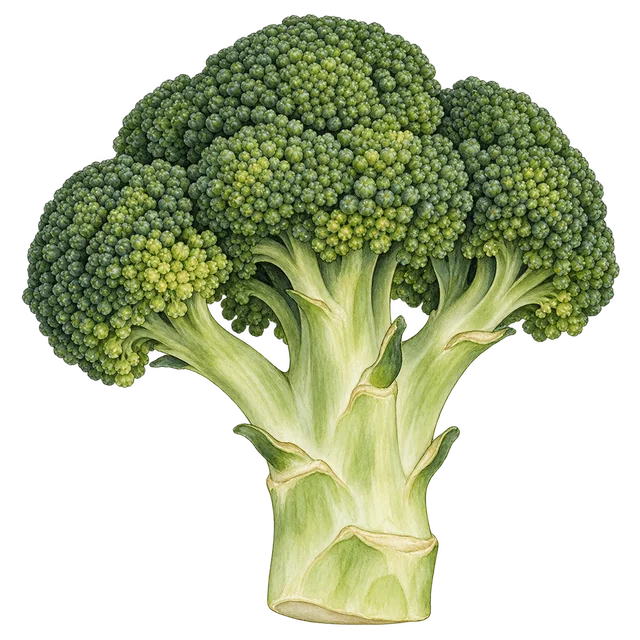
- Crown
- Tightly clustered flower buds that have not opened.
- The stalk is edible too
- Fibre-rich and crunchy; peel off the tough outer layer.
Illustration for understanding; not to scale. Saved figures include explanations and sources.
Background · The dark-green vegetable underneath
Color is a rough gauge. Deeper-green florets usually hold more chlorophyll and a set of phytochemicals; heads that are yellowing or starting to flower are already losing them.As a dark-green vegetable, broccoli is a solid source of vitamin C, vitamin K1, folate, and fiber. That is its everyday base on the plate, not its signature. The signature is glucosinolates, a family of sulfur compounds locked inside intact cells and opened by an enzyme only when the cells are cut; glucoraphanin is the member most tied to broccoli.
Chapter 2
Low calorie, high in C and K1
Its everyday nutrition holds up too, especially two vitamins. Weight for weight, raw broccoli has about as much vitamin C as citrus, or more; many people think only fruit supplies vitamin C, but crucifers are an underrated source. Vitamin K1 is also high in the dark florets, and the body needs it for blood clotting and bone metabolism.
Numbers · What 100 g of broccoli holds
Raw broccoli has only about 30-35 kcal per 100 g and is about 90% water. Carbohydrate is about 6-7 g, of which 2-3 g is fiber. Protein is about 2.5-3 g — decent for a vegetable, but small in absolute terms — and fat is close to zero.Beyond those two vitamins, it also brings folate (see Folate), some potassium and manganese, and a little calcium.
These numbers describe what is in the food, not what you still get after cooking. Vitamin C (see Vitamin C) dissolves in water and is sensitive to heat, so long boiling loses a good deal of it. Vitamin K1 (see Vitamin K1 (Phylloquinone)) does not dissolve in water and needs a little fat to reach the gut wall. One long boil costs you not only vitamin C but also the enzyme that turns glucoraphanin into sulforaphane.
Chapter 3
Cooking to keep sulforaphane
The enzyme is heat-sensitive. Boiling broccoli hard for your health can cook that step away. Letting it sit a while after chopping before you heat it, steaming lightly instead of boiling, and sprinkling on a little mustard powder are kitchen moves aimed at this lock. In cell and animal experiments, sulforaphane switches on the cell's own antioxidant programs; whether eating broccoli therefore means less disease has not been shown in people.
Mechanism · They meet when cut; heat kills the enzyme
Broccoli's signature compounds are a family of sulfur compounds called glucosinolates, and the one most tied to broccoli is glucoraphanin. In an intact cell it is kept in a different compartment from myrosinase; while the two stay apart, glucoraphanin is almost inactive. Bite or cut, the compartments open into each other, and only then does the enzyme convert it into active sulforaphane. Fahey 2001 set out this chemistry, along with the fact that the enzyme is heat-sensitive.The enzyme is a protein. Long cooking at high heat, especially boiling, inactivates it, and once it is gone, conversion stops. The water also carries off some water-soluble nutrients.
Three kitchen moves map onto this pathway:
Steam lightly instead of boiling: a few minutes of steaming keeps most of the myrosinase and loses less of the water-soluble nutrientsChop, then wait: after chopping, let it sit a while before cooking, so the enzyme finishes converting before the heat arrivesAdd a little mustard powder or a raw crucifer (such as arugula): they carry their own myrosinase and can restore some conversion in broccoli that is already cooked
Sulforaphane that has already formed tolerates heat somewhat better than the enzyme does, so the order is: cut first, let the enzyme finish, then heat. All three moves work on the enzyme's chemistry and govern how much sulforaphane forms; how much difference they make to health has not been measured directly.
Evidence · Nrf2 is a mechanism, not a disease outcome
Most of the evidence on sulforaphane comes from cell and animal experiments. There it activates a pathway called Nrf2, the cell's own switch for antioxidant and detoxification defenses: sulforaphane does not neutralize free radicals itself, it nudges the body's own program into action. Human studies are mostly small, and what they measure is biomarkers — intermediate markers that can be tested in blood or urine.A mechanism that makes sense does not carry you to a disease outcome. The claim that "eating broccoli means less cancer" still rests mostly on mechanism and biomarkers, without strong evidence on disease outcomes in people. Minich 2007, reviewing cruciferous phytochemicals, also notes that most human evidence stops at biomarkers rather than disease outcomes.
The accurate framing: broccoli is a good food, and sulforaphane's mechanism is interesting. The missing step between the two cannot be filled with a superfood halo.
Chapter 4
What it lacks · how to pair
So its best partners are a little fat and a serving of protein. The small amount of compounds in crucifers that can interfere with iodine use is hardly a concern for people with normal iodine intake who eat their broccoli cooked.
In practice · What to pair it with; the thyroid question
A few practical pairings map onto what it lacks:A little fat (olive oil, nuts): broccoli's K1 is fat-soluble. The contents of the small intestine are basically a pot of water, and a molecule that does not dissolve in water has to hide inside the micelles that fat forms before it can reach the gut wallGood-quality protein (eggs, fish, lean meat): fills in the protein and B12 it lacksIts own vitamin C: in turn, it helps plant-source iron in the same meal absorb better (see Vitamin C)
One kind of compound is worth knowing about: crucifers contain small amounts of goitrogens, compounds that can in theory interfere with the thyroid's use of iodine. For people with normal iodine intake who are not eating large amounts raw every day, normally cooked broccoli is hardly a concern; cooking itself also cuts these compounds down a lot.
So the honest line is not that broccoli has none of them. It is that at normal cooked portions, with normal iodine, they are no reason to single broccoli out.
Chapter 5
Choosing, cooking and portions
If you take warfarin, you do not need to give up broccoli. What matters is keeping the vitamin K1 you eat each day roughly steady.
In practice · How to choose and cook it
Choosing: keep the stalk; once the tough outer layer is peeled, it is just as edible. Frozen broccoli is usually blanched and frozen soon after harvest, so it keeps its nutrients well.Cooking comes down to one rule: do not let the enzyme be cooked off before it has done its conversion. In practice, steam for a few minutes rather than cooking long; if you boil, use little water and a short time; let chopped broccoli sit a while before it goes in the pan; or sprinkle on a little mustard powder to add back myrosinase. Quick microwave steaming and stir-frying also keep more than long boiling.
How much: broccoli has nothing that needs special limits. As part of your daily vegetables, eating several kinds of dark vegetables is a better deal than fixating on one.
Safety · Warfarin needs steady K1, not a ban on greens
Warfarin is an anticoagulant. Vitamin K1 takes part in making clotting factors, and warfarin blocks exactly that step, so big swings in the K1 you eat make the anticoagulant effect swing too. That causes more trouble than eating one extra head of broccoli, or one fewer, on a given day. The point is not to avoid it, but to keep it steady.How this green fits into your medication plan is a question for your doctor. This is general education and does not replace a doctor's or registered dietitian's judgment of your situation, especially drug interactions.
References · 6
- U.S. Department of Agriculture, Agricultural Research Service. (2019). FoodData Central: Broccoli, raw and cooked. ~34 kcal/100 g raw; high vitamin C and vitamin K1, folate, fiber. fdc.nal.usda.gov
- National Institutes of Health, Office of Dietary Supplements. (2021). Vitamin C — Fact Sheet for Health Professionals. ods.od.nih.gov/factsheets/VitaminC-HealthProfessional
- National Institutes of Health, Office of Dietary Supplements. (2021). Vitamin K — Fact Sheet for Health Professionals. Fact sheet (updated March 29, 2021; Wayback snapshot 19 September 2026): free phylloquinone is about 80% absorbed, but absorption from food is much lower - the body absorbs only 4% to 17% as much from spinach as from a tablet; Table 2: natto, 3 ounces, 850 mcg (as MK-7); egg, hard boiled, 1 large, 4 mcg (as MK-4) (fact sheet). ods.od.nih.gov/factsheets/VitaminK-HealthProfessional
- National Institutes of Health, Office of Dietary Supplements. (2022). Folate — Fact Sheet for Health Professionals. ods.od.nih.gov/factsheets/Folate-HealthProfessional
- Fahey, J. W., Zalcmann, A. T., & Talalay, P. (2001). The chemical diversity and distribution of glucosinolates and isothiocyanates among plants. Phytochemistry, 56(1), 5-51. Foundational chemistry of glucoraphanin conversion to sulforaphane by the enzyme myrosinase; myrosinase is heat-sensitive. 10.1016/S0031-9422(00)00316-2
- Minich, D. M., & Bland, J. S. (2007). A review of the clinical efficacy and safety of cruciferous vegetable phytochemicals. Nutrition Reviews, 65(6), 259-267. Reviews I3C/DIM/sulforaphane mechanisms — CYP1A1 induction, 2-hydroxylation shift — and notes most human evidence is biomarker-only, not disease outcomes. Abstract: significantly more clinical trials exist for I3C than for DIM; I3C shifts hormone markers favourably and limited evidence suggests DIM may do the same; more human research is needed on whether DIM poses a safety risk; current data do not suggest DIM gives greater clinical benefit than I3C. The listed affiliation is Metagenics, Inc., Department of Research and Development (abstract and affiliation, PMID 17605302). 10.1111/j.1753-4887.2007.tb00303.x