Story
Bitter Melon
Last updated
In one pass Bitter melon is a good vegetable, but it is not a glucose-lowering drug. Not this — Bitter melon is as good as glucose-lowering drugs — Cell studies show glucose-related signals; human trials are few and small and show no reliable effect, and adding it to diabetes drugs can stack into low blood sugar.
Educational content, not medical advice — consult a clinician.
Story path
Chapter 1
What bitter melon is
If you take glucose-lowering medication, remember one thing: do not use bitter melon in place of your medicine, and do not stop your medicine on your own. Before eating a lot of bitter melon or drinking its juice every day, tell your doctor — stacked on top of the drug, it may push your blood sugar too low.
Bitter melon has a bumpy, warty skin and is common in East, South, and Southeast Asian kitchens: tossed cold, stir-fried, stuffed with meat, or simmered in soup. Its scientific name is Momordica charantia, and it belongs to the gourd family. The bitterness comes from bitter molecules such as cucurbitacins and momordicin. They are normally locked inside the cells of the flesh, and only rush out when you chew those cells open.
As a vegetable, its basics are good: very low in calories, high in water, decent in fiber, with vitamin C that is high for a vegetable, plus some potassium and folate.
A CLOSER LOOK
From bumpy skin to flesh, pith and seeds
This shows the exterior and cut face; visible structure cannot prove a glucose-lowering effect in people.
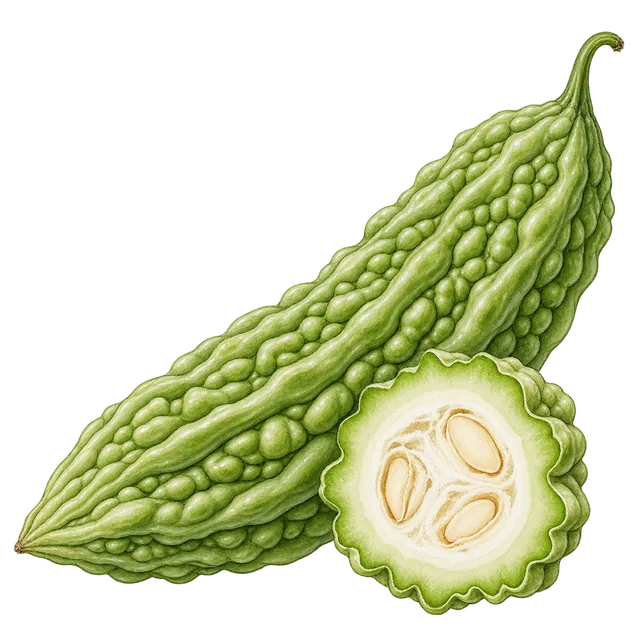
- The bumpy exterior
- The whole melon has a continuous bumpy surface, shown beside its cross-section.
- Flesh surrounds pith and seeds
- The pale-green flesh at the slice's outer ring is distinct from the central pith and seeds.
Illustration for understanding; not to scale. Saved figures include explanations and sources.
In practice · How blanching and salting cut bitterness
Two kitchen moves are used most often to cut the bitterness: blanching and salting. They are not mysticism. Each walks a very specific physical path.First, where the bitterness is hidden
Most of the bitter molecules are locked inside the flesh cells. When you cut bitter melon, you only slice open a thin layer of cells on the cut face; almost everything inside is still intact — so when you bite raw bitter melon, the bitterness slams out at the moment you chew the cells open. To cut the bitterness, you have to get those molecules out of the cells before they reach your mouth, then carry them away. Which of those two steps each move is responsible for becomes clear below.
Blanching: let the bitterness leave with the water
Heat makes the cell membrane lose its ability to keep things in. Once the membrane loosens, whatever inside the cell can dissolve in water starts to diffuse out, and the bitter molecules are part of that. They enter the pot water; you pour the water off, and the bitterness goes with it. That is also why you rinse under cold water after blanching, and why the blanching water should not be kept for soup — what you just poured off is exactly what you did not want to eat.
Salting: use osmosis to pull the water out
Salt sprinkled on cut slices immediately makes the outside saltier than the inside of the cells. Water walks itself toward the saltier side, so water inside the cells is pulled out bit by bit, and the bitter molecules ride that water out. After a while you will see a layer of water collect at the bottom of the plate — that layer is the bitterness that was carried away. Squeeze it off, rinse once, and the bitterness is clearly milder.
The cost has to be said clearly
These two moves take more than bitterness. Vitamin C is water-soluble, so some of it runs off with the water as well; potassium likewise. In other words, the harder you cut the bitterness, the less remains of the nutrition you came for in the first place. The compromise: less water, wait until the water is boiling before the melon goes in, shorter time. Bitterness-lovers, of course, never needed this step to begin with.
A side note on the seeds
The white pith and seeds in the middle are usually scraped out. Besides texture, this step has a safety reason too: the red coating around the seeds may be toxic to children, so do not give the seeds to kids.
Chapter 2
Where the 'lowers sugar' claim comes from
Charantin: showed glucose-lowering signals in cell and animal experiments;Polypeptide-p: a short chain of amino acids that, in experiments, can produce a little of insulin's effect — the source of the plant insulin label;Momordicin and similar bitter compounds: in a dish, they can make cells take up a little more sugar.
The problem is that a signal in a dish or in a mouse does not mean it works, or reaches an adequate dose, when a person eats it. The compounds in a plate of food have to pass stomach acid, the gut wall, and the liver before they reach your cells, and every one of those gates subtracts.
Mechanism · What each of the three compounds acts on
First, make the insulin chain clear — the next two names both lean on itAfter you eat, sugar in the blood rises, and the pancreas releases insulin. Insulin rides the bloodstream to the surface of muscle cells and fat cells, and stops at the receiving ports waiting specifically for it. Once the cell gets this signal it does one very concrete thing: it pushes a batch of glucose-carrying doors, normally stored inside the cell, up onto the cell membrane. Once the doors open, sugar in the blood has a path, so it walks into the cell, and blood sugar comes down.
Remember this chain: stop at the receiving port → push the doors onto the membrane → sugar enters the cell. So-called insulin-like just means something can make one step on this chain move.
Polypeptide-p: why it got called plant insulin
A polypeptide is a short chain of amino acids linked together, the same class of thing as a protein. Polypeptide-p earned the nickname plant insulin because in experiments it can produce a bit of the effect of the chain above.
But here is a question anyone can ask themselves: why does insulin itself have to be injected, and cannot be swallowed as a pill? Because it is a protein. Swallowed, it hits the stomach first; stomach acid unfolds the shape it was folded into; then it reaches the small intestine, where proteases specialize in cutting this kind of chain into fragments and amino acids, absorbed as a meal. Any polypeptide that walks the digestive tract has to pass this gate first.
That does not mean polypeptide-p in bitter melon necessarily cannot get through — it means a claim of an oral insulin-like polypeptide still owes the reader an answer about this gate. Human trials so far have not answered that gate, which is one reason bitter melon has never shown a reliable effect in people.
: the low-power-mode switch inside the cell
AMPK can be understood as an alarm switch inside the cell that says energy is running low. The cell's energy currency is called ; when most of the ATP has been spent and the leftover breakdown products pile up, this switch is flipped, and the cell immediately cuts into low-power mode: do fewer energy-costing jobs (such as making fat), do more inbound jobs — muscle cells push glucose-carrying doors onto the membrane to take more sugar, and liver cells turn down the production line that releases sugar into the blood.
So anything that can flip this switch in a dish will, on paper, look like it lowers blood sugar. The reverse of that sentence is equally true: it can activate AMPK by itself proves nothing — you do not even know yet whether it can reach this switch in a person.
Charantin-class steroidal saponins
A steroid is a carbon skeleton; cholesterol and many hormones use the same set. This skeleton is oil-loving and slips easily into cell membranes. The other end of a saponin hangs a sugar chain, water-loving — one end oil-loving, one end water-loving, so it foams like a dish-soap molecule, which is why saponins are named after soap. What cell experiments usually measure with this class is: after you add it to the culture medium, does the cell take sugar from the liquid any faster. That reading is what people call the glucose-lowering signal.
By this point the three names are no longer just names. But notice one thing: every line above is about what happens when you add the ingredient directly outside the cell. You eat bitter melon with your mouth, and between the plate and the cell there is still a whole road.
Mechanism · The gates between the plate and the cell
The concentration in the dish is set by the researcher. The concentration in your blood is notA cell experiment works like this: dissolve the compound directly into the medium the cells sit in. Make the concentration as high as you want — the body is not standing in the way at this step.
When you eat a plate of stir-fried bitter melon, the same compound has to finish this road:
Mouth and stomach: chewed first, then soaked in stomach acid. Acid-fragile molecules already lose a batch here.Small-intestine wall: whether it can be absorbed into blood depends on its size and whether it prefers oil or water. What cannot be absorbed goes into the large intestine as-is, and is excreted.Liver: what the small intestine absorbs does not enter the systemic circulation directly. It is sent to the liver first through a dedicated vessel. Enzymes in the liver remodel and break down a portion first; this gate is called the first pass. Many compounds lose most of their dose here.Dilution: only what remains enters the systemic circulation, spread across tens of kilograms of tissue and body fluid.On station: the tiny amount that finally stops on the surface of muscle cells and liver cells is the amount that has a chance to act.
Every step on this road is subtraction. So the concentration that worked in the dish and the concentration the cell actually sees after you eat are often far apart. This is not bitter melon's private problem. It is the shared crack in every claim of the form food X contains compound Y, therefore it treats condition Z. Next time you see that sentence shape, you can walk this road in your head: can it survive stomach acid? Can it be absorbed? Can it pass the liver gate? How much is left after dilution?
One more layer: bitter melon is not a tablet
The point of a tablet is that every tablet is the same. Bitter melon is not: variety differs, ripeness differs (green and turning yellow are not the same), eaten raw or cooked, juiced or stir-fried, even whether it was blanched — all of these change the compound content. And blanching is exactly the first step many people take to cut bitterness; among the water-soluble compounds it carries away are quite possibly the very classes that were studied.
So eat bitter melon to lower blood sugar may not even be the same act in two people's pans. That is also why trials of this kind are hard to run, hard to compare, and hard to settle. What the human trials look like — you can already guess half of it.
Chapter 3
What human trials actually show
No detectable difference from a drug is not the same as as good as the drug: trials this small often simply cannot measure a difference.
Cochrane's conclusion: current evidence does not support using bitter melon to treat type 2 diabetes. That does not mean bitter melon does nothing at all to blood sugar. It means that in people, it has not shown a reliable glucose-lowering effect you could use as a medicine.
Evidence · Insufficient evidence is not proof of no effect
First, the basics of this review: it is a 2012 Cochrane systematic review (Ooi et al.) that found only 4 qualifying , 479 patients in all, of low overall quality. In 3 of those trials, bitter melon showed no significant difference in blood-sugar response compared with placebo or with glucose-lowering drugs (glibenclamide, metformin). Metformin appears here only as a comparison group; it was not what was being studied.This conclusion is easy to misread. It is worth unpacking into three pits.
First pit: insufficient evidence is not the same as proven ineffective
The two phrases sound similar. In evidence they are two different things. Insufficient evidence means: the studies done are too few, too small, too rough; we still cannot see clearly. Proven ineffective means: we have already seen clearly, and the result is zero. Cochrane is saying the former.
So you should neither read it as bitter melon is a fraud, nor as it just has not been discovered yet, maybe it really works. The honest position is in the middle: as of today, there is no reliable evidence for using it as a medicine — that sentence is enough for you to decide, and you do not need to wait for another round of research.
Second pit: what 'low quality' actually means
Low trial quality is usually several things stacked: few participants, short follow-up, randomization and blinding done loosely. Why does blinding matter? If participants know they are eating bitter melon rather than placebo, expectation itself will push the result — how they report feeling will change, and even what they eat and how much they move in that period may change with it. In the end you cannot tell whether you measured bitter melon, or knowing you are eating bitter melon.
Bitter melon has one more built-in trouble here: it is too bitter. One taste and a person knows which group they are in; a placebo is hard to make convincing. That discounts blinding at the source. When you read any plant-compound trial, this is a checkpoint you can use offhand: can this thing's taste, smell, and color be hidden? If they cannot, double-blind is often double-blind in name only.
Third pit: why 'no ' is a heavy sentence
Hard endpoints are the real outcomes — death, heart attack, blindness, amputation. A blood-sugar number (such as fasting glucose or , glycated hemoglobin) is a . We watch it because long-term high blood sugar damages the tiny vessels in the retina, the filtering units in the kidney, the nerves at the ends of the limbs, and the large vessels throughout the body — those outcomes are what we actually fear.
The trouble with a surrogate is: something that can push the number down does not automatically mean it improved the outcome. Between the number and the outcome there is still a stretch of road, and that stretch has to be walked and verified separately.
Put this back on bitter melon: Cochrane specifically notes that not a single study examined death, complications, or quality of life, which means — even if a future trial does produce a blood-sugar number, that later stretch is still blank. That is also the line between metformin and bitter melon: metformin made it into guidelines because long, large trials walked that later stretch for it; bitter melon has not even secured the first stretch, the blood-sugar number.
Chapter 4
It cannot replace diabetes drugs
Red flags (this is about safety — remember it):
People with type 2 diabetes must never use bitter melon to replace glucose-lowering medication, and must never stop medication on their own — stopping without medical advice can let blood sugar run out of control, even into a crisis such as ketoacidosis;If you already take glucose-lowering drugs (especially sulfonylureas or insulin), eating a lot of bitter melon or drinking its juice may stack into hypoglycemia (blood sugar that falls too low) — tell your doctor;During pregnancy, avoid medicinal doses of bitter melon and its seeds (traditionally used to bring on menstruation and to induce abortion, which carries risk);The red coating around bitter melon seeds may be toxic to children — do not give children the seeds.
Mechanism · What metformin does in the liver
The two are simply not on the same level — that sentence should not be something you memorize — it should be something you can derive yourself. To derive it, you first have to see clearly which part of the body metformin acts on, and what it acts on.First, meet an organ that is always overlooked: when you are fasting, it is the liver that is feeding you
You ate nothing all night, and blood sugar did not fall to zero — because the liver keeps releasing sugar into the blood, so the brain always has fuel. The liver has two production lines:
Break down stores: it takes glycogen stored in liver cells apart, unit by unit, into glucose and sends it into the blood;Make it on the spot: it takes lactate, amino acids, glycerol and other feedstocks and synthesizes glucose inside liver cells — this line is called gluconeogenesis.
Normally, insulin brings the liver a message: there is enough sugar outside, shut down. One of the core problems in this kind of diabetes is that the liver has gone dull to that message: it does not shut down when it should, and the lines stay open all night. So high fasting blood sugar, much of the time, is not about what you ate last night. It is that your liver never clocked off all night. That sentence can explain a confusion many people have: they ate no late-night snack, and the morning number is still high.
What metformin mainly does is turn this production line down
It enters the liver cell and changes the energy books inside it, and the cell judges from that: this is not the time to spend heavily on making sugar. Exactly which molecules carry this step is still debated; the cell's low-energy switch, , is the most discussed candidate. The result: the gluconeogenesis line is turned down, the liver releases less sugar into the blood, and fasting blood sugar comes down with it.
Notice how specific the cause-and-effect is: in one named organ, turn down one named production line. It is not a vague lower blood sugar, so a doctor can also expect which stretch of blood sugar it mainly presses down.
But mechanism is only half. The other half is that the amount can be calculated
This second half is the gate bitter melon truly cannot pass:
Metformin is one molecule; how much is in one tablet is fixed;How much is absorbed, how long it stays in the blood, and where it is cleared have all been measured — so a doctor can estimate roughly what level is in your blood, know when to raise the dose, and know at what kidney function it must be stopped;Effect and risk can both be talked about against this amount, not against a feeling.
Bitter melon: it is not one molecule. It is a whole plate of plant. The content of the several-dozen compounds inside it moves with variety, ripeness, and method (every gate on the road from mouth to cell subtracts). Nobody can tell you what this plate of stir-fried bitter melon equals. Even if one of those compounds really can reach AMPK, you have no way to tune it to just enough, and no way to hit the brake when there is too much.
So what 'natural metformin' gets wrong, you can now say yourself
It treated the site of action looking adjacent as fit to use as a medicine. What makes a drug a drug is half that the mechanism makes sense, and half that the amount is controllable, reproducible, and stoppable. Bitter melon only brushes a little of the first half. The second half is not there at all.
This also hands you a general ruler: next time you see natural [some drug], do not rush to argue mechanism. Ask first — who is calculating the dose of this thing?
Chapter 5
How to enjoy it well
As a vegetable it is low in calories and sugar, with good fiber and vitamin C, and people who like bitterness can eat it often — blanching it, or salting it first, cuts the bitterness. It does count as a blood-sugar-friendly vegetable, but that is a different thing from lowering blood sugar and treating diabetes: eating more vegetables already helps blood sugar and weight, with no miracle drug effect required.
If you really want to control blood sugar, put your effort where the evidence is stronger: weight loss, regular exercise, a better overall diet (less refined sugar, more fiber), and medication as prescribed. Bitter melon can be one dish on that table, but do not let it replace any of these.
This page is general health information, not medical advice; for diabetes medication, follow your doctor.
In practice · Blood-sugar-friendly is not blood-sugar-lowering
Bitter melon counts as a blood-sugar-friendly vegetable, but that is a different thing from lowering sugar and treating diabetes. That sentence is worth spreading out — once you spread it out, you get a ruler you can use everywhere.First, watch what happens in the body with that bite of white rice
The main component of rice is starch — a long chain of glucose holding hands. It reaches the small intestine; enzymes in the intestinal fluid and on the intestinal wall cut this chain into individual glucose molecules; glucose crosses the wall into blood. The faster the chain is cut, the faster and higher blood sugar rises.
Now look at that plate of bitter melon
Bitter melon itself is already low in carbohydrate, and a good share of that is fiber. Fiber is also a chain of sugars linked together, but the linkage happens to be the kind human digestive enzymes cannot cut — uncut means unabsorbed; it walks the small intestine more or less as-is, and does not become sugar in the blood. The remaining absorbable carbohydrate is small in amount as well.
So where does the difference actually come from
Swap a bowl of white rice for a plate of bitter melon, and the post-meal blood-sugar curve is indeed different. But the source of that difference is: you did not eat that bowl of rice, not that bitter melon is taking sugar apart inside you. It is a subtraction effect — it occupies the plate, and sends almost no sugar into the blood.
And this ability is not unique to bitter melon. Any low-carb, high-fiber, bulky vegetable has it: broccoli, greens, celery, mushrooms — swap those in and the effect is about the same. Your reason for choosing bitter melon can be that you love this bitterness. It should not be that you think only this one works.
The ruler
Once you have these two things apart, next time you see food X lowers blood sugar, you can ask first:
Is it actively pulling blood sugar down, or is it only replacing the bite that would have raised blood sugar?
The great majority of so-called glucose-lowering foods belong to the latter. And the latter is already useful — replacing part of the staple, eating vegetables before rice, bringing each meal's sugar load down: these are things that really do improve blood sugar. They just do not need to be packaged as a drug, and they should not be treated as a reason to stop medication.
One last small thing: bitter-melon juice
Drinking bitter melon juiced is not the same act as eating a plate of stir-fried bitter melon. Juicing smashes the fiber, and may even filter it out, and what you lose is exactly the occupy the plate, do not send sugar ability above. Also, one glass of juice uses far more bitter melon than you can eat in a meal — if you are already taking glucose-lowering medication, it may stack with the drug into hypoglycemia. Wanting to drink it is fine. Just know what you are drinking, and tell your doctor first.
References · 2
- U.S. Department of Agriculture, Agricultural Research Service. (2024). FoodData Central: Balsam-pear (bitter gourd), pods, raw. USDA. Very low calorie, high water, notable vitamin C and folate for a vegetable. fdc.nal.usda.gov
- Ooi, C. P., Yassin, Z., & Hamid, T. A. (2012). Momordica charantia for type 2 diabetes mellitus. Cochrane Database of Systematic Reviews, (8), CD007845. Four low-quality RCTs (479 patients); three trials showed no significant difference vs placebo or antidiabetic drugs (glibenclamide, metformin) in blood-sugar response, and no trial assessed hard endpoints — current evidence does not warrant using bitter melon to treat type 2 diabetes. 10.1002/14651858.CD007845.pub3