Story
Bell Pepper
Last updated
In one pass The riper a bell pepper, the more vitamin C and carotenoids it holds; and the bright red pigment of a red pepper dissolves only in fat, so it absorbs well only when eaten with some fat.
Educational content, not medical advice — consult a clinician.
Story path
Chapter 1
Color shows ripeness and variety
Bell pepper (Capsicum annuum) and hot chili are the same species. Through breeding, the sweet-pepper line lost its working route for making capsaicin, so it is barely hot at all.
Color tells you two things: how ripe the pepper is, and which variety it is. A green pepper is an unripe pepper. Left on the plant, it turns the color its variety has when fully ripe: red, yellow, or orange. So green and red peppers can be picked from the same plant at different times, while yellow and orange peppers are usually other varieties at full ripeness, not half-finished red peppers.
Green: picked earliest, cheapest to produceRed, yellow, orange: hang on the plant longer, sweeter, more carotenoids, and pricier
A fully ripe red pepper has a good deal more vitamin C than a green one, and far more carotenoids.
A CLOSER LOOK
Different colours, different nutrient profiles
Green and red peppers are compared; composition needs the same weight and preparation basis, and the picture cannot measure amounts.
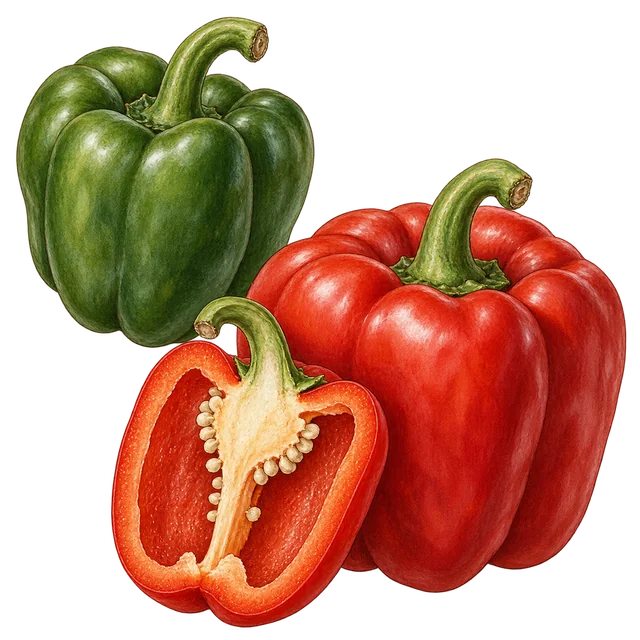
- Green peppers also supply vitamin C
- Green bell peppers also contain vitamin C; a lack of red colour does not mean a lack of nutrients.
- The red pepper's nutrient profile
- On the same raw-weight basis, red peppers are more prominent in vitamin C and carotenoids; use composition data for exact amounts.
Illustration for understanding; not to scale. Saved figures include explanations and sources.
Mechanism · How the fruit rebuilds itself as it ripens
A green pepper and a red pepper picked from the same sweet-pepper plant do not differ by variety; the fruit itself went through a thorough rebuild. Once you understand that rebuild, the later differences in color, sweetness, price, and nutrition all follow on their own.When it is green, the cells hold a factory
The cells of unripe fruit contain chloroplasts packed with chlorophyll — the workshop that turns light into sugar — and green is the color of chlorophyll. At this stage the fruit's job is to grow and store things up, not to be eaten.
Once ripening starts, the factory becomes a warehouse
When the ripening program begins, chlorophyll is taken apart step by step, and the same organelles are remodeled for a different role: chromoplasts, built for storing pigment. As the green withdraws, carotenoids are made in bulk and packed in, so the color shifts from green toward the color that variety has when fully ripe.
Capsanthin, the pigment typical of red peppers, is only made at this stage. Green peppers have almost none — not because the green hides it, but because it has not been made yet.
It is worth comparing this with leaves turning yellow in autumn: a leaf loses its green and reveals yellow that was there all along, while a sweet pepper withdraws its green and at the same time builds a whole new set of red. One is a curtain rising; the other is construction.
Two more things happen in the same window
Enzymes break starch down into sugars, so the later it is picked, the sweeter it gets; organic acids fall at the same time, so it also gets less sharp.Pectin in the cell walls partly loosens, so a red pepper is a little less crisp than a green one, with a softer bite.
So the price gap can be worked out
A red pepper has to hang on the plant for several more weeks. In that time it takes up the plant's capacity, still needs water and fertilizer, and still runs the risk of insect damage and splitting; ripe fruit is softer, so losses in shipping and on the shelf are higher too. A green pepper is picked early, is firm, and ships well, and the field frees up a slot for the next crop.
So what you pay for is not the red itself but the waiting time and the risk. Likewise, a red pepper is not more nutritious because it is red; it is more nutritious because the fruit did extra work in that extra time.
While we are here: why it is not hot
In the hot branch of this species, capsaicin is made by the white pith inside the fruit (the placenta); the seeds themselves do not make it. In the sweet-pepper branch, breeding switched that production route off: the pith is still there, but the heat is gone. So a sweet pepper is not a mild chili; it is the same species that never carried that key. How heat actually works in the body is the subject of the Chili & Capsaicin story.
Chapter 2
More vitamin C than an orange
Raw red bell pepper: about 128 mg of vitamin C per 100 gOrange: about 53 mg of vitamin C per 100 gRaw green bell pepper: about 80 mg of vitamin C per 100 g
By weight, a red pepper has roughly 2.4 times the vitamin C of an orange. The idea that you can only get vitamin C from fruit is a common misconception; cruciferous vegetables and the pepper-and-tomato family are underrated sources.
The recommended daily amount () of vitamin C for adults is about 75-90 mg (lower for women, higher for men), and a small bowl of raw red pepper covers it easily. Vitamin C dissolves in water and does not survive long cooking, so raw or quickly stir-fried peppers keep the most.
What else? A good amount of vitamin B6, some folate, and about 2 g of fiber per 100 g. Calories are very low (about 31 kcal per 100 g), and it is about nine-tenths water.
Mechanism · Why collagen-making stops without vitamin C
Vitamin C is often vaguely said to boost immunity. But its most solid job, and the easiest to explain, is making collagen — and collagen is the rope that sews the whole body together. Skin, blood-vessel walls, gums, tendons, and the organic scaffold inside bone are all made mainly of it.How the rope is twisted
Collagen is not one chain but three chains twisted into a braid. To twist tight and hold under tension, the three chains need plenty of hooks that grab each other.
Those hooks come from a chemical modification: a set of prolines and lysines on each chain must have an oxygen atom added at specific positions by an enzyme (hydroxylation). Only the modified sites can form hydrogen bonds between the three chains and lock the braid. Unmodified chains will not twist tight; pull, and they come apart.
Where vitamin C stands
The enzyme that does the hydroxylation has an iron atom at its active site, and that iron has to be in its ferrous form to work. Each round of the reaction can oxidize the iron into a form the enzyme cannot use, and then the enzyme stalls.
Vitamin C's job is to reduce the iron back, so the enzyme can do the next round — like someone standing beside the machine, swapping the battery back in again and again.
So vitamin C is not a raw material for collagen; it is what keeps the collagen-making machine running. Pile on as much raw material as you like: without it, the line still stops. This matters, because it explains why more vitamin C does not make the rope stronger (enough battery is enough), while a cut in supply stops the whole line at once.
When supply is cut, the body fails in order
When vitamin C is severely short for a long time, newly made collagen will not twist tight. The first places to fail are those where collagen turns over fastest and mechanical stress is highest:
Bleeding, swollen gums and loose teeth (collagen fibers around the teeth are what hold them in the bone)Small spots of bleeding in the skin (capillary walls are held up by collagen; when they cannot hold, they leak)Old wounds that had healed splitting open again (scar tissue is itself collagen and also needs constant renewal)Joint pain and fatigue
That is what scurvy looks like. It is not as abstract as missing a vitamin; it is every rope in the body going slack at once.
One boundary
Falling this short on an ordinary diet is very rare: a small bowl of raw bell pepper, a few florets of broccoli, or one citrus fruit easily covers the need. The point of this page is not to scare you but to turn the empty phrase what vitamin C is for into one concrete action: it keeps a machine running.
Evidence · Its other jobs, and whether it prevents colds
Collagen is only vitamin C's easiest job to explain, not its only one.It also works at these posts
Antioxidant: vitamin C dissolves in water, so it guards watery environments such as the inside of cells and blood plasma. It is easily oxidized itself, so it takes the hit in place of more important molecules. It can also restore vitamin E that has been oxidized; vitamin E guards the oily environment of cell membranes, so the two work a relay, one in water and one in oil.Making carnitine: before fatty acids can enter the mitochondria to be burned, they have to be attached to a carrier called carnitine. One step in the route that makes carnitine involves vitamin C, which is one source of the vague fatigue that comes with severe vitamin C deficiency.Making certain neurotransmitters: the enzyme that converts dopamine into norepinephrine needs vitamin C's help, so it also has a place in the chain behind mood and stress responses.Especially high levels inside immune cells: white blood cells actively pull vitamin C inside, where the concentration is far higher than in plasma. That shows they really do use it — but they use it and eating more makes them stronger are two different statements.
So does vitamin C prevent colds?
This is one of the most repeated nutrition claims in the world. Taking many placebo-controlled trials together, the answer splits in two:
Prevention: in the general population, taking vitamin C regularly over the long term does not lower how often people catch colds. Taking it every day will not make you catch fewer colds.Duration: people who have been taking it regularly have slightly shorter colds once they do catch one. Note that this benefit belongs to people who were already taking it as a habit, not to people who start swallowing large amounts on the day they get sick — trials in that second group have not shown a consistent benefit.
There is one exception group: people under brief, extreme physical strain (such as marathon runners and soldiers on exercises in severe cold). In them, a drop in how often colds occurred really was seen. That suggests vitamin C's role is more like filling a gap that extreme conditions have emptied than adding a shield for ordinary people.
How to use both halves together
Treat vitamin C as something to have in place on ordinary days, not as an emergency remedy for a cold. And the easiest way to have it in place is not a bottle of tablets but a daily source of vitamin C you can eat by the mouthful — bell pepper is the one most often overlooked.
Chapter 3
Its red pigments need fat to absorb
Capsanthin: the main red pigment of red peppers, a fat-soluble antioxidantBeta-carotene: the raw material for vitamin A, which the body converts into retinol as needed
The key point: these fat-soluble pigments absorb well only when eaten with fat. A controlled trial measured this directly: with the same salad, eating it with a full-fat dressing led to clearly more carotenoid absorption than eating it with a reduced-fat dressing.
At the table, that means a pepper salad tossed with a little olive oil, or peppers eaten with scrambled eggs or meat, gives you far more usable carotenoids than eating raw peppers plain or with fat-free foods.
What about green peppers? They are not yet ripe; the chlorophyll is still there and there is very little capsanthin. They have vitamin C too, but clearly less than red peppers.
Mechanism · What adding oil does, step by step
"Add a little oil" is everywhere in recipes, but a whole route is hidden inside it. Walk through it once and you can judge for yourself which methods help and which are wasted effort — and the same route applies to carrots, pumpkin, sweet potatoes, and tomatoes, so you do not have to memorize each one.Starting point: it does not dissolve in water
Carotenoids dissolve only in fat. But the digestive tract is a watery world from start to finish: gastric juice, intestinal fluid, and the partly digested food in the gut are all water-based. A molecule that does not dissolve in water, carried along in water, never even reaches the absorbing surface.
The five steps below are how the body works around that problem.
Step one · Get out of the cell
The pigment is locked inside plant cells, each wrapped in a cell wall that people cannot digest. Chopping, chewing thoroughly, and heating all break the cell walls and release the pigment.
This is the first reason stir-fried bell pepper is absorbed better than a whole raw one, and it has nothing to do with oil yet.
Step two · Dissolve into fat
If the meal contains fat, that fat is broken into small droplets in the small intestine. Carotenoids are fat-loving, so they dissolve into these droplets and finally have somewhere to stay that is not water.
Step three · Bile salts pack them into micelles
When fat enters the small intestine, the gallbladder releases bile. Bile salts are molecules with one water-loving end and one fat-loving end: the fat-loving end faces inward, wrapping the oil and the pigment dissolved in it, while the water-loving end faces outward toward the intestinal fluid. The result is tiny spheres called mixed micelles.
This step is the key to the whole route: a micelle is water-friendly on the outside, so it can move freely through water and carry its fat-soluble cargo all the way to the gut wall — like putting a waterproof coat on a passenger who is afraid of water.
Step four · Unload into the cell
The micelle docks on the surface of the cells lining the small intestine (the brush border) and hands over the carotenoids, which enter the cells.
Step five · Take the lymph, not a blood vessel
The cells repack the carotenoids into large particles called chylomicrons. These particles are too big to squeeze into the capillaries beside the gut wall, so they enter the lymph vessels, whose openings are looser, and travel through the lymphatic system until they join a vein near the collarbone. Only then have they truly entered the blood.
Without fat, it stalls at step three
With too little fat, little bile is released, and micelles do not form or form only in small numbers. The pigment has already left the cells, but it has no transport, so it leaves unchanged in the stool.
That is exactly what the 2004 controlled trial by Brown and colleagues measured: with the same salad, a full-fat dressing led to clearly more carotenoid absorption than a reduced-fat one. The study reported the result; the steps above explain why it came out that way.
So these follow on their own
Pepper strips in a salad: add a little olive oil, or pair them with a few nuts or some avocado.Peppers stir-fried with eggs or served with meat: the fat is already there; nothing extra needed.Eating a whole raw pepper: cell walls intact and no oil — the worst way to eat it for this route (though it keeps vitamin C best, so it is not a bad way to eat it, just not the way that protects carotenoids).Raw pepper dipped in fat-free yogurt: sounds healthy, but the carotenoid route barely opens.People with fat-absorption problems (for example, some diseases of the pancreas, bile ducts, or intestine): the stall may be exactly at step three. That is a question for a doctor, not something eating more vegetables will fix.
Myth · Red does not equal vitamin A
The two pigments in red peppers look alike, but their fates are completely different. Tell them apart, and you will not see bright red and assume you are topping up vitamin A.Beta-carotene: can be turned into vitamin A
Its molecule is shaped like a long, symmetric stick. Once it enters a cell lining the small intestine, a dedicated enzyme cuts the stick at its exact middle, splitting it in two, and each half becomes retinol — the usable form of vitamin A.
The key is that these scissors are regulated: when the body already has enough vitamin A, the cells turn the scissors down, so extra carotene is no longer converted and is instead stored as is or cleared.
That is why you cannot get vitamin A poisoning from eating carotene, but you can from high-dose vitamin A supplements: the first comes with a valve in the body, the second does not. Eating lots of orange-red vegetables may turn your skin slightly yellow (the pigment builds up in the outer layer of the skin, most visibly on the palms and soles); eat less for a while and it fades. That is buildup, not poisoning, and the two should not be confused.
Capsanthin: an antioxidant only, never vitamin A
Capsanthin carries oxygen-containing groups at both ends of its molecule, which puts it among the oxygen-containing carotenoids (the xanthophylls). With that oxygen, it is no longer the clean, symmetric stick, and whatever is cut from it is not retinol — so it provides no vitamin A at all.
Its role is as a fat-soluble antioxidant: it sits in fatty environments such as cell membranes and takes oxidation hits in place of the fat molecules in the membrane. That job has nothing to do with vitamin A, but it is not unimportant — it just cannot be counted on the vitamin A ledger.
So half the red of a red pepper counts, and half does not
Red peppers do supply beta-carotene, but their most striking red comes mainly from capsanthin, which gives no vitamin A. The color truly dominated by beta-carotene is the more orange shade of carrots, pumpkin, and sweet potatoes.
Deeper color means more vitamin A roughly holds within one vegetable (red peppers really do have more carotenoids than green ones), but it breaks down when you compare across vegetables, because the reds and yellows of different vegetables are not even the same molecules.
What the two have in common
Both dissolve only in fat. So both have to travel the same five steps described earlier (leave the cell, dissolve into fat, be packed into micelles, enter the gut cells, travel through the lymph). Without oil, neither absorbs well.
Chapter 4
What it lacks · how to pair
What it lacks:
No vitamin B12 or vitamin DVery little iron, and it is non-heme iron (poorly absorbed)Almost no fat (which also means fat-soluble nutrients depend on what you pair it with)Little calciumOnly a trace of protein
Good pairings:
With fat (cooking oil, olive oil, nuts): more capsanthin and beta-carotene get absorbedWith plant sources of iron (tofu, beans, whole-grain staples): the vitamin C in bell pepper helps more of the non-heme iron in the same meal get absorbed; adding a few slices of raw pepper when you eat tofu or beans is a small, useful trickWith good-quality protein (eggs, fish): fills in the protein and B12 that bell pepper lacks
Bell pepper has almost no antinutrients to worry about and nothing that needs a special limit. For nearly everyone, it is a very safe vegetable to eat freely.
Mechanism · Which iron vitamin C helps absorb
The vitamin C in bell pepper can raise iron absorption from the same meal. That is true, but it comes with conditions. Get the conditions clear and the trick works as intended, instead of becoming one more pairing slogan you hear and forget.Food iron comes in two kinds, which use two different doors
Heme iron: from the hemoglobin and myoglobin in meat, poultry, and fish. The iron sits inside a ring-shaped cage, and the gut wall has a dedicated entrance that takes in the whole cage. It is already absorbed fairly well and is not much affected by other things in the same meal.Non-heme iron: from beans, tofu, dark leafy greens, nuts, and fortified grains. This iron is bare and has to get in through a different transporter door in the gut wall — and that door only accepts ferrous iron.
Here is the problem: most non-heme iron in food is ferric, so it cannot get through the door.
Vitamin C does two things in the gut
It is a reducing agent: it turns ferric iron into ferrous iron, the form the door recognizes.It binds iron first, forming a soluble complex, so the phytate in beans and grains and the polyphenols in tea and coffee cannot grab it. Once those compounds bind iron, they form insoluble clumps that never even reach the door, and the whole lot is excreted.
So vitamin C does little for the heme iron in meat — that door never checks which form the iron is in.
Condition one · It has to be the same meal
Both the reducing and the escorting happen during a short window in the gut. Take vitamin C a few hours after the meal and the iron has already passed that stretch of intestine. So the claim that vitamin C raises iron absorption needs the words in the same meal, or it is wrong.
Condition two · The vitamin C in that meal has to still be there
Vitamin C is sensitive to heat and water. If the pepper has been simmered for a long time, the working vitamin C has already gone into the broth or been oxidized. To use this trick, the meal should include something raw or quickly stir-fried.
So these are different versions of the same chain
Tofu, chickpeas, or lentils with raw pepper stripsA spinach salad with citrus or kiwiOatmeal with strawberriesStrong tea and coffee moved to a while after the meal
One last boundary
This raises the share of iron absorbed; it does not create iron out of nothing. If you eat little iron to begin with, even a higher share brings a limited absolute gain. Anyone already diagnosed with iron deficiency should go the route of a doctor and testing; pairing tricks are only the everyday foundation.
Chapter 5
How to choose · how to cook
Which color: ranked by vitamin C and carotenoids, red is best, orange and yellow come next, and green has the least. But green peppers are cheaper and their vitamin C is not bad (~80 mg per 100 g); they just have fewer carotenoids. If saving money matters, green peppers are perfectly fine.
Cooking:
Raw or in a cold salad: keeps the most vitamin C (it does not survive high-heat boiling); remember some fat for the carotenoidsQuick stir-fry: a short blast of high heat loses some vitamin C, but plenty remains; carotenoids are not harmed by heat and actually absorb better when stir-fried in oilLong simmering or boiling: loses the most vitamin C (it dissolves into the water); carotenoids seep into the broth, so drinking the broth still puts them to use
Storage: whole peppers keep for 1-2 weeks in the fridge's vegetable drawer; once cut, eat them soon, because vitamin C is lost fairly quickly to oxidation.
Mechanism · The three things vitamin C fears
"Vitamin C can't take high heat" is incomplete. Vitamin C actually fears three things at once, and the three have completely different consequences. Look at them separately and you can judge where a cooking method loses out, instead of memorizing a table of retention rates.One · Dissolving into water (it moved, but it did not break)
Vitamin C dissolves in water. When you soak, blanch, or boil peppers, it runs out of the cut surfaces into the water.
Note that this is not destruction; it is a change of place. So if you make soup and drink the broth, most of it is still there; if you blanch and pour the water away, it really is lost. At the same temperature, the difference between these two methods is not in the pot but in whether you pour the water out afterward.
Two · Oxidation (it really did break)
Vitamin C's own job is to take oxidation hits for other molecules, so it is itself very easily oxidized into an inactive form. Three conditions speed this up:
Contact with air: the more cut surface and the longer it is exposed, the fasterOxidizing enzymes that were kept separate in the flesh are released by cutting and start working on the spotHigher temperature makes both of the above run faster
This is an irreversible loss; drinking the broth will not get it back.
Three · High heat (mainly an accelerator)
Heat itself does break vitamin C down, but its bigger role is to speed up the first two: tissue collapses faster and releases its juice, and oxidation runs faster too. So time matters more than temperature: between one minute over high heat and twenty minutes over low heat, the second loses more.
So these conclusions follow on their own
Storing whole beats storing cut: fewer cut surfaces is better. If you prep ahead, keep the pepper whole in the fridge.Cutting and eating right away beats cutting and leaving it: losses after cutting are counted in hours, not days.A quick stir-fry beats a long simmer: short time and little water keep a good share of the vitamin C.If you must boil it, eat the broth too.Blanching and then pouring the water away is the worst deal for vitamin C.
Carotenoids run the other way
They do not dissolve in water and are quite stable at home-cooking temperatures, so stir-frying and boiling do not destroy them. On the contrary, heat softens the cell walls and makes them easier to release from the cells, and the oil in the pan serves as their transport — stir-fried bell pepper delivers more absorbable carotenoids than raw.
So you do not have to choose between raw and cooked
The two methods were never protecting the same thing. Have some quickly stir-fried pepper (for the carotenoids) and a few raw strips (for the vitamin C) in the same meal, and you get both. That is far more useful than worrying about which method is healthier.
References · 4
- U.S. Department of Agriculture, Agricultural Research Service. (2019). FoodData Central: Peppers, sweet, red / green / yellow, raw and cooked. Red bell pepper ~128 mg vitamin C / 100 g raw — roughly 2.4× orange by weight; also a source of capsanthin, beta-carotene, vitamin B6, and fiber. ~31 kcal / 100 g. fdc.nal.usda.gov
- National Institutes of Health, Office of Dietary Supplements. (2021). Vitamin C — Fact Sheet for Health Professionals. ods.od.nih.gov/factsheets/VitaminC-HealthProfessional
- National Institutes of Health, Office of Dietary Supplements. (2025). Vitamin A and Carotenoids — Fact Sheet for Health Professionals. ods.od.nih.gov/factsheets/VitaminA-HealthProfessional
- Brown, M. J., Ferruzzi, M. G., Nguyen, M. L., Cooper, D. A., Eldridge, A. L., Schwartz, S. J., & White, W. S. (2004). Carotenoid bioavailability is higher from salads ingested with full-fat than with fat-reduced salad dressings as measured with electrochemical detection. The American Journal of Clinical Nutrition, 80(2), 396-403. Dietary fat markedly raises absorption of fat-soluble carotenoids. 10.1093/ajcn/80.2.396