Story
Sardines
Last updated
In one pass A can of sardines with the bones in gives you calcium and the vitamin D that helps calcium get into the blood in the same bite, and because sardines sit low on the food chain, they carry very little mercury.
Educational content, not medical advice — consult a clinician.
Story path
Chapter 1
Sardines · a small fish low on the food chain
Sardines are a group of small oily sea fish. Adults are usually only 15-25 cm long and eat plankton their whole lives. Their identity has two halves: they are oily fish, storing plenty of omega-3 in their muscle like salmon and mackerel; and they are small, short-lived and low on the food chain, so they never have time to build up much mercury. That is the biggest difference between sardines and tuna.
They are cheap, very nutrient-dense, and often underrated.
A CLOSER LOOK
Small does not mean low-fat
Small size, oily muscle and a low food-chain position are separate traits; the bones chapter covers calcium.
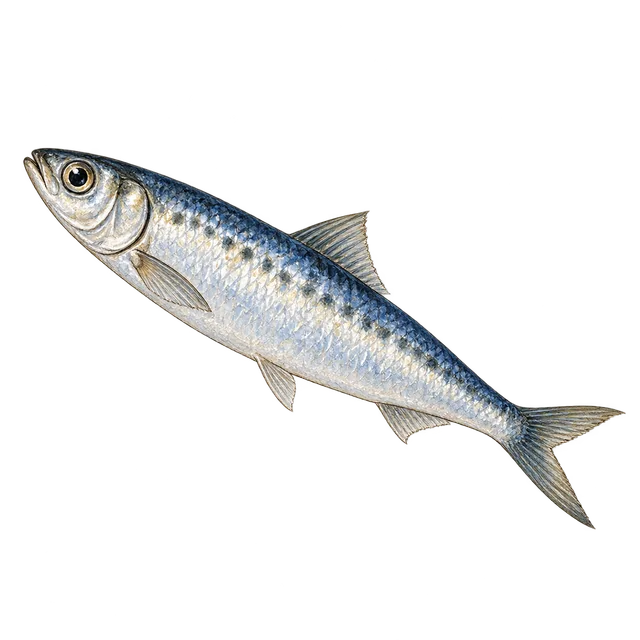
- Oil in the muscle
- Sardines are oily fish with omega-3 in their muscle.
- Feeding on plankton
- Their low food-chain position, small size and short life limit mercury accumulation.
Illustration for understanding; not to scale. Saved figures include explanations and sources.
Background · How canned and fresh sardines differ
The most common form is canned sardines. They usually come with edible soft bones, packed in olive oil, tomato sauce or brine.Canned and fresh sardines differ in nutrition in two main ways: sodium, because cans are often salted for preservation; and the packing oil, because the Olive Oil version adds calories. Protein and omega-3 are broadly the same.
Canning has one bonus: the high-heat sterilization after sealing softens the small fish's bones, so you can eat the whole fish, bones and all, and the calcium in the bones comes along. Fresh sardine bones are hard and usually get picked out, so that calcium is lost.
So when picking a can, look at two things: whether it has bones, and what it is packed in. How to choose is covered in the chapter Choosing, eating and portions.
Chapter 2
Protein and calories per can
For sardines canned in oil, per 100 g: about 24-25 g of protein, all of it complete protein; about 11-14 g of fat; carbohydrate near 0; about 200-210 kcal. A standard small can (about 90 g drained) gives roughly 20 g of protein, and it is usually inexpensive (see Protein & Amino Acids).
Canned sardines are often salted. If blood pressure is a concern, choose brine-packed and drain them, or pick a low-sodium version.
Numbers · How the packing changes the numbers
The same can of sardines adds up differently depending on what it is packed in.Oil: about 11-14 g of fat and about 200-210 kcal per 100 g. Part of that fat comes from the packing oil itself, so how well you drain the can also moves the numbers.Brine: somewhat fewer calories, and lighter once drained.Tomato sauce: a little extra vegetable on the side.
The protein side barely changes: whatever the packing, the protein is in the fish, about 20 g in a small can, with all the essential amino acids. Sardines are cheap, ready to eat as soon as you open the can, and keep in the cupboard for a long time, which is part of why they are called a "poor person's superfood".
Watch the sodium side: cans are often salted for preservation. If blood pressure is a concern, choose brine-packed and drain them, or look for a low-sodium label, and do not add much extra salt or soy sauce to the same meal.
Chapter 3
Its fat is mostly omega-3
Why is this small fish so rich in omega-3? EPA and DHA are first made by marine microalgae, and sardines eat phytoplankton directly, taking the goods at the source instead of several steps up the food chain like large predatory fish (see Fats & Omega-3).
Gram for gram, one can of sardines gives about as much EPA plus DHA as several standard Fish Oil capsules, and it brings protein, vitamin D, calcium and B12 along too.
Evidence · Eating fish is not the same as fish oil
One can equals several fish-oil capsules is a count of grams of omega-3. But eating a can of fish and swallowing a few capsules are two different questions in research.In observational studies, people who eat more oily fish have less cardiovascular disease. That is an association: people who eat a lot of fish tend to be healthier in other ways too, and a fish meal often replaces a meal of red or processed meat.In randomized trials that gave omega-3 capsules to the general population, most results were negative.
So this cannot be read as the evidence for eating fish is stronger than for capsules. The two kinds of study ask different things: one asks what happens when fish replaces another meal, the other asks what happens when a little omega-3 is added on top of the usual diet.
A whole fish also brings protein, vitamin D, calcium, selenium and B12 at the same time, which is often called the food matrix. The idea makes sense, but it has not been tested on its own in people. The Fish Oil story puts the two kinds of evidence side by side (see Fish Oil).
Chapter 4
Calcium and vitamin D, bones included
Calcium: the most underrated point. Canned sardines come with edible soft bones, which supply about 300-380 mg of calcium per 100 g, close to a glass of milk. For people who do not drink milk, this is a rare non-dairy source.Vitamin D: oily fish are one of the few natural food sources. It is not a coincidence that it comes with the calcium: vitamin D opens the pathway that carries calcium into the blood, and without it most of the calcium from the chewed bones cannot get in. More in Vitamin D.Vitamin B12: very high; one can often covers more than a day's need. More in Vitamin B12.Selenium: sea fish are generally rich in it, and it is a part of antioxidant enzymes.Omega-3: among the highest of any common food; more in Fats & Omega-3.
So these are not separate selling points side by side: calcium is the material, vitamin D is the switch, and both come in the same bite.
Mechanism · Why calcium and vitamin D are one chain
A bone-in can of sardines gives calcium and vitamin D at the same time. The weight of that sentence is not in at the same time. It is that these two sit as consecutive, interlocking rings on the same chain. Walk the chain apart once, and you can derive the answers to several common questions yourself.Step 1: the calcium in the bone first has to become ions
The calcium in the soft bones is not loose. It is locked in a crystal called hydroxyapatite, grown together with a collagen matrix. You have to chew it apart first, then soak it in stomach acid, before the crystal surface starts to dissolve and release calcium ions that can be absorbed. That is why the soft bones in the can have to be chewed in — swallow them whole and the surface area stomach acid can reach is too small, so less calcium dissolves out.
Step 2: calcium has to cross the small-intestine wall, and there are two paths
A layer of intestinal epithelial cells sits between the lumen and the blood. Calcium has two ways across that wall:
Passive seepage: squeezing through the gaps between cells, down the concentration gradient. Unregulated; only noticeable when calcium concentration in the lumen is high.Active carrying: through the cell itself, handed along in relays. The capacity of this path is set by vitamin D.
Step 3: what vitamin D does is open that active-carrying path
The vitamin D you eat is still only raw material. It has to be processed once in the liver, then once more in the kidney, before it becomes the active form. Active vitamin D enters the epithelial cells of the duodenum, finds the receptor waiting in the nucleus (), and once the pair bind they do one very specific thing: they raise the production of three proteins.
The calcium channel facing the lumen (TRPV6) — calcium ions enter the cell hereThe calcium-binding protein inside the cell (calbindin) — wraps the calcium and escorts it across the cell. Without it, free calcium floating in the cell is itself a danger signalThe calcium pump facing the blood (PMCA) — spends energy to push calcium into the blood
All three rise, and the capacity of this active channel goes up. When vitamin D is short, there are fewer doors and fewer carriers, and calcium is left with only the passive-seepage gap.
Step 4: into the blood, then still into bone
Calcium entering the blood is only halfway. Osteoblasts on the bone surface first lay down a collagen-protein matrix; calcium and phosphorus then crystallize on that net into hydroxyapatite — this step is mineralization. Only here does the calcium from that can of sardines truly become your bone.
Once the chain is in place, you can derive the next few yourself
Why supplementing calcium without vitamin D works poorly: the switch is off, the active channel has low capacity, calcium can only squeeze through the passive gap, and the rest leaves as it came.Why supplementing vitamin D without eating calcium does not work either: the switch is on, but there is no material.Why swallowing a large handful of calcium at once is worse than splitting it: the active channel has a capacity ceiling. Give too much at once and the excess can only use passive seepage, so the absorbed fraction actually drops.Why bone-in sardines are special on this: most foods give only one end of the chain — milk gives calcium, sunlight gives vitamin D. A bone-in can of sardines packs the material and the switch into the same bite.
Finally, connect the other two as well, so they do not look like unrelated items side by side: B12 and omega-3 both matter for the nervous system, but they do different jobs. Nerve fibers are wrapped in an insulating sheath called myelin, which lets electrical signals hop and travel fast, and maintaining that sheath needs B12; is the most abundant long-chain polyunsaturated fat in the membranes of the brain's nerve cells. Selenium is fitted into a class of antioxidant enzymes built around it, which clear away peroxides left by oxidation inside the cell — and it is also the element that binds mercury, covered in the chapter on mercury.
Chapter 5
What it lacks · how to pair
The idea when pairing is to fill those gaps: dark leafy greens or tomato for fiber and vitamin C, a whole-grain staple for carbohydrate. Chew the bones and eat them too, or you miss the calcium.
The can is already salty, so do not add much extra salt or soy sauce; an oil-packed can already brings a fair amount of calories in its oil, so there is no need to pour more on.
In practice · A few classic pairings
A few classic pairings, each filling one of the gaps:Tomato: sardines canned in tomato sauce are already a good combination, and the vegetable adds fiber, vitamin C and polyphenols.A whole-grain staple (brown rice, whole-wheat bread): adds carbohydrate and fiber, as a sardine sandwich or a rice bowl.The bones: the soft bones in the can are the main calcium source, so chew them in rather than picking them out.A squeeze of lemon: it cuts the fishy note, and its vitamin C helps the body absorb iron from plant foods in the same meal.
The packing liquid is part of the pairing too: tomato sauce adds a little vegetable, brine is the lightest once drained, and olive oil tastes richer but carries more calories.
Chapter 6
Why it has so little mercury
The mechanism is called biomagnification. Methylmercury is very dilute in seawater, but each step up the food chain adds another round of buildup inside the animal. The bigger, longer-lived and higher up a predatory fish is, the more mercury it holds; sardines eat only plankton and live short lives, so they never have time to build it up.
In their 2022 advice on eating fish, the US Food and Drug Administration (FDA) and Environmental Protection Agency (EPA — here the agency, not the fatty acid) put sardines in the top Best Choices group, with 2-3 servings a week for adults. Methylmercury can affect the developing nervous system of fetuses and young children, so this matters most for women who are pregnant, breastfeeding or trying to conceive, and for young children.
The other side: sardines are very high in purines, so people with gout or high uric acid should limit how often and how much they eat.
Mechanism · How mercury builds up the food chain
Why mercury piles up, layer by layerBiomagnification sounds like a statistical phenomenon. The mechanism is quite physical.
Once microbes in seawater convert inorganic mercury into methylmercury, the properties change: it can cross cell membranes, and once inside the fish it binds tightly to sulfur-containing groups on proteins, stored mainly in muscle — the part you eat. Tight binding means slow clearance: the fish clears it far more slowly than it takes it in.
So the mercury in each fish is roughly equal to the sum of the mercury in everything it ate in its life. That one sentence explains three things:
Higher toward the top: every small fish a predator eats has already piled a round for it.Higher the longer it lives: accumulation is a function of time; the longer it lives, the more it piles up.Within the same species, larger means higher: body size is often a stand-in for age.
Sardines stand on the favorable side of all three: they eat only plankton (the lowest starting point), live a short life, and stay small. So they are not cleaned of it. They never had time to pile it up.
You can also run it the other way: if you want to eat fish and take in less mercury, the question is not whether this sea is clean. It is what this fish eats, how long it lives, and how large it grows. The same reasoning holds for any fish — you do not need to memorize a fish list.
The selenium synergy
There is one more synergy: sardines are rich in selenium, and selenium binds mercury. Mechanistic research suggests this may partly offset mercury's toxicity — but that should not be taken as a license to eat more high-mercury fish.
Purines: who needs to hold back
Like anchovies, oysters, shrimp and crab, and animal liver and kidney, sardines are among the highest-purine foods. Purines are broken down into uric acid in the body, and people with gout (see Gout & Hyperuricemia) or hyperuricemia (see Hyperuricemia) may set off an attack by eating a lot at once — a study that followed people with gout found more recurrent attacks after days when they ate more purines, oily fish included (an observed association). Over the long run, in a US cohort that followed tens of thousands of men (Choi and colleagues), the group that ate the most seafood had a higher risk of gout, while the higher-purine vegetables showed no such link; this too is an association, seen only in men.
This group is not under an absolute ban — they need to control how often and how much, and it is better to avoid sardines during an acute attack. In a gout diet, sugary drinks and alcohol come before seafood as the things to cut first.
Add a stretch of mechanism so this reminder is not just a prohibition. Purines are building units of the genetic material in cells, so any food made of cells contains them. Purines are broken down in the body; the endpoint is uric acid. Uric acid has limited solubility in blood. When the concentration stays high for a long time, it precipitates first as needle crystals in cooler, slower-flow places — most typically the joint of the big toe. Immune cells treat the crystals as foreign and surround them, and the joint turns red, swollen, and sharply painful.
So the advice to control frequency and portion targets the long-term level of uric acid in the blood, not whether one meal was right or wrong. That also explains why you avoid it during an acute flare: crystals are already in the joint then, and pushing uric acid higher only makes the situation harder to settle.
Chapter 7
Choosing, eating and portions
When picking a can, look at two things. First, choose whole, bone-in fish where you can, since the bones are the main calcium source. Then choose the packing to suit you: brine or low-sodium if sodium matters, and oil-packed less often if calories matter. For fresh fish, look for clear eyes, bright red gills and firm flesh.
Portions: for healthy adults, 2-3 servings of low-mercury fish a week, the Best Choices group in the advice from the FDA and EPA (two US federal agencies), is reasonable. During pregnancy, breastfeeding, when trying to conceive, and for young children, sardines are a recommended low-mercury fish, but still keep to the weekly amount. People with gout or high uric acid should limit how often they eat them and avoid them during an attack. This page does not replace a doctor's advice; for any specific condition, ask a professional.
In practice · Packing, serving and sustainability
Choosing the packing: olive oil tastes richer but has more calories; brine has fewer calories and is lighter once drained; tomato sauce adds a little vegetable.How to eat them: canned sardines can go straight onto whole-wheat bread, into a salad or a rice bowl, seasoned with onion and lemon. Fresh sardines are good grilled, pan-fried or cooked over charcoal.
Sustainability is a bonus: sardines are low on the food chain and breed quickly, so they are generally a greener choice than large predatory fish, though how well fisheries are managed varies from place to place.
References · 11
- U.S. Department of Agriculture, Agricultural Research Service. (2019). FoodData Central: Fish, sardine, Atlantic, canned in oil, drained solids with bone. ~24-25 g protein and ~1.4-1.5 g EPA+DHA per 100 g; edible bones supply ~300-380 mg calcium/100 g. fdc.nal.usda.gov
- Mozaffarian, D., & Wu, J. H. Y. (2011). Omega-3 fatty acids and cardiovascular disease: effects on risk factors, molecular pathways, and clinical events. Journal of the American College of Cardiology, 58(20), 2047–2067. 10.1016/j.jacc.2011.06.063
- National Institutes of Health, Office of Dietary Supplements. (2024). Calcium — Fact Sheet for Health Professionals. ods.od.nih.gov/factsheets/Calcium-HealthProfessional
- National Institutes of Health, Office of Dietary Supplements. (2024). Vitamin D — Fact Sheet for Health Professionals. Fact sheet (updated June 27, 2025; Wayback snapshot 20 September 2026): 25(OH)D below 30 nmol/L (12 ng/mL) is associated with deficiency, 30 to below 50 nmol/L is generally considered inadequate, 50 nmol/L (20 ng/mL) or more is sufficient for most people, and above 125 nmol/L (50 ng/mL) can be associated with adverse effects; RDA 600 IU (15 mcg) to age 70 and 800 IU (20 mcg) above 70; adult UL 4,000 IU (100 mcg); older people and people with darker skin (more melanin) make less vitamin D from sunlight (fact sheet). ods.od.nih.gov/factsheets/VitaminD-HealthProfessional
- National Institutes of Health, Office of Dietary Supplements. (2024). Vitamin B12 — Fact Sheet for Health Professionals. Fact sheet (updated July 2, 2025; Wayback snapshot 20 September 2026): multivitamin/mineral supplements typically contain 5 to 25 mcg B12, B-complex products 50 to 500 mcg, B12-only supplements typically 500 to 1,000 mcg; absorption is only about 2% at 500 mcg and 1.3% at 1,000 mcg; a 2018 Cochrane review of 3 RCTs (153 participants) compared very high oral doses (1,000-2,000 mcg) with intramuscular B12; high oral doses (e.g. 1,000 mcg/day) might be equally effective in Crohn's disease and appear as effective as hydroxocobalamin injections after Roux-en-Y bypass. These are product contents and trial doses; the sheet gives no recommended daily supplement range (fact sheet). ods.od.nih.gov/factsheets/VitaminB12-HealthProfessional
- National Institutes of Health, Office of Dietary Supplements. (2021). Selenium — Fact Sheet for Health Professionals. Table 2: Brazil nuts, 1 ounce (6-8 nuts), 544 mcg selenium (989% DV); the text says Brazil nuts contain 68-91 mcg per nut and could cause selenium toxicity if consumed regularly, and that values from other analyses vary widely. The version read carries 'Updated: April 15, 2024' (Wayback Machine snapshot of 31 December 2024), newer than the 2021 date above (fact sheet, read 2026-09-24). The September 4, 2025 update (Wayback snapshot 19 September 2026) adds: the body absorbs up to about 90% of selenium from selenomethionine, selenium-enriched yeast, selenite and selenate; selenium-only supplements typically contain 100 to 400 mcg; Keshan disease, an endemic cardiomyopathy first identified in 1935 in low-selenium parts of China, fell dramatically after selenium intervention trials in the 1970s-1990s; in 2017 the American Thyroid Association issued a weak recommendation against selenium supplements for TPOAb-positive pregnant women (fact sheet). ods.od.nih.gov/factsheets/Selenium-HealthProfessional
- U.S. Food and Drug Administration & U.S. Environmental Protection Agency. (2022). Advice about eating fish: For those who might become or are pregnant or breastfeeding and children ages 1-11. Salmon, sardines, shrimp, and light canned tuna are 'Best Choices' (lower mercury); 2-3 servings/week recommended for adults, including those pregnant or breastfeeding (1 serving = 4 oz); children 1-11: 2 servings/week of Best Choices, with serving size by age (1 oz at 1-3, 2 oz at 4-7, 3 oz at 8-10, 4 oz at 11). www.fda.gov/food/consumers/advice-about-eating-fish
- EFSA Panel on Contaminants in the Food Chain (CONTAM). (2012). Scientific opinion on the risk for public health related to the presence of mercury and methylmercury in food. EFSA Journal, 10(12), 2985. Methylmercury biomagnifies up the marine food chain and affects the developing nervous system. 10.2903/j.efsa.2012.2985
- Ralston, N. V. C., & Raymond, L. J. (2010). Dietary selenium's protective effects against methylmercury toxicity. Toxicology, 278(1), 112-123. Selenium binds methylmercury and may partly offset its toxicity — mechanistic, not a license to ignore mercury. 10.1016/j.tox.2010.06.004
- Zhang, Y., Chen, C., Choi, H., Chaisson, C., Hunter, D., Niu, J., & Neogi, T. (2012). Purine-rich foods intake and recurrent gout attacks. Annals of the Rheumatic Diseases, 71(9), 1448-1453. Acute purine-rich intake (including oily fish) was associated with a higher risk of recurrent gout flares. 10.1136/annrheumdis-2011-201215
- Choi, H. K., Atkinson, K., Karlson, E. W., Willett, W., & Curhan, G. (2004). Purine-rich foods, dairy and protein intake, and the risk of gout in men. New England Journal of Medicine, 350(11), 1093-1103. Health Professionals Follow-up Study: 47,150 men with no gout at baseline, 12 years, 730 confirmed incident cases. Highest vs lowest fifth: meat RR 1.41 (1.07-1.86), seafood RR 1.51 (1.17-1.95), dairy RR 0.56 (0.42-0.74). Purine-rich vegetables and total protein intake were NOT associated with a higher risk (abstract, PMID 15014182). 10.1056/NEJMoa035700