Story
Salmon
Last updated
In one pass Salmon's most valuable fat comes down to a few bends in its molecules: they keep cell membranes soft in cold water, and they make the fat easily damaged by long, high-heat cooking.
Educational content, not medical advice — consult a clinician.
Story path
Chapter 1
Salmon · not one fish, but a family
"Salmon" is a trade name, not a biological species. It covers at least two broad groups: Atlantic salmon, more than nine-tenths of which is farmed, and several wild Pacific species — king, sockeye, coho, pink, and chum.
Fat content, omega-3, flesh color, and price all shift with the species and with whether the fish was farmed or wild. A farmed Atlantic salmon can carry two to three times the fat of a wild pink salmon, so two fish sold under the same name can have quite different nutrition labels.
The orange-red of the flesh comes from a carotenoid called astaxanthin. Wild fish build it up by eating krill; farmed fish get it added to their feed.
One point matters directly for eating it raw: fish sold as salmon for raw eating is often farmed Atlantic salmon or rainbow trout, not wild Pacific salmon.
Mechanism · Why flesh color is not a nutrition guide
The orange-red of salmon flesh comes from astaxanthin, a pigment the fish cannot make and can only get from food. Follow it back to its source and you arrive at the one thing most worth knowing when you buy fish: a deep color says nothing about how much omega-3 is inside.The color is passed up from the sea, one level at a time
The makers of astaxanthin are marine microalgae. Krill eat the algae and turn red; salmon eat the krill and their flesh turns red. Salmon cannot synthesize it themselves, not a single molecule. Every bit of orange-red in the meat was carried there from food (see Astaxanthin).
Why it collects in the lean flesh, not along the fat edge
This is the opposite of the gamey smell in lamb. Those odor molecules are purely fat-soluble, so they travel with fat tissue; trim the fat edge and most of them go with it.
Astaxanthin is different. Each end of the molecule carries a water-loving group, and the middle is a long carbon chain that avoids water. That water-loving at both ends, water-avoiding in the middle shape means it cannot curl up inside a fat droplet. Instead it slots crosswise into the cell membrane: one end at the outer surface, one end at the inner surface, and the long chain spanning the middle.
So it sits in the membranes of muscle cells, and the color lives in the muscle itself. That is why salmon flesh is orange-red while its fat layer is not.
What it does in the living fish
Salmon muscle membranes are packed with long-chain fats that carry a great many double bonds (a kind of fixed bend in the carbon chain): and . That is how the fish keeps its membranes soft in cold water. The other side of having many double bonds is that they oxidize very easily.
So the membrane needs a molecule that sits inside it and can take oxidative hits on behalf of those fats. Astaxanthin happens to sit right there, and chemically it can do that job. The mechanism predicts that this is the work it does in the living fish; that step has not been measured directly in live salmon.
In a wild fish, the color and this good fat come from the same food chain: eating krill supplies both the soft membrane and the pigment that most likely protects it.
So choosing fish by color treats a dial as a gauge
In farmed fish, astaxanthin comes from a feed additive, and the amount can be adjusted. Which oil goes into the feed is a separate setting, adjusted independently. On a farm, those two dials are split apart.
The result: a deeper color tells you only how much astaxanthin the fish ate (or was given). It does not tell you how much omega-3 it has. In wild fish the two broadly move together; in farmed fish they need not.
The next time you see a fillet flushed an intense red, what it shows you is the feed formula, not the nutrition panel.
Chapter 2
A high-protein fatty fish
Per 100 g, cooked farmed Atlantic salmon provides roughly 22–25 g protein, 12–13 g fat, and 0 g carbohydrate, for about 200–210 kcal. The same weight of cod has under 1 g of fat.
The protein holds no surprises. It is complete protein, with all nine essential amino acids, and it is well digested and absorbed, in the same class as lean beef and chicken breast (see Protein & Amino Acids).
What makes salmon interesting is those 12–13 g of fat. The fat is not a burden; it is the fish's real value. What makes it good, and why it fears heat, is covered in Why its fat is valuable.
In everyday amounts: a typical salmon fillet weighs about 150–180 g, and a 6-slice serving of sashimi about 90–100 g. One fillet gives you more than 35 g of protein and 2–3 g of plus , which is more than most Fish Oil supplements provide in a day.
A CLOSER LOOK
Protein and fat in the same fillet
The pale streaks show fat distribution; colour and marbling cannot tell you its omega-3 content.
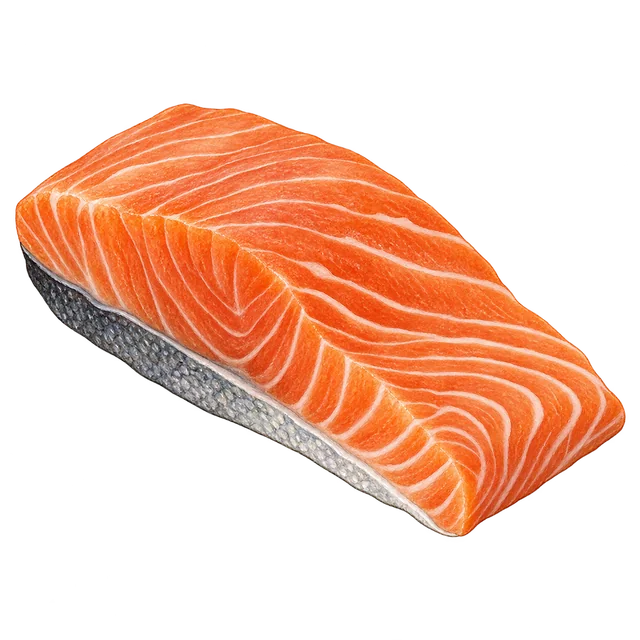
- Complete protein in the flesh
- All nine essential amino acids are present.
- The fat of a fatty fish
- It also supplies EPA and DHA; amounts vary with species and how the fish is raised.
Illustration for understanding; not to scale. Saved figures include explanations and sources.
Mechanism · Why salmon stores its oil in the muscle
Salmon is a fatty fish and cod is a lean white fish. The split is not a casual fat-versus-thin label: the two fish store their oil in different parts of the body, and behind that sit two completely different ways of living.A fish that travels a long way and does not eat on the road
Salmon have what biologists call an anadromous life history: born in fresh water, grown at sea, then swimming back upstream from the ocean to spawn in the river where they hatched. The journey is long and against the current, and on the way back the fish barely feeds.
A long trip without eating means the fuel has to be on board before departure, and it has to sit where it will be used: in the swimming muscle itself and in the layer under the skin pressed against that muscle. So salmon store fat in fine threads through the muscle tissue.
Farmed Atlantic salmon do not migrate, of course, but they inherit the same body design, and their fat still sits in the muscle.
Cod does the opposite
White-fleshed fish such as cod, which make no long migrations, store their reserve oil in the liver. The muscle itself holds almost no fat. That is why cod turns dry and tastes mild when cooked, and why the phrase cod liver oil comes from this fish: the oil was always there, just not in the piece of meat you eat.
Two everyday facts now connect
If you want omega-3 from the flesh, look for fish that store oil in the muscle, such as salmon, sardines, and mackerel. A white fish, however fresh, gives little of it in the meat (see Fats & Omega-3)Vitamin D works the same way. It is fat-soluble and travels with the fat, so only fish with fat in the muscle carry a worthwhile amount of vitamin D in the muscle
One practical conclusion that runs the opposite way from red meat
Most of the fat on beef and lamb can be trimmed: the fat edge and the fat layer go with one cut. Salmon is different. Its fat is woven between the muscle fibers, and you cannot pick it out.
So the question of whether to strip off the fat layer under the skin has the opposite answer from red meat. That layer is one of the places where omega-3 and vitamin D are most concentrated, and removing it throws away the most valuable part of the fish.
What deserves your attention is not trimming but avoiding cooking methods that ruin this fat. Why it is so sensitive to heat is explained in Why its fat is valuable.
Chapter 3
Why its fat is valuable
Per 100 g, farmed Atlantic salmon holds about 1.8–2.5 g of EPA plus DHA, one of the highest concentrations in any natural food. The body uses EPA to make a set of signal molecules that help regulate inflammation. DHA is a building material for cell membranes and makes up a large share of the fat in the retina and in the brain's gray matter (see Fats & Omega-3).
The distinction that matters is eating fish versus taking fish oil. The Cochrane 2020 systematic review, which pooled 86 randomized trials of Fish Oil supplements in about 163,000 people, found that omega-3 supplements gave almost no cardiovascular benefit. Cochrane rated the certainty of that finding as high, meaning new studies are unlikely to overturn it. But it assessed omega-3 taken in capsules, not whole fish. A piece of fish brings complete protein, vitamin D, selenium, and B12 along with its EPA and DHA, and it often replaces a serving of red meat. That whole-food package is something a capsule cannot supply (see Fish Oil).
Mechanism · Why cold-water fat is precious and fragile
The most valuable fats in salmon are and . It is worth asking one step further upstream: why is it cold-water fish in particular that have these, while tropical fish and pond fish usually have far less?The answer is a physical one, and it also explains why this fat is so delicate.
A double bond puts a bend in the chain
A fatty acid is a carbon chain. The saturated kind is straight, and the molecules can pack tightly like chopsticks, which is why beef tallow is hard at room temperature.
Each extra double bond (a special kind of link between two carbon atoms) adds a fixed-angle kink to the chain. The more kinks, the more the molecule curls and the more irregular it gets, and the less neatly it packs. Packing poorly means packing loosely, and packing loosely means it stays fluid at a lower temperature.
Every organism in cold water faces the same problem
A cell membrane is two layers of fat molecules. That membrane has to stay soft, because the proteins in it that pass signals and move cargo must change shape to do their jobs; once the membrane freezes stiff, they cannot move.
The colder the seawater, the sharper the problem. So organisms in cold water, starting with the microalgae at the bottom of the food chain, load their membranes with long-chain fats that carry many double bonds. EPA and DHA are two of the most sharply bent fats of that kind.
So these two fats concentrate as they move up the marine food chain
Microalgae make them; krill and small crustaceans eat the algae and store them; small fish eat those; salmon eat the small fish. Every level is a cold-water organism with the same need, so this batch of fat is kept and concentrated all the way up.
The reverse also makes sense. Fish in warm water, and freshwater fish raised in ponds, face much less cold pressure and do not need as many double bonds in their membranes; and the omega-3 in a fish depends in the first place on how much is in what it eats. So two fish can differ in omega-3 by an order of magnitude.
The same structure is also its biggest weakness
The double bonds that bend the chain are also its most fragile points. More precisely, the weak spot is the position between two double bonds. The hydrogen atom there is the easiest to steal, and once it is stolen, that site becomes a new thief and takes a hydrogen from a neighboring chain. A fuse is lit, and that is oxidation.
The more double bonds, the more of these ignition points. EPA and DHA have the most double bonds of all, so they are also the fats that oxidize most easily.
So the cooking rules do not have to be memorized; they can be worked out
Long, high-heat frying and reheating again and again: temperature speeds up this chain reactionLeaving fish cut and sitting uncovered: more exposed surface, and more oxygen reaching itLeftover fish smelling especially fishy overnight: part of that smell is small aldehyde molecules produced by oxidation. A stronger fishy smell is a sign that this fat may be going bad, not your imaginationThe other way: steaming, slow roasting at low temperature, and a light sear that leaves the center slightly pink (for pregnant people and others who need fish fully cooked, cook it through) all keep you in the range where the reaction cannot run fast
The structure that keeps this fish soft in cold water is the same structure that lets it spoil in your pan. You cannot have the first without the second; you can only manage it with temperature and time.
Finally, the cholesterol number
Salmon holds about 60–70 mg of cholesterol per 100 g, which has limited effect on blood lipids for most people.
The effect is limited because the body makes far more cholesterol than you eat, and the liver adjusts its own output to what comes in: eat a little more, and it makes a little less. What actually moves blood lipids is the overall eating pattern, not the cholesterol line for any one food (see Dyslipidemia).
Chapter 4
A rare natural source of vitamin D
Its signature fats, and , have their own chapter, Why its fat is valuable (see Fats & Omega-3). The rest of the list is strong too:
Vitamin B12: up to 2.5–3 μg per 100 g, enough to cover most adults' recommended intake for a day (see Vitamin B12)Selenium: sea fish is a good source, and selenium is part of several of the body's antioxidant enzymes (see Selenium)Complete protein, with all nine essential amino acids (see Protein & Amino Acids)
The selenium deserves one more line. It binds mercury, and chemistry suggests it can offset a little of the trace mercury in sea fish, but do not treat that as a license to ignore mercury.
That makes salmon one of the few natural foods that delivers high-quality protein, vitamin D, omega-3, B12, and selenium together.
Mechanism · Why vitamin D sits in fatty fish
Natural foods that deliver a worthwhile amount of vitamin D are strikingly few, and fatty fish is one of the most reliable of them. Why fatty fish? Two reasons stack on top of each other.First reason: vitamin D is fat-soluble, so it travels with the fat
Where a nutrient sits in a food is largely decided by whether it dissolves in water or in oil. Vitamin D dissolves in oil, so it sits where the fat is.
Salmon stores its oil in the muscle itself (why it does so is explained in A high-protein fatty fish), so the vitamin D is in the piece of meat you eat. Cod stores its oil in the liver, and its vitamin D goes with it; the flesh has almost none. Cod liver oil can supply vitamin D while a cod fillet cannot, and the root cause is the same.
Second reason: a fish's vitamin D is also gathered up the food chain
Marine plankton and algae are the start of this chain. Small fish eat them, larger fish eat the small fish, and the vitamin D is carried upward. That is why wild fish usually carry somewhat more vitamin D than farmed fish, another case of what you eat decides what you carry.
After you eat it there are two more steps, and neither happens on the plate
What you get from salmon is the raw material, not the finished product. It has to be processed once in the liver and a second time in the kidneys before it becomes the active form the body can actually use (see Vitamin D).
This chain explains two things:
Why sunlight and eating fish are two entrances to the same thing: what your skin makes under ultraviolet light and what you eat in fish are the same raw material, feeding the same pool and going through the same two later stepsWhy people with liver or kidney problems may not get enough from the raw material alone: if those two later steps have lost capacity, piling up more raw material in front of them will not get through. These cases call for a doctor's judgment, not a bigger dose you choose yourself
A particularly practical conclusion for winter
Making vitamin D in the skin needs ultraviolet light of enough strength. At higher latitudes the winter sun sits low, and most of that band of ultraviolet light is blocked by the atmosphere. In other words, however long you sit in the winter noon sun, that pathway is basically shut.
So in winter, vitamin D mainly has two remaining entrances: food and supplements. Among natural foods, the food entrance is held up mainly by fatty fish, and that is salmon's real weight in this column.
Mechanism · Why selenium does not cancel out mercury
Selenium in sea fish binds mercury, which is often summed up as selenium detoxifies mercury. Lay the mechanism out and the relationship turns out to be more precise than that line, and more useful: selenium does block some of the mercury, but it is the side that gets used up, so it is no excuse for eating more high-mercury fish.Mercury's toxicity comes from grabbing sulfur
Once methylmercury (the main form of mercury in sea fish) enters the body, the main harm it does is binding tightly to sulfur atoms on proteins. Many proteins depend on sulfur at specific sites to hold their shape or carry out a reaction; once that sulfur is taken, the protein stops working.
Selenium and sulfur belong to the same group, and mercury prefers selenium
On the periodic table, selenium sits directly below sulfur, and its chemistry is very similar, similar enough that mercury treats the two as the same kind of thing. And mercury's affinity for selenium is much higher than its affinity for sulfur.
So when selenium is present, chemistry predicts that mercury will grab the selenium first and leave the sulfur alone. That is where the line selenium is protective comes from. It makes sense, but it is a prediction from chemistry, not a protective effect measured directly in people.
But here is the cost
The body's selenium is not sitting idle. It is built into the active centers of a set of enzymes as selenocysteine, an amino acid that contains selenium. Most of those enzymes clean up oxidative damage; they are the body's own antioxidant crew (see Selenium).
When mercury grabs selenium, it takes it from those enzymes. So the protection works in both directions: selenium blocks some of the mercury, at the cost of being used up itself. Selenium is not an antidote; it is the side that gets consumed.
So of the two lines you often hear, one is right and one is wrong
The right one: selenium in sea fish can partly offset the mercury in the same fish. Counted as a whole fish, most sea fish still do more good than harm, and selenium is one item in that accountThe wrong one: this fish is high in selenium, so a bit more mercury does not matter. By this mechanism, the more mercury there is, the more selenium gets tied up; tie up enough and you have not neutralized the mercury, and you have also lost some of your own antioxidant capacity
A line you can actually use
Whether a fish is worth eating often still depends on how much mercury it carries, not on whether its selenium is enough to offset it. Selenium only makes the account look less bad; it does not change which way the account points.
For salmon this is easy. It already sits in the low-mercury tier, so selenium here is a pure bonus, not something needed to rescue the fish. The fish that really need this account worked out are large fish high on the food chain, and for them the answer is usually to eat less, not to take more selenium.
Chapter 5
What's missing · how to pair
Fiber, vitamin C, and most plant polyphenols have to come from vegetables and fruit. Pairing a serving of salmon with dark leafy greens, cruciferous vegetables such as broccoli, or colorful vegetables adds fiber and vitamin C and brings a range of plant polyphenols into the meal.
Carbohydrate is also zero. If you will exercise after this meal, adding whole grains or potatoes makes sense.
Iron is a common misunderstanding. Salmon is not high in iron, nowhere near red meat. Relying on salmon for iron is not realistic, and people short on iron should look to red meat instead (see Iron).
Calcium is essentially absent too, unless you eat canned salmon with the bones in.
Two practical points for pairing:
Salmon's omega-3 is a polyunsaturated fat. It is sensitive to long, high-heat frying and repeated reheating, which oxidize it, and gentler cooking keeps more of itA little of something rich in vitamin C, such as lemon or bell pepper, is more than seasoning: it helps you absorb the iron in the plant foods at the same meal (non-heme iron)
In practice · What salmon lacks and what fills each gap
The things salmon lacks are not the same kind of lack. One is structurally impossible, one is something you removed yourself, and one depends on what the meal has to do. Different causes call for different fixes.Fiber: not a low amount, but structurally impossible
Fiber is the building material of plant cell walls. Animal cells have no cell walls at all, so any piece of meat and any fish contains exactly zero fiber.
This gap can only ever be filled by vegetables, whole grains, and legumes; switching to another fish or another meat will not help. Once you know this, you will stop looking for high-fiber meat.
Vitamin C: the reason to pair it is not the one you think
Lemon and bell pepper are not there to add vitamin C to the fish. They are there because the same plate usually also holds rice, beans, or dark leafy greens, and the iron in those plant foods (non-heme iron) is absorbed better when vitamin C is present. Salmon's own iron is low to begin with, and vitamin C does little for it (see Iron).
So that slice of lemon has two real jobs: helping the iron in the plant foods on the same plate, and using its acid to tame the fishy smell. Both are real; neither is helping the salmon.
Calcium: the one gap with a clever fix
The calcium in a fresh fillet is negligible, because calcium is stored in the bones, and you picked the bones out.
Canned salmon, especially bone-in sockeye, is an unusual exception. Canning pressure-cooks the bones soft enough to chew, so the calcium phosphate in them goes down with the fish. Canned sardines work the same way.
This is a badly underrated choice: cheap, shelf-stable at room temperature for a long time, ready to eat from the can, and supplying omega-3 and calcium together, a combination that is very rare among natural foods.
Carbohydrate: whether it is missing depends on what the meal is for
Salmon has zero carbohydrate. A meal of only fish and vegetables is plenty for a day at a desk. But if you will run or train after this meal, add whole grains or potatoes; otherwise the fuel for that training has to come from your body's reserves.
The right shape for the meal
One piece of salmon, a large plate of dark-colored vegetables, and a serving of whole grains or potatoes.
The fish supplies protein, omega-3, and vitamin D; the vegetables supply fiber, vitamin C, and polyphenols; the starch supplies the fuel the day needs. Each of the three fills its own gap, and none can stand in for another. That is why the idea of relying on one superfood never holds up in nutrition.
Chapter 6
Farmed or wild, and mercury
On mercury there is an official answer. In the 2022 fish advice from the U.S. Food and Drug Administration (FDA) and the U.S. Environmental Protection Agency (EPA), salmon is listed under "Best Choices," the lowest-mercury tier, and 2–3 servings a week are within the recommended range for pregnant and breastfeeding women, 2 servings a week for children (with a smaller serving for each age). Salmon is short-lived and sits low on the food chain. Unlike sharks and swordfish at the top of the chain, it does not spend a lifetime piling up methylmercury.
The real differences between farmed and wild salmon come down to three things: contaminants, the makeup of the fat, and where the color comes from. None of the three reduces to "wild is always better." On contaminants the result even runs against intuition: a study that measured both directly found that wild Atlantic salmon carried more PCBs, dioxins (two kinds of industrial pollutants that build up in fat over time), and mercury than farmed salmon.
So choosing a reputable seller, a clear origin, and fresh fish matters more than agonizing over wild versus farmed.
Mechanism · Why big fish carry more mercury than salmon
Salmon carries little mercury because it is short-lived and sits low on the food chain. Unpack that sentence and you come away with a way of judging any sea fish.Step one: once mercury is in a fish, it hardly comes out
Microbes in the sea convert mercury into methylmercury, which then binds tightly to the fish's muscle protein. The bond is so tight and excretion so slow that, as a rough approximation, nearly all the mercury a fish takes in over its life is still in it.
This step is the foundation of everything else. If fish could clear mercury the way they clear other waste, the build-up described next would never happen.
Step two: each level up adds what the level below stored over a lifetime
A trophic level is an organism's position on the food chain: plankton eaters sit low, fish eaters sit high. A small fish spends its life eating plankton and stores that mercury in its flesh. A medium fish eats many such small fish and adds what each of them stored to its own body. A large fish one level up eats many medium fish and adds again.
So it is not as simple as more mercury in the sea means more mercury in the fish. Each level up multiplies the amount. That is biomagnification.
Step three: so whether a fish is high in mercury comes down mainly to two things
Where it sits on the food chain: lowest if it eats plankton, shrimp, and crab; higher if it eats fish; highest if it eats fish that eat fishHow long it has lived: at the same level, the longer it lives, the more it accumulates
Sharks, swordfish, and bigeye tuna max out on both. They are top predators, and they live many years and grow large. Salmon scores on neither: it mainly eats krill and small fish, and it is short-lived.
This is the method you can take with you
The next time you meet a sea fish you have never heard of, you can make a rough guess without a table. Ask three questions:
What does it eat? Fish that eat shrimp, crab, and plankton are mostly low in mercuryHow large does it grow? Large size often means a high trophic levelHow long does it live? Long-lived fish accumulate more
Run through those three and sardines, anchovies, shrimp, scallops, and salmon land in the low tier, while large tuna, swordfish, and sharks land in the high tier. That matches the fish advice chart from the U.S. Food and Drug Administration and the U.S. Environmental Protection Agency reasonably well. It is no coincidence: the chart ranks fish by their measured mercury, and the measurements fall where this mechanism predicts.
So the trade-off people pin on salmon does not really exist
Eating sea fish is often described as a dilemma: fish richer in omega-3 tend to be bigger and fattier, and bigger fish carry more mercury.
The dilemma is real, but it only bites in fish that are both high on the food chain and rich in fat, such as large tuna.
Salmon is one of the few fish that come out ahead on both counts. The fat of wild salmon comes from eating krill, a route low on the food chain, while mercury build-up requires a high trophic level. In salmon the two conditions are separate, so there is no trade-off to make.
That is also why, in the fish advice from the U.S. Food and Drug Administration and the U.S. Environmental Protection Agency for pregnant people and children, salmon sits in the recommended tier rather than in the column of fish to limit.
Mechanism · Why farmed and wild differ: the feed
Farmed and wild salmon really differ in three ways, and two of them come from a single cause: the oil in farm feed was changed. First the three differences, which should not be flattened into wild is always better:Contaminants (PCBs and dioxins, industrial pollutants that build up in fat over time): Lundebye 2017, a study that directly measured wild and farmed Atlantic salmon, found that the wild fish actually carried more PCBs, dioxins, and mercury than the farmed ones. Over the past decade and more, farm feed has shifted toward plant oils, and these contaminants have dropped clearlyFat and omega-3: farmed fish carry more total fat, so the absolute amount of plus per fish is often not low, but wild fish have a higher share of DHA in their fatColor: the orange-red of wild fish comes from natural astaxanthin, while farmed fish get it from a feed additive; a deeper or paler color does not by itself mean more or less nutrition (see Astaxanthin)
The cause: fish do not make omega-3; they only store what they eat
EPA and DHA are made by marine microalgae and passed up the food chain one level at a time (the chain is traced in Why its fat is valuable). Salmon make almost none of these two long-chain fats themselves. They are the chain's collectors, not its producers.
So there is a firm rule: what is in the feed is what ends up in the flesh. On a farm, that sentence is literally true.
So one change, swapping the oil in the feed, moved two columns at once
Early salmon feed used a lot of fishmeal and fish oil, and that fish oil was itself pressed from small wild fish. That meant two things were concentrated into the feed together:
The EPA and DHA in those small fishThe persistent organic pollutants those small fish had built up over their lives. PCBs and dioxins are fat-soluble; they travel with the oil
Over the past decade and more, for a mix of reasons including cost, sustainability, and contaminant control, much of the fish oil in farm feed has been replaced with plant oil. Plant oil contains no EPA or DHA (only the short-chain ), and none of the marine PCBs and dioxins.
The same change therefore produced two results pointing in opposite directions:
The good news: PCB and dioxin levels in farmed fish fell clearly, to below those in wild fish. That is where the counterintuitive finding comes fromThe cost: the share of DHA in the fat was diluted. Note that this is the share, not the absolute amount; farmed fish carry more total fat, so the absolute EPA plus DHA in a fillet is often not low
So why "wild is always better" does not hold up
It bundles three things that can each be set independently into a single label:
How much contaminant depends on what the fish was exposed to over its life, and a farmed fish's life can be controlledHow much omega-3 depends on the oil in the feed or in the natural dietHow deep the color depends on how much astaxanthin was eaten or added
For wild fish, all three are decided by the stretch of sea it lived in, and the buyer has no way of knowing. For farmed fish, all three are decided by the feed formula, and a formula can be looked up, regulated, and improved.
This does not mean farmed is always better. It means the two routes carry different kinds of uncertainty. Knowing what those look like is far more useful than memorizing a label.
The question to actually ask when you buy
Not wild or farmed? but where did this fish come from, and how was it shipped?
For a piece of salmon, the risk a buyer can best check is neither PCBs nor mercury but whether the cold chain was ever broken. A broken cold chain is also exactly when that heat- and oxygen-sensitive fat spoils most easily.
Chapter 7
Choosing, cooking and portions
How to choose: judge freshness by the eyes and the smell. The flesh should be springy and not slimy, and it should smell faintly of the sea. Canned salmon, especially bone-in sockeye, is an underrated choice: cheap, long-keeping, and a source of calcium when you eat the softened bones with it. A wild label does not automatically mean better.
How to cook: the method directly decides whether that good fat survives.
Steaming, low-temperature roasting, and a light pan-sear protect omega-3 best; polyunsaturated fat is damaged by long, high-heat roastingDo not sear salmon until it is well-done and dry. A slightly pink center tastes better and spares the heat-sensitive fatLemon, herbs, and bell pepper add flavor and vitamin C
A separate note on eating it raw: salmon labeled as safe to eat raw has usually been frozen to kill parasites. Pregnant people, anyone with a weakened immune system, older adults, and young children are advised to eat it cooked, and the slightly pink center is not for them either.
This page is general nutrition education and does not replace individual advice from a doctor or dietitian.
Safety · Raw salmon and why home freezing falls short
Salmon labeled as safe to eat raw has usually been frozen first to kill parasites. Every word in that sentence matters: what is being killed, why freezing works, and why a home freezer cannot do the same job. Misreading it can be costly.The thing being killed has a life cycle in the sea
The parasite most often named in sea fish is the anisakis group of roundworms. Its life passes through several hosts. Eggs hatch in seawater; the larvae are eaten first by small crustaceans; fish or squid eat those infected crustaceans; and the larvae burrow into the fish's gut and muscle to wait for the next stage. The final host is a marine mammal.
Humans are not a link in this chain. But if you eat raw fish that still carries live larvae, the larvae try to burrow into the stomach or intestinal wall, and the result is severe abdominal pain. This is not a stomach upset; it is the worm physically boring in.
That is why farmed fish carry a naturally lower risk
Notice where the chain closes: it needs the fish to eat infected wild crustaceans. Farmed fish eat formulated feed from the start and grow up in net pens or tanks, so that link is broken.
That is why fish labeled safe to eat raw is often farmed Atlantic salmon or rainbow trout rather than wild Pacific salmon. On this point, wild is not a plus but a risk, the opposite of what many people assume.
Why freezing works, and what the key is
Cold wrecks the larva's cell structure and inactivates it. But this needs two conditions, and both are required: the temperature has to be low enough, and the fish has to stay at that temperature long enough.
What food-safety agencies set is exactly such a temperature-plus-time combination, not a line that says frozen is fine.
So freezing fish at home for a few days and then making sashimi is not reliable. A home freezer compartment usually cannot reach that temperature, and opening the door often makes the temperature swing. It looks like the same step, but none of the conditions is actually met.
If you want to eat it raw, the only reliable route is to buy fish clearly labeled safe to eat raw and handled by a supply chain that can blast-freeze.
Cooking it through is a second, fully reliable route
These larvae are killed by heat just as they are by cold. Cook the fish through and the parasite risk is gone.
So pregnant people, anyone with a weakened immune system, older adults, and young children are not being told to eat less salmon; they are being told to eat cooked salmon. Those two pieces of advice differ a lot: the first would mean less omega-3 and vitamin D, while the second costs almost no nutrition.
A note on smoked salmon
Cold-smoked salmon is, by its process, never truly heated; it is preserved by salting and low-temperature smoking. For pregnant people, anyone with a weakened immune system, older adults, and young children, it belongs in the same caution tier as sashimi, not with cooked food.
Mechanism · Why fish flakes when done, then dries out
Salmon overcooks easily: it is just right with a slightly pink center, and a few more minutes in the pan leave it dry. Why does fish overcook so easily, when beef shank only gets better the longer it stews? Because the two meats are built in completely different ways.Fish muscle is short blocks fitted together, not long fibers bundled
Land animals have to fight gravity: they stand, walk, and carry their own weight. So their muscle is long fibers bundled together and wrapped in a thick net of connective tissue.
Fish do not fight gravity, because the water holds them up. Their muscle is made of short blocks called myomeres, separated only by very thin sheets of connective tissue. The collagen in those sheets breaks down at a much lower temperature, and a little heat is enough to dissolve it.
So two conclusions follow at once
Fish flakes the moment it is done: once those thin sheets dissolve, the short blocks are no longer held together and separate cleanly along their original boundaries. That is where the flakes come fromFish does not need stewing and cannot stand it: stewing gives thick collagen time to break down. Fish collagen breaks down almost at once, so further heating only makes the muscle fibers contract and squeeze out water; the longer it goes, the drier the fish
In other words, the beef-shank curve of push past the dry stage and it gets better does not exist for fish. Fish only goes downhill.
That white layer is a visible overcooking warning light
The layer that seeps out on the surface when you sear fish and sets into white curds in the heat is water-soluble protein that has been squeezed out.
Its appearance tells you one thing: the muscle fibers contracted so hard that they squeezed the water out of the cells, along with the protein dissolved in it.
So it works as a free gauge: the more white there is, the more water the fish has lost and the drier it is. You do not need a thermometer; just look.
How to keep it down
Lower the heat and allow more time: to bring the center to just done, medium-low heat squeezes out far less water than a fierce flameSalt it briefly before it goes in the pan: sprinkle on a little salt ahead of time or give it a short soak in a weak brine. The salt loosens the protein structure in the fibers a little and helps them hold more water, so less is squeezed out in the panDo not cook it all the way through: keep the center slightly pink, before most of the contraction has happened (pregnant people, anyone with a weakened immune system, older adults, and young children should have it cooked through)Let it rest after it leaves the pan: this lets juices pushed to the edges spread back
Salmon's two good things, ruined by one thing
The heat-sensitive fat and the water that has not been squeezed out are both ruined by the same thing: high heat for a long time.
So the whole craft of cooking fish fits into one sentence: use just enough heat, for just enough time.
References · 11
- U.S. Department of Agriculture, Agricultural Research Service. (2019). FoodData Central: Fish, salmon, Atlantic, farmed and wild, cooked. ~1.8-2.5 g EPA+DHA per 100 g; a natural vitamin D source. fdc.nal.usda.gov
- National Institutes of Health, Office of Dietary Supplements. (2023). Omega-3 Fatty Acids — Fact Sheet for Health Professionals. ods.od.nih.gov/factsheets/Omega3FattyAcids-HealthProfessional
- Mozaffarian, D., & Wu, J. H. Y. (2011). Omega-3 fatty acids and cardiovascular disease: effects on risk factors, molecular pathways, and clinical events. Journal of the American College of Cardiology, 58(20), 2047–2067. 10.1016/j.jacc.2011.06.063
- Abdelhamid, A. S., Brown, T. J., Brainard, J. S., Biswas, P., Thorpe, G. C., Moore, H. J., et al. (2020). Omega-3 fatty acids for the primary and secondary prevention of cardiovascular disease. Cochrane Database of Systematic Reviews, (3), CD003177. 86 RCTs (162,796 participants), mostly capsule supplementation. High-certainty evidence that increasing long-chain omega-3 has little or no effect on all-cause mortality and cardiovascular events — which is about pills, not whole fish. 10.1002/14651858.CD003177.pub5
- National Institutes of Health, Office of Dietary Supplements. (2024). Vitamin D — Fact Sheet for Health Professionals. Fact sheet (updated June 27, 2025; Wayback snapshot 20 September 2026): 25(OH)D below 30 nmol/L (12 ng/mL) is associated with deficiency, 30 to below 50 nmol/L is generally considered inadequate, 50 nmol/L (20 ng/mL) or more is sufficient for most people, and above 125 nmol/L (50 ng/mL) can be associated with adverse effects; RDA 600 IU (15 mcg) to age 70 and 800 IU (20 mcg) above 70; adult UL 4,000 IU (100 mcg); older people and people with darker skin (more melanin) make less vitamin D from sunlight (fact sheet). ods.od.nih.gov/factsheets/VitaminD-HealthProfessional
- National Institutes of Health, Office of Dietary Supplements. (2024). Vitamin B12 — Fact Sheet for Health Professionals. Fact sheet (updated July 2, 2025; Wayback snapshot 20 September 2026): multivitamin/mineral supplements typically contain 5 to 25 mcg B12, B-complex products 50 to 500 mcg, B12-only supplements typically 500 to 1,000 mcg; absorption is only about 2% at 500 mcg and 1.3% at 1,000 mcg; a 2018 Cochrane review of 3 RCTs (153 participants) compared very high oral doses (1,000-2,000 mcg) with intramuscular B12; high oral doses (e.g. 1,000 mcg/day) might be equally effective in Crohn's disease and appear as effective as hydroxocobalamin injections after Roux-en-Y bypass. These are product contents and trial doses; the sheet gives no recommended daily supplement range (fact sheet). ods.od.nih.gov/factsheets/VitaminB12-HealthProfessional
- National Institutes of Health, Office of Dietary Supplements. (2021). Selenium — Fact Sheet for Health Professionals. Table 2: Brazil nuts, 1 ounce (6-8 nuts), 544 mcg selenium (989% DV); the text says Brazil nuts contain 68-91 mcg per nut and could cause selenium toxicity if consumed regularly, and that values from other analyses vary widely. The version read carries 'Updated: April 15, 2024' (Wayback Machine snapshot of 31 December 2024), newer than the 2021 date above (fact sheet, read 2026-09-24). The September 4, 2025 update (Wayback snapshot 19 September 2026) adds: the body absorbs up to about 90% of selenium from selenomethionine, selenium-enriched yeast, selenite and selenate; selenium-only supplements typically contain 100 to 400 mcg; Keshan disease, an endemic cardiomyopathy first identified in 1935 in low-selenium parts of China, fell dramatically after selenium intervention trials in the 1970s-1990s; in 2017 the American Thyroid Association issued a weak recommendation against selenium supplements for TPOAb-positive pregnant women (fact sheet). ods.od.nih.gov/factsheets/Selenium-HealthProfessional
- National Institutes of Health, Office of Dietary Supplements. (2024). Iron — Fact Sheet for Health Professionals. Fact sheet (updated September 4, 2025; Wayback snapshot 21 September 2026): RDAs 8 mg/day for men and for women 51+, 18 mg women 19-50, 27 mg pregnancy; UL 45 mg/day from age 14; bioavailability about 14%-18% from mixed diets with meat, seafood and vitamin C and 5%-12% from vegetarian diets; serum ferritin below 30 mcg/L suggests iron deficiency and below 10 mcg/L IDA, but inflammation can raise ferritin; supplemental iron of 45 mg/day or more may cause nausea and constipation; people with hereditary hemochromatosis are at risk of iron overload (fact sheet). Heme vs nonheme: heme iron (lean meat and seafood are the richest sources) has higher bioavailability than nonheme iron, and other dietary components affect it less; calcium might reduce the bioavailability of both forms; heme iron is about 10%-15% of total iron intake in western populations. The sheet gives no separate heme and nonheme absorption percentages (fact sheet, Wayback 2026 snapshot). ods.od.nih.gov/factsheets/Iron-HealthProfessional
- U.S. Food and Drug Administration & U.S. Environmental Protection Agency. (2022). Advice about eating fish: For those who might become or are pregnant or breastfeeding and children ages 1-11. Salmon, sardines, shrimp, and light canned tuna are 'Best Choices' (lower mercury); 2-3 servings/week recommended for adults, including those pregnant or breastfeeding (1 serving = 4 oz); children 1-11: 2 servings/week of Best Choices, with serving size by age (1 oz at 1-3, 2 oz at 4-7, 3 oz at 8-10, 4 oz at 11). www.fda.gov/food/consumers/advice-about-eating-fish
- Lundebye, A. K., Lock, E. J., Rasinger, J. D., Nøstbakken, O. J., Hannisdal, R., Karlsbakk, E., et al. (2017). Lower levels of persistent organic pollutants, metals and the marine omega-3 fatty acid DHA in farmed compared to wild Atlantic salmon (Salmo salar). Environmental Research, 155, 49-59. Wild salmon carried higher PCBs/dioxins/mercury; farmed had lower DHA share, attributed to changing feed. 10.1016/j.envres.2017.01.026
- Higuera-Ciapara, I., Felix-Valenzuela, L., & Goycoolea, F. M. (2006). Astaxanthin: a review of its chemistry and applications. Critical Reviews in Food Science and Nutrition, 46(2), 185-196. 10.1080/10408690590957188