Story
Pork
Last updated
In one pass Pork needs to be cooked through, but not cooked to leather.
Educational content, not medical advice — consult a clinician.
Story path
Chapter 1
What is pork · cuts differ a lot
A piece of pork can vary enormously, and the cut is what matters. Tenderloin is nearly pure lean, often 3-5 g of fat per 100 g; pork belly is more than half fat and can carry two to three times the calories of tenderloin. So there is no single answer to whether pork is fatty.
Pork is paler than beef or lamb, but it still counts as red meat (judged by its myoglobin and heme iron), just with less of both than beef or lamb.
A CLOSER LOOK
The cut changes the nutrient profile
This compares structure, not serving size; figures also depend on the cut and whether it is raw or cooked.
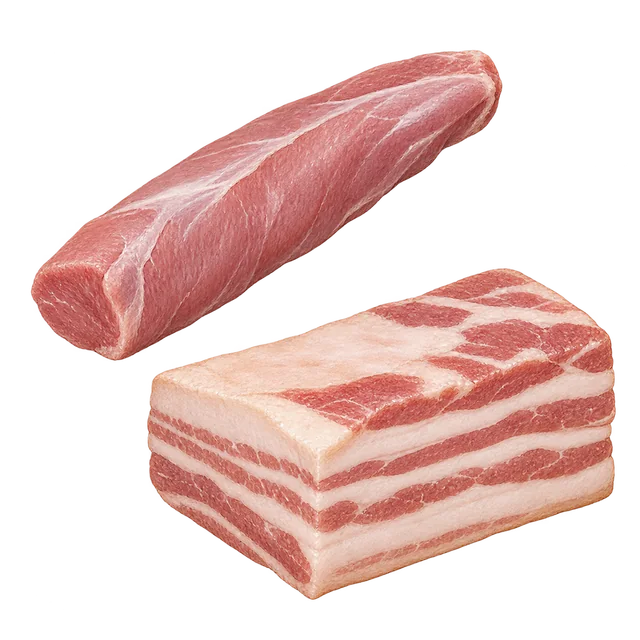
- Lean tenderloin
- Mostly muscle, with less fat: a source of protein.
- Belly fat layers
- Pale fat alternates with muscle; belly has more fat and calories than tenderloin.
Illustration for understanding; not to scale. Saved figures include explanations and sources.
Background · Common cuts, lean to fatty
Common cuts, roughly from lean to fatty:Tenderloin and loin: the leanest, with a high share of proteinLeg and shoulder, with the fat trimmed: fairly lean, good for braisingShoulder butt: lean with some marbling, tenderBelly: alternating layers of fat and lean, the fattiest
Pork is one of the most-eaten meats in the world. Because it is pale, many people are surprised it counts as red meat. What decides red meat is the myoglobin and heme iron in the muscle; pork has both, just less than beef or lamb. How calories change with the cut, and where the B vitamins are, are covered in the chapters on lean-pork protein and on vitamin B1.
Chapter 2
Protein and calories in lean pork
Pork protein is complete, with all nine essential amino acids, and it is rich in leucine, which supports keeping and building muscle (see Protein & Amino Acids).
Numbers · Read raw and cooked figures separately
When you compare figures per 100 g, keep raw and cooked meat apart. Cooking drives water out, so by weight cooked pork is more concentrated in protein and fat, and frying adds oil on top.So any talk of pork calories has to start with the cut and then with raw versus cooked. The same tenderloin gives different numbers per 100 g raw and pan-fried, and at the same weight, tenderloin and belly can differ threefold in calories.
Chapter 3
Pork fat isn't all saturated
One honest caveat: pork's polyunsaturated fat is far more omega-6 than omega-3, so pork is not a good source of omega-3. That is where oily fish is strong (see Fat Types and Fats & Omega-3).
A pig's feed can rewrite these proportions, which is not true of cattle and sheep. As for cholesterol, lean pork has about 60-70 mg per 100 g, on par with most lean meats; for most people, dietary cholesterol affects blood lipids less than saturated fat does.
Mechanism · Why pork fat follows the pig's feed
Pigs have a single stomach, so the fat they eat shows up fairly directly in the meat, which is not true of cattle and sheep. Where exactly the difference lies is worth filling in, because it decides for which animal you can read the fat makeup off the feed.Cattle and sheep feed passes through a microbial step first
Before the true stomach, cattle and sheep have a rumen, where microbes digest the forage first. Unsaturated fat from grass that enters the rumen gets hydrogenated by those microbes and straightened: the bends in the chain are filled in one by one, and the fat becomes saturated again. So whatever the animal is fed, the fat that finally settles into beef and lamb has already been trimmed by this step (see Beef).
Pigs have no such step
A pig has only one stomach. The fat it eats is absorbed directly in the small intestine and carried, largely unchanged, to fat tissue for storage, with no microbes rewriting it along the way.
So the same change in feed has very different effects in the two animals:
Feed cattle a ration rich in unsaturated fat, and most of it is flattened in the rumen; the meat changes little.Feed pigs the same ration, and the change shows up quite directly in the makeup of the lard.
That is why flaxseed-fed pigs really do end up with different fat, and why the fat makeup of lard is not a fixed property of the species but a quantity that shifts with how the animal is raised.
Monounsaturated fat makes up a large share of lard, mainly oleic acid, the same molecule that dominates olive oil. And because the whole profile shifts, is lard healthy? has no single answer: the makeup of the jar in your hand depends partly on what that pig ate.
One thing does not shift
This chain changes the makeup of the fat. It cannot change the total amount of fat or the calorie density. Belly is still belly, and tenderloin is still tenderloin.
So the right use of this point is to explain why lard is not as all saturated as many people think. It is not a reason to eat more fatty cuts: the cut is a much bigger lever than the fat makeup.
Chapter 4
Especially rich in vitamin B1
B1 governs how sugar becomes energy. After rice and noodles are broken down into glucose, the glucose has to get inside the mitochondria before it really burns for energy, and there is a checkpoint at the door. In the body, B1 is converted into TPP (thiamine pyrophosphate), the card that checkpoint requires. Without enough cards, sugar piles up outside.
So when B1 runs short, the first to fail are the nerves and the heart, which use the most energy and can least switch to other fuels. The numb hands and feet, swelling, and heart failure of beriberi all begin with this checkpoint jamming.
Mechanism · Why beriberi shows two faces
B1 stands at the checkpoint where sugar becomes energy, but that sentence is still only a conclusion. Walk it through step by step, and the seemingly unrelated symptoms of beriberi, numb legs, a fast heartbeat, and swollen legs, turn out to be different exits from the same jam.First, where the checkpoint is
Rice, noodles, and sugar are first broken down in the cell's cytoplasm into an intermediate called pyruvate. Very little energy has been released by this point. The real energy plant is inside the mitochondria, and pyruvate has to be converted into another form before it is allowed in.
The conversion is done by an enzyme complex called pyruvate dehydrogenase. It is like a machine that will not start until a tool head is fitted, and that tool head is TPP, the form the body turns B1 into.
So the chain runs like this: B1 becomes TPP, TPP fits onto pyruvate dehydrogenase, pyruvate can then enter the mitochondria, and sugar actually becomes energy. A B1 shortage breaks the first link, but the damage shows at the last one.
What happens when pyruvate piles up outside
It does not just wait. Pyruvate that cannot enter the mitochondria is turned into lactate, the same substance that makes muscles burn during hard exercise. Normally this is a brief emergency exit. When B1 is badly short, the exit becomes the default, and the acid in the blood stays high.
This step is worth remembering on its own, because it explains something counterintuitive: a person can eat until full, with blood sugar that is not low, and still be in an energy crisis. Fuel keeps arriving; it just cannot get into the furnace.
Why nerves and the heart fail first
Every tissue uses this checkpoint, but their tolerance differs widely.
Nerve cells burn almost nothing but sugar and store almost no energy. Other tissues can switch to fat for a while when sugar runs short, but nerves have little fallback: once the checkpoint jams, they have nothing to use.Heart muscle can never stop. It beats from before birth to the end of life and has the highest demand for a steady energy supply, with no lower gear to drop into.
The more an organ depends on burning sugar, and the less it can stop working, the earlier it shows the shortage. That is not a coincidence; it follows directly from where the checkpoint sits.
The two faces of beriberi are two exits from the same jam
The nerve-leaning form: numbness, tingling, and weakness starting at the tips of the hands and feet, and an unsteady walk. The longer the nerve fiber, the farther its tip is from the cell body, and the first to fail when energy runs tight.The heart-leaning form: a fast heartbeat, shortness of breath, and swelling in the lower legs. The order is often told backwards. It is not heart failure first and swelling second. The blood vessels in the limbs relax first, the heart is forced to keep pumping harder to maintain circulation while itself short of energy, it cannot keep up, and fluid starts to collect in the legs.
Put both forms back at the checkpoint and there is nothing to memorize: in one, the tissue that can least afford a power cut fails first; in the other, the pump that can least afford to stop wears out first. Numbness and weakness in the hands and feet, shortness of breath, or swollen legs call for a doctor: heart failure and nerve damage from B1 deficiency need medical treatment, not a few extra meals of pork.
A few things you can work out yourself
The more carbohydrate you eat, the more B1 you need. Traffic through this checkpoint is set by sugar, and more traffic needs more tool heads. So people who live mainly on refined staples and eat little else sit exactly where high demand meets low supply.The more refined the staple, the less B1 it brings. The outer layers of the grain are where B1 is concentrated, and milling removes them. Historically, large outbreaks of beriberi followed the spread of polished rice.B1 is water-soluble, and the body stores very little of it. Unlike fat-soluble vitamins, it does not last long in the body, so you need a source every day rather than a lot in one meal.It is sensitive to heat and water. Long cooking at high heat and boiling in plenty of water both lose it, and much of what is lost dissolves into the broth: when you stew pork, drinking the broth brings back more than flavor.
Where pork fits in this chain
Back to the opening number: few common foods can raise B1 intake as clearly in one meal as lean pork. For people who eat rice and noodles every day and rarely eat whole grains or legumes, it is a low-cost way to fill the gap.
One honest limit: why pork has so much more B1 than beef or lamb is not explained here with an invented mechanism. It is a fact read from food-composition data, not derived from a published mechanism, so we say that it is high, not why.
Background · What pork brings besides B1
B1 is pork's signature, but it does not come alone. The nutrients below live in the same lean cut. Each one's mechanism is covered in its own story; this page only explains why they show up together.Pork's other nutritional highlights:
Zinc: involved in immunity and in building tissue, and better absorbed from animal sourcesVitamin B12 (Vitamin B12): in natural foods it is found almost only in animal foods, and both blood-making and nerves depend on itSelenium: a core part of antioxidant enzymesNiacin (vitamin B3): involved in -related energy metabolism
Pork also contains heme iron, which is absorbed better than the non-heme iron in plants, though pork has less of it than beef or lamb. One lean cut delivers protein, B1, zinc, B12, selenium, and B3 at once, and that is its real value on the plate.
The list has one thing in common
They all travel with the lean part. Protein, B1, zinc, and selenium live in muscle tissue because they are parts the muscle needs to do its work; fat tissue supplies almost nothing but calories.
So for the same hundred grams of pork, choosing tenderloin or belly changes more than the calories: it changes how concentrated this whole list is. In a hundred grams of belly, more than half the weight has no place on this list at all.
That is why this story keeps coming back to the cut. The cut is not a matter of taste; it is the nutrient density of the meat. If you want what is on this list from pork, choosing the right cut does more than eating more of it.
Chapter 5
What it lacks · how to pair
Some practical pairings:
Vitamin-C-rich produce (peppers, tomatoes, citrus): vitamin C helps you absorb the iron from plant foods in the same mealWhole grains or tubers: add fiber and carbohydrateDark leafy greens: add calcium, folate, and vitamin C
Raw fish and raw shellfish contain an enzyme that breaks down B1, but heat inactivates it, so cooked meals are almost never a concern. For how to balance the whole plate, see Fruit & vegetables.
Mechanism · An enzyme that takes B1 apart
The thiaminase in raw fish and raw shellfish breaks B1 down, but the enzyme is inactivated by heat. That sentence is right; it just squeezes three separate points into one line, and each is useful on its own.First: what the scissors cut
The B1 molecule is two rings joined by a short bridge. Thiaminase does one simple job: it cuts the bridge in the middle. Both fragments are still there afterward, but they can never be joined again, so they can no longer be turned into TPP. In other words, this is not absorption getting worse. The molecule itself is destroyed.
There is a further catch: this happens both in your bowl and in your gut. Whenever raw fish or shellfish sits together with a food containing B1, the scissors are at work, and they do not care whose B1 it is. The share contributed by other foods in the same meal gets cut too.
Second: why heat solves it in one move
The scissors are themselves a protein, and a protein works only because of the shape it is folded into. Heat unfolds that shape; once it is unfolded, the active site no longer fits its target, and the enzyme is ruined for good.
That is the key difference between an enzyme and an ordinary chemical contaminant: a chemical is often still there after heating; an enzyme is gone. So the answer to a problem caused by an enzyme has always been cook it, not eat less of it.
Third: so the risk is long-term, not one-off
Put the first two points together and you can judge for yourself whether to worry:
An occasional plate of sashimi: some of the B1 in that meal is cut, and that is all. The body takes in B1 from other foods every day, and one meal's loss gets diluted.Eating mostly raw fish, in large amounts, for a long time, on top of refined staples: that is the squeeze from both ends, with little coming in and much being cut. This kind of deficiency has happened in history, and the settings were always day after day, not a single meal.
The same chain works elsewhere
You can carry the same question to other claims. Next time you hear that some food destroys a nutrient, ask first: does it work through an enzyme? If it does, whether it was heated decides nearly the whole answer. If it does not, then dose and frequency still need asking.
Back to pairing
Pairing pork with whole grains and with fruit and vegetables is about filling in the fiber, vitamin C, and complex carbohydrate it lacks. Those three pairings were never meant to protect B1; they complete a meal. Keep the two ideas apart.
Chapter 6
How to cook it safely
The current US Department of Agriculture (USDA) guidance:
Whole cuts (ribs, loin, roasts): bring the center to 63°C (145°F), then rest for 3 minutesGround pork and fillings (sausages, patties): bring the center to 71°C (160°F)Judge doneness with a food thermometer, not by color
So a little pink in the middle is acceptable, as long as the temperature has been reached.
Mechanism · Why whole cuts and ground meat differ
In 2011 the USDA lowered the safe temperature for whole cuts of pork from 71°C to 63°C, on the grounds that this temperature plus a rest is enough to inactivate disease-causing microbes, and the meat stays more tender. So there are now two center temperatures: one for whole cuts, and a higher one for ground meat. Many people treat them as two rules to memorize. They are really one principle applied to two shapes.Start with a question: where were the bacteria to begin with?
The inside of a whole muscle is almost sterile to begin with, because it was sealed inside the living animal. Contamination happens on the surface: slaughter, skinning, cutting, and packing, plus your cutting board and hands. Every contact happens on the outside.
So in a whole cut, what really has to be heated through is the outer layer. And in a pan or an oven, the outer layer always reaches temperature before the center: by the time the center climbs to the required number, the outside has been past it for a long while. A little pink in the middle is therefore not a danger sign. It only means the heat has not fully traveled inward, and the inside was never where the contamination was.
Grinding removes that premise entirely
What grinding does is specific: it mixes the original surface into the center. Bacteria that used to sit only on the outside are now spread through the whole mass. The natural advantage of the surface cooking first is gone: any spot may once have been surface, so every spot has to reach the mark on its own.
Once the requirement becomes every spot reaches the mark, the threshold has to be set higher and more cautiously. The higher temperature for sausages, patties, and fillings is the price paid for that.
Follow the same reasoning and you can work out a few more:
Grinding a whole cut at home carries the same risk as buying ground meat: what decides the risk is the act of grinding, not who does it.Piercing a whole cut, injecting a marinade, or mechanically tenderizing it also carries surface bacteria into the center. Whole cuts treated this way are closer to ground meat for safety.Rolled meat, diced meat, and chopped fillings are all cases where the surface has been tucked inside.
What the minutes of rest are doing
The rest that follows the temperature is often treated as a cooking trick to let the juices settle. It does that, but it is also part of the safety rule.
Inactivation does not finish the instant a temperature is reached. It keeps going while the meat stays at temperature. After you take it off the heat, the heat stored in the outer layer keeps moving inward, and the center temperature usually does not fall but climbs a little more. Throughout that time the meat stays at an effective temperature, and the inactivation keeps adding up.
Put another way: the thermometer reading is the ticket, and the minutes of rest are the time in your seat. You need both for the full rule. Cutting the meat the moment it hits the temperature uses only half the rule.
Trichinella is the easiest part of this rule
Cooking through remains the baseline. It is worth adding that cooking to the temperatures above takes care of this parasite as well; it is not a reason to add extra degrees. Neither panic nor an extra margin is needed; the line already set is the one to keep.
Freezing can also work against it under certain conditions, but that cannot be extended to every wild source. Wild boar and other game should still be cooked through.
A last word on color
Pork has less myoglobin than beef or lamb to begin with, so it already looks quite pale before it reaches temperature. That makes judging doneness by color more misleading for pork than for redder meats: it pushes you to take the meat off too early. A thermometer measures the thing you actually care about; color is only a related stand-in, not the same thing.
This is general safety information and does not replace specific guidance from a doctor or your local food-safety authority.
Chapter 7
Choosing, cooking and portions
Cooking: low and slow (braising, simmering, steaming) is steadier than fierce high heat and chars less. Do not overcook lean cuts; 63°C with a rest is tender enough. Eat bacon, sausage, cured pork, and other processed meats sparingly; they are a separate kind of risk, covered in Red & processed meat.
How much: pork is red meat. A common recommendation is to keep red meat to no more than about 500 g a week, and processed meat as low as possible.
In practice · Who can lean on it, who should hold back
Lean pork is a fine protein source; the three things that matter are lean cuts, gentle cooking, and little processed meat.Who can lean on it: meat-eaters who need more B1, zinc, and B12. One piece of lean pork brings all of them together.
Who should hold back: people with a family history of cardiovascular disease or colorectal cancer should lean toward less processed meat and fewer fatty cuts. For personal medical questions, consult a doctor.
Chapter 8
Is pork unhealthy?
So the issue is which cut, cooked how, not pork being dirty in itself. Eaten in moderation, lean pork is a good source of quality protein, B1, zinc, and B12.
Myth · Is pork dirty or unhealthy?
The first layer is the old parasite impression. As the chapter on how to cook pork safely explains, trichinella is now rare in commercial pork, and bringing the center to 63°C with a rest takes care of it, so it is no longer an everyday risk. Wild boar and other game are the exception.The second layer is cultural and religious food rules. Those are choices of faith and tradition, not conclusions of nutrition science, and the two should not be mixed up.
Only the third layer has real nutritional grounding. Fatty cuts such as belly, and processed pork such as bacon and sausage, really are higher-fat, higher-sodium, higher-risk ways to eat it. The International Agency for Research on Cancer (IARC) classifies processed meat as a Group 1 carcinogen and unprocessed red meat as Group 2A (probably carcinogenic). These groups describe how certain the evidence is, not how large the risk is.
So the accurate statement is not pork is unhealthy but go easy on fatty cuts and processed forms; lean pork in moderation is a good food. That matches the general advice for all red meat.
References · 9
- U.S. Department of Agriculture, Agricultural Research Service. (2019). FoodData Central: Pork (fresh loin/tenderloin/belly, raw and cooked). Lean pork is among the richest common dietary sources of thiamine (B1). fdc.nal.usda.gov
- Carson, J. A. S., Lichtenstein, A. H., Anderson, C. A. M., Appel, L. J., Kris-Etherton, P. M., Meyer, K. A., et al. (2020). Dietary cholesterol and cardiovascular risk: A science advisory from the American Heart Association. Circulation, 141(3), e39-e53. Saturated and trans fats raise LDL more than dietary cholesterol itself. 10.1161/CIR.0000000000000743
- National Institutes of Health, Office of Dietary Supplements. (2021). Thiamin — Fact Sheet for Health Professionals. ods.od.nih.gov/factsheets/Thiamin-HealthProfessional
- National Institutes of Health, Office of Dietary Supplements. (2022). Zinc — Fact Sheet for Health Professionals. ods.od.nih.gov/factsheets/Zinc-HealthProfessional
- National Institutes of Health, Office of Dietary Supplements. (2024). Vitamin B12 — Fact Sheet for Health Professionals. Fact sheet (updated July 2, 2025; Wayback snapshot 20 September 2026): multivitamin/mineral supplements typically contain 5 to 25 mcg B12, B-complex products 50 to 500 mcg, B12-only supplements typically 500 to 1,000 mcg; absorption is only about 2% at 500 mcg and 1.3% at 1,000 mcg; a 2018 Cochrane review of 3 RCTs (153 participants) compared very high oral doses (1,000-2,000 mcg) with intramuscular B12; high oral doses (e.g. 1,000 mcg/day) might be equally effective in Crohn's disease and appear as effective as hydroxocobalamin injections after Roux-en-Y bypass. These are product contents and trial doses; the sheet gives no recommended daily supplement range (fact sheet). ods.od.nih.gov/factsheets/VitaminB12-HealthProfessional
- National Institutes of Health, Office of Dietary Supplements. (2021). Selenium — Fact Sheet for Health Professionals. Table 2: Brazil nuts, 1 ounce (6-8 nuts), 544 mcg selenium (989% DV); the text says Brazil nuts contain 68-91 mcg per nut and could cause selenium toxicity if consumed regularly, and that values from other analyses vary widely. The version read carries 'Updated: April 15, 2024' (Wayback Machine snapshot of 31 December 2024), newer than the 2021 date above (fact sheet, read 2026-09-24). The September 4, 2025 update (Wayback snapshot 19 September 2026) adds: the body absorbs up to about 90% of selenium from selenomethionine, selenium-enriched yeast, selenite and selenate; selenium-only supplements typically contain 100 to 400 mcg; Keshan disease, an endemic cardiomyopathy first identified in 1935 in low-selenium parts of China, fell dramatically after selenium intervention trials in the 1970s-1990s; in 2017 the American Thyroid Association issued a weak recommendation against selenium supplements for TPOAb-positive pregnant women (fact sheet). ods.od.nih.gov/factsheets/Selenium-HealthProfessional
- U.S. Department of Agriculture, Food Safety and Inspection Service. (2020). Safe minimum internal temperature chart. Whole pork 63 °C (145 °F) + 3-min rest; ground meat 71 °C (160 °F); poultry 74 °C (165 °F). www.fsis.usda.gov/food-safety/safe-food-handling-and-preparation/food-safety-basics/safe-temperature-chart
- Centers for Disease Control and Prevention. (2024). Trichinellosis — epidemiology & risk factors. Now rare in commercial pork in developed regions; wild game still carries risk; cooking to safe temperature inactivates the parasite. www.cdc.gov/parasites/trichinellosis
- Bouvard, V., Loomis, D., Guyton, K. Z., Grosse, Y., Ghissassi, F. E., Benbrahim-Tallaa, L., et al. (2015). Carcinogenicity of consumption of red and processed meat. Lancet Oncology, 16(16), 1599-1600. IARC classifies processed meat as Group 1 carcinogen, red meat as Group 2A. 10.1016/S1470-2045(15)00444-1