Story
Oysters
Last updated
In one pass Oysters eat by pumping seawater through their own bodies.
Educational content, not medical advice — consult a clinician.
Story path
Chapter 1
What oysters are · filter feeders of the sea
An oyster is a bivalve that spends its whole life fixed in one place, filtering the same patch of seawater through its gills again and again. Zinc from the water is kept a little at a time, which makes oysters one of the highest-zinc common foods. Which proteins zinc holds up, and what breaks first when it runs short, is the subject of the later chapter on what zinc does in the body.
If you get fever with chills, feel dizzy or unsteady on your feet, or see painful red patches or blisters on your skin after eating raw shellfish, go to the emergency department right away and tell the doctor you ate raw shellfish. People with liver disease, diabetes, cancer or a weakened immune system are at the highest risk and should not eat them raw.
Oysters go by many names in China: shenghao in Guangdong, hailizi in the north, and haochi once dried. The most widely farmed species in the world is the Pacific oyster, and China is the largest producer, so oysters are not expensive there — they are the high-zinc food ordinary people can most easily get. Eating them raw (with lemon or vinegar) is the mainstream in French and Japanese cooking; grilling over charcoal, steaming, baking with garlic and glass noodles, or frying into an omelet brings the risk down.
Mechanism · one pump, two consequences
Slow this pump down and walk through it once, and every later judgment about oysters you can derive yourself.Oysters do not swim. Once a larva settles on a reef or a hanging rope, it cements itself there with its shell and never moves. An animal that cannot chase food has one path left: let food flow to it. So the gills are not only a breathing organ — they are a filter. Dense cilia on the gill surface beat like countless tiny oars, always in the same direction, pulling seawater in one side of the shell, across the gills, and out the other. Algae and debris hit the gills, stick in mucus, ride grooves into the mouth; the leftover water is dumped.
The key is that this pump runs for a lifetime, and it always draws the same water. Whatever is in that water slowly becomes whatever is in the body:
Zinc in the water (dissolved, and stuck to algal particles) comes in with the water and the food, and is kept in the tissue, accumulating a little at a time. So an oyster is not accidentally high in zinc — it has been saving it for a long time. The zinc in its body is inventory after months of seawater running through it, pass after passViruses and bacteria in the water are caught by the same mucus and left in the same meat. They do not make the oyster sick, and they do not change how it looks or smells, so from the outside you cannot tell
Nutrition and risk are therefore two ends of the same chain, which also lets a few common questions answer themselves:
Why do origin and water quality get written into its nutrition table? Because its body is a record of that waterWhy is raw eating riskier in hot weather? Because bacteria multiply faster in warm seawater, and the oyster keeps pumping that water just the sameWhy can even a clean restaurant not stop it? Because the concentrating happened before it was hauled up, in the water — the only kitchen move that changes the outcome is heat
Keep this one line, and zinc, iron, and Vibrio later are not three facts to memorize. They are three results of the same action.
Chapter 2
A high-protein, low-fat shellfish
Those numbers are for the Eastern oyster. The Pacific oyster, the species China farms most, is denser: the same 100 g has about 81 kcal and 9.4 g of protein — about 60% more. So when you read a nutrition figure for shellfish, the first question is which species; the zinc chapter later runs the same check on zinc.
Oyster protein is complete protein: it has all nine amino acids that the body cannot make and must get from food, and among shellfish it is one of the easier ones to digest. That is worth remembering more than the protein total. How the body takes protein apart and rebuilds it is covered more fully in Protein & Amino Acids.
As with most seafood, cooking drives out water, so protein and sodium per gram both rise; frying also soaks up extra oil. Read raw and cooked figures on a nutrition table separately.
Numbers · how much meat a dozen oysters actually is
The 100 g on a nutrition table is the edible portion, not the weight of the plate you set down. Skip this conversion and every later estimate tilts.A medium oyster in the shell is about 60-80 g, but the meat you can eat after shucking is only 10-15 g — the shell is most of it. So a dozen (12) oysters on the market is roughly 120-180 g of edible portion, which, using the Eastern oyster figures, holds about 7-10 g of protein.
Hold that ratio and a lot of claims fall apart on their own. Someone uses zinc per gram of meat to scare you, but treats shell weight as meat weight, and the how many it takes to go over is off by several times. Someone else decides a dozen oysters delivers almost nothing, forgetting that minerals are counted on the meat — and that serving is not small at all.
A useful habit: when you see a shellfish nutrient figure given by weight, convert it in your head to the meat of how many oysters first, then decide what the number means for you.
Mechanism · where complete in complete protein actually sits
Complete protein is stamped on the packaging of almost every high-protein food, but it does not mean a lot. It means all present.Protein is not absorbed as a whole block after it enters the stomach and small intestine. Digestive enzymes cut it into short peptides and amino acids, those are absorbed into the blood, and the body rebuilds them on its own blueprint into what it needs — muscle fiber, antibodies, enzymes, hair. Of the twenty-odd amino acids, some the body can make; nine it cannot, and must take from food. Those nine are the essential amino acids.
The assembly rule is rigid: whichever one the blueprint calls for has to be on the floor. Miss one and the whole line stops at the missing step; the other parts already there have nowhere to go, and get broken down and burned as fuel. So judging a protein is not just looking at the total. You look at how far the shortest of those nine can carry you — how much water a barrel holds is set by the shortest stave.
Oyster protein has all nine, and shellfish muscle is relatively easy for digestive enzymes to cut, so the share that actually reaches the blood is high as well. Those two facts together are what the complete protein label actually means: not a content champion, but no short stave.
That also clears a common confusion: why eating one plant protein alone is often called not enough, while beans and grains in the same day work. Their short staves are not the same one — what one lacks, the other can give. The line wants all present. It does not care which plate a part came from.
Chapter 3
Fat structure · low fat, not a fish-oil dose
The fat they do have holds a little and (the two omega-3 fatty acids in fish oil), but the amounts are small: per 100 g of raw oyster, about 0.3 g in the Eastern oyster and about 0.7 g in the Pacific oyster, against about 2.0 g in farmed Atlantic salmon — several times less whichever species you pick. So oysters are a low-fat food, not a reliable omega-3 source. If you want EPA and DHA, eat oily fish such as salmon (Fats & Omega-3).
For cholesterol, raw oysters carry about 25-50 mg per 100 g (wild Eastern 40, Pacific 50, farmed Eastern 25), below shrimp and crab. For most people, cholesterol in food moves blood lipids far less than saturated fat does; the fuller breakdown is in Eggs and Shrimp.
An oyster's value was never its fat. It lies in micronutrients such as zinc.
Mechanism · why low fat is built not to hold a fish-oil dose
Put the Fish Oil figures for oysters and salmon side by side and you can derive something more useful than the numbers themselves.and are fatty acids. They can only live in fat. How much fish oil a food can hold is capped by how much fat it has. An oyster's total fat (about 1.7-2.3 g per 100 g, depending on species) sits in the same order of magnitude as the EPA+DHA in the same weight of salmon (about 2.0 g) — meaning even if all of an oyster's fat were those two fatty acids, it could at best tie, and in fact only a small share is. That is not something origin, season, or cooking can change. It is a structural ceiling.
So seafood for fish oil treats a whole ocean as one thing. What actually decides the Fish Oil amount is not whether it is seafood, but how much fat this animal stored: salmon, sardines, and mackerel store oil in the muscle, so it is dense; oysters, shrimp, and cod are lean, so it is thin. Next time a seafood is sold as a Fish Oil treasury, look up its total fat first. The answer is usually already there.
The flip side: low fat is the oyster's strength. The same weight gives very few calories, but plenty of protein and minerals. A food does not have to cover everything; expecting it to replace fatty fish is what disappoints. Used where it is strong, it is very useful.
Now, why food cholesterol matters so little for most people. Most of the cholesterol in your blood is made by your own liver; only a small share comes in through the mouth. More important is a negative feedback between the two — when more arrives from food, the liver turns its own synthesis line down a little, and the total is leveled. That is why, for most people, one seafood meal that contains cholesterol does not push blood lipids straight up. Saturated fat walks a different road. It is not governed by this negative feedback, so the two cannot be treated as one. That also means: to judge whether a plate of seafood is friendly to blood lipids, look at how much saturated fat it carries and how it was cooked (fried, breaded, sauteed in butter) — not the cholesterol row on the panel.
Chapter 4
What zinc does in the body
Zinc is the nail that holds a shape. Many proteins that switch genes on and off first clamp a zinc ion with a short stretch of their chain, and only then fold into a shape that can grip DNA (these structures are called zinc fingers). Without enough zinc the shape collapses, and genes that should be read cannot be read.
So the first places to suffer when zinc runs short are the ones that must keep dividing and renewing — the gut lining, immune cells and taste buds. That explains something often treated as folklore: a person short of zinc may find food tasteless, heal slowly and catch more colds. These are not three illnesses; they are one loose nail.
Fill the gap and these functions return to where they belong. In someone who is not short, eating more changes nothing: the sites that need zinc are already full, most of the extra leaves in the stool, and it does not turn into super-immunity (see Zinc).
Numbers · why this zinc figure comes in several versions
Online zinc figures for oysters are a mess, from the teens to the nineties. Most of them are not invented. They blended two different things into one range:Species: the American eastern oyster carries about 39 mg zinc per 100 g raw; the Pacific oyster (cupped oyster) — the species farmed most heavily in China — carries only about 16.6 mg, more than twofold less. In a Chinese kitchen you are usually eating the latterPreparation: cooking and canning concentrate by water loss; the same eastern oyster runs about 61 mg roasted and about 91 mg canned. Those scary high numbers come from concentration, not from some magic harvest site
The second point especially is worth getting clear. Cooking did not invent zinc. It only drove the water out — after the same oyster is roasted, there is more zinc per gram of meat, but the total zinc in the oyster you swallowed did not change. Comparing raw and cooked by weight is really comparing water content.
Even on the conservative 16.6 mg, the US Recommended Dietary Allowance () for adults is only 8-11 mg, depending on sex — a serving of 6 oysters (about 70-90 g edible portion) still covers or exceeds a day's need. The conclusion that oysters are a high-zinc food does not rest on the biggest number, which is exactly why it holds.
A general way to read numbers is hiding here too. See a startling nutrient figure, ask three questions first: which species, raw or cooked, and on what weight. After those three, most superfood claims shrink to ordinary size on their own — and the ones that truly hold do not change after you ask.
Mechanism · why zinc is needed daily and extra does nothing
Textbooks often write zinc is a cofactor for over 300 enzymes. That sentence is true, but it gives the reader no picture. Swap in the picture of a nail and it is much clearer: zinc usually does not join the reaction itself. It stands there and holds the protein in a shape that can work.Push that picture down and several commonly asked things all have answers.
First, why zinc must be eaten every day. The body has no dedicated zinc warehouse. Calcium has bone; iron has stores in the liver and spleen; zinc has no matching organ — almost all of it is locked in proteins that are working right now, and pulling one out means that protein stops. So the body does not manage zinc by opening a granary. It turns two knobs: the share absorbed in the gut, and the amount sent back from the gut wall into the lumen. Eat little, absorption goes up and export goes down; eat a lot and the reverse. This regulation is sensitive, but it has no stock to lean on, so a few weeks of not eating enough and the gap shows quickly.
Second, why extra does not make a replete person stronger. The zinc-finger sites that should be occupied are finite. Full is full — extra zinc has no new post, and most of it is blocked in the gut and leaves in the feces. This is the hole supplement zinc to boost immunity most often falls into: it tells fixing a broken part as bolting a turbo onto a working part. The first can be done. The second does not exist.
Third, why zinc-deficiency signals look the way they do. The picture already lets you derive it: the tissues that must turn over fastest cry out first. Taste-bud cells renew extremely fast, so dull taste and smell often appear first; immune cells have to proliferate in numbers during infection, so zinc-deficient people get infections more often and recover more slowly; skin and mucosa repair also need cell division, so wounds heal slowly and the corners of the mouth crack. In children there is one more — growth itself is division, so long-term zinc deficiency slows growth. You do not need to memorize these one by one. Remember the fastest-dividing places break first and you can derive them.
Put the three together and you get an intuition much more accurate than a little extra cannot hurt: zinc is an amount you fill level, not an amount you pile high.
Mechanism · why oyster iron is harder to absorb than meat's
Other highlights:Selenium: a core part of antioxidant enzymesVitamin B12: essential for blood formation and nerves; shellfish are rich in it (Vitamin B12)Iron: the amount is not low (about 4.6 mg per 100 g raw), but most of it is non-heme iron — direct measurement puts heme iron in the Pacific oyster at only about 0.85 mg per 100 g, so absorption trails red meat. This is often written the wrong way aroundCopper: competes with zinc for absorption; small amounts together are fine
One piece of oyster delivers zinc, selenium, B12, iron, and copper at once — its irreplaceable place on the plate. And precisely because zinc is so high, anyone eating large amounts every day should heed the dose note in the later chapter on choosing oysters and how many to eat.
The iron line is worth unfolding, because it is the claim about shellfish that gets written backwards most often.
Iron has two roads into the body. Heme iron is an iron atom locked in a flat ring; the gut wall moves the whole ring, iron and all, through a dedicated channel of its own — almost nothing beside it can block it, so iron from red meat is absorbed at a high and stable rate. Non-heme iron is a bare iron ion: it has to be loosened from the food first, then reduced into a form that can pass, and it walks through a door it shares with other metals. That road is full of checkpoints — polyphenols in tea and coffee, phytate in whole grains and legumes, can grab it and walk it out, while vitamin C can escort it through (that is what the advice to pair oysters with lemon is about).
Most oyster iron takes the second road. This was measured directly, not inferred from a story: someone split the iron in several molluscs into heme and non-heme, and Pacific oyster carries only about 0.85 mg heme iron per 100 g against several mg of total iron — almost all the rest is on the second road. Red meat is the opposite: its muscle hangs oxygen on hemoglobin and myoglobin, so heme iron is everywhere. Oyster iron looks decent in total; the share that can be moved in efficiently is much smaller than red meat's.
Watch an inference that comes out too easily: you cannot decide the iron is non-heme just because it is a shellfish. The same bivalve class, the blood clam (Anadara) really does use hemoglobin — its meat is red, and the heme-iron share is not the oyster's. Difference inside one class of animal is that large, so this has to be measured species by species. You cannot derive it from shellfish are like that.
So the claim that shellfish beat red meat for iron mixes amount with absorption rate into one thing. Oysters can certainly be one iron source, but if you are seriously treating iron deficiency, they should not be the main one. The same test can be reused: a nutrition panel only writes how much is here. It never writes how much you can take.
Mechanism · selenium is an enzyme part, not an antioxidant
The line selenium is a core part of antioxidant enzymes goes by too fast. Unfold it and you get a judgment tool that works on many supplements.When cells burn sugar and fat for energy, they leak a little hydrogen peroxide and other highly reactive molecules. At low concentration those are signals; at high concentration they smash membranes, proteins, and DNA. The body does not handle them by sending some antioxidant substance to die with them. It keeps a crew of dedicated enzymes stationed where leaks are likely, taking hydrogen peroxide apart into water on the spot.
Selenium sits inside that crew. It is not the side that goes out to neutralize free radicals. It is embedded in the enzyme's active site and becomes the cutting edge of those scissors — without that edge, the enzyme folds and still cannot work.
That difference decides what the dose curve looks like. Part-type nutrients share a rule: once enough enzyme is made, extra parts have no post, and more will not make more enzyme or make it turn faster. So more selenium, more antioxidant power was pointed the wrong way from the start. It treated a part as a consumable. Selenium is also one of the few trace elements with a narrow safe window; long-term excess is toxic — which makes more is better especially dangerous on it.
Selenium in an oyster arrives with the whole food, at a dose inside the natural range. That is a different thing from swallowing a high-dose supplement pill (see Selenium).
Chapter 5
What it lacks · how to pair
Pair whole grains or tubers for fiber and carbs; dark leafy greens for calcium, folate, C; lemon for brightness, and the vitamin C helps plant iron in the same meal. Oysters are molluscs, shrimp and crab are crustaceans — two allergen classes. Some people react to both, some to one.
Mechanism · in one meal, minerals are always being grabbed
Pairing oysters with whole grains, dark leafy greens and lemon looks like common sense. Underneath, one mechanism is doing the work: for a mineral to be absorbed, it first has to stay in a form that can be carried in the gut, and the other parts of the same meal are always grabbing at it.That squeeze of lemon is help. Iron in plants is a bare ion. In the gut's environment it oxidizes easily into an insoluble form; once it clumps and settles, it cannot be moved. Vitamin C reduces it back to a soluble form and escorts it to the absorption site so nothing else snatches it halfway. The key is that this has to happen in the same meal — an orange one meal later, and the iron from that plate is already gone.
The bowl of whole grains has a cost. Grains, legumes, and nuts hold phytate, the plant's way of storing phosphorus, with several claws in the structure that grab metals. In the gut it locks zinc, iron, and calcium together, and humans have no enzyme that can take it apart, so the grabbed share leaves intact. Pair with whole grains is fully true on fiber; on minerals it takes a discount.
On an oyster meal, that discount does not change the conclusion, because the zinc base is so high — phytate blocks some, and what remains is still a day's worth. The people this mechanism actually traps are another group: vegetarians who get most of their zinc from legumes and whole grains. The same phytate, dropped on an already tight zinc intake, shows the difference at once. That is the real reason behind vegetarians are more likely to be short of zinc — not because plants have no zinc, but because that zinc was grabbed.
A common confusion along the way: if phytate blocks zinc, should you eat fewer whole grains? No. Soaking, sprouting, and fermenting (sourdough, for one) can break down some of the phytate, and the fiber and other nutrients from whole grains are real. What you adjust is the method, not the food — a line that applies to a lot of panic about antinutrients.
Put both sides together and an ideal oyster meal is easy to set: oysters cover zinc, protein, and trace minerals; a soaked or fermented staple covers carbohydrate and fiber; a squeeze of lemon handles flavor and the plant iron in the same meal. The three do not fight, and you can now say why for each.
Chapter 6
Key knowledge · the raw-eating risk is real
For healthy adults, most infections are a bout of gastroenteritis that clears up on its own. But one kind of Vibrio, Vibrio vulnificus, is a completely different matter: about 1 in 5 people infected with it die, sometimes within a day or two of falling ill. The flesh-eating bacteria in news stories is usually this one.
The high-risk groups named by the US Centers for Disease Control and Prevention (CDC) — liver disease (including cirrhosis), cancer, diabetes, a weakened immune system, plus iron-overload conditions such as hemochromatosis, and people who take acid-suppressing drugs long term or have had stomach surgery — are more likely to develop a bloodstream infection and dying skin lesions after infection, and should avoid raw shellfish completely. In pregnancy, do not eat raw seafood either.
When you must go to the emergency department — if any of these appear after eating raw shellfish:
fever with chillsfalling blood pressure (dizzy, unsteady on your feet)painful red patches or blisters on the skin
— get medical care at once, and tell the doctor yourself that you ate raw shellfish. That last part decides which direction the doctor treats in from the start, and this infection does not allow delay.
A CLOSER LOOK
A body that feeds by filtering water
This is a specimen for identifying a shellfish, not advice to eat it raw; a fresh appearance does not rule out pathogens.
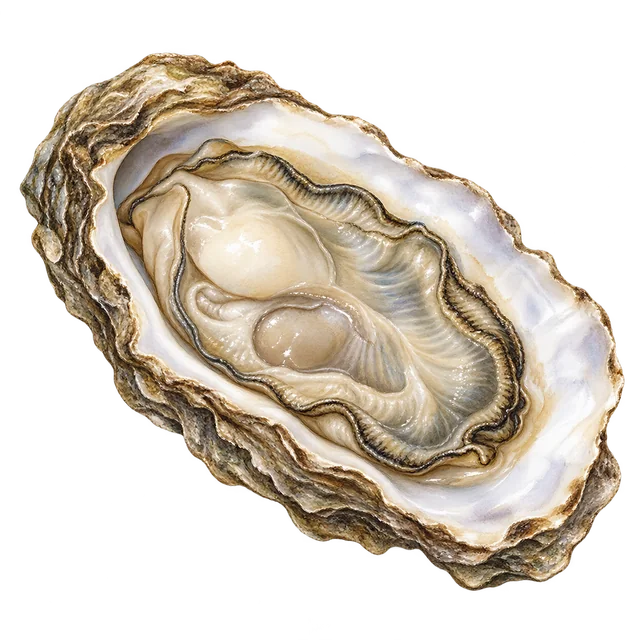
- Soft body
- Oysters are bivalves that feed by repeatedly filtering seawater through their gills.
- Shell and safety differ
- Filtering brings nutrients but may retain viruses and bacteria; the shell cannot establish safety.
Illustration for understanding; not to scale. Saved figures include explanations and sources.
Safety · why only heat actually works
Why acid-suppressing drugs and stomach surgery are also on the high-risk list: *Vibrio vulnificus* is iron-loving; iron overload is a pantry already stocked for it. Stomach acid itself is a barrier, and acid-suppressing drugs and stomach surgery thin that barrier. Avoiding raw seafood in pregnancy is advice on a different line (the same family of risk as listeria — see Foodborne Illness).It can also enter through a wound, not only by eating: soaking a cut hand in seawater, or a shell cut while shucking bare-handed, can infect. So wear cut-resistant gloves to shuck; if you have a wound on your hand, stay out of the sea and do not handle raw shellfish.
How to bring the risk down: buy from an intact cold chain, shells closed, no off-odor once opened; cook thoroughly — after steaming until the shells open, give it more time, to a center of at least 63°C (145°F) (CDC's number for shellfish; see Foodborne Illness). Heat kills virus and Vibrio. Cooked is the stabler choice for most people; raw is a flavor preference, not a nutritional necessity. This is general food-safety information. It does not replace local food-safety guidance.
On raw-oyster safety, the most widely circulated folk methods happen not to work, and they fail in a regular way — they treat looking clean as clean at the microbial level.
Lemon, hot sauce, and spirits do not kill Vibrio. Acid and alcohol need enough concentration, enough contact time, and they have to actually reach the bacteria. A dip only touches the surface, and Vibrio is in the oyster's tissue — that bite of acid reached your tongue, not the bacteria. Heat is the only thing that can do itLooks normal, smells normal, tastes normal, tells you nothing. Vibrio does not make the oyster sick, and it does not change how it looks, smells, or tastes. A contaminated one and a clean one on the same plate look identicalExpensive, labeled by origin, or from a famous restaurant is no exception. The concentrating happened before it was hauled up, in that water — the result of the same filtering pump. A cold chain and clean handling can stop bacteria from multiplying further in transit; they cannot take out what is already in the meat
Line the three up and one conclusion is left: on Vibrio and virus, the only move that truly changes the risk is heat. Every other fuss — origin, season, the rank of the restaurant, what condiment you pair — can shift the odds a little. It cannot remove the mechanism.
The scope has to be said clearly: the sentence above governs Vibrio and virus, not everything. Another class of risk heat cannot remove, and it can only be blocked by monitoring at the origin — so there is a separate rule: when a local red-tide or harvest-ban notice is out, do not eat shellfish from that water, raw or cooked. That does not fight the heat rule. They are two mechanisms, each with its own only working method.
That also explains why folk talk about raw oysters is so abundant and so unreliable: most people who eat raw oysters are fine (healthy adults were always likely to be fine), so every folk method can collect a pile of I have always eaten them this way and never had a problem. That testimony does not prove the method works. It only reflects that the baseline risk was already not high — and not high is not zero, and still less is it not high for high-risk groups.
Mechanism · why warm water raises risk and cooking kills it
These two facts are two ends of the same temperature curve.The hot end. Vibrio already lives in warm nearshore seawater. It is a resident of that water, not an outsider that arrives only with pollution. When the water warms they divide faster and the density rises; the oyster in that stretch keeps pumping that water through its body — the pump does not stop because the weather is hot. So the bacterial load inside the oyster mostly tracks water temperature. That is the only part of folk eat raw oysters only in the cold that holds: it caught temperature as a variable. It is not a safety guarantee, because norovirus is not afraid of cold.
The other hot end. Bacteria and viruses live on a set of proteins folded just so: the coat, the enzymes, the structures used to attach — all folded shapes. Heat shakes those shapes apart — once the temperature is high enough, the weak forces that hold the fold cannot hold, the protein opens, and it cannot fold back. That is irreversible, so a thoroughly heated oyster does not come back to life when it cools.
Why is a shell opening taken as a done signal? Because what pulls the two shells tight is a muscle, and muscle is protein too. While it is alive it keeps pulling, so the shell stays clamped shut; heat it far enough and that muscle's protein opens the same way, loses its pull, and the shell springs open on its own. Tap it when you buy and it closes: that muscle is still pulling (the oyster is alive). The shell springs open when you cook: that muscle has already denatured. Two states of the same muscle — one to pick with, one to judge doneness. You can read it from the outside because you are reading the state of a protein.
One caution: an open shell is only a starting to cook signal, not proof the center is hot enough. Steaming and grilling both want a little more time after the shell opens, especially on large ones. The Foodborne Illness story gives a number you can use: oysters and shellfish need a center of at least 63°C (145°F), not just a brief steam (CDC). This page is the principle; the exact temperature-and-time combination follows local food-safety guidance.
Chapter 7
Choosing, cooking and how much to eat
The UL is about a long-run daily amount; going over it at one occasional meal is usually harmless. Treat oysters as an occasional high-zinc meal, not a daily habit.
Who can lean on them more: people who need zinc, B12 and selenium but do not eat red meat. Who should hold back: pregnant people, and anyone with liver disease, diabetes, cancer or a weakened immune system, should not eat them raw; people with a shellfish allergy should avoid them; anyone eating large amounts for a long time should keep copper in mind. For your own situation, ask a doctor.
Mechanism · how eating a lot daily squeezes out copper
First, land buying and cooking. Choosing: pick live oysters with closed shells; a slightly open shell that snaps shut when tapped counts as alive. Shucked meat should be plump and glossy, with no sour odor. Frozen and vacuum-packed are fine if the cold chain is intact. Cooking: cooked is the safest — steam, grill, or bake with garlic vermicelli; cook until the shells open and the meat is done. Eat raw only when the source is reliable, the cold chain intact, and you are not in a high-risk group.The line long-term large amounts may interfere with copper absorption unfolds into a very specific process. Worth knowing, because it explains a whole class of crashes in the supplement world.
Zinc and copper enter the body on the same stretch of road: the epithelial cells of the small intestine. The problem is not that they shove each other at the door. It is that zinc rebuilds this stretch of road.
Gut-wall cells hold a small protein called metallothionein, whose job is to grab free metal ions so they do not ricochet around inside the cell. When more zinc comes in, the cell makes more of these grabbers — insurance the body puts on itself. The trouble is that this grabber holds copper tighter than zinc. Copper that enters the cell is held and never reaches the blood; and gut-wall cells themselves are consumables, shedding in batches after a few days and leaving in the feces, copper trapped inside them flushed out with them.
So high zinc crowding out copper is not two minerals fighting over one door. It is: zinc rebuilt the gut wall into a copper trap, and that trap is flushed on a schedule.
Once the chain is clear, several things fall into place:
Why the problem is long-term high dose, not one meal. Rebuilding takes time; an occasional high-zinc meal will not retune this systemWhy zinc in food is much safer than a single-ingredient supplement. The zinc in a serving of oysters arrives with copper (oysters are not low in copper themselves); both sides rise together and the ratio is not wrenched. A zinc-only supplement lifts one sideWhy copper-deficiency signs often arrive late, and do not look like copper deficiency. Copper is a part in several enzymes, including those in blood formation and nerve upkeep, so long-term copper shortage can show up as anemia or nerve symptoms — and if you have been supplementing zinc on your own for a long time, few people think to look that way
The logic behind the portion advice is then simple: treating oysters as an occasional high-zinc meal is safe; treating high zinc itself as a more-is-better target is where the risk comes from. That is the same sentence this story keeps repeating — zinc is an amount you fill level, not an amount you pile high.
Chapter 8
Do oysters really boost libido
The true half: oysters are among the highest-zinc common foods, and zinc really is a required raw material for making testosterone and sperm. In one small study with no control group, young men put on a zinc-poor diet saw their testosterone fall, and mildly zinc-deficient older men saw theirs rise again after zinc was given back.
The false half: the effect appears only in deficiency. In people who already get enough zinc, there is no evidence that more zinc pushes testosterone higher — the body does not make more hormone just because raw material is in surplus. Zinc deficiency is not rare among vegetarians and older adults, but plenty of people are not short at all.
So the more accurate version is: oysters are not an aphrodisiac; they fill a zinc gap so the function that should be there returns to normal. That is repair, not enhancement. And anyone at high risk from raw shellfish has even less reason to take on Vibrio for the sake of this claim.
To judge a claim like this, ask three questions in a row: does the mechanism hold (zinc is required to make testosterone — yes)? Who does it work for (only people short of zinc)? Am I one of them? The third question is the one that matters.
Evidence · what that study actually did
The core evidence behind making testosterone needs zinc is a very small experiment. What is worth learning is not its conclusion but its design — because the same design will keep showing up in nutrition claims you meet later.It did two things: put young men on a zinc-restricted diet and watched testosterone change; then gave zinc to mildly zinc-deficient older men and watched testosterone change. The first fell; the second rose back.
Watch what this design can prove, and what it cannot. It took zinc away and gave it back, so it proves: zinc is a required link on this synthesis chain — remove it and the level drops, return it and the level returns. It never tested the other question — what happens if a person who is not deficient eats still more zinc. That question needs a different design: take a group of zinc-replete people, supplement half and not the other half, then compare. That is not what this study did.
The sample was also very small, and there was no control group, so it cannot even say precisely how much repletion raises testosterone in deficient men — only that the direction holds. That is not a hidden flaw. A small experiment can only answer a question of this size.
The distinction sounds pedantic, but it is the swap supplement marketing uses most often: take a deficiency-to-repletion study and tell it as a supplementation-to-enhancement effect. One habit blocks most of it — any time you see X raises Y, ask first: were the people in that study deficient at the start?
The question has a more practical version, asked of yourself: am I that person? A conclusion that holds only in deficiency, used on someone who is not deficient, is not a smaller effect. It does not apply.
Mechanism · why it stops climbing once the gap is filled
The nail from the chapter on what zinc does in the body can be used here again.Testosterone is not made in one step. It starts from cholesterol and has to be remade by several enzymes in relay before it becomes testosterone, and a good share of those enzymes and the gene switches behind them need zinc to hold their shape before they can work. Spermatogenesis is one of the fastest-dividing processes in the body — divide and you copy DNA, copy and those zinc-clamped proteins have to be in place. So when zinc is short, this chain slows with taste, immunity, and wound healing. That is not strange: they are stuck at the same point.
The reverse is then clear. Holding shape with zinc is a enough is enough job: once the sites that should be occupied are full, extra zinc has no new post, and the enzymes do not turn faster. Hormone output is not set by the raw-material stock anyway — it is run by a feedback line from the brain: high, send fewer instructions; low, send more. Enough raw material only means not dragging. It was never the accelerator.
So the accurate version of oysters boost libido is: they return a system that a zinc gap had slowed to its original speed. Repair, not enhancement. The difference between those two words decides whether it is useful to you — and that depends on whether you are short, not on how many you ate.
One practical last line. If you really suspect you are short of zinc, trying a few more raw oysters is the most expensive and least accurate test, and eating them raw stacks Vibrio risk on top. Whether you are short can be checked, and how much to replenish has a recommended amount; both are more reliable than guessing. For a personal case, consult a doctor.
References · 10
- U.S. Department of Agriculture, Agricultural Research Service. (2019). FoodData Central: Mollusks, oyster, eastern, wild, raw (SR Legacy, FDC ID 171978). Per 100 g raw: 51 kcal, 5.71 g protein, 1.71 g fat, 39.3 mg zinc, 4.61 mg iron, 2.86 mg copper, 19.7 µg selenium, 8.75 µg vitamin B12, 40 mg cholesterol, 85 mg sodium, EPA+DHA 0.31 g. Pacific oyster (FDC ID 174219) — the species farmed most heavily in China — differs materially: 81 kcal, 9.45 g protein, 16.6 mg zinc, 77.0 µg selenium, 50 mg cholesterol. Cooking and canning concentrate zinc (eastern, cooked dry heat FDC ID 175171: 61 mg; canned FDC ID 171981: 91 mg). fdc.nal.usda.gov
- Carson, J. A. S., Lichtenstein, A. H., Anderson, C. A. M., Appel, L. J., Kris-Etherton, P. M., Meyer, K. A., et al. (2020). Dietary cholesterol and cardiovascular risk: A science advisory from the American Heart Association. Circulation, 141(3), e39-e53. Saturated and trans fats raise LDL more than dietary cholesterol itself. 10.1161/CIR.0000000000000743
- National Institutes of Health, Office of Dietary Supplements. (2022). Zinc — Fact Sheet for Health Professionals. ods.od.nih.gov/factsheets/Zinc-HealthProfessional
- King, J. C. (2011). Zinc: an essential but elusive nutrient. American Journal of Clinical Nutrition, 94(2), 679S–684S. 10.3945/ajcn.110.005744
- National Institutes of Health, Office of Dietary Supplements. (2021). Selenium — Fact Sheet for Health Professionals. Table 2: Brazil nuts, 1 ounce (6-8 nuts), 544 mcg selenium (989% DV); the text says Brazil nuts contain 68-91 mcg per nut and could cause selenium toxicity if consumed regularly, and that values from other analyses vary widely. The version read carries 'Updated: April 15, 2024' (Wayback Machine snapshot of 31 December 2024), newer than the 2021 date above (fact sheet, read 2026-09-24). The September 4, 2025 update (Wayback snapshot 19 September 2026) adds: the body absorbs up to about 90% of selenium from selenomethionine, selenium-enriched yeast, selenite and selenate; selenium-only supplements typically contain 100 to 400 mcg; Keshan disease, an endemic cardiomyopathy first identified in 1935 in low-selenium parts of China, fell dramatically after selenium intervention trials in the 1970s-1990s; in 2017 the American Thyroid Association issued a weak recommendation against selenium supplements for TPOAb-positive pregnant women (fact sheet). ods.od.nih.gov/factsheets/Selenium-HealthProfessional
- National Institutes of Health, Office of Dietary Supplements. (2024). Vitamin B12 — Fact Sheet for Health Professionals. Fact sheet (updated July 2, 2025; Wayback snapshot 20 September 2026): multivitamin/mineral supplements typically contain 5 to 25 mcg B12, B-complex products 50 to 500 mcg, B12-only supplements typically 500 to 1,000 mcg; absorption is only about 2% at 500 mcg and 1.3% at 1,000 mcg; a 2018 Cochrane review of 3 RCTs (153 participants) compared very high oral doses (1,000-2,000 mcg) with intramuscular B12; high oral doses (e.g. 1,000 mcg/day) might be equally effective in Crohn's disease and appear as effective as hydroxocobalamin injections after Roux-en-Y bypass. These are product contents and trial doses; the sheet gives no recommended daily supplement range (fact sheet). ods.od.nih.gov/factsheets/VitaminB12-HealthProfessional
- National Institutes of Health, Office of Dietary Supplements. (2024). Iron — Fact Sheet for Health Professionals. Fact sheet (updated September 4, 2025; Wayback snapshot 21 September 2026): RDAs 8 mg/day for men and for women 51+, 18 mg women 19-50, 27 mg pregnancy; UL 45 mg/day from age 14; bioavailability about 14%-18% from mixed diets with meat, seafood and vitamin C and 5%-12% from vegetarian diets; serum ferritin below 30 mcg/L suggests iron deficiency and below 10 mcg/L IDA, but inflammation can raise ferritin; supplemental iron of 45 mg/day or more may cause nausea and constipation; people with hereditary hemochromatosis are at risk of iron overload (fact sheet). Heme vs nonheme: heme iron (lean meat and seafood are the richest sources) has higher bioavailability than nonheme iron, and other dietary components affect it less; calcium might reduce the bioavailability of both forms; heme iron is about 10%-15% of total iron intake in western populations. The sheet gives no separate heme and nonheme absorption percentages (fact sheet, Wayback 2026 snapshot). ods.od.nih.gov/factsheets/Iron-HealthProfessional
- Taniguchi, C. N., Dobbs, J., & Dunn, M. A. (2017). Heme iron, non-heme iron, and mineral content of blood clams (Anadara spp.) compared to Manila clams (V. philippinarum), Pacific oysters (C. gigas), and beef liver (B. taurus). Journal of Food Composition and Analysis, 57, 49-55. Direct measurement of heme versus non-heme iron in molluscs: Pacific oyster carries only ~0.85 mg heme iron per 100 g against several mg of total iron, i.e. most oyster iron is non-heme — unlike red meat, and unlike the blood clams (Anadara) that do use haemoglobin. 10.1016/j.jfca.2016.12.018
- Centers for Disease Control and Prevention. Vibrio and oysters / Preventing Vibrio infection. Oysters filter-feed and can concentrate Vibrio from the water; the bacteria are not visible and do not change taste or smell, and hot sauce or lemon juice does not kill them — only cooking does. CDC names liver disease, cancer, diabetes and a weakened immune system as raising the risk of severe illness, and advises those groups not to eat raw or undercooked shellfish. Vibrio vulnificus in particular can cause bloodstream infection and necrotising skin lesions in people with liver disease. The page adds that many people with Vibrio vulnificus infection need intensive care or limb amputation, and 'about 1 in 5 people with this infection die, sometimes within a day or two of becoming ill' (page, Wayback snapshot 10 September 2026). www.cdc.gov/vibrio/prevention/vibrio-and-oysters.html
- Prasad, A. S., Mantzoros, C. S., Beck, F. W., Hess, J. W., & Brewer, G. J. (1996). Zinc status and serum testosterone levels of healthy adults. Nutrition, 12(5), 344-348. Small before-after study in two groups: experimental dietary zinc restriction in young men lowered serum testosterone, and zinc repletion in marginally zinc-deficient older men raised it. Very small samples and no control arm — it establishes that zinc is required for testosterone synthesis, not that extra zinc raises testosterone in zinc-replete people. 10.1016/s0899-9007(96)80058-x