Story
Walnuts
Last updated
In one pass Most of the omega-3 in walnuts is the plant form, alpha-linolenic acid (ALA), and the body can turn only a small share of it into the EPA and DHA found in fish.
Educational content, not medical advice — consult a clinician.
Story path
Chapter 1
What are walnuts · the brain-shaped nut
A halved walnut looks like a brain, so folk tradition has long said walnuts feed the brain. That is not a mechanism, and the reasons walnuts are worth eating have nothing to do with their shape: they are about 65% fat, most of it polyunsaturated, and a handful also brings protein, fiber, and polyphenols from the papery skin.
People with a tree-nut allergy should avoid walnuts completely. If, after eating them, the lips or throat feel tight or breathing becomes difficult, call emergency services immediately.
Background · The brain shape and what is inside
The walnut (the English walnut, Juglans regia) is a tree nut. Because a halved walnut looks like a brain, folk tradition has long said like feeds like, so walnuts feed the brain. A resemblance in shape is not a mechanism, but walnuts do contain a few things worth knowing about; the reasons just have nothing to do with the shape.Their nutrition picture comes down to three keywords:
High in fat, mostly polyunsaturated: walnuts are about 65% fat, and most of it is polyunsaturated fatty acids (), especially the plant form of omega-3, alpha-linolenic acid (). This is their biggest selling point and also the easiest to misread.Plant protein and fiber: a handful of walnuts also supplies protein and fiber, and together with the fat they make walnuts very filling.Polyphenols in the skin: the thin, astringent film around the kernel is rich in polyphenols, which gut bacteria turn into compounds such as urolithins.
So this story sets out to answer a few things: whether the walnut's omega-3 really counts, how far the evidence for its heart benefits goes, whether all those calories make you gain weight, and how to eat and store walnuts and who should be careful.
Chapter 2
Why it cannot replace fish oil
The right half: among common nuts, walnuts have the most alpha-linolenic acid (). ALA is an omega-3 and an essential fatty acid, which means the body cannot make it and has to get it from food.
The wrong half: the omega-3s in fish and seafood are mainly the long-chain and , and DHA is one of the main building materials of cell membranes in the brain and retina. ALA is short-chain. A string of enzymes has to lengthen it and add bends before it becomes EPA and then DHA, and that conversion line has very little capacity. Eating walnuts raises ALA and nudges EPA up a little, but it barely raises DHA at all.
So for people who need EPA and DHA (during pregnancy, for example), walnuts cannot replace oily fish or algae oil (see Fish Oil). For people who eat no fish, walnuts are still an important omega-3 source, but what they supply is the starting point, not the finished product.
Numbers · How low the conversion actually is
The key: this conversion rate is very low (a 2005 review by Burdge and Calder)to : about 5-10% (a little higher in women, possibly because of how estrogen regulates it)ALA to : often less than 1%
In other words, most of the ALA you eat never even starts down the road to EPA and then DHA. Where does it go? A good share is burned directly as fuel, and some is stored unchanged in fat tissue. Conversion is not ALA's default destination; it is a minority taking a narrow road.
This explains a common disappointment. Some people pile on walnuts and flaxseed, hoping to push up the DHA in their bodies, and almost nothing moves. Adding more raw material cannot widen the channel, because what is narrow is the conversion line itself, and the jam is at its very first step.
So is the ALA itself wasted? No. It is an essential fatty acid that the body cannot do without, and the heart benefits of walnuts (covered in the later chapter on the heart) do not depend on it turning into DHA. Just keep two claims apart: eating ALA has benefits and eating ALA gets you DHA are different claims. The first holds; the second does not.
Mechanism · The bottleneck sits at the first step
A string of enzymes that keep lengthening and bending the chain: that phrase covers the whole line, so the reader cannot see where it jams and cannot work out what to do. The jam is actually easy to pin down, and it decides which levers you have.The first step is the bottleneck. For to become , the first move is to open one more double bond at a specific spot on the chain (desaturation), and the enzyme that does this is called delta-6 desaturase (Δ6-desaturase). The line has further lengthening and bending steps after that, but the first step sets the pace for the whole line: if the front is jammed, it does not matter how fast the rest is.
It jams because you are not the only one using this machine. Delta-6 desaturase handles not only ALA on the omega-3 side but also linoleic acid on the omega-6 side, and both use the same active site. Picture two lines of people queuing at one window: whichever line is longer takes up more of the time.
And in a modern diet, the linoleic acid line is much longer. Linoleic acid is plentiful in common seed oils and in processed foods fried in or dressed with them, so everyday intake far exceeds ALA. Most of the window is taken up by linoleic acid, and ALA waiting behind it only gets through now and then. By this mechanism, part of the low conversion rate comes from the machine being occupied, not only from the body being bad at it by nature; the enzyme's activity is also shaped by genes, so people differ a great deal.
So you have two levers; do not mix them up:
Shorten the queue: eating somewhat less linoleic acid should, by the mechanism, improve ALA conversion a little. That does not mean you should avoid seed oils. Linoleic acid lowers when it replaces saturated fat, and there is no human evidence that pushing omega-6 down is good for health (background on this site in Seed Oils / Linoleic Acid).Go around the machine: eat EPA and that are already finished (oily fish, algae oil), which never have to pass the delta-6 step at all.
Note that the two levers are not equally strong. Shortening the queue can at most improve the ratio, not the ceiling. Even with the window completely free, the stretch from ALA to DHA is still long and inefficient. So for people who truly need DHA (during pregnancy, or those who eat no fish at all), the right move is still to go around, not to hope the queue clears. That is the mechanistic reason walnuts cannot replace oily fish or algae oil.
Chapter 3
Cardiovascular · here the evidence is solid
A randomized trial: PREDIMED studied about 7,400 adults in Spain at high cardiovascular risk. The group assigned to a Mediterranean diet with mixed nuts had about 30% fewer major cardiovascular events (heart attack, stroke, and cardiovascular death combined) than the control group advised to eat a low-fat diet. It is an intervention trial, which carries more weight than observation alone, but it went through a retraction and republication, so its evidence counts for somewhat less.
Large cohorts: in two US cohorts totaling more than 110,000 people, followed for up to 30 years, those who ate nuts more often had lower death rates overall and from several specific causes. That is an observed association, adjusted for many factors, but it cannot on its own show that the nuts were the cause.
These benefits are not walnut magic on its own, and a few walnuts are not an antidote that cancels out an otherwise unhealthy diet.
Evidence · How to read that retraction footnote
PREDIMED's original paper, first published in 2013, was retracted because some participants had not been randomized according to the protocol, and it was republished in 2018 with a corrected analysis and similar results. That footnote deserves a second look, because two opposite camps misuse it at the same time.One camp reads the retraction as the conclusion being void. The problem was that some participants were not individually randomized, not that data were faked. When those people were excluded and the data reanalyzed, the direction and size of the result on the primary endpoint held up. So retracted here means the assignment procedure fell short, not the result does not stand. It does mean, though, that the trial is no longer a clean randomized trial, and its evidence counts for somewhat less.
The other camp, because the main conclusion held, forgets what was actually randomized. Participants were randomized to a whole way of eating, a Mediterranean diet plus mixed nuts, not to the single variable a few walnuts a day. So the trial can support this dietary pattern reduces cardiovascular events, but not walnuts lower heart attacks. Any reading that turns it into the latter goes one step further than the trial itself.
That is also why not walnut magic on its own is not a polite hedge. It is the boundary of the evidence itself.
Mechanism · Which layer of the vessel walnuts act on
There are four likely mechanisms: polyunsaturated fat improving blood lipids (lowering ); anti-inflammatory effects of and polyphenols; arginine helping blood vessels make nitric oxide so they relax; and the added effects of fiber and magnesium. These are directions predicted by mechanism; the trial did not test them one by one.It is worth separating which layer of the blood vessel each one reaches. Once separated, they turn out not to overlap but to point at the same endpoint.
① Polyunsaturated fat and blood lipids. The surface of liver cells carries a set of receptors that hook LDL particles out of the blood and dispose of them. Eating a lot of saturated fat lowers the number of these receptors, so LDL lingers in the blood longer; replacing some saturated fat with polyunsaturated fat brings the receptors back and speeds up clearance. The keyword is replacing: adding walnuts on top of your existing diet does not get you this one.
② Arginine and nitric oxide. The endothelial cells lining the inside of blood vessels use arginine as a raw material to make nitric oxide, a signaling molecule that relaxes the smooth muscle of the vessel wall as soon as it is released. The vessel widens, and pressure is a little lower for the same blood flow. Walnut protein is relatively rich in arginine, which is the supply end of this pathway.
③ ALA, polyphenols, and inflammation. An atherosclerotic plaque is not simply oil clogging a pipe. It is a process in which, after the endothelium is damaged, immune cells move in and keep smoldering within the layers of the vessel wall. Damping down that chronic inflammation should, by the mechanism, slow how fast plaques grow and rupture. The polyphenols in walnut skin enter the circulation after gut bacteria process them, and ALA joins the pool of raw materials the body uses for inflammatory signals.
④ Fiber and magnesium. Fiber carries some bile acids out of the gut, and the liver has to use cholesterol to make new bile acids. Magnesium takes part in relaxing vascular smooth muscle. Neither effect is large on its own, but both point the same way as the other three.
Each of these is small on its own, and they most likely work together. That also explains the boundary described earlier: the trial compared whole dietary patterns, and no single mechanism is large enough to carry that result by itself.
Chapter 4
Do walnuts make you gain weight
The calories really are high, about 650 kcal per 100 g. But high in calories does not directly mean fattening. Protein, fat, and fiber make walnuts very filling, so people tend to eat a bit less later without trying. The nut's cell walls also let some of the fat pass through unabsorbed, so the body discounts the calories on the label. In observational studies, people who eat nuts in moderation are not heavier than people who do not.
Moderation is the condition: a small handful a day, about 30 g. Eat a whole bag the way you would eat chips, and any energy-dense food becomes too much.
Mechanism · Why high-calorie does not mean fattening
The 650 kcal per 100 g on the label is correct, but it answers how much energy the food contains, not how much of it you end up keeping. Two checkpoints stand in between.First checkpoint: walnuts make you eat less later
With protein, fat, and fiber together, the stomach empties slowly and fullness signals arrive early, so after a handful of walnuts people tend to eat a little less at the next meal or snack without trying. When walnuts replace another snack, the net calories go up by less than the label suggests. But if you add a handful on top after you are already full, this checkpoint does nothing.
Second checkpoint: some of the fat is never absorbed
The oil in nuts is packed inside individual cells with tough walls. Chewing breaks the nut into chunks of tissue, not into single cells, so a good share of the oil stays locked in unbroken cells, travels the whole length of the gut without being released, and leaves in the stool. The calories the body actually gets are therefore fewer than the composition table says; it is the same mechanism described in almonds. Once walnuts are ground into butter or flour, the cell walls are broken and this discount shrinks.
What is seen in people
In observational studies, people who eat nuts in moderation are not heavier than those who do not, and in the PREDIMED trial, the group given nuts did not gain weight either. Both findings point the same way as the two checkpoints above.
The takeaway: at a sensible serving (a small handful a day, about 30 g), use walnuts to replace other snacks or as an ingredient in meals, without fearing them for being high in calories. Moderation is the condition, of course: eat a whole bag the way you would eat chips, and any energy-dense food becomes too much.
Chapter 5
Eating, storing, and cautions
Walnuts are rich in polyunsaturated fat, which oxidizes and goes rancid easily, so keep them sealed, away from light, and cold. A paint-like or bitter smell means they have gone rancid and should be thrown out.
People with a tree-nut allergy must avoid them strictly. People hoping to get from them should not count on it. People trying to lose weight should eat them as a replacement snack, not as an extra.
A CLOSER LOOK
Hard shell and thin skin are different layers
The folds are the walnut kernel's shape, rather than evidence of a brain benefit. The number shown is not a recommended serving.
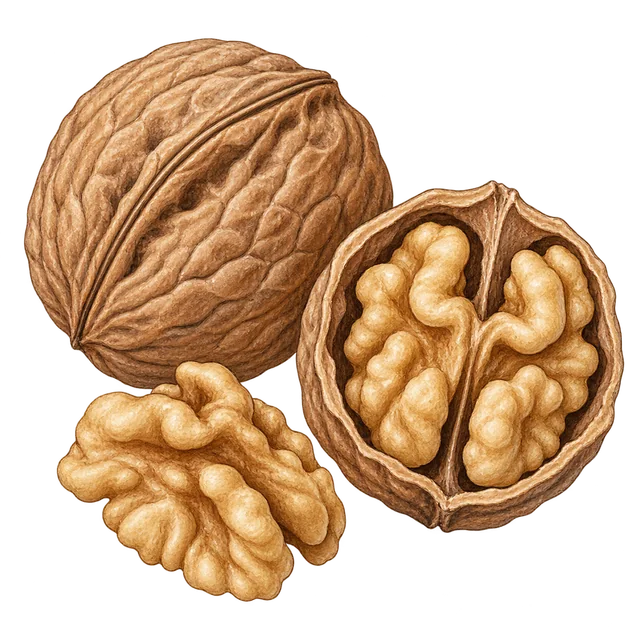
- Woody shell
- Walnuts in the shell keep longer than shelled kernels. After opening, follow the article's sealed, dark and cool storage advice.
- Kernel with thin skin
- The thin film on the kernel contains polyphenols and need not be rubbed off, as the article explains. It is separate from the hard shell.
Illustration for understanding; not to scale. Saved figures include explanations and sources.
In practice · Storing them, and who should take care
Why storage matters for healthMost of the fat in walnuts is polyunsaturated (), with many bends in its chains, so oxygen in the air attacks it easily and it goes rancid. Once oxidized, walnuts not only taste worse but also form harmful oxidation products. So:
Keep them sealed, away from light, and cold (in the fridge or freezer)A paint-like or bitter smell means they have gone rancid, and they should be thrown outDo not stock up too much at once; walnuts in the shell keep longer
This tendency to oxidize easily also explains why foods rich in omega-3 generally need careful storage (fish and flaxseed follow the same logic).
Who should take care
People with a tree-nut allergy: walnuts are a common allergen, and people who are allergic must avoid them strictly. This is an immune problem, not a nutrition one. If, after eating them, the lips or throat feel tight or breathing becomes difficult, call emergency services immediately.People hoping to get from them: do not count on it. Walnuts supply almost no DHA, so people who are pregnant or otherwise need and DHA still need fish or algae oil.People watching calories or losing weight: moderate amounts are fine; make walnuts a replacement snack rather than an extra on top.
This is general information only. For allergies or special nutritional needs, consult a doctor or dietitian.
References · 6
- U.S. Department of Agriculture, Agricultural Research Service. (2024). FoodData Central: Nuts, walnuts, English (SR Legacy). Composition reference for walnuts (~65% fat, rich in the plant omega-3 ALA). fdc.nal.usda.gov/food-search?query=walnuts%20english
- Burdge, G. C., & Calder, P. C. (2005). Conversion of alpha-linolenic acid to longer-chain polyunsaturated fatty acids in human adults. Reproduction, Nutrition, Development, 45(5), 581-597. Conversion of dietary ALA to EPA is limited (~5-10%) and conversion to DHA is very low (often <1%), so plant ALA cannot substitute for the EPA/DHA in fish. 10.1051/rnd:2005047
- Estruch, R., Ros, E., Salas-Salvadó, J., Covas, M.-I., Corella, D., Arós, F., et al. (2018). Primary prevention of cardiovascular disease with a Mediterranean diet supplemented with extra-virgin olive oil or nuts. New England Journal of Medicine, 378(25), e34. PREDIMED RCT (~7,447 high-risk adults); a Mediterranean diet supplemented with mixed nuts (or EVOO) reduced major cardiovascular events versus a control low-fat diet. (First published 2013; retracted in 2018 over randomization issues and republished the same year with corrected data.). 7,447 adults aged 55-80 (57% women) at high cardiovascular risk; median 4.8 years. Events 3.8% (olive oil), 3.4% (nuts), 4.4% (control); adjusted HR 0.69 (0.53-0.91) and 0.72 (0.54-0.95). Results similar after omitting 1,588 participants whose assignments departed from protocol (household members enrolled without randomisation, some participants at 1 of 11 sites assigned without randomisation, inconsistent use of randomisation tables at another site) (abstract, PMID 29897866). 10.1056/NEJMoa1800389
- Bao, Y., Han, J., Hu, F. B., Giovannucci, E. L., Stampfer, M. J., Willett, W. C., & Fuchs, C. S. (2013). Association of nut consumption with total and cause-specific mortality. New England Journal of Medicine, 369(21), 2001-2011. Two prospective cohorts (>118,000 people, 30-year follow-up); nut intake frequency — analyzed separately for tree nuts and peanuts — was inversely associated with total and cause-specific mortality. 10.1056/NEJMoa1307352
- U.S. Department of Agriculture & U.S. Department of Health and Human Services. (2020). Dietary Guidelines for Americans, 2020-2025 (9th ed.). www.dietaryguidelines.gov/sites/default/files/2020-12/Dietary_Guidelines_for_Americans_2020-2025.pdf
- Estruch, R., Martínez-González, M. A., Corella, D., Salas-Salvadó, J., Fitó, M., Chiva-Blanch, G., et al. (2019). Effect of a high-fat Mediterranean diet on bodyweight and waist circumference: a prespecified secondary outcomes analysis of the PREDIMED randomised controlled trial. Lancet Diabetes & Endocrinology, 7(5), e6-e17. Replaces the authors' 2016 report, withdrawn after the randomisation deviations (866 participants, 11.6%) came to light; the estimates do not rely only on the assumption that everyone was randomised. 7,447 older adults at high cardiovascular risk, diets unrestricted in energy and no physical-activity advice, median 4.8 years: all three groups had marginally reduced bodyweight and increased waist circumference. Adjusted 5-year difference versus the low-fat-advice control: bodyweight -0.410 kg (p = 0.056) with olive oil and -0.016 kg (-0.453 to 0.421; p = 0.942) with nuts; waist -0.466 cm (p = 0.154) and -0.923 cm (-1.604 to -0.241; p = 0.008). Funders included the California Walnut Commission and nut companies (abstract, PMID 31003626). 10.1016/S2213-8587(19)30074-9