Story
Peanuts
Last updated
In one pass The peanut is the seed of a legume, and its pods ripen underground.
Educational content, not medical advice — consult a clinician.
Story path
Chapter 1
Peanuts are legumes, not nuts
Its other English name, groundnut, says exactly this: after the flower is pollinated, the stalk pushes into the soil and the pod grows underground. So botanically the peanut is a bean, a relative of soybeans and lentils, not a tree nut like walnuts or almonds. In nutrition and use, though, it behaves like a nut: high in fat (mostly monounsaturated), high in protein, low in water, and eaten as a snack or as a spread.
If your lips or throat swell or you struggle to breathe after eating peanuts, it is an emergency: go to the emergency department or call your local emergency number right away. As for when a baby should start eating peanut, follow the advice of a pediatrician or allergist.
A CLOSER LOOK
Seeds inside a pod: a legume
Pod, skin and kernel make the peanut's legume identity concrete. This is an object study, not an infant feeding method or a safety assessment.
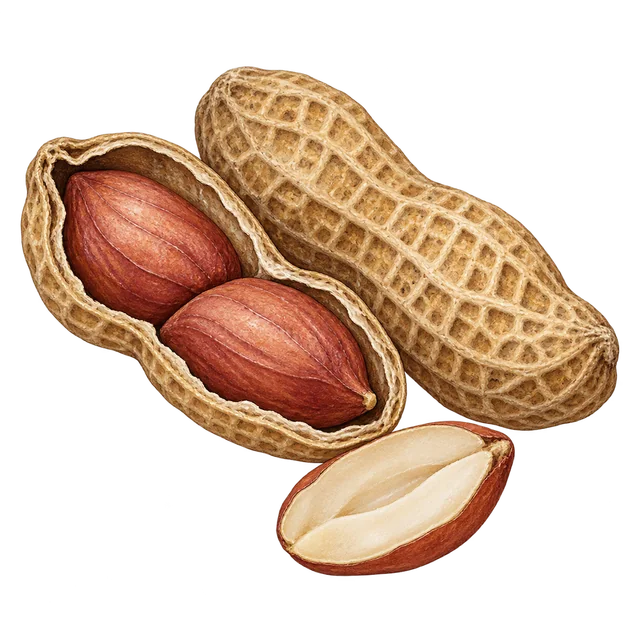
- Underground pod
- Peanut pods mature underground, the growth pattern behind the name groundnut.
- Oil- and protein-rich seed
- Botanically a legume, peanut often resembles a nut in nutrition and use: high in fat and protein, with little water.
Illustration for understanding; not to scale. Saved figures include explanations and sources.
Mechanism · Growing underground explains three things
That peanuts grow underground is often treated as a fun fact and left at that. But several things in this story that look unrelated all start here.First: why half of its nutrition profile looks like a bean
Legumes have a talent other plants do not: nodules grow on their roots, and those nodules house bacteria that can fix nitrogen from the air. Protein's backbone requires nitrogen, and for most plants nitrogen is precisely the hardest thing to get — legumes come with their own nitrogen supply line. That is why beans as a group are the high-protein athletes of the plant world, and peanuts are no exception.
Second: why the other half of its nutrition profile looks like a nut
Because it put its resources into oil. A peanut is a seed, and a seed's job is to feed the seedling on its own until the seedling can photosynthesize; fat is the highest-energy storage form per unit weight, so oil-rich seeds are the most efficient at this.
So: high protein comes from being a legume; high fat comes from the seed's job — the two things are not at all contradictory on the same peanut. It is not a coincidence that it is a bean that looks like a nut; it is two different biological logics stacked on the same seed.
Third: why it is a natural neighbor of mold
The peanut's fruit matures in the soil, and the molds that make aflatoxin already live in the soil. This is not a processing error; it is the starting point this plant's way of growing gives it. Everything in the later chapter on mold risk starts here.
So taxonomy is not a boring label
Once you know the peanut is a legume, you can derive two things yourself: its protein should not be low; its mold risk has a natural starting point in the soil. That is the difference between knowing what it is and memorizing its benefits — the former can generate new conclusions; the latter can only be repeated.
Chapter 2
Nutrition · a bean that eats like a nut
Plenty of protein: about 25 g per 100 g, in the high tier for plant foods. On its own, though, it is not a complete protein; both lysine and methionine run low. Add grains, milk, eggs, or soy foods over the same day and the proteins fill each other's gaps (see Protein & Amino Acids).Mostly monounsaturated fat: fat makes up about 50% of a peanut, mainly monounsaturated fatty acids (the same family as the oleic acid in olive oil), plus some polyunsaturated fat, with relatively little saturated fat. That is the fat base behind its heart-friendly profile.Micronutrients: good amounts of niacin (vitamin B3), vitamin E, magnesium, folate, and biotin.Arginine: peanuts are a good dietary source. The lining of blood vessels uses arginine as the raw material for nitric oxide (), and NO relaxes the vessels — possibly one of the ways peanuts and nuts benefit the heart.They also contain small amounts of resveratrol and other polyphenols, but far too little to be a reason to eat them.
Compared with tree nuts: similar nutrition and fat profile at a much lower price. It is the budget nut, putting nut-level nutrition within reach of more people.
Mechanism · Protein quality is set by the shortest stave
The line peanut protein is not complete on its own, but eaten alongside other proteins the gaps fill in is the easiest one to skim past. It is worth unfolding.First, be clear: when we ask whether protein is enough, what are we actually asking
To build a protein, the body has to get at the same time every amino acid that sequence needs. A few of those the body cannot make; they must come from food, and they are called essential amino acids.
The key is those two words, at the same time: missing any one, the production line stops at that step. The other amino acids already in place do not wait in line — they get used for something else, or simply burned as fuel. So how much of a protein you eat actually becomes protein on you is not decided by the most abundant one.
Then there is a barrel
Think of these essential amino acids as the staves around a barrel: how much water the barrel can hold is decided by the shortest stave, not the longest. The quality of a food's protein is likewise how short its shortest stave is. That shortest stave is called the limiting amino acid.
This model teaches only one thing, but that one thing explains a lot: why eating more and more of a single staple still does not raise protein-use efficiency; why the number protein content by itself can lie.
Complementation is putting together two barrels whose short staves sit in different places
Grains and legumes have their short staves in different places. Put them in the same day's eating, and the extra stretch on one side fills the gap on the other; the combined barrel is taller than either alone. Chinese eating has been doing this for a long time — rice with tofu, steamed buns with soy milk, a handful of beans in a mixed-grain porridge — it just never got a name.
A few inferences you can use directly
Complementation within the same day's eating is enough; you do not have to pair every bite — the body has a small pool of free amino acids that can match up ingredients arriving at different times, within a windowEating a mix is itself the lowest-effort way to do this. The more a diet leans on a single staple, the more the short-stave problem stands outJudging a plant protein by grams of protein per 100 grams alone is not enough: that says how big the barrel is, not where the shortest stave sits
The peanut's place on this picture is clear: its barrel is not small (protein amount is high among plants), but it is not a perfect barrel — the way to make it more useful is not eating more peanuts, but having other protein sources in that day's eating whose short staves sit elsewhere.
Chapter 3
Cardiovascular · peanuts count on their own
They do. Two large, long-running cohorts counted peanuts and tree nuts separately. People who ate nuts (peanuts included) more often had lower total mortality, and the peanut column pointed the same way as the tree-nut column — while peanuts cost far less.
But this is an observed association, not a trial. People who eat nuts tend to live healthier lives overall, statistics cannot fully subtract that, so these data cannot show the benefit comes from the peanuts themselves. The practical point is that nut-level benefits may not require expensive imported nuts.
Two more conditions. Peanuts are one member of a healthy diet, not an antidote to fried, sugary eating. And the finding is about plain peanuts and unsweetened peanut butter, not sugar-coated fried peanuts or peanut-butter snacks loaded with sugar and hydrogenated oil.
Evidence · how this conclusion was calculated
Bao et al. 2013 (NEJM): two prospective cohorts totaling over 110,000 people, followed for 30 years, counted tree-nut and peanut intake separately. The result: nut intake frequency, including peanuts, was inversely associated with total mortality and several cause-specific mortalities (cardiovascular, some cancers, and others). That is, the associational benefit from peanuts is comparable to tree nuts — and they cost far less.Why those two words, analyzed separately, are the key
If a study only reports a lumped nuts category, peanuts — because more people eat them, and they are cheap — could get carried along by the tree-nut result, or they could flatten the tree-nut result the other way. Once they are counted apart, the peanut column itself points the same direction — the conclusion lands on peanuts, not on borrowed light.
What this kind of study can say, and what it cannot
A prospective cohort works like this: first record what a group of people eat now, then wait many years and see who dies first, and of what. Its strength is a clear time order — the eating habit is recorded first, the outcome happens later, so it cannot reverse cause and effect.
Its weakness is equally clear: people who eat nuts are often different in other ways too (smoke less, exercise more, earn more). Statistics can subtract some of those factors, but not cleanly, and not the differences that were never recorded. So what it gives is an association, not causation.
The right way to read this evidence is to put it next to the physiology: the population data say the direction is consistent, the mechanism says it makes sense, both point to the same place, but neither can close the case alone.
Mechanism · How peanuts might act on blood vessels
Peanuts may act on blood vessels along five routes: the type of fat, arginine, vitamin E and polyphenols, magnesium, and the fullness that fiber brings. Start by taking the two main ones apart.First: change the kind of fat, and the fleet that carries fat in the blood changes with it
Fat you eat does not sit in the blood as-is; it is packed into successive lipoprotein particles for transport. When saturated fat intake is high, the liver's ability to clear low-density lipoprotein () particles falls, so they stay in the blood longer; the longer they stay, the more chance they have to slip into the inner wall of an artery and pile up.
Monounsaturated fat is not more is better; its value is in replacement: use it to displace the saturated fat that was already in the diet, and that clearance step loosens. That is why the peanut's cardiovascular story always comes with replace, do not add — stacked on top of the original diet, you have only eaten more oil.
Second: arginine is only the raw material; the thing that actually works is nitric oxide
The innermost layer of a vessel is the endothelium, sitting directly in the bloodstream. Endothelial cells have an enzyme that uses arginine as raw material to make nitric oxide ()NO is an extremely small gas molecule; it does not need a receptor to open a door; it diffuses straight through the cell membrane into the vascular smooth muscle right next to itSmooth muscle is a ring of muscle wrapped around the vessel. Inside it, NO opens a signaling enzyme, which makes a second messenger (cGMP), and cGMP brings the calcium inside the cell downMuscle contraction depends on calcium. When calcium drops, that ring of muscle lets go as a whole, the lumen widens, and flow resistance falls
So arginine helps vessels relax really means: peanuts supply the most upstream raw material on this production line. More raw material does not mean more product — the line is also limited by how healthy the endothelium itself is, and that is decided by blood sugar, blood pressure, smoking, and sleep together. A handful of peanuts does not enter those steps; it only fills the raw-material cabinet a little.
The remaining three, each in one sentence
Vitamin E and polyphenols: make lipoprotein particles less easy to oxidize — oxidized particles are more readily swallowed and piled up by scavenger cells in the vessel wallMagnesium: takes part in regulating vascular smooth-muscle tone and heart rhythmFiber and satiety: this one is the plainest and the most real — the bite that was peanuts is usually a bite that replaced a cookie or a chip
Put these together and one common point is worth noticing: none of them is a peanut-specific magic ingredient. They are a combination of ordinary mechanisms — fat type, amino-acid raw material, antioxidants, minerals, and satiety. That is precisely what credible looks like — if a food can only explain its benefits through a unique active compound, that sentence was usually written by someone selling it.
Chapter 4
Early peanut can prevent allergy
The old advice (since rewritten): the mainstream view used to be that high-risk babies should delay and avoid allergy-prone foods such as peanut, on the idea that later contact means less allergy.
A randomized trial called LEAP turned that idea around: high-risk babies who already had eczema or egg allergy were randomly split into two groups. One group ate peanut products regularly from infancy; the other avoided peanut completely. By preschool age, the avoidance group had several times the rate of peanut allergy of the early-eating group — avoidance was not protection but a risk.
Important safety points: first, whole peanuts and large pieces are a choking hazard for young children, so use thinned peanut butter or peanut powder; second, anyone already diagnosed with peanut allergy must strictly avoid peanut and carry an epinephrine auto-injector; third, before introducing peanut to a high-risk baby, always talk to a pediatrician or allergist first — do not push it on your own.
This is general information only; for infant feeding and allergy care, follow your doctor's advice.
Evidence · How LEAP was run and what it found
First write out the advice that was rewritten: the previous mainstream advice was that high-risk infants should delay or avoid allergenic foods such as peanut until they were toddlers or older. That approach was not picked casually; behind it sat a reasoning that sounded reasonable — the immune system is not finished growing yet, so meeting fewer unfamiliar proteins means fewer chances to get it wrong.The LEAP study (Du Toit et al. 2015, NEJM): this enrolled 640 high-allergy-risk infants (4-11 months, already with eczema or egg allergy), randomized into two groups: one ate peanut products regularly from infancy (a set weekly amount of peanut protein), the other completely avoided peanut until age 5.
The result was striking: by age 5, 17.2% of the avoidance group developed peanut allergy, versus only 3.2% in the early-eating group — about an 80% reduction. That is, early exposure did not increase allergy; it prevented it.
Why this study weighs more than ordinary nutrition research
Cohort studies like Bao 2013 can only give associations. LEAP is different: it is a randomized controlled trial. Who went into which group was decided by a draw, so the two groups were comparable on family history, eczema severity, household habits, and the rest. The only variable that was deliberately changed was eat or not eat. When the outcomes differ, it is hard to push the difference onto some other explanation.
More worth noticing is who it enrolled: high-risk infants who already had eczema or egg allergy — precisely the group the old advice most insisted should avoid. In the population where you most expected to see avoidance work, the result flipped.
Current guidelines have changed: based on this, guidelines in several countries (for example the US NIAID) have shifted toward appropriately introducing peanut in infancy (timing and form set with a clinician's assessment), especially for high-risk infants.
Read this as why the advice changed, not as a plan to run at home. Whether a particular child should be introduced, when, and in what form, is decided after a pediatrician or allergist assesses.
Mechanism · How immunity tells food from an invader
LEAP's result feels counterintuitive because most people default to exposure equals sensitization. The leading explanation is finer: the immune system does not only look at what it met, but at which door it came through. This explanation (called the dual-allergen exposure hypothesis) rests mainly on animal experiments and observations in people; LEAP's result fits it, but not every step has been confirmed in humans.In through the mouth: default to treating it as food
The gut faces a flood of foreign proteins every day. If it treated all of them as enemies, a person could not live. So gut immunity has a dedicated do not attack pathway: a protein that arrives in small, repeated amounts through the digestive tract is more readily judged as something that can coexist, and a set of immune cells is trained whose job is to hold the reaction down. This path is called oral tolerance — it is an actively learned peace, not no reaction.
In through broken skin: default to treating it as an invasion
Skin is a barrier; the immune cells stationed under it are there to intercept. An eczematous skin barrier leaks; peanut protein in the environment (if someone in the house eats peanuts, it is in the dust, on the sofa, on an adult's hands) enters through those gaps, meets a pathway that treats invaders, and produces the kind of antibody that fires on contact.
So what avoidance actually does is this
It only shuts the mouth door; it cannot shut the skin door. Especially in an infant who already has eczema, the result is: the body first met peanut on the skin, and never learned in the gut that it is food. The day it is first actually eaten, the immune system pulls the invader file.
This explains two things that used to look contradictory
Why a child who has never eaten peanut can be allergic the first time they eat it — sensitization already happened; it just did not happen in the mouthWhy infants whose eczema starts earlier and is more severe have a higher risk of food allergy — the longer the barrier leaks, the more that skin path gets used
It also explains why eczema care keeps coming up in conversations about food allergy: under this hypothesis, repairing the barrier narrows the door that should not be open. Preventing food allergy through skin care, however, has not been shown in trials so far. How to care for eczema itself belongs to dermatology; see Inflammatory skin disease.
One last note on scope: the above is the immunology of why the advice changed, not an operating plan for any particular child.
Mechanism · Why peanut, of all things, tends to hit hard
Peanut allergy can be severe. Why peanut, of all things? Part of the answer sits in the protein itself.The immune system recognizes shape, not composition
An antibody recognizes a protein by a small patch on the three-dimensional shape that protein folds into. If the shape is destroyed (heat denatures it, digestive enzymes cut it up), that patch no longer holds, and the antibody cannot recognize it. So for an allergen to make a whole-body scene, it has to arrive at immune cells still holding its shape.
Peanut's main allergens belong to the sturdy class
They are storage proteins in the seed — a seed has to last through damp, temperature swings, and microbes in the soil, so this class of protein was selected to be compact and hard to fall apart. The result: they survive the high heat of roasting, and they also hold up reasonably against stomach acid and digestive enzymes, so they can reach the small intestine relatively intact and meet the immune system there.
Set it next to the contrast and it is clear
Many fruit allergies that only itch in the mouth have very fragile allergens: a little heat and they deform; they are taken apart quickly in the stomach. So the reaction usually stays in the mouth, and the same fruit cooked is often fine. Peanut takes the opposite road — after roasting, the shape that needs to be recognized is still there.
There is also a practical factor: it hides deep
Peanut often shows up in invisible form in sauces, pastries, candy, and restaurant food; trace contamination is hard to avoid. An allergen that is heat-stable, digestion-resistant, and everywhere is one of the combinations with the highest chance of accidental contact. That is also why people with a confirmed diagnosis are told to carry emergency medicine — not because they are careless, but because this allergen is genuinely hard to dodge.
This page is so you understand why this is taken seriously, not so you can judge yourself. If you suspect you or a family member has a peanut allergy, see an allergist for a proper evaluation; medication and emergency plans for people already diagnosed come from a clinician. This site does not give any treatment advice.
Chapter 5
Mold risk and how to eat peanuts
When peanuts (and corn, among others) are damp or badly stored, they easily grow Aspergillus mold, which makes aflatoxin. It damages the liver, and the International Agency for Research on Cancer (IARC) places it in its top category, carcinogenic to humans (a statement about how certain the evidence is, not how large the risk is), mainly linked to liver cancer. Keep it in proportion:
Peanuts from reputable channels, stored properly, are regulated, with legal limits on aflatoxin, and the risk is low.The real high-risk cases are peanuts and peanut products from humid regions, sold loose, badly stored, or moldy.What to do: buy reputable brands; store them somewhere dry and cool; spit out and throw away any peanut that tastes bitter, looks moldy, or is discolored — bitterness is often the sign of mold. You cannot rescue a moldy batch by picking out the bad ones.
One cause and effect is often turned around: heat can kill the mold, but it cannot break down the toxin the mold has already made. The step that actually works comes before the toxin forms: drying, storage, and sorting.
Allergy and young children: people with peanut allergy must strictly avoid peanut, which often hides as an ingredient in sauces, pastries, and all kinds of dishes, so check the ingredient list. Whole peanuts are a choking hazard for young children; do not give whole peanuts to children under 5, and use ground peanuts or thinned smooth peanut butter instead.
Mechanism · The toxin's source and its harm to the liver
Why peanuts and corn, of all thingsBack to what a peanut is: its fruit matures in the soil. The molds that make aflatoxin already live in soil, so from the moment it is grown, the peanut is their neighbor. Add that harvested peanuts still hold a lot of water; if they are not dried enough, and then piled warm and damp, that is exactly the condition mold likes best: warm, moist, and fed.
There is another entry that is often missed: damage. An intact seed coat is a barrier; the kernels cracked, insect-eaten, or split during harvest and transport are handing the nutrients inside straight to the mold. So in the same batch, toxin is often highly concentrated in a few kernels, not spread evenly — and that fact decides every response that follows.
Why picking matters more than heating
Mold is alive; heat can kill it. But the toxin is a small molecule; it is not a living thing, and there is no such thing as killing it. Its structure is quite heat-stable; the temperatures of roasting and boiling do not take it apart. So a dangerous illusion can appear: after roasting the moldy smell fades and it looks normal, but what should still be there still is.
Put the two lines above together and you get a very concrete conclusion: since the toxin sits in a few kernels and cannot be taken apart, taking those kernels out is the only action that truly reduces the amount. Industry does this with sorting equipment, kernel by kernel; the matching action at home is spit it out the moment it tastes bitter, and do not eat the rest of the pack. This does not contradict you cannot rescue a moldy batch by picking out the bad ones — that line is about the home setting: you cannot inspect kernel by kernel, and the mold's hyphae may already have grown into neighbors that still look fine.
Once it is in the body, why the liver is the one that gets hurt
After the toxin is absorbed in the small intestine, the first stop is the liver — all blood from the gut has to pass the liver first. The liver is the body's chemical plant; its standard move on a foreign molecule is to hang a reactive group on it first, so it becomes easier to dissolve in water and leave in urine.
The problem with aflatoxin is that this processing intermediate is more reactive than the parent: that intermediate grabs DNA in the cell nucleus and binds to it. Most of that damage gets repaired, but every time there is a chance of a repair error, and if the wrong repair lands on genes that put the brake on cell proliferation, that cell has one fewer brake. That is why the International Agency for Research on Cancer (IARC) lists it in its top carcinogen category, and why the target organ is the liver — not because it burned the liver directly, but because it miswrote the liver cell's blueprint.
So the shape of the risk is this
It is not the kind of acute poison where one kernel and you are done; it is a probability built up from long-term, repeated, small doses. That explains why the risk is low where there is strict regulation and dry storage, and a real problem in humid regions, loose sales, and home-pressed crude oil. It also explains why the focus of the response is do not let it keep coming in, not a single moment of panic.
In practice · How much, how to buy, how to store
How to eat, how much: a small handful of plain peanuts a day, or a spoonful of unsweetened, non-hydrogenated peanut butter (the only ingredient should be peanuts, with a little salt at most). Avoid sugar-coated, deep-fried, or heavily salted and sweetened peanut snacks.Calories, weight loss: like other nuts, eat them in moderation and use them to replace another snack, not on top of everything else.
Why watching the ingredient list is worth this much
The peanut's own nutrition picture (protein, monounsaturated fat, magnesium, vitamin E) is the premise its heart benefits rest on. Sugar-coating and deep-frying do the opposite of that picture in two strokes: they add sugar and refined oil, and they turn a snack that replaces chips into a snack eaten on top of chips. The same peanut, a different preparation, and its role in the diet flips from replacement to addition — and replacement versus addition is exactly the switch that decides whether its benefit survives.
Loose or packaged
Given where the mold and toxin come from, what decides risk is not the form loose itself, but whether this batch went through the three steps dried enough, sorted and culled, stored dry. What you pay a reputable brand for is precisely that those three steps were inspected and recorded; with open-air loose sales, unclear origin, and a stale smell, you have no way to judge.
Storage at home
Don't open the bag and leave it sitting out; sealed, dry, and cool are the three pointsIn humid seasons, such as the plum-rain season in southern China, the fridge is safer than the cupboard once the bag is openDon't stockpile too much at once. Peanuts are high in fat; left too long they go rancid even without mold — that is the smell of oxidized fat, a different thing from mold, but it equally means they are past when they should be eaten
The one thing to do while eating: if any kernel tastes bitter, spit it out at once and do not eat the rest of the pack. That action takes less than a second, and it is the only truly effective screen in a home setting.
References · 7
- U.S. Department of Agriculture, Agricultural Research Service. (2024). FoodData Central: Peanuts, all types, raw (SR Legacy). Composition reference for peanuts (~25 g protein and ~50% mostly-monounsaturated fat per 100 g). fdc.nal.usda.gov/food-search?query=peanuts%20raw
- Bao, Y., Han, J., Hu, F. B., Giovannucci, E. L., Stampfer, M. J., Willett, W. C., & Fuchs, C. S. (2013). Association of nut consumption with total and cause-specific mortality. New England Journal of Medicine, 369(21), 2001-2011. Two prospective cohorts (>118,000 people, 30-year follow-up); nut intake frequency — analyzed separately for tree nuts and peanuts — was inversely associated with total and cause-specific mortality. 10.1056/NEJMoa1307352
- Du Toit, G., Roberts, G., Sayre, P. H., Bahnson, H. T., Radulovic, S., Santos, A. F., et al. (2015). Randomized trial of peanut consumption in infants at risk for peanut allergy. New England Journal of Medicine, 372(9), 803-813. The LEAP trial (640 high-risk infants 4-11 months); early regular peanut consumption reduced peanut allergy at age 5 (3.2% vs 17.2% with avoidance, ~80% relative risk reduction), reversing prior 'avoid early' guidance. Participants had severe eczema, egg allergy or both and were randomized at 4 to under 11 months; in the 530 skin-prick-negative infants, peanut allergy at 60 months was 13.7% with avoidance vs 1.9% with consumption; in the 98 skin-prick-positive infants, 35.3% vs 10.6%; no significant difference in serious adverse events; peanut-specific IgG4 rose mainly in the consumption group (abstract, PMID 25705822). 10.1056/NEJMoa1414850
- U.S. Department of Agriculture & U.S. Department of Health and Human Services. (2020). Dietary Guidelines for Americans, 2020-2025 (9th ed.). www.dietaryguidelines.gov/sites/default/files/2020-12/Dietary_Guidelines_for_Americans_2020-2025.pdf
- International Agency for Research on Cancer. (2012). Aflatoxins. In IARC Monographs, Volume 100F: Chemical Agents and Related Occupations (pp. 225-248). Lyon: IARC. Aflatoxins are classified Group 1; carcinogenicity is driven by metabolic activation in the liver and aflatoxin-DNA adducts inducing G:C to T:A transversions in TP53. publications.iarc.who.int/Book-And-Report-Series/Iarc-Monographs-On-The-Identification-Of-Carcinogenic-Hazards-To-Humans/Chemical-Agents-And-Related-Occupations-2012
- NHS. (2026). Foods to avoid giving babies and young children. No added salt, stock cubes or gravy, as salt is not good for babies' kidneys; no sugar or sweeteners including honey, syrup, fruit juice and smoothies (tooth decay), though fruit is fine; honey occasionally contains bacteria that can produce toxins in a baby's intestines causing infant botulism, so no honey before 1 year; no whole nuts under 5 years (choking), but crushed or ground nuts and nut butter spread on food are fine from around 6 months, and talk to a GP first if there is a family history of allergies; avoid mould-ripened soft and unpasteurised cheeses (listeria); hens' eggs without the British Lion mark should be cooked until white and yolk are solid; no rice drinks instead of milk under 5 (arsenic); avoid raw shellfish and shark, swordfish and marlin (mercury); raw jelly cubes are a choking hazard (page last reviewed 18 February 2026). www.nhs.uk/baby/weaning-and-feeding/foods-to-avoid-giving-babies-and-young-children
- Togias, A., Cooper, S. F., Acebal, M. L., Assa'ad, A., Baker, J. R., Beck, L. A., et al. (2017). Addendum guidelines for the prevention of peanut allergy in the United States: report of the National Institute of Allergy and Infectious Diseases-sponsored expert panel. Journal of Allergy and Clinical Immunology, 139(1), 29–44. Guideline 1: infants with severe eczema, egg allergy or both should have age-appropriate peanut-containing food as early as 4 to 6 months, with peanut-specific IgE and/or skin-prick testing strongly considered first; Guideline 2: mild-to-moderate eczema, around 6 months, may be at home; Guideline 3: no eczema or food allergy, introduce freely with other solids; other solids first to show developmental readiness; about 6 to 7 g of peanut protein a week over 3 or more feedings; whole nuts not under 5 years, peanut butter from a spoon or in lumps not under 4 years; home first feeding: give a small taste on the tip of a spoon, wait 10 minutes, then the rest at the usual pace, and stay with the infant for 2 hours; mild signs are a new rash or a few hives around the mouth or face; lip swelling, vomiting, widespread hives, face or tongue swelling, difficulty breathing, wheeze, repetitive coughing, pale or blue skin or sudden limpness need immediate medical attention (full text PMC5226648). 10.1016/j.jaci.2016.10.010