Story
Lentils
Last updated
In one pass Lentils raise blood glucose slowly because their starch is wrapped in a fiber gel and in intact cell walls, so digestive enzymes take time to reach it.
Educational content, not medical advice — consult a clinician.
Story path
- 1What are lentils · one of the oldest cultivated legumes
- 2High protein, almost no fat
- 3Carb quality · why the glucose rise is slow
- 4Rich in · iron, folate, and potassium in one shot
- 5Vitamin C helps its iron absorb
- 6Key knowledge · anti-nutrients: cooking handles them
- 7Choosing, cooking and how much to eat
- 8Are anti-nutrients in beans toxic
Chapter 1
What are lentils · one of the oldest cultivated legumes
White rice and white flour offer limited protein and little fiber; lentils have both and can still serve as a staple, which is unusual among plant foods. They are also an easy source of iron and folate for vegetarians. Their protein is incomplete: high in lysine and low in methionine, and eating them alongside grains over the course of a day fills the gap.
Red lentils have had their hulls removed; green and brown lentils keep theirs. Whether that hull is there decides how tightly the starch is wrapped, and how quickly the lentils soften in the pot.
Background · Name, varieties and a long history
The lentil's scientific name is Lens culinaris, and it is a legume. It has been cultivated for more than 10,000 years and was among the first crops people grew on a large scale.Lentils are usually grouped by color into red, green, brown, and black. The grouping is about more than color: red lentils are dehulled, while green and brown lentils keep their hulls.
Whether that hull is there explains how they behave in the pot. As the chapter on carb quality explains, one reason legumes raise blood glucose slowly is that an intact seed coat and cell walls wrap the starch granules, so digestive enzymes take time to reach them. Removing the hull strips away that outermost barrier ahead of time. That is why red lentils cook fast and fall apart into a mash, which suits soups, purees, and curries, while green and brown lentils take longer to soften and keep some chew, which suits salads and side dishes.
In other words, choosing a color is a texture question in the kitchen and a how tightly is the starch wrapped question in the gut. They are two sides of the same fact.
Chapter 2
High protein, almost no fat
Lentil protein is incomplete: high in lysine and low in methionine. That is not a flaw, because grains run the other way, and eating the two over the course of a day fills each other's gap. Lentils with rice have been eaten in India, the Middle East, and Latin America for thousands of years, and tradition and the amino-acid tables say the same thing. see Protein & Amino Acids.
Numbers · The composition table and what it means
In numbers, 100 g of cooked lentils has about 9 g of protein, 20 g of carbohydrate (about 8 g of it dietary fiber), very little fat (about 0.4 g), and about 116 kcal. Dry lentils are about 2.5 times as concentrated, with about 25 g of protein per 100 g, which puts them in the top tier of plant foods for protein. Protein supplies about 30% of their calories, which is very rare for a staple (white rice about 7-8%, bread about 12%).The difference between dry and cooked is almost all water. Dry lentils soak up water and swell in the pot, so the same nutrients are spread through a heavier serving. When you hear lentils are very high in protein, first ask whether that means dry or cooked. You buy them dry and serve them cooked; both numbers are right, but they are not describing the same bowl.
The easiest item on this table to underrate is fiber. It is the direct reason lentils raise blood glucose slowly (the chapter on carb quality covers this in detail). Put the other way, a good share of the carbohydrate column never becomes blood glucose at all: digestive enzymes in the small intestine cannot break fiber down, so it travels intact to the large intestine, where gut microbes ferment it.
Fat is almost zero, which also explains something in the kitchen. The seed holds little oil that can oxidize, so sealed dry lentils keep for a long time without going rancid. Oil-bearing dry goods such as nuts or whole-wheat flour are different: the oil is the first thing to spoil.
One last point about protein. Lysine and methionine both belong to the amino acids the body cannot make and must get from food. Lentils are rich in exactly the one grains lack, and grains are rich in exactly the one lentils lack. Lentils with rice was invented again and again in unrelated regions because the two sets of gaps sit offset, and only together do they make a complete set of amino acids.
Chapter 3
Carb quality · why the glucose rise is slow
The result is that the same serving of carbohydrate raises blood glucose more slowly and less high. For anyone managing blood sugar, lentils are a rare food that can serve as a staple with a flat glucose curve. see Carbs & Fiber.
Mechanism · How gel and cell walls slow digestion
The first layer is fiber. Lentils are rich in soluble fiber (beta-glucans, pectin, and others), which forms a viscous gel in the gut, slowing sugar absorption and adding to fullness.The second layer is a physical barrier. A lentil's cell walls stay intact, and its starch granules are embedded in a matrix of protein and fiber, so digestive enzymes need longer to reach the starch molecules. Refined grains are completely different: the starch in white bread has almost no barrier and is digested very fast.
Stacked together, these two layers stretch out how fast glucose enters the blood and flatten the post-meal spike. Red lentils have lost their hull, the outermost barrier, so they are a little faster than hulled green or brown lentils, but the gel and the inner cell walls remain, and they are still far slower than a refined staple. A third layer is resistant starch, which is not used up until it reaches the colon.
Mechanism · What resistant starch becomes in the colon
The third layer is resistant starch. Lentils contain a fair amount of it, and the share rises further when cooked lentils are cooled. It is barely digested in the small intestine and reaches the large intestine, where gut microbes ferment it. It behaves like fiber: a flatter glucose rise, plus the production of short-chain fatty acids ().In numbers, lentils are a low glycemic index food, with a of about 25-30 (white rice is about 73). see Carbs & Fiber for the full mechanism.
Chapter 4
Rich in · iron, folate, and potassium in one shot
Lentils also carry potassium, which helps the sodium-potassium balance behind blood pressure. see Folate and Potassium & Sodium.
Mechanism · Iron and folate on one marrow line
Iron deficiency and folate deficiency are often treated as two unrelated problems. Seen from inside the bone marrow, they jam two different stations on the same production line.Red blood cells are made in the bone marrow, and they are made very fast. Precursor cells divide round after round, and every division first needs a full copy of the DNA. Copying DNA uses ready-made bases as bricks, and the step that builds those bases is exactly where folate works as a coenzyme. When folate is short, the cell wants to divide but cannot gather enough bricks, so division stalls at that step.
Something very specific happens after the stall: the cytoplasm keeps growing while division falls behind, so the red cells that come out are too large and too few. That is what anemia looks like when folate is short.
Iron jams the later station. Once division is done, the red cell has to fill itself with hemoglobin, and every hemoglobin molecule has an iron atom seated at its center; that iron atom is what grabs oxygen and carries it away. When iron is short, the line itself keeps running, but each cell can load less hemoglobin, so the red cells that come out are small and pale.
So the same word, anemia, looks opposite depending on what is missing: folate shortage makes cells too large, and iron shortage makes them too small. That is also why anemia means take iron is not always right. Supply the wrong station, and the line stays jammed where it was.
Where lentils sit on this line is then clear: one seed supplies the materials both stations need, and those are exactly the two that people who do not eat meat most easily run short of together. How those materials get from the gut into the blood is covered in the later chapter on pairing with vitamin C.
The other micronutrients:
Zinc: about 1.3 mg per 100 g cooked, a moderate plant sourceMagnesium: about 36 mg per 100 g cookedB vitamins (thiamine, or B1, and B6): take part in energy metabolism
Taken as a whole, lentils are a micronutrient-dense, moderate-calorie food, and vegetarians who eat them a few more times a week can clearly raise their iron and folate intake.
Numbers · iron 3.3 mg, folate 90-180 µg, potassium 369 mg
Iron: cooked lentils have about 3.3 mg of iron per 100 g, near the top among plant foods. But it is non-heme iron, and how much of it you absorb depends on what else is in the same meal, which the later chapter on pairing with vitamin C covers. see Iron.Folate: about 90-180 µg of dietary folate equivalents per 100 g of cooked lentils, roughly 20-45% of an adult's daily need (400 µg ). Folate is a key coenzyme for making DNA and for cell division, and it matters most in early pregnancy. Lentils are among the easiest food sources of folate for vegetarians. see Folate.
Potassium: about 369 mg per 100 g, which helps keep blood pressure in balance. see Potassium & Sodium.
Chapter 5
Vitamin C helps its iron absorb
Vitamin C in the same meal is that reducing agent. It turns ferric iron (Fe³⁺) into ferrous iron, and it keeps the iron from forming deposits that cannot be absorbed. So pairing the meal with vitamin C clearly improves non-heme iron absorption. That effect comes from single-meal studies; across a whole diet that changes from day to day, it is smaller. see Iron and Vitamin C.
Mechanism · Fe³⁺ must become Fe²⁺ before DMT1 will take it
Food iron comes in two forms, and the body absorbs them with very different ease, several times apart. Heme iron in meat is held inside a ring-shaped molecule and taken into gut cells whole, so it is absorbed well and is not much affected by what else is in the meal. Non-heme iron from plants is absorbed far less well and is easily interfered with. The iron in lentils is non-heme iron.Two kinds of blockers: phytate, found naturally in legumes, forms insoluble complexes with iron and reduces how much is absorbed; polyphenols in tea and coffee also grab onto iron.
Vitamin C is the way through. The mechanism is clear. Vitamin C is a strong reducing agent that converts ferric iron (Fe³⁺) into ferrous iron (Fe²⁺), and ferrous iron is the form that DMT1, the transporter on the cells lining the small intestine, can recognize and absorb. At the same time, vitamin C forms a soluble complex with iron, which works against phytate's blocking effect.
In practice · Why the lemon goes in the same meal
Hallberg's classic 1989 review summed up what vitamin C does here: it keeps iron from forming compounds that cannot be absorbed, and it reduces ferric iron to ferrous iron. With vitamin C in the same meal, non-heme iron is clearly better absorbed. That effect, though, comes from single-meal studies; across a whole diet that changes from day to day, it is much smaller.So the lemon has to go into the same meal. Vitamin C reduces and escorts the iron right there in the gut; it does not build up in you and turn you into a better iron absorber. A tablet a few hours after the meal does nothing for the iron in this bowl of soup.
Practical pairings: squeeze a little lemon into lentil soup, serve it with green peppers or tomatoes, or eat an orange after the meal. These habits help you absorb a bit more iron from the same meal. see Iron and Vitamin C for the full mechanism.
Chapter 6
Key knowledge · anti-nutrients: cooking handles them
So cooked lentils are not a toxin. Eating them raw or undercooked is the condition under which lectins cause trouble, not a normal bowl of soup that has already been cooked soft.
Safety · Lectins lose activity when boiled through
Lectins are natural defense proteins in beans, but they are proteins, and heat denatures them. Boiling at 100 °C for 10-15 minutes brings their activity down to almost zero. Raw or undercooked red kidney beans are extremely high in lectins and have caused cases of acute food poisoning, so beans must always be cooked through. Lentils have fewer lectins than red kidney beans to begin with, and once cooked they are no problem at all.The risky condition is raw or undercooked, not a normal bowl of soup that is already soft. Phytate is a separate matter: soaking and sprouting reduce its drag on mineral absorption, and the bean was never a toxin to begin with.
In practice · How to cut phytate, and whether to
Phytate binds iron, zinc, and calcium and lowers how well they are absorbed. To reduce it, soak dry lentils for 8-12 hours, discard the soaking water, and then cook them; this removes part of the phytate. Sprouting removes more.There is one more move: the approach from the chapter on pairing with vitamin C directly offsets phytate's drag on iron. Soak first, then add vitamin C-rich vegetables or fruit to the same meal, and the two effects add up. In a normally varied diet, phytate's drag is far smaller than what lentils bring in protein, iron, folate, and fiber.
This is general information only and does not replace specific guidance from a doctor or a food-safety authority.
Chapter 7
Choosing, cooking and how much to eat
Do not add acid to the cooking water; it makes the seed coat tougher and slower to soften. Squeeze lemon in after cooking instead, which also gives iron absorption a lift. People in the middle of a gout flare, or with poor kidney function, should ask a doctor before eating large amounts.
A CLOSER LOOK
The seed coat changes the cooking
These common forms explain why red lentils suit soups and purees while whole lentils keep more chew. They are not equal-weight portions.
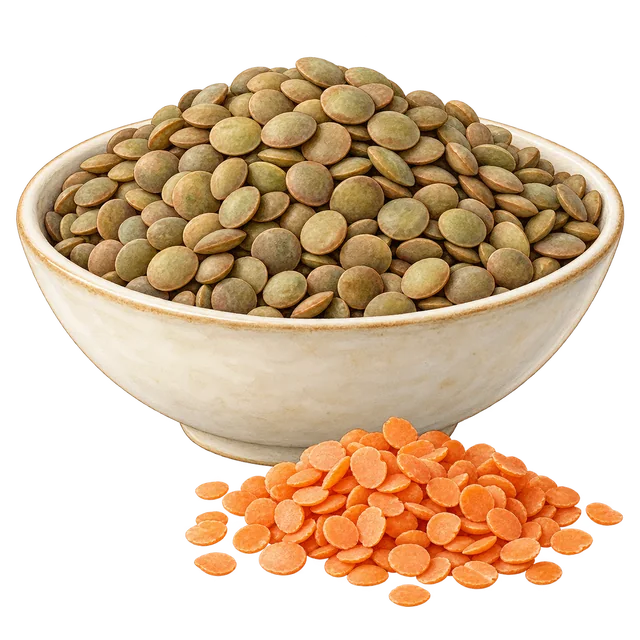
- Whole lentils
- Green and brown lentils retain their seed coats, take longer to cook and keep some chew afterward.
- Split red lentils
- Dehulled and split lentils soften more readily and suit soups, purees and curries.
Illustration for understanding; not to scale. Saved figures include explanations and sources.
In practice · Choosing, cooking, how much
Choosing: dry lentils should be plump, free of insect holes, and even in color. Sealed, they keep for more than a year without spoiling. Canned lentils are already cooked and convenient, but rinse them, because some are high in salt.Cooking tips:
Red lentils: no soaking needed; they soften in 15-20 minutes and suit soups, purees, and curriesGreen and brown lentils: soaking for 30-60 minutes shortens the cooking time and keeps their texture; they suit salads and side dishesDo not add acid (lemon juice, vinegar) to the cooking water, because it toughens the seed coat and lengthens cooking; add it once they are doneIron pairing: add lemon after cooking, or serve with vitamin C-rich vegetables, so the iron is better absorbed
How much: as a source of protein and fiber, 3-5 times a week at 80-150 g of cooked lentils per serving (about half a bowl to a bowl) is a reasonable range. For vegetarians, lentils can be one of the main daily protein sources.
Eating a lot of legumes when you are not used to them tends to cause gas; increasing the amount gradually lets gut microbes adapt, and drinking enough water helps the fiber move through smoothly.
A note for people with gout: lentils have a moderate purine content, so during an acute flare, consult a doctor. People with impaired kidney function should also check with a doctor before eating large amounts of foods high in potassium and protein.
Chapter 8
Are anti-nutrients in beans toxic
So cooked lentils are not a toxin. The claim that legumes are toxic takes something that really happens with raw beans and applies it to normal cooking. People have eaten legumes as a staple for thousands of years, and Asian, Middle Eastern, and Mediterranean diets are built on them, without any widespread lectin poisoning.
Myth · A raw-bean problem applied to cooked beans
Legumes contain lectins and phytate that damage the gut and block nutrient absorption over time: this claim circulates widely in some diet communities, especially around paleo and legume-free diets. Does it hold up?One part is true. Raw or undercooked beans do contain active lectins that can cause acute stomach and bowel upset, and phytate does lower the absorption of iron and zinc (the chapter on anti-nutrients covers how to handle it).
The harmful over the long term step has been blown far out of proportion. These problems only arise when beans are eaten raw or undercooked, and people have eaten legumes as a staple for thousands of years. Asian, Middle Eastern, and Mediterranean diets are built on them, and there has never been widespread lectin poisoning.
Myth · Why avoiding lentils is the costly choice
In a real, varied diet, phytate's drag on iron is much smaller than single-meal studies suggest. Everyday meals already include helpers such as vitamin C and meat, and when the body's iron stores run low, it turns up iron absorption on its own. In the lab, phytate also acts as an antioxidant, though how much that matters in the human body is not yet clear.Legumes are toxic takes something real under one specific condition (raw beans) and forces it onto normal cooking. Cooked lentils are cheap and provide plenty of protein and iron; skipping them to dodge an exaggerated phytate problem is the truly costly choice.
References · 8
- U.S. Department of Agriculture, Agricultural Research Service. (2024). FoodData Central: Lentils, mature seeds, cooked, boiled, without salt (FDC ID 172420). fdc.nal.usda.gov/food-details/172420/nutrients
- Institute of Medicine. (2005). Dietary Reference Intakes for Energy, Carbohydrate, Fiber, Fat, Fatty Acids, Cholesterol, Protein, and Amino Acids. National Academies Press. nap.nationalacademies.org/catalog/10490/dietary-reference-intakes-for-energy-carbohydrate-fiber-fat-fatty-acids-cholesterol-protein-and-amino-acids
- National Institutes of Health, Office of Dietary Supplements. (2024). Iron — Fact Sheet for Health Professionals. Fact sheet (updated September 4, 2025; Wayback snapshot 21 September 2026): RDAs 8 mg/day for men and for women 51+, 18 mg women 19-50, 27 mg pregnancy; UL 45 mg/day from age 14; bioavailability about 14%-18% from mixed diets with meat, seafood and vitamin C and 5%-12% from vegetarian diets; serum ferritin below 30 mcg/L suggests iron deficiency and below 10 mcg/L IDA, but inflammation can raise ferritin; supplemental iron of 45 mg/day or more may cause nausea and constipation; people with hereditary hemochromatosis are at risk of iron overload (fact sheet). Heme vs nonheme: heme iron (lean meat and seafood are the richest sources) has higher bioavailability than nonheme iron, and other dietary components affect it less; calcium might reduce the bioavailability of both forms; heme iron is about 10%-15% of total iron intake in western populations. The sheet gives no separate heme and nonheme absorption percentages (fact sheet, Wayback 2026 snapshot). ods.od.nih.gov/factsheets/Iron-HealthProfessional
- National Institutes of Health, Office of Dietary Supplements. (2022). Folate — Fact Sheet for Health Professionals. ods.od.nih.gov/factsheets/Folate-HealthProfessional
- National Institutes of Health, Office of Dietary Supplements. (2021). Potassium — Fact Sheet for Health Professionals. ods.od.nih.gov/factsheets/Potassium-HealthProfessional
- National Institutes of Health, Office of Dietary Supplements. (2021). Vitamin C — Fact Sheet for Health Professionals. ods.od.nih.gov/factsheets/VitaminC-HealthProfessional
- Hallberg, L., Brune, M., & Rossander, L. (1989). The role of vitamin C in iron absorption. International Journal for Vitamin and Nutrition Research. Supplement, 30, 103–108. Short review: ascorbic acid has a key role in non-heme iron absorption by preventing insoluble, unabsorbable iron compounds and by reducing ferric to ferrous iron. The abstract gives no dose-response numbers (e.g. no mg of vitamin C or fold increase) (abstract, PMID 2507689).
- U.S. Department of Agriculture & U.S. Department of Health and Human Services. (2020). Dietary Guidelines for Americans, 2020-2025 (9th ed.). www.dietaryguidelines.gov/sites/default/files/2020-12/Dietary_Guidelines_for_Americans_2020-2025.pdf