Story
Almonds
Last updated
In one pass Some of the fat in the almonds you chew never reaches your body.
Educational content, not medical advice — consult a clinician.
Story path
Chapter 1
An almond is not really a nut
That chain gives you two practical calls on the spot: whole almonds are absorbed less than almond butter, and the finer you chew, the more calories you take in.
Beyond that, an almond packs fat (mostly monounsaturated fat), protein, fiber, vitamin E, and magnesium into one small kernel, and the later chapters take them one at a time.
One safety note comes first: bitter almonds (including the bitter apricot kernels used in Chinese medicine) release cyanide in the body when eaten raw and are not a snack. If you feel dizzy, nauseated, vomit, or breathe fast after eating them, get medical care right away.
Background · What seed it is, and why bitter ones are toxic
The almond (scientific name Prunus dulcis) is botanically not a nut but the seed of a drupe, a stone fruit. The tree is a close relative of the peach and the apricot; its fruit flesh is thin and dry, and what we eat is the kernel inside the stone. The almonds sold in supermarkets, often labeled California almonds in China, and the badam of Xinjiang are this seed. The sweet and bitter apricot kernels used in Chinese desserts and medicine come from the apricot tree and are a different thing. In everyday diet and nutrition, though, grouping almonds with true nuts is entirely reasonable: what decides how a food moves through the body is its makeup (lots of fat, plus protein and fiber), not which taxonomic branch it hangs on.Almonds come as sweet almonds and bitter almonds. Almost all almonds sold as food are sweet almonds. Bitter almonds contain amygdalin, which on hydrolysis yields a small amount of hydrogen cyanide (HCN). Eating large amounts raw is toxic, and they are not used as everyday food. The bitter apricot kernel of Chinese medicine is also bitter and contains the same compound. This article is about sweet almonds.
Hydrolysis here is worth an extra sentence, because it explains why bitter and toxic are the same event. Amygdalin sitting quietly in the cell does not release poison. Only after the seed is chewed and its cells are broken does it meet an enzyme stored in another compartment, get split apart, and release hydrogen cyanide. That sharp bitter taste comes with this breakdown — in other words, the bitterness and the toxicity come from the same reaction step.
This also explains why edible almonds were bred to be sweet: selecting against bitterness also selected against this poison-making path. So the name sweet almond is not just a flavor description; it marks a safety trait.
If someone has eaten bitter almonds or bitter apricot kernels and feels dizzy, nauseated, vomits, or breathes fast, get medical care right away — do not wait at home to see what happens.
Chapter 2
Why almonds keep you full
The calorie number on the label needs a discount. Nutrition labels are calculated as if the food were fully digested and absorbed, but the intact cell walls of whole almonds lock away some of the fat and carry it out of the body unchanged. This is called the food-matrix effect: the same nutrition table, packed into a different structure, does not deliver the same amount to the body.
The protein line has a detail too. Almonds contain every essential amino acid, but lysine is on the low side and arginine is very high, so they count as an incomplete protein. Eating them with legumes fills the gap — legumes run short in a different place.
Numbers · How to read the nutrition table
Per 100 g (raw, unsalted), almonds contain roughly: about 49 g fat, about 21 g protein, about 22 g carbohydrate (of which about 12.5 g is dietary fiber), and about 579 kcal.A few comparisons help you place this table:
Protein at 21 g / 100 g is high for a nut. All 9 essential amino acids are present, but it is an incomplete protein (very high in arginine, low in lysine), and pairing it with legumes fills the gapFiber at about 12.5 g / 100 g is high for a nut, and includes both soluble and insoluble fiberThe fat line sets the calorie density: most of the calories come from fat, so almonds being high in calories and being nutritious are two sides of the same fact, not two opposing facts
One note on the frame: everything above is per 100 grams, and a real serving is far smaller. What one serving is, and how many calories you actually absorb from it, is in the chapter on choosing almonds and how much to eat.
Mechanism · Why the label overestimates the calories
579 kcal / 100 g sounds extremely high. But that number is calculated with the traditional Atwater conversion factors, and those factors rest on one assumption: that the fat, protein, and carbohydrate in a food are fully digested and absorbed. Almonds happen to break that assumption — their cell walls stay intact, a lot of the fat is wrapped inside a fibrous cellular matrix that digestive enzymes cannot reach, and part of the fat leaves in the stool unchanged. This is called the food-matrix effect.Zoom out a little and it challenges an assumption we take for granted: that you absorb whatever you eat. We treat food as a nutrition table, but food has structure — how thick the cell walls are, how intact the matrix is, and how finely the particles are ground all decide whether digestive enzymes can reach what is inside.
So the same almonds, eaten whole, chopped, or ground into butter, deliver different amounts of energy to the body, while the lines on the nutrition table stay identical. This is not an almond-only quirk; it has simply been measured most clearly in almonds. How that study was done, and how large the gap was, is in the chapter on why the real calories are lower than the label.
Chapter 3
Its fat is mostly oleic acid
One thing to be clear about first: almost all of the polyunsaturated fat in almonds is omega-6, and omega-3 is very low. If you want omega-3 you need another source, and the chapter on what almonds lack says where to find it. Do not file nuts as one thing; their fat makeup differs a lot from nut to nut.
Here is the practical call: most almond fat sits inside intact cell walls, and grinding or pressing breaks those walls. So the fat in whole almonds is digested and used less than the same amount of almond butter or almond oil — the other side of the food-matrix effect.
Which is better depends on what you want. To keep calories down, eat them whole and chew slowly. To pack more energy into a small volume (for an older person with a poor appetite, or fuel before exercise), use almond butter. Both have their place.
A CLOSER LOOK
Fat is inside the kernel; cells need a closer view
The cut distinguishes shell, seed coat and kernel. Fat is enclosed by microscopic cell walls inside the kernel, rather than by the visible brown skin.
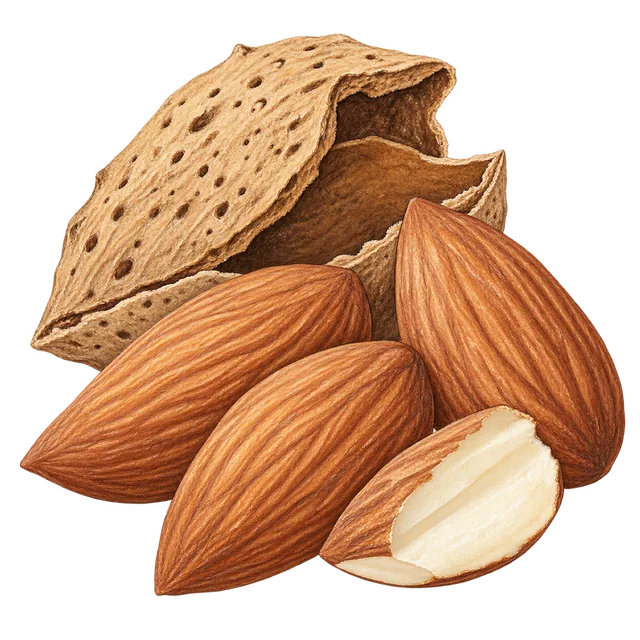
- Brown seed coat
- The visible brown seed coat surrounds the kernel and differs from the walls of individual cells inside it.
- Pale kernel
- Fat sits mainly in the kernel's cells. Grinding or pressing breaks cell walls and changes how that fat becomes available.
Illustration for understanding; not to scale. Saved figures include explanations and sources.
Numbers · The fatty-acid breakdown
Almond fat is about 49 g / 100 g, and it breaks down like this:Monounsaturated fat (): about 31 g — mainly oleic acid (C18:1), the same dominant fatty acid as in olive oil. When it replaces saturated fat, blood low-density lipoprotein cholesterol (, the so-called bad cholesterol) goes down; people who eat more of this kind of fat also have less heart disease, and that second point is an observed association. see Fat Types.Polyunsaturated fat (): about 12 g — mainly linoleic acid (omega-6). Omega-3 is very low; almonds are not an omega-3 source.Saturated fat (): about 3.7 g — relatively low, mainly palmitic and stearic acid.
Fat ratio: MUFA 63% / PUFA 25% / SFA 8% — mostly monounsaturated and low in saturated fat, which is a good fat profile.
Why oleic acid and other monounsaturated fats deserve their own call-out: the difference is how many double bonds sit on the carbon chain. A double bond is the softest spot on the chain and the easiest one for oxygen to attack. A chain with no double bonds is saturated fat — sturdy, but solid at room temperature. A chain with many double bonds is polyunsaturated fat — flexible, but quick to oxidize and go off. Monounsaturated fat has exactly one double bond and sits in between — it holds up to storage and moderate heat, and it does not push blood LDL up the way saturated fat does.
Olive oil being studied over and over, and almonds being filed under good fat, rest on the same chemistry. Remember this and you can roughly judge any oil's label yourself: first look at the ratio of these three classes, then at how it will be used (raw, low heat, or high heat).
Chapter 4
Rich in vitamin E and magnesium
Vitamin E has a specific job: it is fat-soluble, so it lives in cell membranes and blocks free radicals before they damage the easily oxidized unsaturated fats there. Almonds are oily and also carry a lot of vitamin E — which makes evolutionary sense, since it protects the almond's own fat. Almonds are in the top tier of all foods for vitamin E, and one handful covers a large share of an adult's daily need. see Vitamin E.
Magnesium works at a more basic level: , the cell's energy currency, has to bind magnesium before enzymes can recognize and use it. So everything from muscle contraction to nerve firing needs magnesium on hand. In a real magnesium deficiency, the early signs are vague, like poor appetite and tiredness; cramps and an irregular heartbeat appear only when the deficiency gets worse. It does not work in reverse: an ordinary calf cramp cannot be read as a sign of low magnesium. see Magnesium.
Almonds also bring a fair amount of calcium, manganese, copper, and riboflavin. Overall they are a good example of a nutrient-dense food — the calories are concentrated, but so are many micronutrients.
Numbers · How much vitamin E and magnesium you get
Vitamin E (Vitamin E): almonds are among the highest food sources of vitamin E. About 25.6 mg α-tocopherol per 100 g; the adult daily need is about 15 mg. A handful of almonds (about 28 g) already provides about 7 mg, nearly half a day's need. Vitamin E is a fat-soluble antioxidant whose main job is protecting polyunsaturated fatty acids in cell membranes from oxidation. Fat and vitamin E showing up together (as in nuts) makes evolutionary sense — it protects its own fat. see Vitamin E.Magnesium: about 270 mg per 100 g. A handful (28 g) is about 76 mg, about 18-24% of the adult daily need (320-420 mg). Magnesium takes part in 300+ enzymatic reactions, including synthesis, DNA replication, muscle contraction, and nerve signaling. see Magnesium.
Read those two lines as one sentence: a handful of almonds is a main source for vitamin E (nearly half a day's need) and a helper for magnesium (around one fifth). Judging what a food is rich in is exactly this ratio, not the absolute milligrams — a number only means something next to how much you need in a day.
Numbers · the other items, and the oxalate discount
Other highlights:Calcium: about 264 mg / 100 g, quite high among nuts (but it contains oxalate, so the absorption rate is discounted)Manganese and copper: important minerals for bone and enzyme systemsRiboflavin B2: about 1.1 mg / 100 g
The oxalate discount is worth explaining, because it is a textbook case of high on the label and absorbed by the body coming apart. Oxalate is a small molecule the plant makes itself. In the gut it binds calcium into an insoluble particle; once bound, both leave together — neither enters the blood. So the calcium line on the table is larger than what the body actually gets.
The conclusion is not don't eat almonds, but don't count on almonds to cover calcium: it is a perfectly fine food that happens to bring a little calcium; it is not a suitable main source.
The same logic holds for iron: plant iron eaten with almonds is absorbed a little less because of oxalate. So on a meal where you really need iron, do not make almonds the lead — eat them at another time; they do not conflict.
Chapter 5
What it lacks · how to pair
Almost no omega-3: their polyunsaturated fat is mostly linoleic acid (omega-6). For omega-3 you need something else — walnuts are the highest among tree nuts, followed by fatty fish and flaxseed. see Fat Types and Fats & Omega-3.
Almost no vitamin C, and no vitamin B12 at all (reliable sources of B12 are animal foods, fortified foods, or supplements).
Lysine is low: pairing with legumes (lentils, black beans) lets the amino acids complement each other.
Practical pairings:
Almonds with dark berries (blueberries, strawberries): vitamin E from one, vitamin C from the otherAlmonds mixed with walnuts: covers the omega-3 gapAlmonds with legumes (tofu, hummus): the proteins complement, with lysine and arginine each suppliedOn a meal meant for iron, skip a big serving of almonds: their oxalate lowers iron absorption a little
The overall strategy: treat almonds as a source of fat, vitamin E, and magnesium, and combine them with foods of different colors and categories.
Mechanism · Why pair almonds with walnuts or beans
Unfold lots of omega-6, little omega-3 and you see why it matters.These two classes of fatty acids share one fact: the body cannot make them, so they have to come from food — that is where the name essential fatty acids comes from. A food that supplies only one of them means the other has to come from somewhere else. Almond fat is a typical one side only case: plenty of linoleic acid (omega-6), almost no (a plant omega-3). Walnuts are the reverse — the highest in omega-3 among tree nuts.
So mixed nuts is not a marketing line; it puts both raw materials into the same handful. The nut group in the PREDIMED trial also ate mixed nuts (walnuts, almonds, and hazelnuts). But that trial tested a Mediterranean diet with added nuts; it never compared mixed nuts with almonds alone. The reason to mix them comes from the fatty acids themselves, not from this trial.
Two other gaps, while we are here:
Vitamin B12 is completely absent, and this is not an almond problem: B12 is made by microbes and is reliably present only in animal foods; plant foods basically cannot be counted on. People who eat fully plant-based need to plan for it separately (fortified foods or a supplement); switching to another nut will not supply itLow lysine and very high arginine is the shared pattern of nuts, and legumes are the reverse. So nuts with legumes complement each other — building protein needs all nine essential amino acids present, and it does not care which dish they came from; they do not even have to be in the same bite, the same day is enough
What this really teaches is not a recipe but a habit: given a food, first ask what it does not have, then decide what fills the gap. Look only at what it has, and even a healthy diet will miss a corner.
Chapter 6
Fewer calories absorbed than labeled
Why: not every cell wall in a whole almond breaks open during chewing and digestion. Cells that stay intact lock the fat inside, where digestive enzymes cannot fully reach it. That fat leaves in the stool along with the cell fragments and never enters your blood. The coarser you chew and the more whole almonds you eat, the stronger the effect.
It challenges the default assumption behind nutrition labels: eaten = absorbed. Label conversion factors assume fat, protein, and carbohydrate are fully digested, and intact plant cells make that assumption fail for nuts.
That gives two practical conclusions pointing in opposite directions. To keep calories down, eat them whole rather than ground into butter. To pack more energy into a small volume, do the reverse.
This is general information only and does not replace personalized advice from a doctor or dietitian.
Evidence · How that gap was measured
Background: the calories on a nutrition label are calculated with the Atwater general conversion factors — protein 4 kcal/g, carbohydrate 4 kcal/g, fat 9 kcal/g. These factors assume those three nutrients are fully digested and absorbed.Novotny and colleagues published a randomized crossover study in the American Journal of Clinical Nutrition (Am J Clin Nutr) in 2012. They enrolled 18 healthy adults and, by precisely measuring the energy in their feces and urine, calculated the actual metabolizable energy of almonds as about 129 kcal per 28 g, not the 170 kcal on the label — a little more than a fifth less.
Why weigh the urine too: energy that goes in has only three exits — kept by the body, lost in feces, or lost in urine. Measure the last two and what remains is what the body actually got. This measure what goes in and what comes out method is far more reliable than a blood test or a questionnaire, and that is why the conclusion holds: it does not depend on people reporting what they ate, and it does not depend on any conversion assumption.
What it means in practice: if you eat 30 g of almonds a day, the calories you actually take in are a little more than a fifth below the label. This also partly explains the observational finding that people who eat nuts are not heavier than people who do not.
One boundary: this discount was measured for almonds eaten whole. It does not extend to all foods, and it does not extend to almond butter or almond flour — once the cell walls are ground open, the discount shrinks.
Chapter 7
Choosing, eating and how much
How much: a handful is about 23-25 almonds / 28-30 g, the often-cited serving; in the big Mediterranean-diet trial, the nut group also ate 30 g of mixed nuts a day. As an afternoon snack or with breakfast they are filling and hard to overeat.
How to eat them: whole and chewed slowly is the way to take in the fewest calories, because some of the fat stays locked in cells you did not break open. Ground into almond butter they are absorbed more completely, so the calories go up; almond milk is mostly water and flavor, so do not expect it to bring you what almonds do.
In practice · Storing and roasting without rancidity
Storage: nuts are rich in unsaturated fat and oxidize readily when exposed to air, heat, and light. Sealed in the refrigerator they keep 3-6 months; frozen, up to 1 year. At room temperature, dry and away from light, about 1-2 months.Why oxidation is worth preventing: unsaturated fatty-acid chains have double bonds, and those are the spots oxygen hits first. Worse, the process passes itself on — the products turn and attack neighboring fat molecules, like a row of matches catching. So rancidity is not getting a little worse with time; past a point it accelerates. That rubbery or paint-like smell is the signal that this row of matches is already burning; if you smell it, do not eat them. Refrigeration and keeping them in the dark are exactly about stopping the first match from being struck.
Raw vs roasted: light roasting (120-150°C, 10-15 minutes) adds flavor with limited vitamin E loss. High-temperature deep roasting and repeated heating oxidize unsaturated fat and generate small amounts of harmful compounds. Principle: a single light roast is better than buying already heavily roasted almonds — you cannot see the commercial roast temperature, how many times they were heated, or how long they sat on the shelf, and those three are exactly the variables that decide how oxidized they are.
Numbers · The same handful in three forms
Calories by form: whole raw almonds measured about 129 kcal per 28 g (4.6 kcal/g), below the label. In almond butter the cell walls are ground open and absorption is more complete, so each 28 g delivers clearly more calories. Almond milk is very low in calories and very low in nutrients. The form changes both the calories and the nutrition a lot.Read these three lines as a choice: do you want nutrition or fewer calories?
Whole almonds and almond butter have almost the same nutrition; the only difference is how efficiently they are absorbed. For calorie control, pick whole almonds. For energy density (before exercise, with a poor appetite, or when you need to gain weight), pick almond butterAlmond milk is a different thing: it is water with a little almond in it, and almost none of the vitamin E, magnesium, protein, or fiber in almonds is left. Treat it as a drink and you will not be disappointed; treat it as drinking almonds and you will be
This is also the general question for any X product: first ask how much of the original food is left in the finished product, then ask what processing it went through — not whether the package still shows a picture of the nut.
Chapter 8
Do nuts make you gain weight
In a large randomized trial, adults at high cardiovascular risk added a daily handful of mixed nuts to a Mediterranean diet. Over several years their weight did not rise more than the control group's, and they had fewer major cardiovascular events. Many observational studies also find that people who eat nuts often have a lower risk of death — that is an observed association, and on its own it cannot show the nuts are the cause.
Why they do not make you fat: three mechanisms stack up. Fat, protein, and fiber keep you full, so you eat less at the next meal; whole almonds deliver fewer calories than the label says; and the nuts you add tend to push out other snacks.
The accurate version: eating straight from the bag like chips is a lot of calories, of course. A small handful a day as a between-meal snack has a roughly neutral effect on weight. Nuts being high in calories is a fact; eat them and you get fat is an inaccurate generalization.
Evidence · What those two studies actually said
Almonds have so many calories (about 579 kcal / 100 g) that people trying to lose weight should not touch them — put that sentence next to the evidence.The PREDIMED trial (Estruch 2018) randomly assigned more than seven thousand adults at high cardiovascular risk to three groups: a Mediterranean diet with added extra-virgin olive oil, a Mediterranean diet with a daily handful of mixed nuts (walnuts, almonds, and hazelnuts), or a control group advised to eat a low-fat diet, and followed them for nearly five years. The nut group had fewer major cardiovascular events (heart attack, stroke, or cardiovascular death) than the control group. The researchers later analyzed body weight specifically: eating a handful of nuts a day, the nut group's weight change did not differ from the control group's.
A pooling prospective studies of several hundred thousand people (Aune 2016) found that people who ate about 30 g of nuts a day had a lower risk of coronary heart disease, of cancer, and of death from any cause.
These two pieces of evidence do not carry the same weight, so read them separately: the first is an intervention trial — researchers assigned one group to eat nuts, so the order between eating nuts and what happened afterward is fixed, although what it tested was a whole Mediterranean diet with nuts. The second pools many observational studies; the numbers of people are huge, but it can only show an association, not cause on its own.
Their value is that they point the same way, and both run against the intuition that eating them makes you fat. When an intuition is contradicted by both an intervention trial and a large observational pool, usually the data are not wrong — the intuition is missing a step. Here the missing step is three changes, in the body and in eating behavior, that follow eating nuts.
Mechanism · Why eating them daily does not make you fat
First, strong satiety. Fat, protein, and fiber together make you feel very full, so you eat less afterward. Each handles one stretch: fat slows how fast the stomach empties, protein is best at damping hunger signals, and fiber takes up room and slows digestion. No one of them alone works as well as the three together.Second, the calories actually absorbed are more than 20% below the label (Novotny 2012; the chapter on why the real calories are lower than the label has the study details). This one was measured directly — it does not depend on you eating less of something else; it is a discount the almond's own structure provides.
Third, dietary compensation. In diet studies that add nuts, people tend to eat a bit less of other things without meaning to. In other words, the added calories do not simply stack on top of the old diet; they push out some of something else — often a less nutritious snack. How large this effect is varies from person to person.
Only the three together explain the results of those two studies: it is not that nut calories do not count, but that the same calories lead to different behavior afterward. It also points to a more general rule: a food's calorie number alone cannot tell you its effect on weight — you also have to look at what you do after you eat it.
References · 9
- U.S. Department of Agriculture, Agricultural Research Service. (2024). FoodData Central: Nuts, almonds (FDC ID 170567). fdc.nal.usda.gov/food-details/170567/nutrients
- Novotny, J. A., Gebauer, S. K., & Baer, D. J. (2012). Discrepancy between the Atwater factor predicted and empirically measured energy values of almonds in human diets. American Journal of Clinical Nutrition, 96(2), 296-301. A randomized crossover study (n=18) measured actual metabolizable energy from almonds as ~24% lower than Atwater predictions, due to incomplete lipid digestion from intact cell walls. Abstract figures: 18 healthy adults ate 0, 42 or 84 g of almonds a day in 18-day crossover periods, with all urine and faeces collected over the last 9 days; measured 4.6 ± 0.8 kcal/g (129 kcal per 28 g) versus 6.0-6.1 kcal/g by the Atwater factors (168-170 kcal per 28 g), i.e. the Atwater factors overestimated by 32%. The abstract gives no mechanism; the cell-wall explanation is the usual interpretation, not an abstract finding (abstract, PMID 22760558). 10.3945/ajcn.112.035782
- Institute of Medicine. (2005). Dietary Reference Intakes for Energy, Carbohydrate, Fiber, Fat, Fatty Acids, Cholesterol, Protein, and Amino Acids. National Academies Press. nap.nationalacademies.org/catalog/10490/dietary-reference-intakes-for-energy-carbohydrate-fiber-fat-fatty-acids-cholesterol-protein-and-amino-acids
- National Institutes of Health, Office of Dietary Supplements. (2021). Vitamin E — Fact Sheet for Health Professionals. ods.od.nih.gov/factsheets/VitaminE-HealthProfessional
- National Institutes of Health, Office of Dietary Supplements. (2022). Magnesium — Fact Sheet for Health Professionals. ods.od.nih.gov/factsheets/Magnesium-HealthProfessional
- U.S. Department of Agriculture & U.S. Department of Health and Human Services. (2020). Dietary Guidelines for Americans, 2020-2025 (9th ed.). www.dietaryguidelines.gov/sites/default/files/2020-12/Dietary_Guidelines_for_Americans_2020-2025.pdf
- Estruch, R., Ros, E., Salas-Salvadó, J., Covas, M.-I., Corella, D., Arós, F., et al. (2018). Primary prevention of cardiovascular disease with a Mediterranean diet supplemented with extra-virgin olive oil or nuts. New England Journal of Medicine, 378(25), e34. PREDIMED RCT (~7,447 high-risk adults); a Mediterranean diet supplemented with mixed nuts (or EVOO) reduced major cardiovascular events versus a control low-fat diet. (First published 2013; retracted in 2018 over randomization issues and republished the same year with corrected data.). 7,447 adults aged 55-80 (57% women) at high cardiovascular risk; median 4.8 years. Events 3.8% (olive oil), 3.4% (nuts), 4.4% (control); adjusted HR 0.69 (0.53-0.91) and 0.72 (0.54-0.95). Results similar after omitting 1,588 participants whose assignments departed from protocol (household members enrolled without randomisation, some participants at 1 of 11 sites assigned without randomisation, inconsistent use of randomisation tables at another site) (abstract, PMID 29897866). 10.1056/NEJMoa1800389
- Estruch, R., Martínez-González, M. A., Corella, D., Salas-Salvadó, J., Fitó, M., Chiva-Blanch, G., et al. (2019). Effect of a high-fat Mediterranean diet on bodyweight and waist circumference: a prespecified secondary outcomes analysis of the PREDIMED randomised controlled trial. Lancet Diabetes & Endocrinology, 7(5), e6-e17. Replaces the authors' 2016 report, withdrawn after the randomisation deviations (866 participants, 11.6%) came to light; the estimates do not rely only on the assumption that everyone was randomised. 7,447 older adults at high cardiovascular risk, diets unrestricted in energy and no physical-activity advice, median 4.8 years: all three groups had marginally reduced bodyweight and increased waist circumference. Adjusted 5-year difference versus the low-fat-advice control: bodyweight -0.410 kg (p = 0.056) with olive oil and -0.016 kg (-0.453 to 0.421; p = 0.942) with nuts; waist -0.466 cm (p = 0.154) and -0.923 cm (-1.604 to -0.241; p = 0.008). Funders included the California Walnut Commission and nut companies (abstract, PMID 31003626). 10.1016/S2213-8587(19)30074-9
- Aune, D., Keum, N., Giovannucci, E., Fadnes, L. T., Boffetta, P., Greenwood, D. C., et al. (2016). Nut consumption and risk of cardiovascular disease, total cancer, all-cause and cause-specific mortality: a systematic review and dose-response meta-analysis of prospective studies. BMC Medicine, 14(1), 207. 20 prospective cohort studies (29 publications); per 28 g/day of nuts, summary RR for coronary heart disease 0.71 (0.63-0.80), stroke 0.93 (0.83-1.05), cardiovascular disease 0.79 (0.70-0.88), total cancer 0.85 (0.76-0.94) and all-cause mortality 0.78 (0.72-0.84); similar for tree nuts and peanuts. Observational: the 4.4 million attributable deaths are stated 'if the associations are causal' (abstract, PMID 27916000). Up to 819,448 participants and 85,870 deaths in the all-cause analysis; total cancer means cancer cases (18,490), not cancer deaths; most of the risk reduction was seen up to about 15-20 g a day (full text, PMC5137221). 10.1186/s12916-016-0730-3