Story
Lychee
Last updated
In one pass Lychee contains two toxins that shut down the body's backup line for making its own sugar, and unripe fruit holds more of them.
Educational content, not medical advice — consult a clinician.
Story path
Chapter 1
What lychee is and which part you eat
How this metabolic chain breaks, link by link, is laid out in full in the chapter on how lychee illness happens. For now, three words are enough: ripe, fed, few — eat ripe fruit, eat it after a meal, and do not eat it by the pound.
Apart from that, lychee is a very simple fruit. The white flesh we eat is not the peel but a layer of flesh that grows around the seed (an aril); it holds almost nothing but sugar, water, and vitamin C, with no protein or fat.
A CLOSER LOOK
Red shell, white aril and one large seed
The edible white part is an aril around the seed. The cut separates outer shell, white flesh and seed.
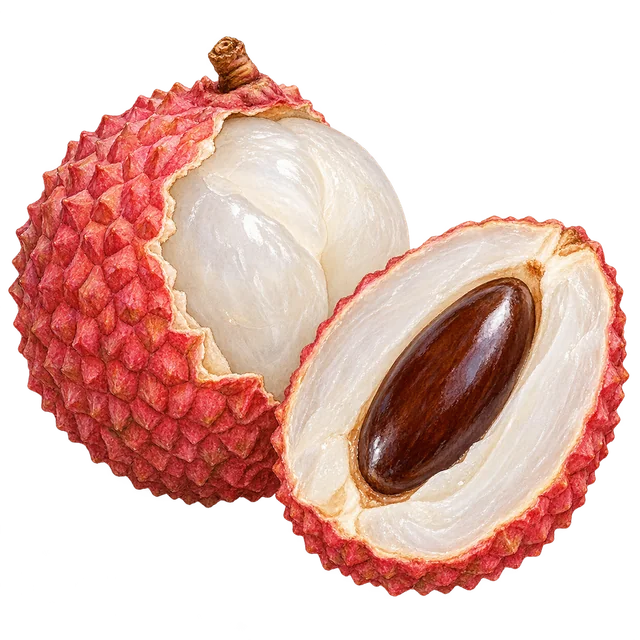
- White aril
- This edible white layer mainly supplies water, sugar and vitamin C, not protein or fat.
- Large central seed
- A brown seed sits at the center, surrounded by the white aril and then the rough red shell.
Illustration for understanding; not to scale. Saved figures include explanations and sources.
Background · where it comes from, which part you eat
Here is the aril in more detail, along with a word about the tree itself.Lychee is an evergreen fruit tree native to southern China and a close relative of longan; both belong to the soapberry family. China is the world's largest growing region and largest market. Feizixiao, Guiwei, and Nuomici are a few well-known varieties; variety mainly changes sweetness, aroma, and pit size, not the fruit's nutritional makeup.
A botanical fact that is often missed: the white flesh we eat is not the peel but the aril, a fleshy coat that grows around the seed. The lychee seed (the pit) is large, and the aril is the part that actually holds the nutrition. Seen another way, the tree piles sugar and water into this ring of flesh around the seed so that animals will carry flesh and pit away together: the sweetness you taste was originally payment for whoever carries the seed.
One point is worth stressing again: ripe lychee is high in sugar and intensely fragrant, but unripe lychee is a different thing. It is not merely less sweet; its chemistry is different, with more of the toxins. That is what the chapter on lychee illness is about.
Chapter 2
Mostly sugar and vitamin C
So in the body, eating lychee is more like drinking a glass of juice than eating a pastry: the sugar is already in small molecules, it is absorbed into the blood in the small intestine with almost no breaking down, and blood sugar rises fairly quickly. But a usual serving is one small handful, so the total sugar is not large and the real hit to blood sugar is limited. How fast it raises blood sugar and how much sugar this sitting actually brings are two different questions (see Glycemic Index & Glycemic Load).
One exception deserves its own note: dried lychee. Once the water is removed the sugar is concentrated, so the same handful brings in several times as much sugar. It is a snack, not a fruit.
Numbers · what is actually in 100 g of the edible part
Fresh lychee has about 66 kcal per 100 g and 16-17 g of carbohydrate, most of it sugar (roughly half fructose and half glucose), with only about 0.8 g of protein, 0.4 g of fat, and about 1.3 g of fiber.What that means for blood sugar: lychee's glycemic index () is moderate to fairly high (about 50-79 depending on the variety), but because a typical sitting is only 5-10 fruits (about 80-150 g), the total sugar is not large, and the glycemic load () is actually not high. For how GI and GL differ (see Glycemic Index & Glycemic Load).
A side note: dried lychee concentrates the sugar about 4-5 times, so per 100 g, dried lychee carries far more calories and sugar than the fresh fruit. As a snack, count your portion by dry weight.
Chapter 3
Fat · nearly none, and that is the point
Fat and protein move slowly through the stomach, and they spread out a meal's sugar so it enters the blood over a longer stretch of time. Lychee has neither, only sugar, so if you eat a big bowl on its own, blood sugar surges first, you do not feel full, and before long you want to eat again.
There is only one practical move: do not let lychee show up alone. Add a small handful of nuts, a cup of unsweetened yogurt, or an egg, and the blood-sugar curve for that meal becomes much gentler; eating it after a main meal works just as well. For a fuller picture of the different fats (see Fats & Omega-3); the classic fat-rich fruit is avocado (see Avocado).
Numbers · how low it sits, and the other extreme
Lychee has only about 0.4 g of fat per 100 g, among the very lowest of common fruits, and no fatty-acid profile worth discussing.Set it beside the opposite extreme and the picture is clear: avocado is a fat-type fruit (about 15 g of fat per 100 g), and lychee is a pure-sugar fruit. Both are called fruit, yet inside the body they travel two different roads: one slow and filling, delivering fatty acids; the other fast and not filling, delivering glucose and fructose. So eat more fruit is not advice on its own; you first have to ask which kind.
Lychee's lack of fat is neither a flaw nor a selling point. It is simply a reminder that lychee cannot be a meal, only part of one.
Chapter 4
Rich in what · vitamin C, a little potassium and copper
Vitamin C does three concrete jobs in the body. First, it helps collagen take shape: one step in building collagen cannot happen without it, and skin, vessel walls, and wound healing all depend on that. Second, in the small intestine it turns iron from plant foods into a form that absorbs more easily, so eating lychee in the same meal as beans or leafy greens nudges iron absorption up. Third, as an antioxidant, it takes some of the oxidative damage off the body (see Vitamin C).
Potassium and copper are supporting players: a little is there, but do not count on it. As for polyphenols, they are just a footnote. Claims like lychee polyphenols slow aging come mostly from test-tube experiments, the same kind of pitch that calls blueberry a superfood: strong in a test tube does not mean useful once eaten.
The ranking is simple: vitamin C is the clear value, and the rest is background.
Numbers · how much vitamin C, and how much else
Lychee's standout micronutrient is vitamin C: about 71.5 mg per 100 g, a little higher than orange (about 53 mg), which puts it in the top tier of common fruits.Other components:
Potassium (see Potassium & Sodium): about 170 mg per 100 g, a moderate levelCopper (see Copper): a small amount, though not low for a fruitPolyphenols: the flesh contains some anthocyanins and flavonoids, but less than berries such as blueberry
Why strong in a test tube is not the same as useful in the body is a general way of taking claims apart that is worth keeping. Cells in a test tube are bathed directly in a concentrated extract, while the polyphenols you eat must get past stomach acid, be selectively absorbed by the gut wall, and then be reworked by the liver, so the concentration that finally reaches the tissues is often lower by orders of magnitude. That a compound can act as an antioxidant is a chemical property; that it helps a person is about what is left after that whole road has been traveled, and the road itself is the gap between the two statements. Claims that lychee polyphenols slow aging get stuck at exactly this step.
Chapter 5
What it lacks · how to pair
A few practical pairings:
With nuts or yogurt: they add protein and fat and keep blood sugar steadierWith whole grains: treat lychee as dessert rather than the meal, with fiber underneathAfter a meal: eaten with or after a main meal, it is steadier than eaten alone on an empty stomach, and this bears directly on whether lychee illness can happen
A bonus from vitamin C: lychee's vitamin C helps the body absorb plant iron from the same meal, so pairing it with beans or leafy greens nudges iron absorption up.
About the pit: lychee pits are not edible, and the hard shell inside the flesh should not be swallowed; for children, remove the pit first to prevent choking.
For how to balance the whole plate (see Carbs & Fiber · see Fruit & vegetables).
Mechanism · how lopsided, and one logic for three pairings
Put lopsided into numbers: lychee has only about 1.3 g of fiber per 100 g, and almost no protein or fat.What little fiber means is worth spelling out. Fiber is the part of carbohydrate the body cannot break down on its own. In the gut it soaks up water and thickens, like adding a net to the meal: sugar molecules have to get through that net before the gut wall can take them up, so the same amount of sugar enters the blood more slowly. Lychee has no such net, so its sugar arrives directly.
Pairing with nuts or yogurt, pairing with whole grains, and eating after a meal are three ways of writing the same logic:
Nuts and yogurt add fat and protein: they slow the emptying of the stomach, and the sugar slows with itWhole grains add fiber: they borrow that net from another foodEating after a meal means other food reaches the stomach first: the seats are taken, so the sugar has to wait in line
Three different roads, one goal: do not let a pile of sugar enter the blood alone and fast. Once you see that, you do not need to memorize a pairing chart to put a plate together; just ask whether anything is standing in front of this mouthful of sugar.
Chapter 6
How lychee illness happens in children
When you go without food overnight, blood sugar is held up by two backup lines: first the body burns fat, which spares glucose for the brain; then it makes new glucose from non-sugar raw materials. Two toxins in lychee, hypoglycin A and methylenecyclopropylglycine (MCPG), cut both lines at the same time: beta-oxidation of fatty acids (breaking fat down piece by piece to burn it) is blocked, and gluconeogenesis (making glucose from non-sugar materials) stalls; unripe fruit contains more of these toxins. So the energy in fat cannot be drawn on, no new sugar can be made, blood sugar crashes, and the brain runs out of fuel, bringing seizures and coma, and in severe cases death.
The danger is greatest when several conditions stack up: unripe fruit, an empty stomach (no evening meal), a large amount, and a young or undernourished child. After a meal the supply of blood sugar is ample, and adults have larger glycogen reserves; so for a healthy adult who has eaten, a few ripe lychees after the meal carry practically none of this risk.
This scene is education and does not replace medical care: if a child who has eaten a lot of lychee on an empty stomach turns dizzy, breaks into a cold sweat or has a seizure, take them to hospital immediately.
Mechanism · how both backup lines get cut at once
Take this chain down to its parts, and you can reason through other cases yourself.Blood sugar has three sources: the meal you just ate, glycogen stored in the liver, and gluconeogenesis, the liver's way of making new glucose from non-sugar materials such as lactate, amino acids, and glycerol. Right after a meal, the first source carries you; a few hours into a fast, the second; in the small hours, once glycogen runs low, everything rests on the third.
At the same time there is a parallel energy-saving move: the body switches to burning fat. Fatty acids are sent into the mitochondria and trimmed shorter, piece by piece, releasing energy; that process is called beta-oxidation. It does two jobs: it supplies energy, and it spares glucose for the brain (the brain runs almost entirely on sugar). More importantly, beta-oxidation also powers gluconeogenesis, so the two lines are in fact tied together.
What hypoglycin A and MCPG in lychee (more of them in unripe fruit) do is exactly to jam beta-oxidation, and gluconeogenesis along with it. So three things collide in the same night:
Fat will not burn → that energy cannot be drawn on, so the body has to keep spending glucoseGluconeogenesis stops → the glucose being used up cannot be replacedGlycogen was already empty → there is no buffer
Blood sugar can only keep falling. The brain is the first organ that cannot cope: it runs almost entirely on glucose and keeps no stock of its own, so the outward signs are seizures and impaired consciousness, not a stomachache. That is why this is called encephalopathy, a brain disorder, rather than food poisoning.
Why the victims are mainly children is clear by now: a child's liver is small and its glycogen stores are thin, so the buffer was slight to begin with, and in an undernourished child it is thinner still; and a bellyful of lychees in the orchard at dusk, with dinner skipped, puts glycogen used up and both backup lines cut into the same night.
Evidence · how this mechanism was traced
This mechanism was worked out during the 2013-2014 outbreaks in Muzaffarpur, Bihar, India (the MMWR field investigation by Shrivastava and colleagues, and the 2017 Lancet Global Health case-control study): children ate large amounts of lychee on an empty stomach in the evening and fell ill during the night.What is worth learning is not only the conclusion but the method. The case-control study did the most basic thing possible: it compared children who fell ill with children of the same age admitted to the same hospitals for other illnesses, and looked at where the two groups' actions differed. They differed in two ways: the sick children were clearly more likely to have eaten lychees the day before falling ill, and more likely to have skipped the evening meal; and when the evening meal had been skipped, the link between eating lychees and falling ill was much stronger. Breakdown products of the two toxins were also found in the sick children's urine, and not in the comparison children's.
So the direction narrowed from a vague lychee is toxic to lychee plus an empty stomach: the investigators advised the region to cut down on lychee, make sure children eat an evening meal, and correct low blood sugar quickly whenever the illness is suspected. The general method worth keeping: when a food is labeled toxic, first look at how the people who got sick differ in their circumstances from those who did not; the difference often lies in the circumstances, not only in the food itself.
Ripe fruit, normal meals, and a moderate amount is the everyday line you can hold: unripe fruit carries more of the toxins, and after a meal the blood-sugar supply is ample. Those three words are more useful than remembering the toxins' names.
Chapter 7
Choosing, eating and how much
Eating:
Eat them ripe: this is the first rule for preventing lychee illness; do not give unripe fruit to childrenDo not eat a lot on an empty stomach: they are safer after a meal, especially for childrenKeep it moderate: for a healthy adult, 100-200 g at a time (about 5-10 fruits) is a reasonable portion; do not eat them by the poundRemove the pits so children do not choke
Dried lychee is a different matter: the sugar is concentrated, so even a small handful carries quite a lot. It is a snack and cannot stand in for fruit.
Who should hold back more: people whose blood sugar is poorly controlled should watch the portion; children should follow the ripe, after-a-meal, moderate-amount rules above. For specific medical questions, ask a doctor.
Numbers · why dried lychee counts as a snack
Dried lychee concentrates the sugar 4-5 times, so the same handful brings in far more sugar than fresh lychee. That is why it counts as a snack and should not stand in for fruit.This is not quite the same thing as free sugars. Under the World Health Organization's 2015 definition, free sugars are sugars added to food, plus the sugars in honey, syrups, and fruit juice; the sugar inside whole fruit does not count. The definition does not say separately whether unsweetened dried fruit counts; for sweetened dried fruit, the added part obviously does.
However it is classified, the problem with dried fruit lies elsewhere. What really limits how much sugar you take in from fresh fruit is not the sugar itself but the volume that water and fiber hold up: only so many pieces fit in one sitting, and the stomach soon reports that it is full. Drying takes the water away, the volume collapses, and the sugar stays exactly as it was: the same handful by weight now holds several times as many pieces, while the feeling of fullness barely keeps up. Dried lychee, raisins, and dried mango all work the same way.
So when you judge any dried fruit, the question is not whether it is natural but what it has lost: what it lost is exactly the volume that made you stop on your own.
Chapter 8
Is lychee heating or toxic
One lychee, three fires (lychee causes internal heat): this is a folk concept, and there is currently no reliable physiological mechanism showing that lychee specifically causes it. The part that can be explained is all about the amount: the mouth and throat discomfort that comes from eating too many at once happens just the same with any other sweet, juicy fruit, and it is not a toxicity unique to lychee. If the real message is do not eat too many at once, there are more accurate ways to say it than heat.
Lychee is toxic, so do not give it to children: this comes from lychee illness, but it squeezes a mechanism that depends on conditions into a line of panic. The danger is greatest when unripe fruit, an empty stomach, a large amount, and a young or undernourished child stack up, and the chapter on lychee illness lays out the whole chain. A few ripe lychees after a meal are ordinary fruit for a child, not poison.
One method works for judging claims like these: ask which mechanism it corresponds to, and under what conditions it holds. Heat has no mechanism behind it, so what it is really describing is the dose; lychee illness has a complete mechanism, but the conditions that got cut out are the key part. State the conditions in full, and the rumor cannot stand.
Myth · what in shanghuo can actually be explained
Take shanghuo down to a level you can test, and not much remains — but it is worth saying plainly, because the same way of taking it apart works on other this food is cooling / this food is heating claims.Some people do feel a sticky mouth and an uncomfortable throat after too much lychee. Three parts can be explained: high-sugar juice repeatedly washing the throat lining; the juicy, sticky flesh leaving sugar in the mouth as food for bacteria; and eating too much in one sitting itself making the mouth feel rough and swollen. All three are consequences of eating too much, not a toxin unique to lychee — swap in another fruit that is just as sweet and just as juicy, and the same things happen.
Why it is worth being precise: shanghuo folds uncomfortable from eating too much and this thing has a special harm into one sentence. The cost of that fold is real — the risk that actually has conditions and a mechanism (lychee encephalopathy) gets heard as the same kind of fuzzy claim and then ignored, and the three rules that should be kept (ripe, fed, few) nobody keeps.
So the shared way to judge is two questions: first, which mechanism it points to that you can describe; then, under what conditions it holds.
Has a mechanism and conditions → follow the conditions; do not widen them and do not shrink them (lychee encephalopathy sits here)No mechanism, only a dose → then what it is saying is simply do not eat too much; say that (shanghuo sits here)
These two questions are not only for lychee. The next time a food is called fa-wu, cooling-natured, or heating, run it through these two questions first; most claims will sort themselves into the second class.
References · 6
- U.S. Department of Agriculture, Agricultural Research Service. (2019). FoodData Central: Litchis, raw (SR Legacy, FDC ID 169086). Per 100 g of the edible aril: 66 kcal, 16.5 g carbohydrate of which 15.2 g sugars, 0.83 g protein, 0.44 g fat, 1.3 g fibre, 71.5 mg vitamin C, 171 mg potassium, 0.148 mg copper. fdc.nal.usda.gov
- World Health Organization. (2015). Guideline: Sugars intake for adults and children. Geneva: WHO. Recommends reducing free sugars to <10% of total energy intake (strong recommendation), and suggests a further reduction to <5% (conditional). 'Free sugars' include monosaccharides and disaccharides added by the manufacturer, cook, or consumer, plus sugars naturally present in honey, syrups, fruit juices, and fruit juice concentrates — explicitly distinguishing them from the intrinsic sugars in whole fruit, vegetables, and milk. www.who.int/publications/i/item/9789241549028
- National Institutes of Health, Office of Dietary Supplements. (2021). Vitamin C — Fact Sheet for Health Professionals. ods.od.nih.gov/factsheets/VitaminC-HealthProfessional
- Shrivastava, A., Kumar, A., Thomas, J. D., et al. (2017). Association of acute toxic encephalopathy with litchi consumption in an outbreak in Muzaffarpur, India, 2014: a case-control study. The Lancet Global Health, 5(4), e458-e466. Two toxins in litchi (hypoglycin A and methylenecyclopropylglycine, MCPG) inhibit fatty-acid beta-oxidation and gluconeogenesis, precipitating hypoglycaemic encephalopathy in children who ate litchis after skipping dinner. 10.1016/S2214-109X(17)30035-9
- Shrivastava, A., Srikantiah, P., Kumar, A., et al. (2015). Outbreaks of unexplained neurologic illness — Muzaffarpur, India, 2013-2014. MMWR Morbidity and Mortality Weekly Report, 64(3), 49-53. Case-control investigation linking the encephalopathy outbreaks to litchi consumption in children, particularly on an empty stomach. www.cdc.gov/mmwr/preview/mmwrhtml/mm6403a1.htm
- Spencer, P. S., & Palmer, V. S. (2017). The enigma of litchi toxicity: an emerging health concern in southern Asia. The Lancet Global Health, 5(4), e383-e384. Commentary explaining the metabolic mechanism: hypoglycin A / MCPG block beta-oxidation, depleting gluconeogenic substrates; malnutrition and skipped evening meals are the critical co-factors. 10.1016/S2214-109X(17)30046-3