Story
Grapes
Last updated
In one pass Grapes need almost no chewing, carry little fiber, and do not fill you up, which makes them one of the few fruits that are easy to eat handful after handful past the point you meant to.
Educational content, not medical advice — consult a clinician.
Story path
Chapter 1
Table, wine and raisin grapes
Grapes are among the most widely grown fruits in the world, but a grape actually goes down three very different paths: table grapes, wine grapes, and grapes dried into raisins.
Table grapes are large, thin-skinned, sweet, and juicy; wine grapes are small, thick-skinned, and full of seeds, with more concentrated polyphenols and sugar. By color, green grapes are lower in polyphenols, while red and purple-black grapes carry more anthocyanins and other polyphenols in the skin.
Mechanism · why wine grapes concentrate more polyphenols
The difference between table grapes and wine grapes is, at bottom, a ratio problem, not a content problem.Polyphenols are not spread evenly through the fruit. They grow almost entirely in the skin and the seeds; that big wad of flesh in the middle is basically sugar water. So how much polyphenol a grape holds depends on how large a share the skin and seeds take of that grape.
The smaller the fruit, the larger the surface relative to the volume: a small grape has less skin in absolute terms, but it wraps even less flesh, so the share of skin in each bite is higher. Wine grapes sit exactly in the small, thick-skinned, seedy class. Stack those three traits, and in the same bite the skin-and-seed share jumps. Table grapes were bred the opposite way: large berries, thin skin, few seeds or none — every one of those traits raises the flesh share, which is to say it lowers the polyphenol share.
It is also no coincidence that the plant puts polyphenols in the skin. Skin is the face the fruit turns toward sun and insects: pigments like anthocyanins block some UV, a layer of sunscreen the fruit makes for itself; proanthocyanidins taste bitter and astringent, so one bite discourages a second — they are there to turn insects away. What needs protecting is the outward layer, so the protective compounds grow in the outward layer.
This chain gives you two conclusions you can push further yourself.
Among grapes, the darker the color and the more the skin makes itself felt, the more polyphenols the skin usually holds. Green grapes sit lower not because they are lesser fruit, but because they never needed that thick a sunscreen.If you habitually spit out the skins and seeds, the polyphenols described here are mostly spat out with them. What you swallow is just sugar and water.
Chapter 2
Mostly sugar and water
What matters is not that fact itself but what follows from it. A grape is thin-skinned, has no pit, and needs no peeling; you chew it twice and swallow, so chewing barely happens. Yet chewing is exactly what normally puts the brakes on eating: take the brake away, and you send food to your stomach far faster than your body can react. With so little fiber, each mouthful does not keep the stomach full for long either (see Carbs & Fiber).
The nutritional highlight is not vitamins but the polyphenols in the skin and seeds: anthocyanins color red and purple-black grapes, proanthocyanidins are concentrated in the seeds, and resveratrol sits mainly in the skin. They are a good thing to have in a diet, but their effect is modest, and they are not a drug.
Mechanism · why you can't stop at one handful
Eating too many grapes is not entirely a willpower problem. Three gates usually keep your eating pace in check; grapes loosen all three at once.The first is chewing. A mouthful of rice takes a dozen chews; a piece of meat takes longer. While you chew, teeth, tongue, and jaw keep reporting to the brain I am eating, and that stretch of time itself is the brake. Grapes are thin-skinned, soft-fleshed, no sinew, no pit; from mouth to swallow they take almost no time — so the amount you can send into the stomach per minute is more than for anything that needs chewing.
The second is fiber. Fiber soaks up water and swells in the stomach, and in the small intestine it makes the chyme viscous. It is the thing that makes a food take up space and move slowly. Grapes have very little fiber, so the same weight of flesh neither holds the stomach for long nor slows the absorption step that follows.
The third is volume. A large part of feeling full comes from mechanical signals when the stomach wall is stretched — the body is measuring how much space is taken. Grapes are about 80% water; water does stretch the stomach, but water is also the first part to leave it. The stretch arrives fast and leaves fast, and the sugar has already stayed behind.
With all three gates loose, you get the line everyone has lived: by the time you feel you have had enough, you have already gone past it. The fullness signal has to travel from stomach and gut to the brain; there is a delay in the middle. Chewing and fiber usually keep eating slow enough that the delay barely shows. Grapes raise the speed, and the same delay becomes a real surplus.
This chain is not unique to grapes. Hold onto it and you will see that everything soft, sweet, chew-free, and watery sits on the same chain; fruit that needs peeling, needs chewing, and carries more fiber comes with its own brakes. Next time you judge whether a fruit is easy to overeat, you do not need a table. Walk these three gates once.
Mechanism · how fast this sugar reaches the blood
The glycemic index () of grapes is not high; it falls roughly between low and moderate. The reason lies in what their sugar looks like.The carbohydrate in staple foods is mostly starch, a long chain of glucose units holding hands. The chain itself cannot enter the blood. Amylase from saliva and the pancreas first has to snip it, piece by piece, into single sugars, and only then can transporters in the small-intestine wall carry them into the blood. That snipping takes time, and the time is a buffer.
Grape sugar skips that step. In the fruit it is already in the form of single sugars, roughly half glucose and half fructose. The glucose half reaches the small intestine and the transporters start carrying it straight away; with no snipping, there is no buffer. Add the low fiber: fiber would otherwise trap sugar molecules in a sticky mass of digesting food so they reach the gut wall a little later, and grapes barely have that speed bump either.
The fructose half takes a different road, though. After it is absorbed, most of it goes to the liver first, and on its own it barely raises blood sugar. With half arriving directly and half hardly moving blood sugar at all, grapes on average land in the middle of the GI scale rather than in the high band.
So the trouble with grapes is mainly not how fast the sugar arrives, but how easy it is to eat a lot at once. Choosing green or purple changes the polyphenol column; what decides this sitting's blood sugar is how much you actually ate.
Numbers · what is actually in a serving of grapes
These are the numbers for table grapes; variety and ripeness will move them a little.Table grapes run about 16-18 g carbohydrate per 100 g (of which roughly 15-16 g is sugar), with protein and fat near zero, and energy landing around 67-70 kcal. That figure by itself is not high — the problem was never how much per hundred grams. It is how many hundred-gram units you eat in one sitting. A bunch on the table is easily three or four hundred grams; then the sugar and calories are no longer small.
The vitamin column has little to say: vitamin C about 3-4 mg, potassium about 190 mg — neither counts as rich. Reaching for grapes to cover vitamin C is looking in the wrong place; they are worth eating because they are sweet, because they quench thirst, because of the polyphenols in the skin — not because of vitamins.
A reasonable serving is roughly a small handful to a cup (about 100-150 g). The use of that number is not to make you weigh. It is to decide how much this sitting is before you start, rather than stopping only when the bag is empty.
In practice · a stick in each of the three gates
Once you know where the gates are, you do not need to memorize a method — you only need to plant a stick at each of those three places.Give resistance back to chewing. Eat the skins; do not spit them. The polyphenols are in the skin anyway. Seeded varieties work too: the act of spitting the seeds is itself a brake.
Give the boundary back to portion. Do not eat from the whole bunch or the whole bag. Portion one serving into a bowl first and put the rest back in the fridge — what you are interrupting is the hand reaching out without having to decide anything.
Give a little attention back. When you eat while watching a screen, the signals above are still firing; no one is listening. Treat the grapes as a real dessert, not as background noise, and the same amount will feel clearly more satisfying.
None of these three is endurance. Endurance is pitting willpower against a delayed fullness signal, and that is hard to win. Planting sticks on the chain is letting the body's own brakes work again.
Chapter 3
What raisins concentrate
By weight, 100 g of raisins carries about three to four times the sugar and calories of fresh grapes (about 300 kcal and 60-65 g sugar vs about 67-70 kcal). Fiber and polyphenols concentrate too, so raisins are not an empty sugar shell. A small handful still packs a lot of sugar.
A CLOSER LOOK
Less water, denser sugar
This compares fresh and dried forms; it does not represent equal weight, equal sugar, or recommended portions.
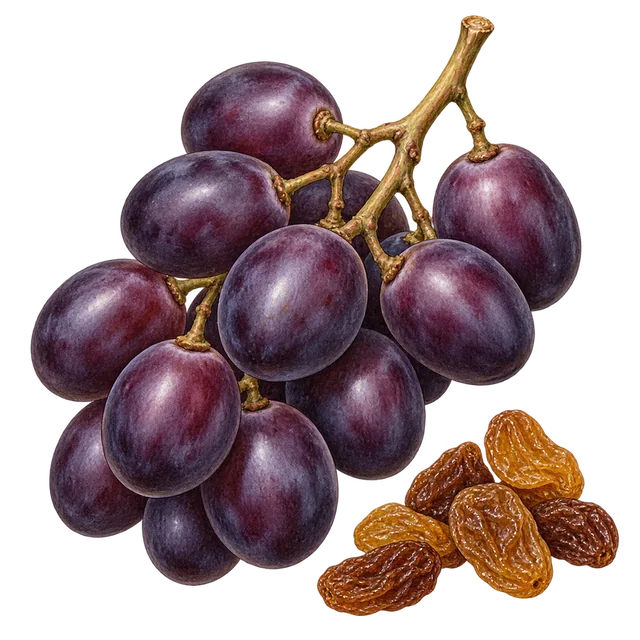
- Fresh grapes
- Water holds the fresh fruit's volume open. The same sugar occupies more space in fresh grapes.
- Raisins
- Drying mainly removes water, leaving sugar, fiber and potassium behind. They become more concentrated by weight.
Illustration for understanding; not to scale. Saved figures include explanations and sources.
Mechanism · why raisins barely fill you up
Fullness is something the body judges by volume, not by calories. Food stretches the stomach wall; stretch receptors in that wall then send the that is quite a load signal — there is no calorie meter inside you.Raisins sit exactly in the gap on this chain. After the water is pulled out, not a gram of sugar or energy is missing, but the volume has shrunk a great deal. The same amount of sugar needs a large bunch's volume as fresh grapes, and that sits plainly in the stomach; raisins need only a small handful and take almost no space.
So you can, without feeling stretched at all, eat the sugar of a large bunch of fresh grapes. This is not a self-control problem — the ruler your body uses to judge enough is not measuring this at all.
The same chain explains a whole class of food. Everything that has had the water taken out — dried fruit, candied fruit, fruit leather — shares one trait: energy density goes up, and the volume signal goes down. Whole fruit is steadier in part because of the water and fiber that give you no calories: they give you no nutrient, they only take up space and buy time.
Push one step further and you have a ruler of your own: whether a food is easy to overeat is not about how high its calories sit. It is about how far its calories sit from the volume it occupies. The farther that gap, the easier it is to eat too much before you notice.
In practice · when raisins are the right choice
The downsides and upsides of raisins are the same string of properties, just in a different setting.On the sofa watching a show, small volume, high sugar density, no prep, handful after handful and you cannot stop — every one of those helps you quietly go over. Fresh grapes or skin-on berries are steadier here: they carry the same sugar, and they force you to spend more time and take more space.
Midway through a long hike or a long bout of exercise, what you want is the most burnable sugar in the least weight and volume, and you want it fast — muscle is waiting for sugar to come back on. Raisins are light, they keep, they do not mind being crushed, and the sugar is already free monosaccharide that does not need slow digestion: every downside above becomes an upside in this setting.
So fresh grapes and raisins are not a healthy-versus-unhealthy pair. They are two packagings of the same molecules, one loose and one tight; which one you take depends on whether you want sugar to come in slower and smaller right now, or faster and larger.
Take this way of judging with you. It is worth more than remembering which food is good. Most is this thing healthy questions have an answer once you swap them for which of my needs right now does it fit.
Chapter 4
Does resveratrol slow aging?
The story started in the lab. When resveratrol was added to cells in a dish or fed to animals, researchers did see antioxidant and longer-life signals. The media then tied it to the notion that the French eat rich food yet have less heart disease, and red wine was packaged as a longevity drug.
But the doses used in those experiments are far higher than anything grapes or wine can give you; red wine contains very little resveratrol to begin with. And once swallowed, most of it is altered on the spot in the gut wall and the liver, so only a tiny amount reaches the blood intact and travels to the heart and brain. The idea that a little red wine protects the heart has not held up either, and alcohol is a clear cause of cancer, with no amount of drinking that is safe for health: do not start drinking for the sake of resveratrol.
Grapes are a fine sweet fruit, and eating a sensible amount is good. But they are not an anti-aging drug, and red wine even less so.
Mechanism · it absorbs well; the trouble comes after
Most people hear low bioavailability and think it means it does not get in. Resveratrol is the opposite: the step through the gut wall it does quite well. What actually stops it are two processing lines after that crossing.The first is inside the gut-wall cells. What you swallow is not absorbed straight into the blood; it first has to pass through that layer of cells. Those cells keep a set of processing enzymes on hand, whose job is to clip a water-soluble handle (a sulfate or a glucuronide) onto incoming small molecules. Once the handle is on, the molecule's properties flip: it becomes highly water-soluble, and therefore easy for the kidney to recognize and send out in urine.
The second is in the liver. Blood coming back from the gut does not join the general circulation at once; it all goes through the liver first. Liver cells run the same processing enzymes, only more of them. Whatever slipped the first gate gets a handle clipped on here.
Those two lines together have a name: first-pass effect — meaning: before the rest of the body gets a turn, it has already gone through the liver. By the time blood finally reaches the heart, vessels, and brain — the places you wanted it to work — intact resveratrol is already almost undetectable; what you can measure in blood is mostly the handled forms lining up to leave.
That is the turning point of the whole story. It is not that it cannot get in. It is that once in, the body treats it as a foreign thing to be cleared. So formulas that claim to raise the absorption rate, even if they do raise absorption, have not touched the stuck link — the stuck place is downstream of absorption.
Push one step further: this path is not unique to resveratrol. Many small plant molecules look fierce in a test tube and do almost nothing when swallowed; they catch on the same step. Hold onto this link, and the next time you see a new super ingredient, you will know where to ask.
Numbers · the dish's dose never reaches your blood
Red wine contains very little resveratrol, typically on the order of a few milligrams per liter. The doses that worked in experiments are far above that: to reach the blood levels that worked in animal studies, the conversion says you would have to drink tens of liters of red wine a day.Alcohol itself is classified by the International Agency for Research on Cancer (IARC) as a Group 1 carcinogen. Group 1 means the evidence that it causes cancer is certain; it does not say how large the risk is. Drink that much and the damage alcohol does to the liver, esophagus, and breast would long since have outweighed any benefit resveratrol might bring. So this is not a question of whether the benefits outweigh the harms: the molecule never reaches an effective concentration, while you take on the full toxicity along the way.
Look back at those 1990s lab results and you can see where the gap comes from. Cells in a dish sit in a constant concentration that the researcher sets directly: no gut wall, no liver, no kidneys. Those three are exactly where most swallowed resveratrol is taken away. So the effective concentration in the dish and the concentration in your blood after you drink are not a little apart. They are not even in the same order of magnitude.
One more point: the French paradox does not lead to a conclusion either. It is a population-level observation: people who drink red wine have somewhat less heart disease. But the same people also tend to eat more vegetables, eat fewer processed foods, eat meals more slowly, and walk more day to day. Jumping from this group has this trait to that molecule in the wine is doing the work is not missing one small step. It is missing a whole set of checks that would have to be done separately.
The idea that light drinking protects the heart has not held up either. It came from the J-shaped curve in observational studies, and that dip was largely a statistical illusion: the non-drinker group included people who had quit because they were ill. The World Health Organization's position is that no level of drinking is safe for health, and less is better. So whatever is said about resveratrol, it is not a reason to start drinking.
In practice · three questions for any anti-aging claim
The valuable part of the resveratrol lesson is not about resveratrol itself. It is the ruler it hands you to use again. Next time a food compound is sold as anti-aging, anti-inflammatory, or cancer-preventing, ask three questions in order.On whom was this effect seen? Cells in a dish, animals, or people? Those three tiers are not the same question getting harder. A dish has no digestion, no liver, no kidney; every step that would take the molecule away on the road is missing.
What is the effective dose converted to a human, and how much can I get from food? Compare those two numbers and most claims end on the spot. A few-fold gap is still worth talking about; a few-hundred- or thousand-fold gap is not something eat a bit more can close.
After it is eaten, does it reach the place you want it to work? Getting absorbed is only the first gate; the liver still sits ahead. Some molecules cannot stay in the blood at all; some cannot enter the tissue that actually needs them. Between useful to a cell in a test tube and useful to a person who ate it sits a whole road, not one step.
Not many claims survive these three. And they do not ask you to know biochemistry. They only ask you to remember one thing: for a molecule to work, it first has to arrive at the scene alive.
References · 4
- U.S. Department of Agriculture, Agricultural Research Service. (2019). FoodData Central: Grapes, red or green, raw; raisins, seedless. Grapes ~67-70 kcal/100 g, mostly sugar and water, low fiber; raisins concentrate sugar and calories ~3-4x. fdc.nal.usda.gov
- National Institutes of Health, Office of Dietary Supplements. (2021). Vitamin C — Fact Sheet for Health Professionals. ods.od.nih.gov/factsheets/VitaminC-HealthProfessional
- Walle, T., Hsieh, F., DeLegge, M. H., Oatis, J. E., & Walle, U. K. (2004). High absorption but very low bioavailability of oral resveratrol in humans. Drug Metabolism and Disposition, 32(12), 1377-1382. Oral resveratrol is almost completely metabolized; the parent compound in plasma is near-undetectable. 10.1124/dmd.104.000885
- Cottart, C. H., Nivet-Antoine, V., Laguillier-Morizot, C., & Beaudeux, J. L. (2010). Resveratrol bioavailability and toxicity in humans. Molecular Nutrition & Food Research, 54(1), 7-16. Reviews the gap between effective experimental doses and the tiny amounts achievable from wine or grapes. 10.1002/mnfr.200900437