Story
Banana
Last updated
In one pass A banana keeps ripening after it is picked: enzymes in the flesh cut its starch, piece by piece, into sugar.
Educational content, not medical advice — consult a clinician.
Story path
Chapter 1
What is banana · varieties and ripeness
Banana is one of the world's highest-volume fruits, but one banana can differ quite a lot from the next. The most common kind in stores is the Cavendish type of sweet banana, and almost every banana we eat as fruit is one of these. The other big group is plantain, which is high in starch and low in sugar and has to be cooked and eaten as a staple.
So before talking about banana nutrition, ask two things: which kind of banana, and how ripe.
Mechanism · How a picked banana ripens itself
Some fruit (grapes, citrus, cherries) stop at the sweetness they left the branch with. Banana does not — it belongs to the kind that finishes the last stretch on its own after being picked. That stretch is worth taking apart, because it is a switch you can flip in your own kitchen.When it is harvested, banana flesh is almost a starch warehouse. Starch is a long chain of many glucose molecules holding hands, and the long chain itself is not sweet — the sweet receptors on the tongue only recognize a single sugar molecule, or two linked together. A long chain is too big; they cannot see it.
What we call ripening is this warehouse being taken apart, segment by segment, by the banana's own enzymes. You only taste sweetness when what is left is one or two sugars linked. So the banana did not become sweeter; it was taken apart: total carbohydrate barely changed. What changed is how small the pieces were cut.
The same dismantling is also moving something else — pectin. Pectin is the glue that sticks cells together. When it is loosened, the flesh goes from firm to soft and sticky. So turning sweet and turning soft are not two events; they are two sides of the same dismantling. That is also why you can estimate sweetness by feel: a squeeze roughly tells you how far the sugars have been taken apart.
This dismantling is contagious. As a banana ripens it releases a ripening gas signal (ethylene) that speeds both itself and the fruit beside it. Three things follow: if one banana in a bunch ripens first, the rest accelerate; to speed it up, bag it with an apple; to slow it down, break the bunch and space them apart.
Plantain sits further toward the starch end of this axis, and when raw its starch is packed tightly — your digestive enzymes only reach the granule surface, so raw plantain is hard and astringent. Heat and water make the starch granules swell and the structure collapse; only then can the enzymes reach the chains inside. That is why plantain has to be cooked as a staple, while Cavendish can be eaten peeled: not a one-liner about different varieties, but how tightly the same kind of molecule is packed.
Chapter 2
Rich in · B6, fiber, some vitamin C
At heart a banana is a carbohydrate fruit: a medium banana (peeled, about 100-120 g) is roughly 90-110 kcal, and each 100 g carries about 23 g of carbohydrate, a little over 1 g of protein, and almost no fat. The impression that bananas are high-calorie and fattening is mostly an illusion: one banana has about the same calories as a medium apple.
Other highlights: dietary fiber (about 2.6 g per 100 g in a ripe banana, including soluble pectin); some vitamin C, though not much; and potassium (Potassium & Sodium), about 358 mg per 100 g. It really is there, but a banana is far from the champion, and the chapter on bananas and potassium lays the numbers out.
Mechanism · Where B6 works once it becomes PLP
Once B6 is converted to PLP, it is the coenzyme for over a hundred enzymes. That sentence is right, but it stops at a noun. Drop it to the level of actions and you find those hundred-plus enzymes are doing two kinds of work, over and over.First, what PLP is. The vitamin B6 you get from food comes in several forms. In the liver they have a phosphate group hung on them, and become the one that actually works — pyridoxal phosphate, abbreviated PLP. That is the word on papers and supplement labels.
PLP's way of working is very simple: it sits in an enzyme's pocket as a handle and helps move amino acids — either carrying a whole amino group away, or snipping off a carboxyl group. The hundred-plus enzymes each have their own target; the action is only these two.
The amino-group path decides whether you can remodel the parts left after protein is taken apart. Once protein is broken into amino acids, the body often needs to turn a surplus kind into a kind that is short; transaminases do that job. They lift the amino group off one amino acid and hang it on another carbon skeleton. and on a lab report are exactly this class of enzyme. Without PLP present, this step cannot happen: amino acids cannot be remodeled, and they cannot easily shed an amino group to be burned as fuel.
The carboxyl-snipping path is closer to home. Several neurotransmitters are themselves amino acids after a carboxyl group has been snipped off, and every step needs PLP present. So B6 takes part in neurotransmitter synthesis is not a courtesy line; it is the same chemical action in a different scene — the same handle, a different pocket.
A third path is easy to miss: the first step of making heme (the part inside a red blood cell that actually grabs oxygen) also needs PLP. So people who are severely short of B6 become anemic, and it is the kind with smaller-than-usual red cells. This chain joins B6 is an amino-acid story to a shortfall causes anemia; without it those two sentences have no bridge.
One thing you can then work out yourself: if B6 is short, symptoms will not pile up in one organ. They scatter to the places that lean hardest on amino-acid remodeling and neurotransmitters — a little in skin and mucosa, a little in nerves, a little in blood-making. That is why a B6 shortfall sounds so mixed.
Myth · Are bananas high-calorie and fattening?
One banana has about the same calories as a medium apple. That is the most counterintuitive fact about bananas, and almost nobody believes it the first time they hear it.The illusion comes from how it feels in the mouth. Bite an apple and most of it is water — juicy, crisp, bulky; a banana has less water, denser flesh, a stickier bite, and swallowing it feels like eating something more substantial. We estimate calories by how substantial it feels to eat, not by how many kilocalories it has — and those two things happen to come apart on a banana.
The same density, on the satiety side, works in your favor. Part of banana fiber is soluble pectin, which turns gel-like in water. That gel makes the chyme in the stomach thicker, emptying slows a little, and the speed of sugar entering blood eases with it. That is exactly the difference from a sweet drink of the same calories: the drink barely needs taking apart before it rushes into blood, while a banana is held and released slowly along the way.
Push one layer further and the fattening label is stuck on the wrong object. What makes people gain weight is a sustained calorie surplus across a day; and a fruit that still needs peeling, chewing, and space in the stomach is precisely the kind hardest to lose control over. What is easy to lose control over does not need chewing, does not take volume, and has no fiber slowing it down — a banana is the opposite on all three.
So a more accurate line is: banana is not a low-calorie fruit. It is a compact, moderate-calorie carbohydrate that comes with its own speed bumps. Eating it as a snack is reasonable; treating it as something that does not count and eating it without limit is where the problem is.
Chapter 3
As bananas ripen, starch turns to sugar
In a green, firm banana, most of the carbohydrate is starch, and a large share of it is resistant starch: it is not digested in the small intestine, so it travels to the colon the way fiber does and feeds gut bacteria, which ferment it into short-chain fatty acids. That is why a green banana raises blood sugar slowly, has a low glycemic index (, a measure of how fast a food raises blood sugar), and is more filling (see Carbs & Fiber).
As it ripens, the banana's own amylase cuts that starch step by step into free sugars (glucose, fructose, and sucrose): the riper it is, the sweeter it tastes, the less resistant starch is left, and the higher the GI. A soft, spotted banana raises blood sugar clearly faster than a green one.
So what is a banana's GI has no single answer; it depends on how ripe the banana is. For steadier blood sugar and feeding gut bacteria, a greener one suits better; for quick carbohydrate after exercise, a fully ripe one is more direct. It is a switch you can set yourself.
A CLOSER LOOK
One banana type, two stages of ripeness
Peel color is a clue to ripening, not a precise measure of starch, sugar or blood-glucose response.
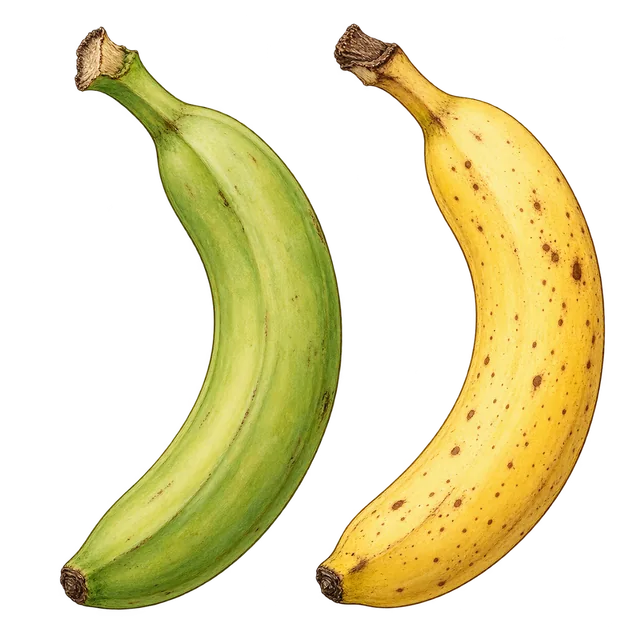
- Greener, more starch
- Unripe banana retains more starch, including resistant starch that can reach the colon and feed microbes.
- Riper, more sugar
- During ripening, the fruit's enzymes break starch into sugars. The banana becomes sweeter and softer, with less resistant starch.
Illustration for understanding; not to scale. Saved figures include explanations and sources.
Mechanism · What resistant starch does in the colon
The line feeds gut bacteria that make short-chain fatty acids stops halfway. Finishing the second half is worth it, because it answers a counterintuitive question: how can something you cannot digest at all count as nutrition?First, why it resists. Starch in a green banana is stacked into tightly packed granules. Your amylase only reaches the granule surface; most of the chains are hidden inside, out of reach. So it travels the length of the small intestine without being taken apart, and arrives in the colon largely intact — the same route fiber takes.
The colon houses a large number of bacteria that have the enzymes you do not. Those chains are taken apart there and fermented; the products are short-chain fatty acids: mainly acetate, propionate, and butyrate.
Each of the three has somewhere to go; butyrate is the one worth remembering. Most of it does not enter blood. It is burned on the spot as fuel by the epithelial cells of the colon wall — and that is those cells' main energy source. In other words, the part you could not digest is handed over as the gut wall's own rations; that is what something you cannot eat can still be nutrition looks like inside the body. Acetate and propionate mostly enter blood and take part in metabolism in the liver.
Once this chain is walked through, two things you can work out yourself:
Eating too much green banana causes gas, and that is not spoilage. Fermentation itself produces gas; it is a by-product of bacteria at work. Swap in any fast-fermenting fiber and it is the sameThe benefit will not cash in on the spot. Mouth to colon is a journey of several hours. Resistant starch works at the end of the trip; sugar works at the start. Reaching for a green banana to rescue a low blood sugar is picking the wrong tool
The last layer is the most practical: the resist in resistant starch comes from structure, not from composition. Cook a green banana and the starch granules swell with water, the structure collapses, and your enzymes can reach it at once — the same banana, after cooking, will send noticeably less of itself as far as the colon. So eating green banana actually has two independent switches: one is green versus ripe, one is raw versus cooked.
Mechanism · Which banana to eat before exercise
In a fully ripe banana, the long chains have already been taken apart into glucose, fructose, and sucrose. Those three names sound like different labels; once they enter the body they go separate ways.Glucose is the most direct: at the small intestine it is moved into blood with almost no further processing. Every cell in the body can use it, including a muscle that is contracting.
Sucrose is one glucose holding one fructose. On the small-intestine wall it is snipped in half, and then each goes its own way.
Fructose is the different one. After it enters blood it is mostly taken over by the liver and remodeled there — turned into glucose, stored as glycogen, and when the amount is large a portion is turned into fat. So fructose is not like glucose, immediately available to muscle; it has to loop through the liver first.
Lay the three roads out and the answer to eating a banana before exercise writes itself: what it can actually be counted on for is sugar, especially the glucose share — a fast carbohydrate that needs little processing, takes little volume, and is portable. The riper it is, the more ready that share is.
Another reason you often hear is eating banana for potassium to prevent cramps. That one is much weaker. Potassium in blood is held very tight by the body; it is not something that jumps a notch because you ate one bite (the chapter on bananas and potassium says why it has to be held that tight). And what causes cramps is still unsettled. Crediting one banana's potassium for a session without cramps leaves several links that cannot be joined — the link that does join is sugar, not potassium.
So which one to pick is actually clear: if you want it fast just before you leave, pick a soft, spotted banana; if exercise is still a while away, or you only want to get through a morning without hunger, pick the greener, firmer one. The same fruit, two uses. The whole difference is how many extra days you left it on the counter.
Chapter 4
Bananas are only average in potassium
Potassium content (mg per 100 g) compares roughly like this:
White beans (cooked): about 561 mgSpinach (cooked): about 558 mgAvocado: about 485 mgPotato with skin (cooked): about 475 mgBanana: about 358 mg, in the middle
By density, potatoes, beans, spinach, and avocado all beat the banana; one whole medium potato holds about 600-900 mg, already several times one banana. Everyone says bananas for potassium because they are so convenient: they come wrapped, peel easily, travel well, and need no cooking. That is a real strength, just not the same thing as the highest content. To actually get enough potassium, eating a variety of beans, potatoes, and leafy greens works far better than loading up on bananas.
People with more advanced chronic kidney disease, or who take drugs that make the kidneys hold on to potassium (such as ACE inhibitors, sartan-type blood-pressure drugs, or spironolactone), should follow their doctor on how much high-potassium food to eat.
Mechanism · the one job potassium does inside the cell
A potassium ranking answers which food has more. It does not answer what more does. Potassium in the body really only does one job, but that job is what lets you move, think, and keep a heart beating.First, remember a layout: potassium almost all stays inside the cell; sodium almost all stays outside. This layout is not natural. It is held up by force — a pump on the cell membrane (the sodium-potassium pump) never stops moving sodium out and potassium in, and the pump is expensive. A sizable share of the energy you burn lying still goes to it.
What that holding-up produces is a stable potential difference across the membrane, like a small battery that stays charged. A nerve firing and a muscle contracting are, at root, this battery being briefly discharged a little and then charged back by the pump; an electrical signal traveling along the membrane is a string of those discharges and resets.
So potassium is not a vague boosts stamina kind of benefit. It is the critical half that keeps that battery. When potassium in blood runs low, the battery's starting point drifts; the signs are soft muscles, cramps, irregular heartbeat. High is equally dangerous, and arrives faster — heart muscle is the most sensitive to this potential difference.
That also explains why the reminder about kidney disease and potassium-keeping drugs is not a boilerplate disclaimer. The body holds blood potassium extremely tight, by the kidneys constantly putting surplus potassium into urine. Once the potassium-excreting end fails (kidney function down, or a medication that keeps potassium), the room on the intake end suddenly shrinks — an amount that is harmless on ordinary days may no longer be harmless then. So that sentence names kidney disease and potassium-sparing drugs, not a vague "in moderation."
It also untangles a common confusion: if potassium is this important, why is almost nobody told to take potassium tablets? Because potassium is spread extremely widely in ordinary food — vegetables, beans, potatoes, fruit, meat all have it; a normal diet is hard to cut off completely. And once blood potassium is pushed up from outside, the risk arrives faster than a shortfall. So the usual question about potassium is not whether you have any; it is whether you have enough, and the fix falls on the structure of meals, not on a tablet.
Numbers · Why a ranking cannot say if you get enough
A potassium ranking compares density — how much per hundred grams. But the potassium your body actually gets is density times how much you eat in one sitting, times how many times a year you eat it. A ranking only gives you the first term.Fill in the other two and the order changes at once:
White beans sit well above banana in density, but they have to be soaked and boiled — think how many times they actually appear in your week of mealsA whole potato really does outweigh one banana, but it usually has to be cooked as a dish; and potassium dissolves in water, so cutting, boiling, and pouring off the water takes some of it awaySpinach density is not low, but it shrinks hard when cooked, so the weight that actually reaches the mouth in one meal is not large
Banana is not outstanding on any of those three, but it has one thing the others do not: it comes in its own wrapper, needs no knife, no fire, no wash, and you can finish it one-handed on a commute. So the frequency with which it appears is far higher than the names at the top of the list — and frequency is the number being multiplied in.
One more layer makes frequency especially important for potassium: the body almost never keeps a long-term store of it. Surplus is put into urine by the kidneys the same day, so it is something that has to be enough every day, not something one meal tops up for a long time. For a nutrient that resets to zero every day, a vehicle you will actually eat every day should not be scored by density alone.
So the banana's real strength is convenience is not an excuse made on its behalf. It is the conclusion of this chain: density sets the ceiling, frequency decides how much you actually get, and when the nutrient resets every day, the weight of the frequency term is amplified.
You can also borrow this chain to judge other rankings. Next time you see that some food is highest in some nutrient, ask three questions first: how much do you actually eat in one sitting? How many times a year? Can the body store this nutrient? Answer all three and the list has usually been re-ranked.
References · 7
- U.S. Department of Agriculture, Agricultural Research Service. (2019). FoodData Central: Bananas, raw. ~358 mg potassium/100 g (middling vs potatoes, beans, spinach, avocado); vitamin B6, fiber; ripeness shifts starch to sugar. fdc.nal.usda.gov
- National Institutes of Health, Office of Dietary Supplements. (2022). Vitamin B6 — Fact Sheet for Health Professionals. Fact sheet (updated June 16, 2023; Wayback snapshot 17 September 2026): plasma PLP is the most common status measure; PLP above 30 nmol/L has been the traditional adequacy indicator in adults, but the FNB used 20 nmol/L as the major indicator when it calculated the adult RDAs; the FNB halved the dose used in the underlying studies to set an adult UL of 100 mg/day (fact sheet). ods.od.nih.gov/factsheets/VitaminB6-HealthProfessional
- National Institutes of Health, Office of Dietary Supplements. (2021). Vitamin C — Fact Sheet for Health Professionals. ods.od.nih.gov/factsheets/VitaminC-HealthProfessional
- U.S. Department of Agriculture, Agricultural Research Service. (2019). FoodData Central: Potatoes, flesh and skin, boiled / baked; french fries; chips. Boiled ~87 kcal/100 g; potassium higher per 100 g than banana, with notable vitamin C and skin fiber. fdc.nal.usda.gov
- U.S. Department of Agriculture, Agricultural Research Service. (2019). FoodData Central: Spinach, raw and cooked. Very low calorie; rich in folate, vitamin K1, lutein, potassium, magnesium; iron is non-heme and bound by oxalate. fdc.nal.usda.gov
- U.S. Department of Agriculture, Agricultural Research Service. (2019). FoodData Central: Avocados, raw (Hass). ~160 kcal/100 g, mostly monounsaturated fat (oleic acid); high fiber and potassium; calorie-dense. fdc.nal.usda.gov
- National Institutes of Health, Office of Dietary Supplements. (2021). Potassium — Fact Sheet for Health Professionals. ods.od.nih.gov/factsheets/Potassium-HealthProfessional