Story
Protein & Amino Acids
Last updated
In one pass For most people, protein quality is not complicated: eat a varied diet with some animal foods, or soy and quinoa, and quality mostly takes care of itself. Not this — BCAAs beat food protein for building muscle — BCAAs supply only 3 of 9 essential amino acids — they ring the start bell without delivering bricks. Complete protein or whey wins in almost every case.
Educational content, not medical advice — consult a clinician.
Stomach · acid + pepsin Protein enters the stomach: the first thing gastric acid (HCl, pH ~ 1.5-2) does is denature the protein — the tertiary structure unfolds, exposing peptide bonds to enzymes.
Leu enters cytoplasm After a meal with enough high-quality protein is digested, leucine reaches the muscle-cell cytoplasm, and it is the only amino acid that directly triggers mTORC1.
Story path
Chapter 1
Which proteins are complete
The one or two that an incomplete protein runs short of are called limiting amino acids. Grains and legumes fill each other's gaps, and eating both within the same day is enough; not every meal has to be complete. For a fully plant-based diet to supply enough, a few conditions have to hold, such as enough calories and enough variety.
Protein sources on the plate: the reference protein (see Eggs); lean meat and fish (see Chicken, see Tuna, see White Fish); soy foods and quinoa (see Soybeans & Tofu, see Tempeh, see Quinoa); legumes (see Lentils, see Chickpeas).
A CLOSER LOOK
Complete protein can come from plants
Soy is one example; a varied diet usually makes protein quality easier to meet.
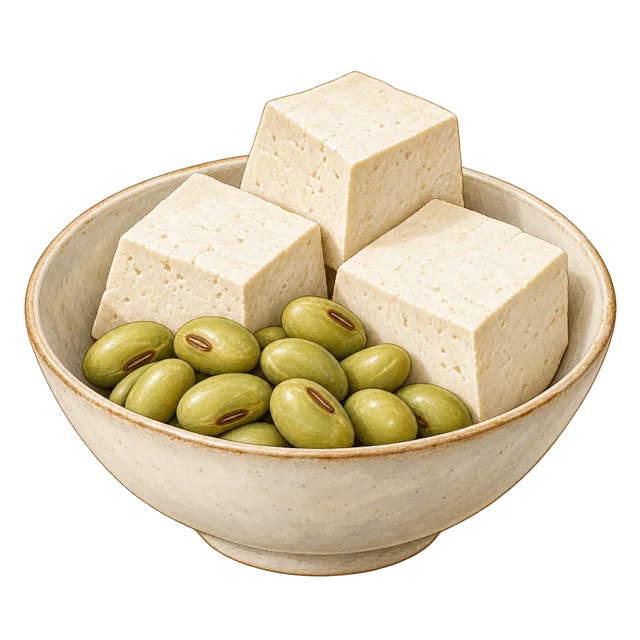
- Soy foods
- Soy is one plant source of complete protein.
- Look at amino acids
- Quality depends on having all nine essential amino acids in proportions close to the body's needs.
Illustration for understanding; not to scale. Saved figures include explanations and sources.
Mechanism · complete proteins and limiting amino acids
Protein quality has two dimensions: whether all 9 essential amino acids are present, and whether their proportions are close to what the body needs.Complete proteins contain all 9 essential amino acids in proportions close to human needs. Among animal foods, egg is the usual reference, and milk, lean meat, fish and poultry all qualify. Among plants, the ones usually listed as complete are soy, quinoa, buckwheat, amaranth and hemp seed — only a few.
Incomplete proteins usually run low on one or two essential amino acids; that shortfall is the limiting amino acid. Grains (wheat, rice, corn) are short on lysine (Lys); legumes are short on methionine (Met) and cysteine (Cys); most nuts and seeds are short on lysine or methionine; vegetables are low in most amino acids.
Complementing them is simple: pair grains with legumes, and eating both within the same day is enough; not every meal has to be complete. The idea that each meal must be complete is an old one from the 1970s and has been overturned. Classic pairings abound: rice and beans (Latin America, India), bread and hummus (Middle East), corn tortillas and black beans (Mexico), oatmeal and milk (Northern Europe), tofu and rice (East Asia).
There are two scoring systems for protein quality. PDCAAS (protein digestibility-corrected amino acid score) is the older standard, on a 0-1 scale. DIAAS (digestible indispensable amino acid score) is the newer, more precise standard proposed by the Food and Agriculture Organization (FAO) in 2013. Written as percentages, egg and milk protein score about 100, soy about 90, and wheat bran about 40.
In practice · when a vegan diet has enough protein
This is the most common worry for vegans and near-vegans, and it can be answered specifically.Plant protein is enough when several conditions hold together: total calories are sufficient (not in a strict diet or an aggressive weight-loss phase); the diet is varied, with legumes, whole grains, nuts and seeds, and soy foods every week; each meal carries somewhat more plant protein than it would animal protein, because plant proteins are lower in leucine and score lower on DIAAS; and there is strength training, with soy or pea protein isolate added when needed.
Situations that tend to go wrong: cutting on a vegan diet without adding protein, where total protein is often too low to hold on to muscle and training results suffer; older vegans who do not exercise, where anabolic resistance (aging muscle responding less to the same protein), low leucine and long-term low energy together speed up sarcopenia; and athletes relying on legumes alone for protein, where methionine stays low.
Two ideas have been revised since the 2010s. The first is that amino acids must be combined within every meal — an old idea from Frances Moore Lappé in the 1970s that has been overturned; the pool of amino acids in the blood and liver stays available for several hours, so combining them within the same day works. The second is that plant protein means low quality, which has been made more precise: soy's DIAAS is close to meat's, and rice and beans eaten together come close as well; single plant sources are indeed lower.
Supplements worth considering for building muscle on a vegan diet: soy protein isolate (DIAAS about 90, with decent leucine); a pea-and-rice protein blend (lysine and methionine fill each other's gaps, giving an amino acid profile close to whey); and essential amino acid powder (a mix of the 9 essential amino acids, added to a main meal).
So vegetarians cannot build muscle is an old claim that does not hold. In a 2021 trial by Hevia-Larraín, young men who were habitual vegans or omnivores (grouped by their existing diet, not randomly assigned) all had their protein set to the same amount (1.6 g per kilogram of body weight a day) and did strength training together; the two groups gained the same muscle and strength. But it takes deliberate planning, not casual eating.
Chapter 2
How stomach and pancreas break it down
The real bottleneck on this chain is the pancreas. When the pancreas works poorly (chronic pancreatitis, cystic fibrosis), both protein and fat are poorly digested, and eating more does not make up for it. Low stomach acid matters more for absorbing vitamin B12 and iron; most protein digestion can still be picked up by the pancreatic enzymes. So the direct-sales line more stomach acid means better digestion overstates the case.
Mechanism · stomach, duodenum and gut in relay
From mouth to blood, protein digestion is a three-station relay: acid unravels it, pancreatic enzymes cut the long chains shorter, and the small intestine trims them into single amino acids for absorption.Station 1, the stomach (acid and pepsin). Stomach acid (hydrochloric acid, pH 1.5-2) denatures protein: once the folded shape opens out, enzymes can reach the peptide bonds inside. Pepsin is switched on at low pH and prefers to cut next to aromatic amino acids (phenylalanine, tryptophan, tyrosine), chopping the whole protein into large fragments 10-50 amino acids long.
Station 2, the duodenum (pancreatic enzymes and neutralizing). As soon as the stomach contents enter the duodenum, bicarbonate in pancreatic juice neutralizes the acid and the pH rises to 6.5-7.5. A set of pancreatic enzymes takes over, each cutting at a different place: trypsin cuts after lysine and arginine, chymotrypsin next to aromatic amino acids, elastase next to small amino acids, and carboxypeptidases remove amino acids one by one from the end of the chain. The large fragments are cut down to short peptides and single amino acids.
Station 3, the small intestine (brush border and gut-lining cells). Enzymes on the surface of the gut wall remove amino acids from the front end of each chain and break short peptides into single amino acids or pairs and triplets (dipeptides and tripeptides). Absorption depends on transporters: dipeptides and tripeptides use a dedicated carrier (PEPT1), and single amino acids have separate carriers for neutral, acidic and basic types. Once inside the gut-lining cells, amino acids travel through the portal vein to the liver, the first checkpoint.
The liver handles most of the amino acids before releasing the rest into the general circulation. The branched-chain amino acids (: leucine, isoleucine, valine) are the exception: the liver has little of the enzyme that breaks them down, so most go straight on to muscle.
Two black boxes are often overlooked. The first is low stomach acid (atrophic gastritis in older age, long-term use of proton pump inhibitors, ): it mainly hampers the release of vitamin B12 from food; protein digestion takes a small cut, but most of it is still picked up by the pancreatic enzymes. The second is poor pancreatic function (chronic pancreatitis, cystic fibrosis), which impairs both fat and protein digestion. In that second case, eating more protein does not build muscle — the bottleneck comes before absorption.
Myth · more stomach acid means better digestion
Low stomach acid causes poor digestion is a common line in direct sales and alternative medicine. The real picture is more complicated.What stomach acid actually does: it denatures protein so that pepsin can cut the peptide bonds; it activates pepsin (which works only below pH 4); it kills germs (partly suppressing foodborne ones such as Salmonella and Campylobacter); it releases vitamin B12 from food protein (the step that lets B12 bind intrinsic factor); and it helps iron absorption (reducing ferric iron, Fe³⁺, to the more absorbable ferrous form, Fe²⁺).
The real causes of too little stomach acid (hypochlorhydria) are few: atrophic gastritis in older age, long-term use of or H2-receptor blockers, many years of Helicobacter pylori infection, and gastric bypass surgery.
The symptoms are often misread. Early fullness, bloating, belching and indigestion, together with vitamin B12, iron, calcium or magnesium deficiency, are what low acid looks like. The so-called acid reflux and heartburn, by contrast, are mostly not too much acid; more often they are gastroesophageal reflux disease () with a loose lower esophageal sphincter. A PPI treats the symptom; it is not as simple as killing off the acid.
Betaine HCl supplements are a direct-sales pitch. Their genuine use is narrow: patients with objectively confirmed low acid who also have trouble digesting protein may partly benefit. Most people with reflux or indigestion should not take them, because they can worsen damage to the esophagus. If used at all, it should be under a doctor's guidance, not as self-directed trial and error.
In practice, older people with genuine indigestion plus a B12 or iron deficiency should see a doctor to have their stomach acid assessed (endoscopy, serum pepsinogen). Buying betaine HCl because your digestion feels poor is not reasonable, and it carries real risk. Eating slowly and chewing thoroughly are the low-risk habits that genuinely help digestion.
Chapter 3
Nine amino acids you must eat
Leucine is the master switch: once a meal supplies enough of it, the ribosomes inside cells start building protein from the blueprint. That is why spreading protein across several meals, each with a decent serving of quality protein, does better in experiments that measure synthesis than one huge meal plus three token ones; over weeks of muscle gain, though, the day's total matters more. Branched-chain amino acid () supplements supply only three of the nine and usually lose to complete protein.
Mechanism · the 9 essential amino acids and leucine
The 20 standard amino acids the body uses to build protein fall into two classes by whether they are essential.The 9 essential amino acids (EAAs) cannot be made by the body and must come from food: the three branched-chain amino acids () — leucine (Leu), isoleucine (Ile) and valine (Val) — plus lysine (Lys), methionine (Met), phenylalanine (Phe), threonine (Thr), tryptophan (Trp) and histidine (His, needed in larger amounts in infancy and pregnancy).
The 11 non-essential amino acids can be made from other amino acids or from metabolic intermediates. But non-essential does not mean unimportant; it only means you do not, in principle, need to eat them specifically. Six of them are conditionally essential: in severe illness, after trauma, and in infancy, the body cannot make enough, so in practice they have to be eaten — arginine, tyrosine, cysteine, glutamine, glycine and proline.
Protein synthesis follows an all-or-nothing rule: while a chain is being built, if any essential amino acid runs short, the whole chain stops and the half-built part is broken back down into amino acids. It is like missing one letter and being unable to spell the word.
Leucine is the real protagonist here. Cells contain proteins that sense it (such as Sestrin2); when leucine rises, they release the brake on the master switch for protein synthesis (), the signal passes on down the line, and the ribosomes start building protein from the blueprint.
How much has to be eaten in a meal to push that switch all the way? A retrospective pooled analysis (in which participants drank a single-source protein) found a breakpoint: about 0.24 g of protein per kilogram of body weight in younger adults and about 0.40 g in older adults (the Morton 2018 cites this result to show that older people need more per meal). For a 70-kilogram person that is roughly 17 g and 28 g. Leucine in common foods is roughly: about 600 mg in each large egg, about 2.5 g in 100 g of chicken breast, about 11% of whey protein, and a slightly lower share of soy protein.
So the consensus view of Phillips and van Loon (2011) is that splitting the day's protein into 3-4 similar meals pushes synthesis furthest; in experiments that measure synthesis over a few hours, that beats one huge meal plus three token ones. Over weeks of strength training, however, Morton 2018 concluded that the day's total matters more than details such as timing and single-dose size.
Myth · what BCAA supplements actually do
Branched-chain amino acid (: leucine, isoleucine, valine) supplements are among the biggest single products in fitness. The evidence can be examined layer by layer.The theory rests on two points: leucine can trigger and start protein synthesis, and the three branched-chain amino acids share the same transport and breakdown enzymes, so they compete with one another.
Here are the human trials, one question at a time.
First, do BCAAs raise muscle protein synthesis (MPS)? Jackman 2017 (Frontiers in Physiology) was a small trial of just 10 trained young men: drinking 5.6 g of BCAAs after exercise raised the synthesis rate of muscle-fiber protein by 22% compared with a placebo. It shows that BCAAs on their own do something, but the comparison was a placebo, not complete protein. The mechanism predicts that full synthesis needs all 9 essential amino acids present; BCAAs supply only 3 of them, which starts the machine without supplying all the raw material.
Second, do BCAAs reduce muscle damage? Some small randomized trials found that BCAAs after exercise slightly reduced felt soreness (delayed-onset muscle soreness, ) and slightly lowered (CK, an enzyme that leaks into the blood when muscle is damaged). But the effect is small, and there is no good evidence that they beat complete protein.
Third is the central-fatigue hypothesis: at the blood-brain barrier, BCAAs compete with tryptophan for the same entry route, so less tryptophan reaches the brain, the brain makes less serotonin (, a neurotransmitter linked to feeling tired), and fatigue eases. Human trials have been inconsistent, and the evidence overall is weak.
The practical conclusion: if you already eat enough complete protein each day (in the Morton 2018 , muscle gains leveled off at about 1.6 g per kilogram a day), adding BCAAs is unnecessary. BCAAs cannot replace complete protein; a mix of all 9 essential amino acids is more complete than BCAAs but still falls short of real food or whey. The setting where they might genuinely help is clinical: very low protein intake in someone who cannot eat normally.
For comparison, 25 g of whey contains about 2.5 g of leucine and all 9 essential amino acids, is itself 25 g of complete protein, and brings other amino acids along too. In almost every situation, whey beats BCAAs.
So BCAAs are a fringe supplement that is precisely marketed and partly right on mechanism; for most people who lift, money spent on them is wasted.
Mechanism · why exactly these 9
The line the body cannot make them, so they must come from food is a tautology. It restates essential in other words and explains nothing. The real answer is more specific.Start with what the body is good at: attaching amino groups. Aminotransferases can take an amino group off one molecule and hang it on another at any time. This is vitamin B6's job. Its active form, PLP, forms an intermediate with an amino acid's α-amino group and then hands that amino group to an α-keto acid, and a new amino acid exists (for this machine that never stops running, see Vitamin B6).
So what the body lacks is never the amino group. What it lacks is the carbon skeleton of these 9 amino acids — carbon frames of particular shapes for which humans have no building enzymes. Put bluntly, our genome carries only the enzymes on the pathways that build the non-essential amino acids; the other 9 pathways were lost by our ancestors over evolution.
So essential does not strictly mean that the body cannot make the molecule; it means the body cannot make the molecule's skeleton.
This is not wordplay. It yields a testable prediction: hand the body the skeleton, and it will attach the amino group itself.
Kidney specialists use that prediction every day. The problem in chronic kidney disease () is nitrogen: protein goes in, the amino groups that are not used end up as urea, and urea has to be cleared by a kidney that is failing. So there is a class of products called ketoanalogues: the carbon skeletons of essential amino acids with only the amino group removed. The patient takes them, and the body uses amino groups already circulating inside it to complete them, by transamination, into full essential amino acids — the patient gets essential amino acids without taking in any extra nitrogen. That is the whole logic of the CKD regimen of a very-low-protein diet (0.28-0.43 g per kilogram a day) plus ketoanalogues.
Read in reverse, the conclusion is sharper still: the skeleton is what is essential; the amino group is not.
Two limits:
Ketoanalogues are a regimen a doctor prescribes according to the stage of CKD, not a supplement to try on your own. How much protein to eat at each stage of CKD is decided by a kidney specialist and a dietitian (see Renal System).These 9 are the line drawn for healthy adults. Change the state of the body (severe illness, trauma, premature birth) and the line moves — that is the topic of conditionally essential amino acids, which this page does not open up.
Chapter 4
Muscle protein synthesis
Synthesis is not a gas pedal either. Over a few hours of measurement, the synthesis from one meal levels off beyond a certain amount, and more of the extra amino acids are burned as fuel. So how protein is split across meals matters, but for muscle gained over weeks the day's total matters more; protein powder is just a convenient way to make up the total.
Mechanism · how food and training signals add up
Muscle protein synthesis (MPS) is set off by two signals stacking.The nutrient signal: amino acids arriving, especially leucine, which activates . Insulin helps too, which is why eating carbohydrate with protein has a combined effect.
The mechanical signal: muscle contracting and being stretched, especially in strength training. On current understanding, mechanical tension works through a second set of signals inside the cell (including focal adhesion kinase, FAK, and vinculin) that also converges on mTORC1, and it makes muscle cells more sensitive to leucine: the same amount of leucine does more after training.
When the two signals stack, synthesis runs at its highest. A protein meal raises MPS for a few hours, after which it returns to baseline; a strength-training session keeps MPS raised for 24-48 hours. Keep the two apart: synthesis being raised for a day or two after training does not mean there is a feeding window that has to be caught.
On how to split meals, two kinds of evidence need to be told apart. One is short experiments that measure the synthesis rate over a few hours: the consensus of Phillips and van Loon (2011) is that 1.3-1.8 g of protein per kilogram a day, split into 3-4 similar meals, pushes synthesis furthest. The other is training trials that measure how much muscle is gained over weeks: the Morton 2018 pooled 49 with 1863 participants and found that once total protein reached about 1.6 g per kilogram a day, lean mass no longer rose with more protein (the 95% for this breakpoint was 1.03-2.20). Timing, the single post-exercise dose and the protein source had little or no effect on the results after several weeks.
Why does a single meal have a ceiling? MPS is less like a gas pedal that goes faster the harder you press and more like lighting a firework: over a few hours of measurement, once a meal's protein passes a certain amount, synthesis no longer rises noticeably, and the extra amino acids lose their amino groups in the liver and are burned as fuel (in effect, protein used as food energy). Whether a large dose adds anything over a longer window is still debated.
The practical upshot: first eat enough in total for the day; then split it over 3-4 meals, each with a decent serving of quality protein. A normal protein-containing meal before training and another after already covers the time around a session, so there is no need to count minutes. Whey is high in leucine and digests quickly, which suits it to after training; casein releases slowly, which suits it to bedtime; plant proteins carry a slightly lower share of leucine, so each meal needs a bit more.
In practice · how to choose a protein powder
Choose a protein powder by budget and purpose.Whey protein is the mainstream choice. Whey concentrate (WPC, 70-80% protein) is the best value, contains a little lactose and fat, and suits most people. Whey isolate (WPI, 90% or more) has less lactose and fat and costs more; it suits people with lactose intolerance or those cutting. Whey hydrolysate (WPH) has already been cut into small peptides and absorbs quickly, but costs another step up; it is used mostly in clinical care (burn recovery, for example) and rarely in fitness. Whey's strengths are its high leucine content (about 11%) and fast absorption, and it is often regarded as the strongest trigger of muscle protein synthesis.
Casein releases slowly, over several hours, which suits bedtime or a long gap between meals; its leucine content is a little below whey's. Micellar casein is better than calcium caseinate, because it keeps its natural structure and releases more slowly.
Egg protein has a DIAAS of about 100, in the top tier, but usually costs more than whey. It suits people allergic to dairy who do not want plant protein.
Plant proteins each have their own profile:
Soy: DIAAS about 90, a complete protein, contains isoflavones (some men worry about estrogen-like effects; the evidence for that is weak)Pea: short on methionine, DIAAS about 65, best paired with rice proteinRice protein: short on lysine, DIAAS about 60, best paired with peaHemp: contains omega-3, but leucine makes up a small share of its proteinA half-and-half pea and rice blend: DIAAS about 85, close to whey, and the practical first choice for building muscle on plants
A few common traps. Amino spiking means adding cheap amino acids (glycine, taurine) to inflate the protein figure, which is calculated from nitrogen content; choosing products with third-party testing avoids it. Clinically proven to add 50% more muscle is marketing talk. The simpler the formula the better; a blend of many ingredients just dilutes the protein.
On amounts: one serving after training, and optionally a serving of casein at bedtime, each sized so that the meal clears the per-kilogram breakpoint described earlier. Protein powder does not replace food; 1-2 scoops a day fill a gap and are not the main source.
Chapter 5
Constant rebuilding, not just muscle
With age comes anabolic resistance: from the same protein meal, older muscle builds less, and it takes more protein to catch up with younger people. So older adults need a more generous serving of quality protein at each meal, plus strength training. Whether high protein harms the kidneys has to be answered separately for healthy kidneys and for kidneys that are already diseased.
Mechanism · how whole-body protein turns over
Each day the human body builds and breaks down about 250-300 g of protein, far more than the typical daily intake (60-100 g). It works by recycling plus a net balance: gross synthesis is about 280 g a day (protein built from the free amino acid pool), gross breakdown about 280 g a day (protein taken back apart into the pool), food adds about 70 g a day (covering replacement and losses), and net oxidation removes about 70 g a day (nitrogen-containing products leaving in the urine).Different tissues turn over at very different speeds. The lining of the gut is replaced every 2-5 days, liver proteins every 10-14 days, skin, hair and nails over weeks, red blood cells every 120 days, muscle over months, and collagen, slowest of all, over years.
So is my protein enough? was never just can I get strong? Immunity (antibodies), wound healing, hair and nails, hormone production (protein and peptide hormones), gut repair and all kinds of enzymes are queuing for amino acids.
Older adults develop anabolic resistance: from the same protein, older muscle builds less. The reasons include lower insulin sensitivity, a blunted response of muscle cells to leucine, and less efficient digestion and absorption. In per-meal terms, a retrospective pooled analysis put the breakpoint at about 0.24 g per kilogram of body weight in younger adults and about 0.40 g in older adults (cited in Morton 2018). The Volpi 2013 review estimates that older adults need about 3 g of leucine to stimulate muscle protein synthesis, equivalent to 25-30 g of quality protein; spreading that amount over several meals to counter sarcopenia is an idea still waiting for randomized trials. What can be done now is a full serving of quality protein at each meal, plus strength training.
That is why the European PROT-AGE consensus recommends that healthy people over 65 raise their protein to 1.0-1.2 g per kilogram a day, and those with acute or chronic illness to 1.2-1.5 g — both above the adult Recommended Dietary Allowance () of 0.8. It is not extra can't hurt; it is without extra you cannot keep up.
Sarcopenia is one of the important reversible causes of disability in old age, and strength training plus enough protein is the best-evidenced response.
Myth · high protein harms the kidneys
High protein harms the kidneys is one of the most persistent nutrition myths, and it has to be taken apart in layers.It goes back to the Brenner hypothesis of the 1980s: eating a lot of protein keeps the kidney's filters (the glomeruli) in a state of high filtration, which over time might scar them. In people who already have chronic kidney disease the worry is reasonable, which is why guidelines tell them to limit protein; the mistake was extending it to everyone.
For healthy kidneys the evidence points the other way. The Devries 2018 (Journal of Nutrition) included 28 papers of randomized trials with 1358 adults without kidney disease, and compared high-protein diets (at least 1.5 g per kilogram of body weight, or at least 20% of energy, or at least 100 g a day) with normal or lower-protein diets. The change in glomerular filtration rate (GFR, how much blood the kidneys filter per minute and the main measure of kidney function) did not differ between the groups. Antonio 2014 (JISSN) had people who lift eat 4.4 g per kilogram a day for 8 weeks, but it measured body composition, not kidney function, so it is not evidence that high protein is safe for the kidneys. Thomas, Erdman and Burke 2016, the joint position statement of the American College of Sports Medicine (ACSM), the Academy of Nutrition and Dietetics and Dietitians of Canada, puts a reasonable intake for athletes at 1.2-2.0 g per kilogram a day; using the upper confidence limit of its estimated muscle-gain plateau, Morton 2018 suggests that people who want to maximize muscle gain can go up to about 2.2 g.
People who actually have kidney disease need handling by stage. In stages 1-2 of chronic kidney disease ( > 60), protein usually does not need to be specially restricted; in stages 3-5 (eGFR < 60) without dialysis, protein is restricted to slow progression; on dialysis the need actually goes up, because dialysis itself removes protein. Exactly how much, and which kinds, is set by stage with a kidney specialist and a dietitian (see Renal System).
So: healthy adults eating 1.5 g per kilogram or more showed no decline in kidney function in these trials; people with known kidney disease should limit protein under medical guidance and not put themselves on a high-protein diet; and nobody should fall short of the recommended intake because they heard it hurts the kidneys — older adults not eating enough protein is far more common than eating too much and harming the kidneys.
On gout: high-purine protein sources (organ meats, sardines, shellfish) should be limited in people who already have gout, while ordinary chicken breast, eggs, milk and tofu carry a low gout risk. This is a heads-up for people prone to gout, not a reason for everyone else to be afraid.
Chapter 6
How much per day
Not all of it has to come from powder. Eat enough in total for the day first, then spread it over several meals with a serving of quality protein in each, and add strength training: that is the research-backed way to build muscle. China's national standard gives grams per day, while the bands by body weight give grams per kilogram. The two answer different questions and do not conflict.
Numbers · how much protein a day, by situation
The US Recommended Dietary Allowance () is 0.8 g per kilogram of body weight a day. It is the floor for avoiding deficiency, not the optimum.Bands by situation:
| Situation | Per kilogram a day (g) | Example (70 kg) | Source |
|---|---|---|---|
| Sedentary adult (baseline) | 0.8 | 56 g | RDA (IOM 2005) |
| Athlete in regular training | 1.3-1.8, over 3-4 meals | 91-126 g | Phillips and van Loon 2011 |
| Strength training to build muscle | 1.6-2.2 (gains level off after about 1.6; 2.2 is the upper end of that estimate) | 112-154 g | Morton 2018 |
| Holding on to muscle while cutting | 1.8-2.0, higher with a bigger calorie deficit | 126-140 g | Phillips and van Loon 2011 |
| Over 65, healthy | 1.0-1.2 | 70-84 g | PROT-AGE |
| Over 65, with acute or chronic illness | 1.2-1.5 (up to 2.0 with severe illness or marked malnutrition) | 84-105 g | PROT-AGE |
| Other severe illness, burns, after major surgery | Set by the clinical team | — | — |
| Second half of pregnancy | RDA plus 25 g a day | RDA plus 25 g | IOM 2005 |
| Breastfeeding | RDA plus 25 g a day | RDA plus 25 g | IOM 2005 |
In the table, the RDA is the US Recommended Dietary Allowance; IOM is the US Institute of Medicine; PROT-AGE is the 2013 consensus of a European expert group on nutrition in older age.
Taking a 70 kg person aiming to build muscle at about 126 g a day (1.8 g per kilogram) as an example, the day could be split like this:
Breakfast, about 30 g: 2 eggs (12 g), 100 g of Greek yogurt (10 g) and 1 scoop of whey (20 g), 42 g in all; or oatmeal with 200 mL of milk (7 g) and 1 scoop of protein powder, 27 g in all.
Lunch, about 35 g: 120 g of chicken breast (32 g) with rice and vegetables; or 150 g of salmon (32 g) with quinoa and salad.
Dinner, about 35 g: 120 g of beef (30 g) with beans and vegetables; or 200 g of tofu (15 g) plus 2 eggs (12 g), with mushrooms and rice.
Snack, about 25 g (after training or before bed): 100 g of Greek yogurt with 1 scoop of casein; or 1 cup of milk and a handful of almonds.
Not all of it has to come from powder. With the day's total covered, spread over 3-4 meals each with a serving of quality protein, plus regular strength training and a slight calorie surplus, you have the research-backed way to build muscle.
Numbers · does China's 65 g clash with the bands
The bands by body weight work in grams per kilogram, while China's national standard (WS/T 578.1-2017) gives grams per day: a Recommended Nutrient Intake () for protein of 65 g a day for adult men and 55 g a day for adult women (with Estimated Average Requirements, EARs, of 60 and 50). It is 70 g in the second trimester of pregnancy, 85 g in the third, and 80 g while breastfeeding.Many people see the two sets of figures and assume they conflict. In fact they answer different questions.
The RNI answers: how much intake ensures that nearly everyone in this population is not deficient. It is a sufficiency line.The 1.6-2.2 g/kg in the bands answers: how much intake lets the adaptation to strength training run all the way. It is an optimization line.
Converting makes it clearer: for a 70 kg man, 65 g works out to about 0.93 g/kg — a little above the US of 0.8, but still in the baseline band, not the muscle-building one.
So the right reading is that the national standard is not telling you not to eat more; it draws a floor that nobody should fall below. If you are building muscle, holding on to muscle during a cut, or already over 65, the bands are what apply, not this floor.
Two more numbers from the same standard are worth keeping, because they are often held up against claims online:
Adult energy shares from the three macronutrients: carbohydrate 50%-65% · fat 20%-30% · protein 10%-15%Adequate intake of dietary fiber: 25-30 g a day
Note that protein sits at 10%-15% of energy, and a high-protein diet easily goes past it. Going past it is not the same as harm (whether high protein harms the kidneys is taken apart layer by layer in the earlier chapter on turnover), but it is worth knowing that you are choosing outside the standard's range, rather than assuming the standard says otherwise.
Myth · does more protein make you taller or leaner
Children who eat more protein grow taller and high protein is best for fat loss are two common claims. Take them one at a time against the evidence.On height, most of the difference in height between people comes from genes; nutrition, enough sleep and physical activity decide whether a child reaches the height their genes allow. Eating enough protein for their age is necessary, but eating more than that does not break through the genetic ceiling. Average height in Japan and South Korea rose markedly from the 1950s to the 2000s, mainly because nutrition improved overall (varied protein, calcium, vitamin D, total energy), not simply from eating more meat. Excess protein does not make children taller and may make them heavier, and some researchers worry that keeping insulin-like growth factor 1 (, a hormone that drives cell growth) high for years might affect chronic-disease risk in adulthood.
On fat loss, high protein does bring clear benefits during a cut. The consensus of Phillips and van Loon (2011) is that eating 1.8-2.0 g per kilogram a day during a calorie deficit helps limit the loss of lean mass. There are three reasons. First, muscle is protected: a calorie deficit plus high protein plus strength training lowers body fat while lean mass holds. Second, heat and fullness: the thermic effect of food (TEF, the energy spent digesting and absorbing food) is about 25-30% of the energy in protein, far above 5-10% for carbohydrate and 0-3% for fat. Third, appetite: after a high-protein meal the hunger hormone ghrelin is pushed lower and appetite falls. But the core is still the calorie deficit; high protein does not create a deficit on its own. Eat more protein and you will get lean is wrong: total calories are the foundation, and protein only fine-tunes.
In practice, growing children and teenagers need enough protein for their age, plus varied food, enough sleep and time outdoors; adults cutting fat need 1.8-2.0 g of protein per kilogram a day, plus a moderate calorie deficit, strength training and plenty of vegetables and fruit. More protein means leaner and more carbohydrate means fatter are the same kind of oversimplification.
References · 7
- Institute of Medicine. (2005). Dietary Reference Intakes for Energy, Carbohydrate, Fiber, Fat, Fatty Acids, Cholesterol, Protein, and Amino Acids. National Academies Press. nap.nationalacademies.org/catalog/10490/dietary-reference-intakes-for-energy-carbohydrate-fiber-fat-fatty-acids-cholesterol-protein-and-amino-acids
- Phillips, S. M., & Van Loon, L. J. C. (2011). Dietary protein for athletes: from requirements to optimum adaptation. Journal of Sports Sciences, 29(sup1), S29–S38. Consensus opinion: leucine (possibly the other BCAAs) is prominent in stimulating MPS; 1.3-1.8 g/kg/day eaten as 3-4 isonitrogenous meals will maximise MPS; up to 1.8-2.0 g/kg/day, depending on the caloric deficit, may help prevent lean-mass loss during energy restriction (abstract, PMID 22150425). 10.1080/02640414.2011.619204
- Morton, R. W., et al. (2018). A systematic review, meta-analysis and meta-regression of the effect of protein supplementation on resistance training-induced gains in muscle mass and strength in healthy adults. British Journal of Sports Medicine, 52(6), 376–384. 49 RCTs, 1,863 participants, resistance training of 6 weeks or more. Protein supplementation added 2.49 kg to 1RM and 0.30 kg to fat-free mass; the effect fell with age and was larger in trained people. Break point for FFM gains at 1.62 g/kg/day (95% CI 1.03-2.20; 42 study arms, 723 participants; the biphasic model was not statistically significant, p = 0.079); given the CI, the authors say ~2.2 g/kg/day may be prudent for those maximising gains; timing, post-exercise dose and source play a minor if any role; they cite per-dose MPS break points of 0.24 (younger) and 0.40 g/kg (older). One author reports grant support from the US National Dairy Council (abstract and full text, PMC5867436). 10.1136/bjsports-2017-097608
- Volpi, E., et al. (2013). Is the optimal level of protein intake for older adults greater than the recommended dietary allowance? The Journals of Gerontology: Series A, 68(6), 677–681. Full text: the threshold dose of leucine for stimulating muscle protein synthesis in older adults appears to be approximately 3 g, corresponding to approximately 25-30 g of high-quality protein; the abstract concludes that new research is needed to establish older adults' protein needs (full text, PMC3660117). 10.1093/gerona/gls229
- Devries, M. C., Sithamparapillai, A., Brimble, K. S., Banfield, L., Morton, R. W., & Phillips, S. M. (2018). Changes in kidney function do not differ between healthy adults consuming higher- compared with lower- or normal-protein diets: a systematic review and meta-analysis. The Journal of Nutrition, 148(11), 1760–1775. 28 trials, 1,358 healthy adults: after the diets GFR was trivially higher on higher-protein diets (SMD 0.19, 0.07-0.31), but the change in GFR did not differ (SMD 0.11, -0.05 to 0.27); the authors conclude higher protein does not adversely affect GFR in healthy adults; selection-bias risk was unclear (abstract, PMID 30383278). 10.1093/jn/nxy197
- Thomas, D. T., Erdman, K. A., & Burke, L. M. (2016). American College of Sports Medicine joint position statement: nutrition and athletic performance. Medicine & Science in Sports & Exercise, 48(3), 543–568. The abstract has no g/kg numbers. Full text: protein intake to support metabolic adaptation, repair, remodelling and protein turnover generally ranges from 1.2 to 2.0 g/kg/day, with higher intakes for short periods of intensified training or reduced energy intake; about 0.3 g/kg after key sessions and every 3-5 hours over multiple meals (full text, MSSE page via Wayback snapshot 7 March 2026). 10.1249/MSS.0000000000000852
- Bauer, J., Biolo, G., Cederholm, T., Cesari, M., Cruz-Jentoft, A. J., Morley, J. E., et al. (2013). Evidence-based recommendations for optimal dietary protein intake in older people: PROT-AGE Study Group. JAMDA, 14(8), 542-559. 10.1016/j.jamda.2013.05.021