Story
Shrimp
Last updated
In one pass Shrimp is not low in cholesterol, but for most people, the cholesterol you eat raises LDL in the blood (low-density lipoprotein, the "bad cholesterol" on a lab report) only modestly.
Educational content, not medical advice — consult a clinician.
Story path
Chapter 1
What shrimp is · eats like meat, profiles like lean fish
Shrimp is a crustacean. Its muscle is almost pure lean protein, with very little fat. It eats like meat, but nutritionally it is closer to a very lean fish.
When you shop, the main differences are in three places: saltwater versus freshwater shrimp (broadly similar in nutrition); fresh versus frozen (frozen shrimp are often flash-frozen on the boat and may be no less fresh); and raw versus treated (salted, or soaked in phosphate to hold water) — treated shrimp can differ a lot in sodium and additives.
The head holds the hepatopancreas, which is rich in flavor and also where heavy metals and cholesterol are more concentrated. The dark line along the back is the gut and is usually removed. Raw shrimp is grayish, and it turns pink when heated because of a pigment called astaxanthin.
If you are allergic to crustaceans and your lips or throat feel tight, or you have trouble breathing after eating shrimp, call emergency services right away.
A CLOSER LOOK
Head and muscle are different
This identifies external regions; artwork cannot reveal internal organs, cholesterol or contaminants.
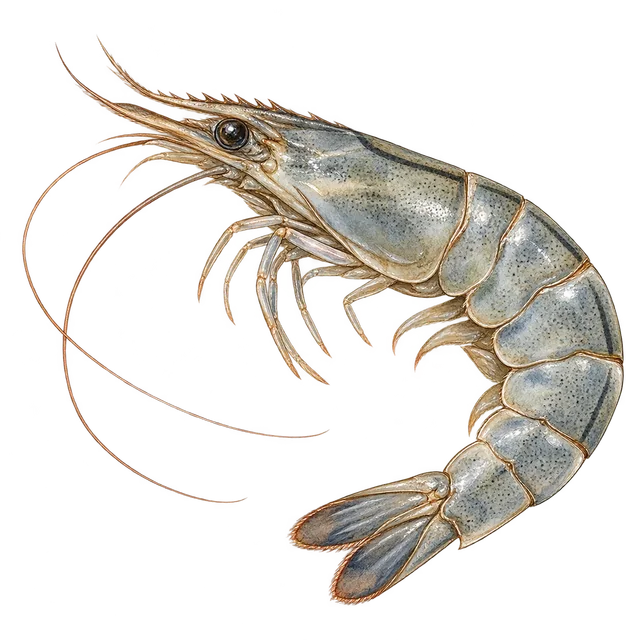
- Head-thorax
- The hepatopancreas lies inside the head region, distinct from the abdominal muscle usually eaten.
- Abdominal muscle
- Shrimp muscle is mostly lean protein with very little fat.
Illustration for understanding; not to scale. Saved figures include explanations and sources.
Mechanism · Why shrimp turns red when cooked
Raw shrimp is gray-green, cooked shrimp is pink — probably the kitchen's nicest demonstration of protein denaturation. And what it makes clear is something counterintuitive: the pigment was always there. What changed is the hand holding it.Astaxanthin is orange-red to begin with
Shrimp do not make this pigment themselves. They get it from the algae they eat. Once they have it, they do not store it loosely — a class of proteins in the shell clutches the pigment molecules.
While clutched, the pigment molecule's shape is twisted and pulled a little straighter. Which stretch of light a molecule absorbs, and which it reflects, depends exactly on its shape. Change the shape and the reflected color slides from the orange-red side over to the blue-green side — that is why a live shrimp looks gray-green with a hint of blue.
Heating does only one thing: it makes that hand let go
Proteins hold their folded shape with a pile of very weak interactions. Heat breaks those interactions one by one, the fold comes apart, and that is denaturation. The moment the hand clutching the pigment comes apart, astaxanthin springs back to its own original shape, and shows the orange-red it always had.
So it only turns red when cooked and protein denaturation are two ways of saying the same sentence. Follow the chain and you can push three more things:
The shell and head are the deepest color: that is where the pigment-binding proteins are most concentrated, so the red from shrimp oil or from frying the heads is especially thick.It can turn red without heat: a strong acid (lemon juice left on it long enough) or a high concentration of alcohol can also make the protein come apart. The color change in drunken shrimp or lemon-marinated seafood takes the same road — the protein does not know heat from acid. It only knows whether it has come apart.A color change is not the same as being done: the heat needed to unfold protein at the surface, and the heat needed to bring the center up to temperature, are two different things. The color change happens at the surface and happens early. It is a cue that heating has started, not a verdict that the center is there.
That last line does not cost much on shrimp — they are small, they cook fast, and color plus curling is usually enough. But the idea that color is a surface reading will get you into trouble on a large piece of meat. On chicken the cost is much higher.
Background · What the vein and the head hold
A shrimp has a few lines and parts that are often misread. Once you have them straight, the question of whether to remove them answers itself.The dark line on the back is the gut
It runs from head to tail. Inside it is food residue the shrimp has not finished passing, and the grit that came in with it.
So deveining is first a texture and appearance question: on a large shrimp this line is thick, the grit in it will crunch, and the residue itself can taste bitter; on a small shrimp it is so fine you barely notice, and leaving it does not matter much.
It is not a safety red line — thorough heating will handle the microbes inside. In other words, you devein for eating well, not for staying alive. Knowing that has two benefits: you need not tense up over a plate of small shrimp that were not deveined, and you will not think deveining means you can cook them less.
The white line on the belly is nerve, not the vein
Flip it over and look at the belly side; sometimes you can see a thin white line. That is the shrimp's ventral nerve cord. It has nothing to do with the digestive tract and usually needs no handling. People who take it for the vein often think it was not cleaned thoroughly and keep picking — they are picking at something else.
The mass in the head is an organ that both digests and stores
The darkest, most flavorful part inside the head is the hepatopancreas. The name already writes its job on its face: it does the work of both liver and pancreas — it secretes digestive juices that take food apart, then takes in the lipids that come out, processes them, and stores them. Crabs have this organ too, in the rich mass people call crab butter. Same construction.
That identity decides its two sides, and the two sides are the same fact:
The most flavor: flavor molecules are mostly fat-soluble; wherever lipids are stored, taste accumulates. The layer of red oil from frying shrimp heads, the burst of savor in the head, both come from here.Also the concentrated end: since its job is to receive and stockpile, things in the environment that travel with lipids (heavy metals are the typical case) also tend to enrich here, and cholesterol concentrates in this stretch as well.
So an occasional slurp of a shrimp head is fine. Treating it as the part you eat every day is not — especially from shrimp of unknown origin. The aroma you want and the things you do not want are locked in the same organ. You cannot pick them apart. The only thing you can tune is amount.
A general reading you can take away: with any seafood, first separate which part is muscle and which is viscera. The muscle is usually clean lean protein, and almost every argument about whether you can eat a lot of this happens on the viscera side.
Chapter 2
High protein, almost no fat
In everyday terms, a palm-size portion of cooked shrimp weighs about 85 g and gives 17–20 g of protein for only eighty or ninety kcal. Protein makes up a very high share of the calories, so for the same calories, shrimp's protein density is excellent. That is why it is popular in weight-control and muscle-building diets (see Protein & Amino Acids).
The difference between raw and cooked is mostly water. Boiling and steaming drive water out, so the nutrients per gram become more concentrated. Frying and battering (tempura, salt-and-pepper shrimp) push fat and calories up several times over, and those extra calories come from the coating and the oil, not the shrimp. To keep what shrimp does well, how you cook it matters more than which kind you buy.
Mechanism · Phosphate soaks: shrimp or water?
Treated shrimp can differ a lot in sodium and additives. This page spells out what the treatment actually does — because the same mechanism explains weighing, weeping, and texture in one go.How much water muscle can hold depends on whether the fibers sit loose or tight
The water in shrimp meat is not soaking in it. It is locked in a net woven by muscle fibers. Loosen the net a little and it can hold more water; tighten it and it cannot.
What decides loose or tight is the charge on the fiber surface: like charges repel. The harder they repel, the farther the fibers are pushed apart, the larger the mesh, and the more water it holds. This is not a shrimp-only rule. All muscle works this way.
What phosphate does is turn that repulsion up
Soak shrimp in a phosphate solution and the charge environment on the fiber surface changes, the fibers push each other apart, and the net opens — so the shrimp takes in and holds extra water. Salt goes into the bath with it, and that is the direct source of the high sodium in treated shrimp.
The consequences arrive in order, one link after the next:
At the scale: part of the money you pay by weight is paying for water.In the pan: heat makes the protein contract, the net that was pushed open tightens again, and the extra water is squeezed back out. A pan that should have been searing shrimp ends up boiling them in their own liquid — the surface stays wet, so they will not brown.On the bite: tissue forced open from the outside is not the same as its original structure. It eats doughy and soft, and you lose that crisp, springy snap.
So how to tell
Read the ingredient list: anything besides shrimp and water that lists phosphates, or a very high sodium number, is usually enough.Watch it after thawing: a big puddle on the plate and shrimp that have visibly shrunk are another face of the same fact.Watch it in the pan: if it weeps the moment it hits the heat and will not brown no matter what, it is usually this too.
This is not a food-safety problem. It is a what did you actually buy problem.
It also explains why frozen shrimp is nothing to apologize for: what decides quality was never whether it was frozen, but whether it was treated before it was frozen. A shrimp flash-frozen on the boat is more honest than a fresh shrimp that sat in a treating bath.
Chapter 3
Rich in iodine, selenium, astaxanthin
Iodine: seafood is generally rich in iodine, an essential raw material the thyroid uses to make its hormoneSelenium: shrimp is a good source; selenium is a core part of several antioxidant enzymesVitamin B12: nerves and blood formation both depend on itZinc: involved in immunity and in building proteinPlus phosphorus, copper, and choline
The most interesting item is astaxanthin, the pigment that turns shrimp pink when cooked. It belongs to the carotenoid family and is a strong antioxidant in lab tests; shrimp get it from the algae they eat. But to be clear: shrimp meat does not contain much of it. Using it as a reason to eat shrimp for antioxidant health is an overstatement. It is an interesting mechanism more than a main reason to eat shrimp.
Mechanism · How iodine becomes thyroid hormone
Iodine is the essential raw material for the thyroid to make hormone — that sentence puts iodine at the start and never says what it becomes at the end. The steps in between are short. Once they are on the table you can see why missing this one element tugs at the whole body.Step one: the thyroid actively pulls iodine in
The concentration of iodine in blood is very low. Thyroid cells therefore carry a dedicated pump that moves iodine from the blood into the cell against the concentration gradient. Few organs in the body fit a dedicated mover for one element — the arrangement itself shows how deep the dependence is.
Step two: hang the iodine on tyrosine in a protein
Thyroid cells make a very large protein with many attachment points of the amino acid tyrosine. Once the iodine is activated, it is hung on those points one by one.
Step three: two iodinated tyrosines are joined
The iodinated tyrosines dock in pairs. The piece that comes out is the body of thyroid hormone, then it is clipped off the large protein and released into the blood.
The hormone's name comes directly from how many iodines hang on it — and on a lab sheet, the number after the letter is the iodine count. That is also why the whole process stalls without iodine: iodine is not a side ingredient. It is one of the structural parts of the hormone molecule.
Why iodine deficiency tugs at the whole body
Thyroid hormone sets a cell's basal running speed — how much heat you make, how fast the heart beats, the rhythm of the gut, the pace of brain development. When a signal that sets the whole-body tempo runs short of raw material, what shows up is a string of things that look unrelated: feeling cold, fatigue, weight change, thinking slowing down. What they share is not one organ. It is the overall pace.
The other direction has to be said too: more iodine is not better
The thyroid regulates its own iodine amount; a long, large excess will also scramble this process. So in the sentence seafood is a reliable iodine source, reliable means enough, not the more the better — especially where table salt is already iodized, everyday intake is usually not short.
How the thyroid itself is regulated, and what the markers on a lab sheet each stand for, belong to another thread. This page only goes as far as the raw-material stretch.
Chapter 4
What it lacks · how to pair
A few easy pairings:
Shrimp with vegetables (broccoli, asparagus, bell peppers): adds fiber and vitamin CShrimp with whole grains or mixed-grain rice: protein plus complex carbohydrate, a balanced training mealSeason with lemon, garlic, and herbs: brighter flavor with less salt, and it keeps shrimp's low-fat advantage better than salt-and-pepper frying or deep-frying
One detail people often miss: most of the sodium in shrimp does not come from the shrimp itself but from processing and cooking. Raw shrimp in the shell is not high in sodium, but salted peeled shrimp, processed shrimp, salt-and-pepper coatings, and sauces can push sodium very high. If blood pressure matters to you, choose untreated shrimp and control the salt yourself.
Mechanism · Why shrimp carries little omega-3
Seafood equals omega-3 is a widely held equation, and shrimp is the best example for taking it apart: shrimp is seafood through and through, yet it is not a good source of omega-3.First, where these fatty acids come from
Fish can make very little long-chain omega-3 on their own. The real source is ocean microalgae — they make these fatty acids, then small zooplankton eat them, then small fish eat those, and the load is passed up level by level. At each step up, a little more of these fatty acids builds up in the next animal's fat tissue.
Note the key words: fat tissue. For these fatty acids to be kept, there has to be somewhere to store them.
What shrimp lacks is exactly that storehouse
Shrimp is so low in fat that it is an outlier even among animal foods: only about 1–1.5 g per 100 g of cooked shrimp. An animal with almost no fat tissue has nowhere to stockpile omega-3, even if it eats algae that carry it — what it has goes into cell membranes, and none is left over to build up a store.
So what decides the content is not whether it lives in the sea, but how fatty it is.
This test is far more useful than the "seafood" label
Apply it across the board and it holds up:
Salmon, sardines, mackerel, saury — all fatty fish, and all main omega-3 sources.Cod, sea bass, shrimp, crab, shellfish — all lean, so none of them is high in omega-3. Each has its own strengths (lean protein, iodine, zinc, B12), just not this one.In cold-water fish, the fat tends to hold more unsaturated long-chain fatty acids — at low temperatures, only unsaturated fat stays soft — which is why cold-water deep-sea fish so often come up in the same breath as omega-3.
So "eat seafood for omega-3" is missing the one qualifier that matters. The accurate version is eat fatty fish: set aside a few meals a week for oily fish, because shrimp cannot stand in for them.
Fairness the other way
Shrimp's low fat is not a flaw. It is the whole selling point — shrimp's excellent protein density is the same fact. When a food is unremarkable in one area, it is usually not because it is poor; it put its resources somewhere else. The right move is to take each food for what it does well, not to demand that every food do everything.
Chapter 5
Does shrimp raise blood cholesterol?
Start with the fact: shrimp does contain a fair amount of cholesterol, about 150–190 mg per 100 g, which is high among common foods.
But cholesterol you eat and cholesterol in your blood are two different things. Most of the cholesterol in the body is not eaten; it is made by the liver, and the liver checks its own stock to decide how much to make. When more comes in from food, it turns its own production down.
So for most people, the cholesterol you eat raises in the blood (low-density lipoprotein, the "bad cholesterol" on a lab report) only modestly; the milligrams on a label do not add one-for-one to your blood lipids. What pushes LDL up more is saturated fat and trans fat, and shrimp has almost no saturated fat.
Why this feedback is not a license to eat as much as you like, and why some people react much more strongly, both follow from the liver's chain of steps.
This is general information only. For your own situation, ask a doctor.
Mechanism · The second half of the liver's feedback
"Eat more and the liver makes less" — left unexplained, that sentence sounds like a reassurance. Explained, it is a negative feedback loop you can follow for yourself, and it has a second half most popular write-ups skip.First, swap out the default assumption
The body cannot do without cholesterol. Every cell membrane relies on it to set how stiff or soft it is, and bile acids, cortisol, and sex hormones are all made from it. The body does not leave the supply of something it uses every day to chance — so liver cells keep a cholesterol-making line running all year, and its output is far larger than the amount you eat.
If the body makes it, it needs a way to know when there is enough
Liver cells watch their own internal stock. The cholesterol you eat is absorbed in the gut and sent to the liver first. When the stock in the liver rises, a switch inside the cell that senses how much is on hand gets pressed, and two things happen at once:
The production line is turned down — the liver makes less. That is the half everyone has heard.The pickup ports are taken down — this is the second half that matters.
What the second half means
Liver cells have a set of receiving ports on their surface whose job is to grab low-density lipoprotein () particles from the blood — the "bad cholesterol" on a lab report is carried inside them — and pull them into the cell. When LDL on a lab report goes down, it is largely because these ports keep scooping it out of the blood.
When a liver cell is no longer short of cholesterol, it not only stops making extra, it also stops hurrying to scoop it out of the blood — the number of receiving ports is turned down. LDL in the blood then has one fewer way out, and it stays a little longer.
So the compensation is not free. It is a trade: the make less side pushes the amount in the blood down, the scoop less side pushes it up, and the net result is whatever is left after the two offset each other.
This one chain explains two things that are often set side by side as if they contradicted each other:
Why the effect is small — a whole feedback loop is trimming it, so the milligrams on a label do not go into the blood unchanged.Why the effect is not zero — the way the liver compensates includes scooping a little less, and that side pushes up.
With this chain in hand, you have two conclusions that should not be confused: adding the milligrams straight onto your blood lipids is wrong, and "the body compensates, so eat as much as you like" is wrong too.
Evidence · What the guideline and the trial found
The liver's feedback loop explains something that surprised many people at the time: in 2015 the US Dietary Guidelines Advisory Committee (DGAC) dropped the long-standing cap of 300 mg of cholesterol a day.It was not dropped because cholesterol is harmless
The committee concluded that the evidence did not support treating dietary cholesterol itself as a nutrient people eat too much of. A cap written in milligrams assumes that however much you eat goes into the blood; the liver's feedback shows that assumption does not hold. Rather than have everyone count a number the body cuts down sharply, it makes more sense to put the attention on what pushes up more: saturated fat and trans fat.
A trial that used shrimp itself
Shrimp holds an unusual position here: its cholesterol is not low, but its saturated fat is almost zero — it naturally pulls the two apart, so dietary cholesterol can be looked at on its own.
A small crossover trial (De Oliveira 1996) used exactly that. During the shrimp period, LDL rose about 7%, (high-density lipoprotein, often called "good cholesterol") also rose about 12%, went down, and the ratios among the blood lipids did not get worse.
How to read that result
The three have to be read together; pick any one alone and you reach the opposite conclusion:
Look only at LDL and you will say shrimp made the lipids worse.Look only at HDL and triglycerides and you will say shrimp improved the lipids.Look at all three and you see what actually happened: each one moved, and the ratios among them did not get worse.
That is the shape the liver's chain predicts: one direction pushing up, a few pushing down, and a modest net effect — not the more you eat, the higher it goes.
One more honest limit
Trials like this measure blood lipid markers, not such as heart attack or stroke. There is still a step between better lipids and better outcomes, and that step cannot be assumed.
So the right reading is: it does not support "you must not eat it," not it proves that eating shrimp is good for you. Telling a negative claim from a positive one is the most useful habit for reading nutrition research — most overblown health headlines are the first dressed up as the second.
Mechanism · Where a hyper-responder differs
Some people are hyper-responders: their blood lipids are more sensitive to dietary cholesterol, and their rises noticeably after high-cholesterol foods.In most articles that sentence is just a lonely label, and all you remember is that some people are different. But lay out the liver's chain and which link differs can be pointed to — there are at least two places on the chain that can give.
First weak point: the absorption end
Cholesterol you eat does not cross the gut wall on its own. It needs a specific entrance on the surface of intestinal cells to carry it in, and that entrance opens to different widths in different people.
In someone whose entrance is wide, a larger share of the same meal is brought into the body, the increase in stock sent to the liver is larger, and the rest of the chain takes a heavier hit. A side note: one class of cholesterol-lowering drugs works by blocking this very entrance — the fact that such drugs exist shows this link really can be adjusted.
Second weak point: how far the turn-down goes
When liver cells sense that stock has risen, they do two things: slow their own production and take down pickup ports. How sensitive and how strong those two moves are also varies from person to person.
If production is not turned down hard enough, or the pickup ports come down too completely, the net result tilts toward a clearer rise in the blood. The two weak points can also stack: someone who absorbs more and whose pickup ports come down fast sits at the most sensitive end of the range.
So being a hyper-responder is not a mysterious constitution
It is the same chain producing different numbers in different people. Seeing it this way has two practical benefits:
It is not all-or-nothing. People form a continuous range, and hyper-responder is just a convenient cut, not a separate species. You may only lean a little toward the sensitive side.It can be observed, not guessed. Check your blood lipids once before and once after a clear change in how you eat, and you will see roughly which side you are on — a better fit for you than any general advice.
Finally, the boundary
Dropping the cap does not mean cholesterol does not matter. It means do not watch cholesterol alone; watch saturated fat and your overall diet. People who already have high blood cholesterol or cardiovascular disease should still manage it as their doctor advises (see Dyslipidemia).
Chapter 6
Buying, cooking, and cautions
Buying: read the ingredient list. If it lists phosphates or shows very high sodium, the shrimp has most likely been treated with added water and salt. Frozen shrimp is nothing to apologize for; shrimp flash-frozen on the boat is often fresher. Fresh shrimp should smell of the sea, not of ammonia.
Cooking: steaming, boiling, quick stir-frying, and grilling all keep shrimp's high-protein, low-fat advantage. With battered and fried shrimp, the calories and fat come mainly from the coating and the oil. Shrimp overcooks and turns tough easily, so take it off the heat as soon as it is just done (pink and curled into a C).
Who should take extra care: people allergic to crustaceans, people whose blood lipids are sensitive, and people with gout each have their own line, and the lines are completely different — with an allergy, not even a bite; with lipids and purines, it is a question of amount. If you are allergic to crustaceans and your lips or throat feel tight, or you have trouble breathing after eating shrimp, call emergency services right away.
This site offers general science only and does not replace a doctor.
Safety · Where the lines sit for allergy, lipids, gout
Who should be especially careful:People allergic to shellfish: shrimp allergy is common among adult seafood allergies. The allergen is a muscle protein called tropomyosin; it is heat-stable, still there after cooking, and in severe cases it can be fatal. Anyone known to be allergic should strictly avoid itPeople with high blood cholesterol, cardiovascular disease, or who are hyper-responders should weigh shrimp within their whole diet (see Dyslipidemia)People with gout are more sensitive to high-purine seafood; during a flare, limiting the amount is advised
If you are allergic to crustaceans and your lips or throat feel tight, or you have trouble breathing after eating shrimp, call emergency services right away.
These three lines sit in completely different places. Remember them as one pile and you will apply the wrong one. Allergy is all-or-nothing — not one bite. Lipids and purines are both questions of amount and long-term pattern; what they call for is weighing, not a ban. The first line is opened up below — it is the only one with no room to negotiate.
What heat-stable means here
Most food proteins fall apart once heated. After they fall apart, the immune system's antibodies no longer recognize the original shape, and the reaction weakens — that is why quite a few food allergies ease after cooking.
Tropomyosin does not play along. It is a long, thin helical rod, simple and sturdy; after heat unfolds it, it can coil back into its original shape once it cools. Antibodies still recognize it.
So the real risk is not the shrimp sitting on the plate
A whole shrimp is easy to avoid. The trouble is that this protein is everywhere, and most of the time it is not in the name of the dish:
Dried shrimp, tiny dried shrimp, shrimp paste, shrimp oil, fish sauce, and any seasoning that uses seafood for savory flavorHidden amounts in stock, hot-pot base, fried rice, tossed noodles, biscuits, and puffed snacksCross-contact from the same pot, the same tongs, the same frying oil
For someone already diagnosed, reading the ingredient list and asking how a dish was made matters far more than recognizing a shrimp.
Steam from cooking shrimp is an exposure route too
The protein can be carried up with the steam. People with severe allergies have had reactions in kitchens, at seafood markets, and in restaurants where shrimp was being boiled. So "I did not eat any" is not always a reason to feel safe.
Peeling the shell does not help
The allergen is in the muscle, not the shell — the shell is made mainly of a completely different kind of substance. Peel it, remove the head, eat only the meat, and the reaction is the same. This is often misunderstood, because an allergy is easy to picture as a reaction to the outer layer.
Why it is often lifelong
A fair share of the milk and egg allergies common in children fade as the immune system matures. Crustacean allergy more often appears in adulthood, and usually does not go away on its own. So for this kind of allergy, the main strategy is long-term avoidance plus emergency preparation, not waiting for it to pass. Anyone already diagnosed should keep an emergency plan in place as their doctor directs.
A side note on where the gout line sits
Seafood contains purines, and the body breaks purines down into uric acid — that part is true. But it is a water-level problem: what matters is long-term intake and where you stand right now, not whether one meal is inherently bad. Someone whose uric acid is normal need not worry over a plate of shrimp; someone whose uric acid is already high, or who is in a flare, has more than this one meal to manage. For what to do in your own case, check with a doctor.
References · 11
- U.S. Department of Agriculture, Agricultural Research Service. (2019). FoodData Central: Crustaceans, shrimp, cooked and raw. ~20-24 g protein and ~1 g fat per 100 g; cholesterol ~150-190 mg/100 g. fdc.nal.usda.gov
- National Institutes of Health, Office of Dietary Supplements. (2022). Iodine — Fact Sheet for Health Professionals. Fact sheet (updated November 5, 2024; Wayback snapshot 16 September 2026): commercial seaweeds range from 16 to 2,984 mcg iodine per gram; dried nori, 2 tablespoons flaked (5 g), 116 mcg; US iodized salt is labelled 45 mcg iodine per gram (measured 47.5-50.7); two RCTs giving 150 or 200 mcg/day iodine from early pregnancy to delivery found no effect on child cognitive, language or motor scores at 1.5-2 years, and one found no benefit at 5-6 years either (fact sheet). ods.od.nih.gov/factsheets/Iodine-HealthProfessional
- National Institutes of Health, Office of Dietary Supplements. (2021). Selenium — Fact Sheet for Health Professionals. Table 2: Brazil nuts, 1 ounce (6-8 nuts), 544 mcg selenium (989% DV); the text says Brazil nuts contain 68-91 mcg per nut and could cause selenium toxicity if consumed regularly, and that values from other analyses vary widely. The version read carries 'Updated: April 15, 2024' (Wayback Machine snapshot of 31 December 2024), newer than the 2021 date above (fact sheet, read 2026-09-24). The September 4, 2025 update (Wayback snapshot 19 September 2026) adds: the body absorbs up to about 90% of selenium from selenomethionine, selenium-enriched yeast, selenite and selenate; selenium-only supplements typically contain 100 to 400 mcg; Keshan disease, an endemic cardiomyopathy first identified in 1935 in low-selenium parts of China, fell dramatically after selenium intervention trials in the 1970s-1990s; in 2017 the American Thyroid Association issued a weak recommendation against selenium supplements for TPOAb-positive pregnant women (fact sheet). ods.od.nih.gov/factsheets/Selenium-HealthProfessional
- National Institutes of Health, Office of Dietary Supplements. (2024). Vitamin B12 — Fact Sheet for Health Professionals. Fact sheet (updated July 2, 2025; Wayback snapshot 20 September 2026): multivitamin/mineral supplements typically contain 5 to 25 mcg B12, B-complex products 50 to 500 mcg, B12-only supplements typically 500 to 1,000 mcg; absorption is only about 2% at 500 mcg and 1.3% at 1,000 mcg; a 2018 Cochrane review of 3 RCTs (153 participants) compared very high oral doses (1,000-2,000 mcg) with intramuscular B12; high oral doses (e.g. 1,000 mcg/day) might be equally effective in Crohn's disease and appear as effective as hydroxocobalamin injections after Roux-en-Y bypass. These are product contents and trial doses; the sheet gives no recommended daily supplement range (fact sheet). ods.od.nih.gov/factsheets/VitaminB12-HealthProfessional
- National Institutes of Health, Office of Dietary Supplements. (2022). Zinc — Fact Sheet for Health Professionals. ods.od.nih.gov/factsheets/Zinc-HealthProfessional
- Higuera-Ciapara, I., Felix-Valenzuela, L., & Goycoolea, F. M. (2006). Astaxanthin: a review of its chemistry and applications. Critical Reviews in Food Science and Nutrition, 46(2), 185-196. 10.1080/10408690590957188
- De Oliveira e Silva, E. R., Seidman, C. E., Tian, J. J., Hudgins, L. C., Sacks, F. M., & Breslow, J. L. (1996). Effects of shrimp consumption on plasma lipoproteins. The American Journal of Clinical Nutrition, 64(5), 712-717. A shrimp diet raised LDL 7.1% but HDL 12.1% and lowered triglycerides 13%, not worsening lipoprotein ratios. 10.1093/ajcn/64.5.712
- Dietary Guidelines Advisory Committee. (2015). Scientific report of the 2015 Dietary Guidelines Advisory Committee. USDA & HHS. Removed the prior 300 mg/day dietary-cholesterol limit; cholesterol no longer treated as a nutrient of concern for overconsumption. health.gov/our-work/nutrition-physical-activity/dietary-guidelines/previous-dietary-guidelines/2015/advisory-report
- Carson, J. A. S., Lichtenstein, A. H., Anderson, C. A. M., Appel, L. J., Kris-Etherton, P. M., Meyer, K. A., et al. (2020). Dietary cholesterol and cardiovascular risk: A science advisory from the American Heart Association. Circulation, 141(3), e39-e53. Saturated and trans fats raise LDL more than dietary cholesterol itself. 10.1161/CIR.0000000000000743
- Vincent, M. J., Allen, B., Palacios, O. M., Haber, L. T., & Maki, K. C. (2019). Meta-regression analysis of the effects of dietary cholesterol on serum lipoproteins. The American Journal of Clinical Nutrition, 109(1), 7-16. Dietary cholesterol raises both LDL and HDL with a modest, variable net effect. 10.1093/ajcn/nqy273
- U.S. Food and Drug Administration & U.S. Environmental Protection Agency. (2022). Advice about eating fish: For those who might become or are pregnant or breastfeeding and children ages 1-11. Salmon, sardines, shrimp, and light canned tuna are 'Best Choices' (lower mercury); 2-3 servings/week recommended for adults, including those pregnant or breastfeeding (1 serving = 4 oz); children 1-11: 2 servings/week of Best Choices, with serving size by age (1 oz at 1-3, 2 oz at 4-7, 3 oz at 8-10, 4 oz at 11). www.fda.gov/food/consumers/advice-about-eating-fish