Story
Beef
Last updated
In one pass Beef's signature is heme iron: it is well absorbed, which makes beef an efficient iron source for people who are short of iron.
Educational content, not medical advice — consult a clinician.
Story path
Chapter 1
What it is · cuts & grades
Beef is cattle muscle. Nutritionally it counts as red meat, and its color comes from a protein in the muscle called myoglobin. The more myoglobin, the redder the meat and the more heme iron it holds.
Cuts from the same animal differ a lot. Lean cuts (tenderloin, round, shank) are high in protein and low in fat; fatty cuts (ribeye, brisket, heavily marbled beef) can carry several times as much fat, and the calories rise with it. When you buy beef, whether it is lean or fatty affects the fat on your plate far more than which country it came from.
Grade labels (such as USDA Prime, Choice, and Select) are based mainly on marbling — the fat inside the muscle. More marbling means more tender and flavorful meat, but also more fat. A higher grade does not mean more nutritious; it just suits a certain texture.
Grass-fed and grain-fed beef also differ in their fat makeup, which the chapter on fat covers in detail.
A CLOSER LOOK
Red muscle, pale marbling
More marbling often means more tenderness, flavour and fat; a higher grade does not mean more nutritious.
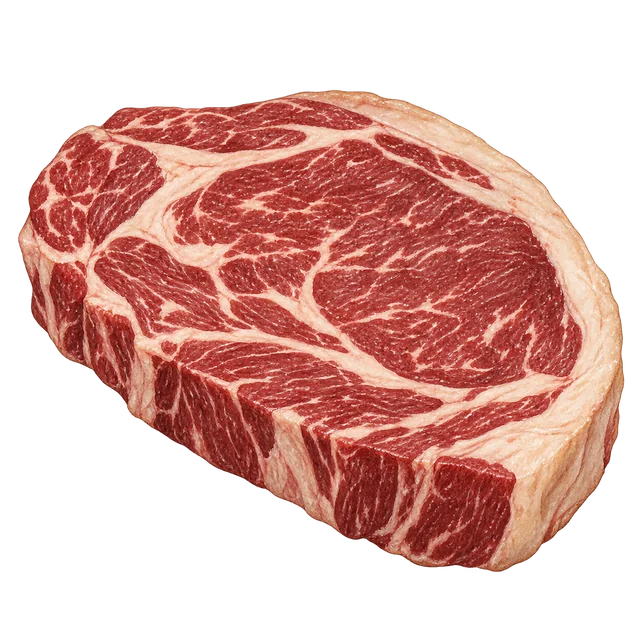
- Red muscle
- Myoglobin, an iron-containing pigment protein, gives the muscle its colour.
- Intramuscular fat
- The pale marbling is fat inside the muscle, affecting texture and calories.
Illustration for understanding; not to scale. Saved figures include explanations and sources.
Mechanism · Why some cuts are tender and others tough
What does tender actually mean? It is not one thing but three things stacked together — and each can be changed by something different.First: how thick the muscle fibers are, and how tightly they are bound
The more work a muscle does in life, the thicker its fibers and the thicker the connective tissue wrapped around them. Tenderloin barely works, so it is naturally fine and tender; shank bears load all the time, so its fibers are thick and the surrounding mesh is thick too. This first factor is set by the animal's anatomy. You cannot change it in the kitchen; you can only choose.
Second: marbling — fat grown between the fibers
Marbling is not the rim of fat on the outside. It is intramuscular fat: fine threads of fat that have grown into the gaps between bundles of muscle fibers. When heated, it melts and coats the fibers, so the meat offers less resistance when you bite and tastes juicier.
Notice what actually happened: the fibers themselves did not become more tender; the fat took over part of the chewing resistance. So higher grades taste better is true, but higher grades are more nutritious is false — the grading ruler measures fat, and fat is the main source of calories on the plate.
Third: aging — the meat breaking itself down
After slaughter, the muscle loses its oxygen supply. The sugar left in the cells can only be burned without oxygen, producing lactic acid, so the meat slowly becomes more acidic. At the same time, calcium stored inside the cells leaks out and activates a set of protein-cutting enzymes the muscle already carried, which start snipping the structural proteins that hold the muscle fibrils in place against one another.
This process is slow and is measured in days. The more gets snipped, the looser the connections between fibers and the more tender the meat — that is aging. Dry aging does one more thing: water keeps evaporating from the surface, concentrating the flavor inside, while the enzymes break protein into more free amino acids, so the savory, umami taste grows stronger too.
Now the kitchen rules of thumb make sense
For the same cut, aged meat is more tender than unaged meat, and that is not going bad — it is enzymes doing their job on scheduleA vacuum-packed, date-stamped steak at the supermarket has actually been wet-aging the whole time it spent in transit and on the shelfMeat you buy and refrigerate for two days before searing is often more tender than meat seared the same day, for the same reasonBut aging cannot rescue thick fibers and heavy connective tissue: shank still has to be stewed however long it is aged, because that is a problem with the first factor, not the third
In short: the cut sets the starting point, aging shapes the process, and marbling sets how smooth each bite feels. Three separate knobs, each controlling its own thing. Do not use one to explain another.
Chapter 2
Protein and calories in lean beef
Beef protein is complete (it contains all the essential amino acids) and is high in leucine. Besides serving as a building block, leucine is one of the signals that tells muscle cells to start building protein, which is one reason people trying to build muscle favor beef (see Protein & Amino Acids).
Compare nutrients on the same basis: cooked meat has lost water, so its protein and calories per 100 g look higher, because the same weight holds more solid meat. Compare raw with raw and cooked with cooked, or you will overestimate.
If you want protein while keeping calories down, choose lean cuts (tenderloin, round); if you want tenderness and flavor, the price of fatty cuts is double the fat and calories.
Mechanism · Leucine is a brick and a switch
Beef is high in leucine, and its effect on muscle building is more direct. What does more direct mean? There is a missing link here.Most amino acids are only building material; leucine is also a signal
Muscle cells have a dispatch system that decides whether to start building protein. It does not count how many grams of protein you ate today; it reads the concentration of a few amino acids inside the cell — leucine above all. When leucine surges, it is as if someone at the door reports the raw material has arrived, and the dispatch system switches the protein-building machinery from standby to running.
So of two equal portions of protein, the one with a higher share of leucine not only delivers the bricks but also presses the switch one extra time.
Why a small bite of meat does little
One popular explanation is the leucine threshold: blood leucine has to rise high enough before the switch is fully pressed. A small bite of meat can hardly push the concentration that far; a proper portion can. But this threshold has not been measured precisely in people — it is a plausible hypothesis rather than a fixed number.
How to spread a day's protein across meals, and whether spreading it out or bunching it together is better, is a separate question and far from settled — do not turn this threshold straight into a meal-splitting plan.
This is also why people building muscle favor animal proteins such as beef, eggs, and dairy. It is not that plant protein is bad; most plant proteins simply have a somewhat lower share of leucine, so you have to eat larger portions to get the same stimulus (see Protein & Amino Acids).
One more point: once the switch is pressed, the protein-building machinery still needs bricks to build anything. So taking leucine alone without eating enough total protein gets things backwards — it is like pressing the start button again and again without loading the hopper.
Now settle the raw-versus-cooked question
The raw-versus-cooked baseline deserves a full explanation. When meat is heated, the muscle fibers contract and squeeze out water, so cooked meat ends up noticeably lighter than raw — and what is lost is mostly water, plus a little fat that drips away with the juices. Almost no protein is lost.
So for the same weighed portion, cooked meat holds more actual substance, and both the protein and the calories on the nutrition label go up. Cooked meat is not more nutritious; the denominator has shrunk.
In practice, remember one rule: before comparing two figures, check that both are raw weight or both are cooked weight. Most online arguments about how much protein is really in a serving come from not lining this up.
Chapter 3
How grass-fed and grain-fed fat differ
Grass-fed and grain-fed beef differ mainly in their fat profile: grass-fed beef has a higher share of omega-3 (especially ), a lower ratio of omega-6 to omega-3, and more conjugated linoleic acid (CLA). But to be honest, the absolute amount of omega-3 in grass-fed beef is still far below that of an oily fish (see Fats & Omega-3), so do not treat it as a substitute for fish oil; and how much that ratio itself matters for health is not settled.
Grain-fed beef usually has more total fat and more marbling, so it is more tender and higher in calories.
In practice, the cut (lean or fatty) affects how much fat you eat more than grass-fed versus grain-fed does. Choose lean first, then think about how the animal was raised.
Mechanism · Stearic acid and the grass-fed fat profile
Two things are often said about beef fat: stearic acid is gentler on blood lipids, and grass-fed beef has a different fat profile. Behind each sits a chain that can be followed to the end.First: part of the stearic acid you eat becomes unsaturated in your body
A saturated fatty acid is a straight chain with no bends, so the molecules can stack neatly together like chopsticks — which is why beef tallow is a hard block at room temperature. Stearic acid is one of the longest common members of this group.
Here is the key: liver cells have an enzyme whose one job is to insert a double bond in the middle of a fatty-acid chain. Stearic acid is the substrate it handles best, and once the double bond is in, it becomes oleic acid — the same monounsaturated fat found in olive oil.
So the stearic acid you eat and the stearic acid that stays in your body are not the same account, and this is thought to be one reason stearic acid is gentler on blood lipids. It is also why judging beef's saturated fat as one lump gives a distorted picture: under the same column of numbers, palmitic acid and stearic acid go different ways in the body.
Second: a cow's fat profile is what its diet becomes after passing through the rumen
Cattle are ruminants. Their feed goes into the rumen first, where microbes digest it on the animal's behalf. The polyunsaturated fat in grass (mainly , a plant omega-3) enters the rumen and is straightened by those microbes through hydrogenation — the double bonds on the chain are filled in one by one, turning it back into saturated fat.
This is the upstream reason beef fat is generally saturated: whatever the animal eats, the rumen shaves off a large share of the unsaturated part first.
But this step is never one hundred percent complete. Some fat always escapes hydrogenation and is absorbed as it is, and a batch of half-finished intermediates also comes out — conjugated linoleic acid (CLA) is one of these. So the chain closes: the more ALA in the feed going in (grass has more than grain), the more escapes hydrogenation and the more intermediates there are, and the more omega-3 and CLA end up stored in the meat.
This chain turns grass-fed from a label into a result you can work out. It also shows why the difference is limited — with the rumen standing in the way, no amount of feeding can turn beef into fish (see Fats & Omega-3).
Back to what matters at the table, in order
The cut (lean or fatty) decides how much fat you eat; this is the biggest knobMarbling and grade decide texture, not nutritionGrass-fed versus grain-fed decides the details of the fat profile; this is the smallest knob
Turn them in the reverse order and you spend the most money for the smallest change.
Chapter 4
Iron, B12, zinc and selenium
Heme iron: beef's signature. It is absorbed several times more efficiently than the non-heme iron in plants, and it is barely held back by phytate or polyphenols in the same meal (calcium is the exception and may lower it somewhat). For people with iron-deficiency anemia, menstruating women, and pregnant women, it is one of the most efficient food sources of iron (see Iron).Vitamin B12: among natural foods, almost only animal foods contain it, and one serving of beef covers a good share of a day's needs (see Vitamin B12).Zinc: red meat is one of the best dietary sources of zinc; meat has no phytate or similar compounds holding absorption back, so its zinc is well absorbed. Zinc is involved in immunity, wound healing, and making testosterone (see Zinc).Selenium: beef is a steady source of selenium, a cofactor that antioxidant enzymes and thyroid-hormone metabolism need (see Selenium).
So beef's value is not its protein (plenty of foods have protein) but this package of micronutrients that come most efficiently from animal sources.
Mechanism · Where B12 comes from, why some still lack it
Of beef's micronutrients, B12 is the one most worth digging into: among natural foods, you can get it almost only from animals, and that fact itself needs explaining.No animal makes its own B12, and neither do cattle
Only bacteria and archaea can actually make B12. The cow's rumen hosts a huge microbial community that makes B12 while digesting feed for the animal; the cow absorbs that B12 and stores it in its liver and muscle.
So beef is not a producer of B12 but a concentrator — what you eat is B12 the cow collected from microbes on your behalf.
The lower part of the human gut also has bacteria that can make B12, but they sit downstream of where it is absorbed, so what they make comes too late to be taken up. That is why people have to get it from food.
From plate to blood, three gates
In food, B12 is bound to protein. To use it, the body first has to free it and then escort it:
First gate, in the stomach: stomach acid and the enzyme pepsin free B12 from food protein, and a binding protein that arrives with saliva catches it firstSecond gate, in the upper small intestine: enzymes from the pancreas cut that binding protein apart, and B12 transfers to a dedicated escort protein — intrinsic factor, which is secreted by cells in the stomach wallThird gate, at the end of the small intestine: that stretch of gut wall has receptors that recognize intrinsic factor specifically, and only a correct match lets B12 in
Miss any one of the three gates and it does not matter how much is on the plate.
Now these facts make sense
Older people who clearly eat meat but still run short of B12: many older adults have a thinning stomach lining and make less stomach acid, so the first gate is the first to fail — B12 that cannot be freed passes straight through. That is also why B12 from supplements works better for them: it is already free and does not need the first gatePeople on long-term acid-suppressing drugs should keep an eye on this: same gate, same logic (see Drug–Nutrient Interactions)People whose stomach wall has been damaged by surgery or autoimmune disease are truly deficient: the cells that make intrinsic factor are gone or damaged, so B12 cannot get past the second gate. Eating more meat will not close this gap; it has to be replaced under a doctor's guidance, often by injectionFor vegans, the gap is at the entrance: all three gates work fine; the goods simply never come in the door (see Vitamin B12)
Why this deficiency is so easy to miss
The liver stores a considerable amount of B12, enough to last a long time. So after intake stops, symptoms take a long time to surface, and sometimes the first ones are neurological — numb hands and feet, an unsteady walk, a worsening memory. The nerves can already be taking damage while blood counts still look normal.
That is also why the reasoning I only recently started eating less meat, so I cannot be short yet does not hold: you are spending savings, and until the savings run out, the balance sheet shows nothing.
Chapter 5
What it lacks · how to pair
Dietary fiber is zero: meat has no fiber. A meat-only meal does the gut microbiome no favors, so add vegetables, whole grains, or beansVitamin C is close to none: this can actually be put to use — vitamin C boosts absorption of the non-heme iron in plants, so a side of bell peppers, broccoli, or tomatoes helps you absorb more of the iron in the rice, beans, and leafy greens on the same plate (see Iron)Carbohydrate and calcium are also low: beef is not a source of either
The best-value way to eat it is beef with plenty of vegetables: the vegetables add fiber and vitamin C and also dilute the meal's saturated fat and heme iron. Cooking experiments have reported that marinating meat with garlic, rosemary, or lemon reduces the heterocyclic amines formed at high heat.
The reverse — beef plus refined carbohydrates plus high-heat oil (the burger-meal pattern) — is the worst-value combination.
Mechanism · Vitamin C helps plant iron, not beef iron
Pairing vegetables helps you absorb more of the meal's iron is true, but it is easy to read as vitamin C makes you absorb more of the beef's iron. Those are two different things, and separating them tells you how to build the meal.The two kinds of iron go through two different doors
The iron in beef is wrapped in a ring structure, and the whole molecule enters the cells of the intestinal wall through a dedicated channel. The iron in plants is a bare ion that has to use a different channel, and before it can enter it must first be reduced — in food it is mostly in the oxidized form, and that channel only accepts the reduced form.
That is exactly what vitamin C does: it hands over an electron to reduce the iron and then holds on to it, so phytate and tea polyphenols cannot carry it off. So vitamin C works at the plant-iron door. Beef's iron uses the other door; vitamin C cannot help it and does not need to.
So how to set up the meal becomes clear
A side of bell peppers, broccoli, or tomatoes raises the iron you absorb from the rice, beans, and dark leafy greens on the same plate — and that is exactly the iron most often wastedThe polyphenols in tea and coffee are the opposing side in the same contest, so what they hold back is mainly plant iron too. To get the most iron from a meal, move tea and coffee to later, with a gap after eatingPut the other way round: an all-meat meal gains almost nothing from added vitamin C, while an all-plant meal gains the most
Now the fiber point, which matters more than it sounds
Meat has zero fiber. That is not low content; it is structurally impossible — fiber is the building material of plant cell walls, and animal cells have no cell walls at all.
Bacteria in the colon live by fermenting fiber, and fermentation produces a set of short-chain fatty acids. One of them, butyrate, has a special destination: it is the main fuel of the cells lining the colon. Most cells in the body burn sugar delivered by the blood, but the colon lining feeds directly from the gut side.
So for the colon, a meat-only meal means a pile of material outside and nothing for itself to eat. By the mechanism, losing this fuel would affect how well the lining renews itself and maintains its barrier — and the colon lining is also exactly where the heme iron chain described in the chapter on whether red meat causes cancer does its work.
So beef with plenty of vegetables is not a platitude
In this meal, vegetables do three things at once: open the plant-iron door, feed the colon lining, and dilute the meal's saturated fat and heme iron. Each works by its own route, and none can stand in for another — which is also why swapping the vegetables for a vitamin C tablet does not work.
Chapter 6
Does red meat cause cancer?
In 2015, the International Agency for Research on Cancer (IARC) classified processed meat as Group 1 (causes cancer) and unprocessed red meat, including beef, as Group 2A (probably causes cancer). The classification describes how certain the evidence is, not how large the risk is: 2A is one step less certain than Group 1, and it does not mean the harm is high.
What really matters is the dose: an occasional steak is not the same as red meat at every meal, and the evidence for processed meat (bacon, sausage) is stronger than for unprocessed beef, with a larger association.
So our position is not ban beef but understand the mechanism and balance the dose: for most people, moderate amounts of unprocessed lean beef add little extra risk; the less processed meat the better; and low-temperature cooking beats charred grilling.
This chapter also covers three things: the mechanistic chain between a piece of meat and a statistical association, how to read a risk multiple, and the contested carnitine hypothesis. The full evidence on red and processed meat is in the Red & processed meat story.
Mechanism · From a steak to a statistical link
Several mechanisms are in play: oxidation in the gut catalyzed by heme iron, and heterocyclic amines (HCAs) and polycyclic aromatic hydrocarbons (PAHs) formed during high-heat cooking. There is also a contested hypothesis — that gut bacteria turn carnitine into TMAO, which may be linked to cardiovascular risk (a mechanistic idea that is still disputed; do not treat it as settled).The first strand, heme iron, is unpacked below. It comes from the meat itself; HCAs and PAHs come from how the meat is cooked, and nitrite from how it is cured. First, a word on the kind of evidence: most links in this chain come from animal experiments and laboratory measurements. The chain can explain the associations seen in population studies, but it has not been shown directly in people as cause and effect.
First, a fact that often gets skipped: the heme iron that is not absorbed keeps moving
Heme iron is absorbed well compared with other food iron, but well does not mean all of it. Whatever does not enter the cells of the intestinal wall travels on with the food residue to the colon — and the colon is the only place in the body that sits bathed in food residue for a long time.
Step one: in the gut, that iron acts as a catalyst
Iron can switch back and forth between two charge states, handing over an electron one moment and taking one back the next. Inside cells this ability is tightly controlled (the body never lets free iron roam), but in the gut no one is watching it.
What else is in the same meal? Fat. And the spot next to a double bond on a fat chain is already prone to having a hydrogen atom stolen. Iron switching back and forth sets this theft alight — one position loses its hydrogen, then its neighbor does, burning along like a fuse. This is lipid peroxidation.
Step two: the fragments left behind are reactive
Where the fuse has burned, the fat chain breaks into a batch of small aldehyde molecules. Unlike free radicals, these fragments do not vanish in an instant; they can spread, linger, and bind to proteins and to the bases of DNA.
A second branch runs at the same time: the gut already contains amines, produced when bacteria in the colon ferment protein. Heme iron can push these amines into forming N-nitroso compounds, molecules that can attach a small chemical group to DNA. Once attached, the DNA may be misread when it is copied.
Nitrite in cured meat feeds this branch directly. This is thought to be one mechanistic reason why, weight for weight, the evidence for processed meat is firmer and its association larger than for fresh meat.
Step three: the lining responds by growing faster, and that has a cost of its own
The colon lining is one of the fastest-renewing tissues in the body; its surface cells turn over every few days. When the surface is repeatedly damaged by the substances above, the stem cells beneath have to divide more often to replace it.
And every division is a copy. The more copies are made, the more chances an unrepaired error has to become permanent.
This is the stretch the mechanism fills in between a piece of meat and an epidemiological association: it is not that meat is poisonous, but that it keeps the colon in a state of ongoing damage and ongoing, accelerated rebuilding — and cancer arises more easily in exactly that state.
So everything you can change is on the plate, not in the blood
Notice that every step of this chain happens in the gut, which is technically outside the body. That makes the risk-lowering moves very concrete, and none of them requires giving up meat. Most are worked out from the mechanism rather than tested one by one in people, but they all point the same way:
Add vegetables and fruit: the polyphenols and vitamin C they bring sit in the same gut and absorb some of the theft that would otherwise hit the fatAdd fiber: it shortens how long residue sits in the colon, and so shortens the exposureDo not char the meat: that cuts out the HCA and PAH strandEat less cured and smoked meat: that cuts off the supply feeding the nitroso branchControl the total: less material going in at the top makes the whole chain shallower
The last point, and the most important one
The same heme iron is one of the most efficient food sources of iron for someone who is iron-deficient, and upstream raw material for this chain for someone whose iron stores are already full.
It is neither good nor bad; it depends on which state you are in. That is why the conclusion here has never been a one-size-fits-all should you eat it.
Evidence · How to read a relative risk
Putting the dose on the table is what makes it meaningful: dose-response analyses of large cohorts suggest the rise in colorectal-cancer risk from unprocessed red meat is a ; the absolute increment is small for most people.Hidden in that sentence is a distinction almost every health headline uses and almost nobody explains. Learn it and you can use it on any later headline that says food X raises the risk of disease Y.
Relative risk is a multiple, not a headcount
What studies usually report is this form: the group that ate more had a disease rate that was some multiple of the group that ate less. Notice the word times — it is multiplied on, and the number being multiplied is your original risk, that is, the baseline.
The same multiple landing on different baselines can convert into very different actual differences:
A risk that was already very low, multiplied a little, still adds a very small absolute amountA risk that was already on the high side, multiplied by the same little bit, adds a much more visible absolute amount
Headlines always report only the multiple, because the multiple sounds large, and it does not have to say for whom. But the decision you have to make rests on the absolute amount.
What sets your baseline
On colorectal cancer, what roughly sets the baseline is: age, whether a first-degree relative has had it, whether there is chronic intestinal inflammation, weight and activity, and whether screening has been done as recommended.
Of these, some you cannot change and some you can — and the ones you can change often move the baseline far more than how many beef meals you had this week.
So the same headline means different things to different people
A young person with a low baseline: the absolute difference that multiple produces is small. Worth knowing; not worth anxietySomeone with a family history: the same multiple lands on a higher baseline, so the difference is more visible, and turning the intake down is more worth doingSomeone already screening as recommended: screening itself is pushing the baseline down, and the return on that is far larger than squeezing grams of meat
Two more pieces of common sense for reading this kind of study
This kind of evidence is almost all observational: researchers cannot randomly split people into an every-meal-steak group and a vegetarian group and raise them for decades. They can only record who ate more and who later got sick. And people who eat a lot of red meat often differ in other habits too — statistics can knock out some of these , but not cleanlyA dose-response is itself a good signal: if more intake goes with higher risk, and the rise is smooth, that is much more credible than a lone there is an association. Conversely, an association with no dose relationship is more easily caused by something else
A line you can take with you
When you see a risk headline, ask three questions in order: is it reporting a multiple or a headcount? Roughly which band is my baseline in? Does this multiple change smoothly with dose?
After those three, you basically know how much attention this headline deserves — and the three questions have nothing to do with beef. Swap in any food, any exposure, and they still work.
Evidence · Carnitine to TMAO is still a hypothesis
The contested hypothesis that carnitine turns into TMAO deserves its own page, because it makes a good exercise: a mechanism that makes sense is not the same as a conclusion that has been established.The chain itself is clear
Beef contains a good deal of carnitine. Its proper job in muscle cells is to escort long-chain fatty acids into the mitochondria to be burned, so hard-working muscle has more of it — which is why red meat is high in it.
Most of the carnitine you eat is absorbed in the small intestine, but some always escapes and moves on. In the lower gut, a particular group of bacteria breaks it down into trimethylamine (TMA). TMA is absorbed into the blood, travels first to the liver through the portal vein, and an enzyme there oxidizes it into trimethylamine N-oxide (TMAO).
In mice, adding TMAO or carnitine to the feed speeds up the build-up of plaque in the arteries. That step comes from intervention experiments, so the conclusion is fairly firm — but it is in mice.
What is really interesting is where the bottleneck in this chain lies
Given the same dose of carnitine, long-term vegetarians produce clearly less TMAO than people who eat meat. The reason is not their liver but their bacteria — without meat for a long time, the gut bacteria that are good at breaking down carnitine never build up.
So TMAO levels look more like a reading of the state of your gut microbiome than of what you ate today. That leads to something counterintuitive: the same steak can produce very different amounts of TMAO in different people, and the difference reflects eating habits over the past few months, not this one meal.
So why it still counts only as a hypothesis
The evidence in people is mostly association: people with high blood TMAO have more cardiovascular events — but that cannot rule out the reverse explanationThe kidneys are a big : TMAO is cleared mainly by the kidneys, so blood TMAO rises as soon as kidney function falls. And poor kidney function is itself a strong predictor of cardiovascular risk. So in the observation people with high TMAO have higher risk, it is not yet possible to separate cleanly how much is due to TMAO and how much is kidney function acting on both ends at onceThe fish problem: deep-sea fish naturally contain a good deal of ready-made TMAO, and blood TMAO rises clearly after eating fish — yet in population studies eating fish is linked to lower cardiovascular risk. A molecule thought to be harmful is abundant in one of the most recommended foods, and there is still no clean explanation for that
So how should you treat it
Treat it as a lead worth following, but not one that should change what you do today. The only practical takeaway it offers right now points the same way as the colon mechanism chain: your gut microbiome is shaped by your long-term eating pattern, not decided by any single meal.
And practice a general habit of judgment along the way. The next time you see scientists find that X causes Y, ask first — was this an intervention in people, or an intervention in animals plus an association in people? The second is very common, and there are usually many years between it and the first.
Chapter 7
Choosing, cooking and portions
Cooking: low heat beats high heat. Stewing, boiling, steaming, and slow roasting produce almost no heterocyclic amines or polycyclic aromatic hydrocarbons; high-heat charcoal grilling, deep-frying, and searing until blackened produce a lot. Cooking experiments have reported that marinating meat with garlic, rosemary, lemon, or wine reduces heterocyclic amines; do not eat the charred parts.
How much: common dietary advice keeps unprocessed red meat to about 500 g a week (cooked weight) or less — a ceiling, not a target. The less processed meat, the better.
Who can eat more: people with iron-deficiency anemia, menstruating women, pregnant women, and people building muscle — beef is an efficient source of iron, protein, zinc, and B12. Who should hold back: people with a family history of colorectal cancer or heart disease, and people whose iron stores are already full, should keep it moderate.
This page is general information and does not replace a doctor. If you have a specific condition or are planning a pregnancy, follow your doctor's advice.
Mechanism · Where HCAs and PAHs come from
Low heat beats high heat, and marinades reduce harmful compounds — both statements are true, but both stop at what to do without saying why. Once you spell out the why, you find two steps that usually get lumped together actually target different things.First, tell them apart: one grows out of the meat, the other drifts back from the fire
Heterocyclic amines (HCAs) are made by the meat itself. Muscle already contains creatine and free amino acids, plus a little sugar. Once the water on the surface has been driven off, evaporation no longer holds the temperature down and it shoots straight up; at a high enough temperature these substances react with one another on the surface, and one of the products is heterocyclic amines. The key condition is high heat after the surface has dried out, not the act of grilling itselfPolycyclic aromatic hydrocarbons (PAHs) come from outside. When meat is grilled over an open flame, fat drips onto the coals, and the greasy smoke that rises carries PAHs; the smoke drifts up and settles back onto the surface of the meat. So PAHs have nothing to do with the meat's own makeup and everything to do with whether fat drips and whether there is smoke
So the two steps can be written separately
For the first: keep the surface from drying out and from climbing that high — stewing, boiling, steaming, and hot-pot cooking keep the meat locked by water far below that range the whole time, and slow roasting works the same way. Cooking the meat through or halfway first and then giving it a short time over the fire also cuts some, because part of the starting material has already left with the juicesFor the second: keep fat from dripping into the fire — catch it with foil or a tray, move the coals to the side instead of directly underneath, and choose a leaner cut. This one has nothing to do with temperature; it is only about the path of the smoke
Why marinades really help
The reactions at high heat move forward step by step through unstable intermediate compounds. The antioxidants in a marinade (garlic, rosemary, lemon, and wine all have them) are thought to step into this process and intercept those intermediates, cutting the reaction chain short.
There is also a simpler effect: a marinade is wet, so it adds an extra layer of water on the surface. Until that water evaporates, the surface temperature cannot climb — in other words, it delays the trigger for the first point above.
What don't eat the charred bits actually means
Both types of compounds are concentrated in the charred surface layer, not spread evenly through the whole piece. So cutting off the burned parts removes a large share of them. For the same reason, the dark fat at the bottom of the grill pan is where they collect too — do not pour it over your rice.
Put them in order
Change the method first: moving high-heat open-flame cooking from everyday to occasional brings the biggest return and takes the least willpowerThen change the handling: skip the charred parts, avoid setups that drip fat into the fire, and marinate before cookingOnly then worry about the total: the roughly 500 g a week figure is a ceiling, not a target
That order is itself the conclusion of this page — the same effort spent on the first two steps buys far more change than endless fretting over grams.
References · 14
- U.S. Department of Agriculture, Agricultural Research Service. (2019). FoodData Central: Beef (ground/loin/round, raw and cooked). fdc.nal.usda.gov
- Daley, C. A., Abbott, A., Doyle, P. S., Nader, G. A., & Larson, S. (2010). A review of fatty acid profiles and antioxidant content in grass-fed and grain-fed beef. Nutrition Journal, 9, 10. Grass-fed beef has a higher omega-3 share and more CLA, but the absolute omega-3 amount remains far below oily fish. 10.1186/1475-2891-9-10
- Hunt, J. R. (2003). Bioavailability of iron, zinc, and other trace minerals from vegetarian diets. The American Journal of Clinical Nutrition, 78(3 Suppl), 633S-639S. Heme iron is absorbed far more efficiently than non-heme iron and is less affected by dietary inhibitors. The abstract gives NO absorption percentages and does not itself state the heme vs non-heme comparison above: it says iron and zinc absorption is lower from vegetarian than non-vegetarian diets, vegetarians have lower iron stores, adverse effects have not been shown with varied vegetarian diets in developed countries, and routine iron supplementation has no demonstrated benefit. The heme 15-35% / non-heme 2-20% figures sometimes attached to this record are not in it (abstract, PMID 12936958). 10.1093/ajcn/78.3.633S
- National Institutes of Health, Office of Dietary Supplements. (2024). Iron — Fact Sheet for Health Professionals. Fact sheet (updated September 4, 2025; Wayback snapshot 21 September 2026): RDAs 8 mg/day for men and for women 51+, 18 mg women 19-50, 27 mg pregnancy; UL 45 mg/day from age 14; bioavailability about 14%-18% from mixed diets with meat, seafood and vitamin C and 5%-12% from vegetarian diets; serum ferritin below 30 mcg/L suggests iron deficiency and below 10 mcg/L IDA, but inflammation can raise ferritin; supplemental iron of 45 mg/day or more may cause nausea and constipation; people with hereditary hemochromatosis are at risk of iron overload (fact sheet). Heme vs nonheme: heme iron (lean meat and seafood are the richest sources) has higher bioavailability than nonheme iron, and other dietary components affect it less; calcium might reduce the bioavailability of both forms; heme iron is about 10%-15% of total iron intake in western populations. The sheet gives no separate heme and nonheme absorption percentages (fact sheet, Wayback 2026 snapshot). ods.od.nih.gov/factsheets/Iron-HealthProfessional
- National Institutes of Health, Office of Dietary Supplements. (2024). Vitamin B12 — Fact Sheet for Health Professionals. Fact sheet (updated July 2, 2025; Wayback snapshot 20 September 2026): multivitamin/mineral supplements typically contain 5 to 25 mcg B12, B-complex products 50 to 500 mcg, B12-only supplements typically 500 to 1,000 mcg; absorption is only about 2% at 500 mcg and 1.3% at 1,000 mcg; a 2018 Cochrane review of 3 RCTs (153 participants) compared very high oral doses (1,000-2,000 mcg) with intramuscular B12; high oral doses (e.g. 1,000 mcg/day) might be equally effective in Crohn's disease and appear as effective as hydroxocobalamin injections after Roux-en-Y bypass. These are product contents and trial doses; the sheet gives no recommended daily supplement range (fact sheet). ods.od.nih.gov/factsheets/VitaminB12-HealthProfessional
- National Institutes of Health, Office of Dietary Supplements. (2022). Zinc — Fact Sheet for Health Professionals. ods.od.nih.gov/factsheets/Zinc-HealthProfessional
- National Institutes of Health, Office of Dietary Supplements. (2021). Selenium — Fact Sheet for Health Professionals. Table 2: Brazil nuts, 1 ounce (6-8 nuts), 544 mcg selenium (989% DV); the text says Brazil nuts contain 68-91 mcg per nut and could cause selenium toxicity if consumed regularly, and that values from other analyses vary widely. The version read carries 'Updated: April 15, 2024' (Wayback Machine snapshot of 31 December 2024), newer than the 2021 date above (fact sheet, read 2026-09-24). The September 4, 2025 update (Wayback snapshot 19 September 2026) adds: the body absorbs up to about 90% of selenium from selenomethionine, selenium-enriched yeast, selenite and selenate; selenium-only supplements typically contain 100 to 400 mcg; Keshan disease, an endemic cardiomyopathy first identified in 1935 in low-selenium parts of China, fell dramatically after selenium intervention trials in the 1970s-1990s; in 2017 the American Thyroid Association issued a weak recommendation against selenium supplements for TPOAb-positive pregnant women (fact sheet). ods.od.nih.gov/factsheets/Selenium-HealthProfessional
- Bouvard, V., Loomis, D., Guyton, K. Z., Grosse, Y., Ghissassi, F. E., Benbrahim-Tallaa, L., et al. (2015). Carcinogenicity of consumption of red and processed meat. Lancet Oncology, 16(16), 1599-1600. IARC classifies processed meat as Group 1 carcinogen, red meat as Group 2A. 10.1016/S1470-2045(15)00444-1
- Norat, T., Bingham, S., Ferrari, P., Slimani, N., Jenab, M., Mazuir, M., et al. (2005). Meat, fish, and colorectal cancer risk: the European Prospective Investigation into Cancer and Nutrition (EPIC). Journal of the National Cancer Institute, 97(12), 906-916. 10.1093/jnci/dji164
- Wang, X., Lin, X., Ouyang, Y. Y., Liu, J., Zhao, G., Pan, A., & Hu, F. B. (2016). Red and processed meat consumption and mortality: dose-response meta-analysis of prospective cohort studies. Public Health Nutrition, 19(5), 893-905. Dose-response meta-analysis of 17 cohorts (9 articles), 150,328 deaths. Per serving a day of processed meat: all-cause RR 1.15 (1.11-1.19), cardiovascular 1.15 (1.07-1.24), cancer 1.08 (1.06-1.11). Unprocessed red meat was associated with mortality in US populations but not in European or Asian ones (abstract, PMID 26143683). 10.1017/S1368980015002062
- Koeth, R. A., Wang, Z., Levison, B. S., Buffa, J. A., Org, E., Sheehy, B. T., et al. (2013). Intestinal microbiota metabolism of L-carnitine, a nutrient in red meat, promotes atherosclerosis. Nature Medicine, 19(5), 576-585. Gut microbiota convert red-meat L-carnitine to TMA, then hepatic TMAO, accelerating atherosclerosis in mice; omnivores produce more TMAO than vegans/vegetarians. Human association: plasma L-carnitine in 2,595 patients undergoing cardiac evaluation predicted prevalent CVD and incident major adverse cardiac events only when TMAO was also high (abstract, PMID 23563705). 10.1038/nm.3145
- Zhong, V. W., Van Horn, L., Greenland, P., Carnethon, M. R., Ning, H., Wilkins, J. T., et al. (2020). Associations of processed meat, unprocessed red meat, poultry, or fish intake with cardiovascular disease and all-cause mortality. JAMA Internal Medicine, 180(4), 503-512. 6 US cohorts, 29,682 adults, median 19.0 years. Per 2 servings a week: incident CVD HR 1.07 for processed meat, 1.03 unprocessed red meat, 1.04 poultry, 1.00 fish (non-significant); all-cause death 1.03 processed, 1.03 unprocessed red meat, 0.99 poultry and 0.99 fish (both non-significant). Observational (abstract, PMID 32011623). 10.1001/jamainternmed.2019.6969
- U.S. Department of Agriculture & U.S. Department of Health and Human Services. (2020). Dietary Guidelines for Americans, 2020-2025 (9th ed.). www.dietaryguidelines.gov/sites/default/files/2020-12/Dietary_Guidelines_for_Americans_2020-2025.pdf
- World Cancer Research Fund / American Institute for Cancer Research. (2018). Diet, Nutrition, Physical Activity and Cancer: a Global Perspective (Third Expert Report). WCRF/AICR. Ten evidence-based Cancer Prevention Recommendations: maintain a healthy weight, be physically active, eat wholegrains/vegetables/fruit/beans, limit fast foods and ultra-processed foods, limit red and processed meat, limit sugar-sweetened drinks, limit alcohol, and do not rely on supplements for cancer prevention. The meat recommendation reads: eat no more than moderate amounts of red meat and little, if any, processed meat. For red meat it gives a quantity - no more than about three portions a week, equivalent to about 350-500 g (12-18 oz) COOKED weight. For processed meat it deliberately gives NO gram figure, only the wording consume very little, if any. Evidence grading for colorectal cancer: processed meat is graded convincing, red meat probable. www.wcrf.org/diet-activity-and-cancer