Story
Tempeh
Last updated
In one pass Tempeh is whole soybeans fermented by a mold.
Educational content, not medical advice — consult a clinician.
Story path
Chapter 1
What is tempeh · a whole-bean cake bound by mycelium
To make it, the threads of the mold Rhizopus oligosporus bind whole cooked soybeans into a single cake. It is not tofu set from soy milk, and not soy protein isolate, which keeps only the protein: tofu loses the fiber in the leftover pulp, while tempeh keeps the whole bean, fiber and minerals included (for a comparison of forms, see Soybeans & Tofu).
A CLOSER LOOK
Mycelium binds whole beans into a cake
The cut face shows a whole-bean cake. Tempeh binds cooked beans with mycelium, whereas tofu is set from soy milk. Their structures differ.
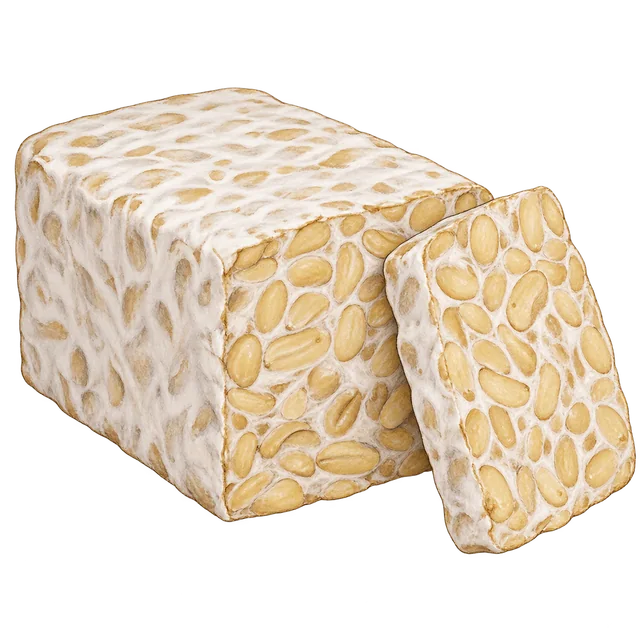
- Whole-bean pieces
- Tempeh retains whole-bean structure, unlike tofu made after grinding and straining soy milk.
- White mycelium
- Rhizopus oligosporus threads grow between the cooked beans and bind them into one cake.
Illustration for understanding; not to scale. Saved figures include explanations and sources.
Background · How mold binds beans into a cake
Tempeh is fermented by a mold, mainly Rhizopus oligosporus. The beans are cooked, dehulled, and inoculated with the mold, which quickly grows a dense white web of threads over their surfaces and into the gaps, wrapping the once-loose cooked beans tightly and binding them into one solid cake.That is why tempeh keeps the whole-bean structure without grinding the beans into milk and straining off the pulp: what holds the beans together is not a processing step (unlike tofu, which needs a coagulant to set) but the mold's threads weaving the beans into one piece.
Chapter 2
Complete, dense protein
Because it is a cake of whole beans, it packs more protein than water-rich tofu. During fermentation, the mold's protein-cutting enzymes also snip part of the protein into short peptides and free amino acids, which is one source of its savory taste and makes it easier to digest.
Numbers · How much protein 100 g holds
USDA: 100 g of tempeh has about 19-20 g of protein and about 190 kcal, with all nine essential amino acids. Soy protein isolate and concentrate have a Protein Digestibility-Corrected Amino Acid Score (PDCAAS, a way of scoring protein quality) near 1.0, in the same tier as milk and eggs (Hughes 2011).Weight for weight, tempeh has a little less protein than lean meat, but it is high for a plant food, with no cholesterol and little saturated fat. For anyone cutting back on red or processed meat who worries that plant protein is not good enough, tempeh is a solid main protein, not a compromise. For amino-acid complementation and quality scores, see Protein & Amino Acids.
Chapter 3
The whole bean stays, fiber and all
Within the soy family, whole-bean foods are more worth eating regularly than isolates (see Soybeans & Tofu; for how fiber feeds gut bacteria and steadies blood sugar, see Carbs & Fiber).
Background · Whole beans versus soy isolate
Tempeh does not strain off the pulp the way tofu does, so most of the bean fiber stays in. Whole beans beating isolates holds true across the whole soy family (see Soybeans & Tofu):The recommended end: tempeh, edamame, tofu, and natto, which keep the natural structure (protein, fiber, minerals)The end to watch: soy protein isolate often hides in sugary, salty ultra-processed protein bars and plant-based meats; what makes those products unhealthy is not the soy but the ultra-processing itself
Tempeh sits at the friendliest end: whole beans plus fermentation, neither a hollowed-out purified protein nor a heavily processed meat imitation, but a real food that is nutrient-dense and minimally processed.
Chapter 4
How fermentation frees up minerals
As Rhizopus oligosporus grows, it releases phytase, which takes part of this lock apart, so the minerals may absorb better. Soaking and cooking already remove some phytate, and fermentation removes a further share on top of that (for the anti-nutrient thread, see Carbs & Fiber / Soybeans & Tofu).
Numbers · How much more phytate fermentation removes
First, what the lock is. Soybeans and other legumes naturally contain phytate (phytic acid, inositol hexaphosphate), which binds iron, zinc, and calcium in the gut and forms poorly absorbed complexes that leave the body; soaking, cooking, and fermentation all lower phytate and improve mineral absorption (Sandberg 2002).How fermentation opens the lock: as Rhizopus oligosporus grows, it releases phytase, which breaks phytate down step by step. Egounlety and Aworh 2003 found that when soybeans were made into tempeh with Rhizopus oligosporus, the fermentation step lowered their phytic acid by about 31%. With less phytate, the iron and zinc it was holding have a chance to come free: in test-tube digestion they dissolve out more, and animal studies point the same way, but whether people who eat tempeh actually absorb more minerals has not yet been measured in any human absorption study (Yarlina 2026).
Mechanism · Isoflavones in a better-absorbed form
Yarlina and colleagues' 2026 scoping review (npj Science of Food) records another effect of fermentation: the mold's enzymes convert soy isoflavones from their bound form to the free aglycone form, and produce some short peptides and amino acids, a kind of pre-digestion. Aglycones absorb more easily, but fermentation does not create more isoflavones out of thin air.These changes are real and the mechanism is clear; for minerals, though, the support so far comes only from test-tube and animal studies, and tempeh is not a miracle food. The halo around fermentation is also often stretched too far; the most common case is the claim that tempeh supplies B12, which does not hold up, as the chapter on whether tempeh can supply B12 explains.
Chapter 5
Can tempeh supply vitamin B12
So tempeh is not a reliable B12 source for vegans. Counting on it can delay the discovery of a deficiency until nerve symptoms appear. The only dependable routes are fortified foods or a supplement (for the mechanism and the consequences of deficiency, see Vitamin B12).
Myth · Where the measured B12 comes from
Plants and fungi cannot make B12; only bacteria and archaea can (Watanabe 2014). So why has B12 turned up in some tempeh? The answer from the Yarlina 2026 review: any B12 in tempeh comes from stray bacteria that got in during fermentation, and the amount is unreliable. That raises three problems:Unpredictable: the amount changes with the workshop's conditions and the batch, and even batches from the same workshop can differ a lotPossibly tiny: the cleaner the production, the fewer stray bacteria get in, so commercial tempeh may carry negligible B12Not necessarily active: some of the corrinoids (molecules shaped like B12) found in plant foods are analogs that have no B12 activity in humans
So the only dependable ways for vegans to get B12 are fortified foods (products with B12 added) or a B12 supplement. This does not take away from tempeh as a source of protein, fiber, and minerals; it simply cannot carry the B12 job. Long-term vegans can check their B12 status with a doctor or dietitian. This is general education and does not replace a doctor's judgment.
Chapter 6
Texture & cooking · handles like meat
It is denser than tofu, with a nutty taste and a faint mushroom note, all from fermentation. Its iron and zinc are the non-heme, plant form, and vegetables rich in vitamin C help the iron absorb (see Iron; for the anti-nutrient thread, see Carbs & Fiber).
In practice · Taming the taste, marinating, pairing
Two practical tricks:If the taste is too strong: steam or simmer the slices for a few minutes first, which softens any bitterness and helps them soak up marinadeTo add flavor: tempeh soaks up sauce like a sponge, and marinating it in soy sauce, miso, or spices before pan-frying is its most common and most crowd-pleasing use
The nutritional logic of pairing: tempeh is high in protein and fiber, so with whole grains and vegetables it makes a filling meal that keeps blood sugar steady; foods rich in vitamin C, such as bell pepper, broccoli, and citrus, also help the non-heme iron absorb (see Iron).
Tempeh is a whole-bean food you can use like meat. If you want protein, fiber, and easy cooking from one soy product, it is a very handy choice.
Chapter 7
How to eat it and who should take care
Eating ordinary amounts long term is safe (for isoflavones, see Soybeans & Tofu). A few groups need care: people with a soy allergy, people taking levothyroxine, and people in the middle of a gout flare; and vegans should not count on it for B12.
In practice · Choosing it and how much to eat
Choosing and cooking:Choose tempeh with a clean ingredient list (soybeans plus the culture, few additives); some brands blend in other beans or grains, so pick what suits youFor easier flavoring and less bitterness: steam or simmer the slices for a few minutes before pan-frying or roastingAs a main protein: use it in place of some red or processed meat, with vegetables and whole grains to round out the mealWatch pre-seasoned tempeh (sauced or deep-fried ready products), which often has extra salt and oil; read the label
How much: as a whole-bean fermented food, 1 serving (about 100 g) a day is a reasonable amount that supplies both good protein and fiber. Like the rest of the soy family, eating ordinary amounts long term is safe (for how isoflavones act as plant estrogens and the common misunderstandings, see Soybeans & Tofu).
Safety · Who should be careful
Who should be careful:Vegans and long-term vegetarians (the key group): do not count on tempeh for B12. Get B12 from fortified foods or a supplement, and keep an eye on your B12 statusPeople with a soy allergy: tempeh is a soy product, so people truly allergic to soy should avoid itGout or high uric acid: beans contain some purines; plant sources of purine are generally thought to be less strongly linked to gout flares than meat and seafood, so moderate amounts are fine, and during an acute flare it is best to ask a doctor firstPeople on thyroid medication (levothyroxine): soy foods may reduce how much of the drug is absorbed, so take the medicine and soy foods a few hours apart and follow your doctor's instructions (see Soybeans & Tofu)
This is general information only; for your own situation, follow your doctor's judgment.
References · 9
- U.S. Department of Agriculture, Agricultural Research Service. (2019). FoodData Central: Tempeh (cooked). ~190-195 kcal/100 g; ~20 g protein and ~7.6 g carbohydrate (by difference) per 100 g; SR Legacy 174272 and 172467 carry NO dietary-fiber value, so no fiber figure may be cited to this record (an earlier note said ~9 g, which is not in the data). fdc.nal.usda.gov
- Yarlina, V. P., Tandra, J. L., Indiarto, R., Andoyo, R., Harlina, P. W., Nik Ubaidillah, N. H., & Lani, M. N. (2026). Unraveling tempeh through omics: a scoping review of fermentation pathways and functional health benefits. npj Science of Food, 10, 122. Rhizopus phytases lower phytate; in vitro digestion shows more soluble iron and zinc and rats fed tempeh regenerate haemoglobin better, BUT there are no human trials and no absorption or isotope-tracer studies, so no conclusion on mineral bioavailability in people; isoflavones shift to aglycone forms; any B12 in tempeh arises from incidental bacterial contamination and is unreliable. 10.1038/s41538-026-00754-2
- Institute of Medicine. (2005). Dietary Reference Intakes for Energy, Carbohydrate, Fiber, Fat, Fatty Acids, Cholesterol, Protein, and Amino Acids. National Academies Press. nap.nationalacademies.org/catalog/10490/dietary-reference-intakes-for-energy-carbohydrate-fiber-fat-fatty-acids-cholesterol-protein-and-amino-acids
- Hughes, G. J., Ryan, D. J., Mukherjea, R., & Schasteen, C. S. (2011). Protein digestibility-corrected amino acid scores (PDCAAS) for soy protein isolates and concentrate: criteria for evaluation. Journal of Agricultural and Food Chemistry, 59(23), 12707-12712. Soy protein is a complete protein with all nine essential amino acids and a PDCAAS near 1.0, comparable to milk and egg. 10.1021/jf203220v
- Sandberg, A.-S. (2002). Bioavailability of minerals in legumes. British Journal of Nutrition, 88(S3), S281-S285. Phytate binds iron, zinc, and calcium; soaking, cooking, and fermentation reduce phytate and improve mineral absorption. 10.1079/BJN/2002718
- Egounlety, M., & Aworh, O. C. (2003). Effect of soaking, dehulling, cooking and fermentation with Rhizopus oligosporus on the oligosaccharides, trypsin inhibitor, phytic acid and tannins of soybean, cowpea and groundbean. Journal of Food Engineering, 56(2-3), 249-254. Phytic acid decreased during fermentation by 30.7% in soybean (32.6% cowpea, 29.1% groundbean); soaking did NOT lower phytate (it rose to 1.7% in soybean), and no loss from cooking is reported. 10.1016/S0260-8774(02)00262-5
- Watanabe, F., Yabuta, Y., Bito, T., & Teng, F. (2014). Vitamin B12-containing plant food sources for vegetarians. Nutrients, 6(5), 1861-1873. B12 is synthesized only by bacteria and archaea, not by plants or fungi, and most plant foods are unreliable sources that may carry inactive corrinoid analogs. ⚠️ The review's own conclusion, however, is that dried purple laver (nori) is the MOST SUITABLE naturally occurring vitamin B12 source presently available for vegetarians, and that it additionally supplies iron and n-3 fatty acids that vegetarian diets tend to lack. Do not cite this paper for the claim that nori B12 is inactive. Full text: supplements made from edible cyanobacteria (Spirulina, Aphanizomenon, Nostoc) often contain large amounts of pseudovitamin B12, which is biologically inactive in humans; chlorella tablets contain biologically active vitamin B12, but the authors' unpublished data show contents from zero to several hundred µg per 100 g dry weight, so users should check the label (full text, PMC4042564; abstract, PMID 24803097). 10.3390/nu6051861
- National Institutes of Health, Office of Dietary Supplements. (2024). Vitamin B12 — Fact Sheet for Health Professionals. Fact sheet (updated July 2, 2025; Wayback snapshot 20 September 2026): multivitamin/mineral supplements typically contain 5 to 25 mcg B12, B-complex products 50 to 500 mcg, B12-only supplements typically 500 to 1,000 mcg; absorption is only about 2% at 500 mcg and 1.3% at 1,000 mcg; a 2018 Cochrane review of 3 RCTs (153 participants) compared very high oral doses (1,000-2,000 mcg) with intramuscular B12; high oral doses (e.g. 1,000 mcg/day) might be equally effective in Crohn's disease and appear as effective as hydroxocobalamin injections after Roux-en-Y bypass. These are product contents and trial doses; the sheet gives no recommended daily supplement range (fact sheet). ods.od.nih.gov/factsheets/VitaminB12-HealthProfessional
- U.S. Department of Agriculture & U.S. Department of Health and Human Services. (2020). Dietary Guidelines for Americans, 2020-2025 (9th ed.). www.dietaryguidelines.gov/sites/default/files/2020-12/Dietary_Guidelines_for_Americans_2020-2025.pdf