Story
Soybeans & Tofu
Last updated
In one pass The isoflavones in soy can sit in the estrogen receptor, but they push it only very weakly and prefer a different receptor, so eating normal soy foods is not the same as taking estrogen.
Educational content, not medical advice — consult a clinician.
Story path
Chapter 1
The many foods made from one bean
Soy is also not one food but a whole family made from one bean. Edamame is the whole bean; soy milk is the ground slurry; tofu is that slurry set into a gel with a coagulant, and which salt is used decides how much calcium ends up in the block. Industrial extraction goes further, to soy protein isolate, which is not the same thing as the whole bean. The estrogen myths online often lump these shapes together.
Mechanism · change the shape, and different molecules remain
The soybean (Glycine max) is the seed of a legume. Among plant staples, which are mostly starchy and low in protein, soy is an outlier: it has a lot of protein, and high-quality protein at that.The same bean becomes:
Edamame: immature green soybeans, eaten wholeSoy milk: soybeans ground into a slurryTofu: soy milk set into a gel with a calcium or magnesium salt, graded by water content into silken, firm, and dried tofuFermented soy: natto, miso, tempeh, soy sauce; fermentation lowers anti-nutrients, a thread followed with fermented foodsSoy protein isolate: an industrially purified protein powder, often hidden in protein bars and plant-based meats, and not the same thing as the whole soybean
This story has two jobs: to show that soy is central to Chinese diets yet undervalued nutritionally, and to take apart the claims circulating online, such as that soy foods contain estrogen, that soy feminizes men, and that people with breast cancer must avoid soy, using the mechanism and the human evidence.
Chapter 2
A rare complete plant protein
A common yardstick of protein quality is the protein digestibility-corrected amino acid score (PDCAAS), with a top score of 1.0. Soy comes close to 1.0, in the same tier as milk and eggs, which is rare among plants. A palm-sized block of firm tofu has about as much protein as a small piece of chicken.
A CLOSER LOOK
Tofu and soybeans belong to one family
These are examples of soy-food forms. Tofu, soybeans, soy milk and isolated protein do not have identical nutrient profiles.
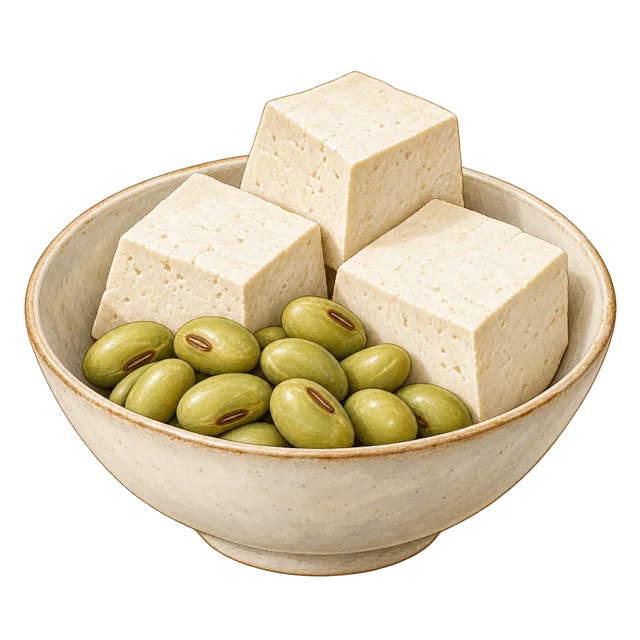
- Tofu
- Soy protein provides all nine essential amino acids. Protein quality and the amount in this particular piece are different questions.
- Soy family
- Firm tofu, silken tofu and whole soybeans differ in water and protein content. Identify the particular food before comparing.
Illustration for understanding; not to scale. Saved figures include explanations and sources.
Numbers · a palm of firm tofu is not a compromise protein
Most plant proteins are incomplete and need pairing (see protein for how amino acids complement each other). Soy does not: it has all nine essential amino acids on its own, and its protein digestibility-corrected amino acid score (PDCAAS) is close to the top score of 1.0. Quinoa is the other exception.From USDA data, per 100 g:
Firm tofu: about 12-17 g protein and about 110-145 kcal, with mostly unsaturated fat; the calcium-set kind can have 150-350 mg calciumSilken tofu: about 5-8 g protein, softer and wetterEdamame: about 11 g protein, plus fiberDry soybeans: about 36 g protein
A palm-sized block of firm tofu has about as much protein as a small piece of chicken, with almost no cholesterol and little saturated fat. If you want to eat less red and processed meat but worry that plant protein is not good enough, soy is a solid mainstay, not a second-best option. The problems with processed meat are in Processed Meat.
Chapter 3
What phytoestrogens are
Being able to sit in estrogen's chair is not the same as being estrogen. Isoflavones push very weakly, and they are picky about which chair they take: the body has two kinds of estrogen receptor, and isoflavones prefer the one that acts as a brake in many tissues. On top of that, gut bacteria convert them into different products, and everyone's gut bacteria are different, so two people eating the same tofu can respond differently.
Mechanism · sits in the chair, barely pushes, and is picky
The main isoflavones are genistein and daidzein. Their structure looks somewhat like the body's own estrogen (), so they can bind estrogen receptors. But binding is not the same as acting like estrogen.Two key differences:
Extremely weak: they activate the receptor orders of magnitude more weakly than the body's own estrogen. Same chair, barely a pushA different preference: the body has two estrogen receptors, ERα and ERβ. Estradiol works on both; isoflavones prefer ERβ. Based on cell and animal studies, ERα is the main driver of cell growth in the breast and uterus, while ERβ often acts as a brake in many tissues
So isoflavones behave like a plant molecule with selective effects, somewhat like the drugs called selective estrogen receptor modulators: in different tissues they may act slightly like estrogen or work against it, depending on the local receptor type and the body's own estrogen level. In human studies, they are neither as risky as taking estrogen nor as all-powerful as the miracle hormone balancer that supplements promise.
Mechanism · Why gut bacteria make people differ
Gut bacteria can also turn daidzein into a more active product called equol, but only some people carry those bacteria, and the share is higher in Asian populations. That partly explains why results differ from person to person and from study to study.So isoflavones are weak molecules that sit in the chair, barely push, and choose which chair to take; they are not the estrogen you might imagine. The chapters on soy and men and on breast cancer test this mechanism against the human evidence.
Chapter 4
Does soy feminize men
When dozens of clinical studies are pooled, men who took soy protein or isoflavones showed no clear change in testosterone or other androgen measures. The soy milk and tofu in a normal diet are nowhere near the extreme doses in those individual cases. Eat tofu and soy milk as the good-quality protein they are.
Evidence · Did testosterone actually change
The myth often travels with an anecdote about drinking soy milk every day and growing breasts. The source is almost always an extreme individual case: a case report described a man who drank several liters of soy milk a day (far more isoflavones than any normal diet) and developed breast tissue, which went away after he stopped. That dose was then blown up into men must not eat soy.Hamilton-Reeves's 2010 pooled 32 clinical studies and asked directly whether soy protein or isoflavones lower men's testosterone, free testosterone, or (SHBG, a blood protein that carries sex hormones). The answer was clear: no significant effect. Across the intakes these studies used, including high ones, men's androgen levels did not change.
Why it runs against intuition: isoflavones bind the receptor very weakly and prefer ERβ, so at the doses in a normal diet they come nowhere near the strength of the body's own estrogen. Within a normal diet, men who eat soy foods are not feminized and do not have lowered testosterone.
Chapter 5
Can people with breast cancer eat soy
The worry comes from lab dishes and mice, where high concentrations of isoflavones stimulated one type of breast cancer cell. A person eating tofu gets nothing like that dose or that metabolism. In long-term follow-up of breast cancer patients in China and the United States, those who ate more soy foods after diagnosis had fewer recurrences and no more deaths. That is an observed association, but it points the opposite way from the myth.
Evidence · What survivor cohorts actually saw
In some cell and mouse experiments, high concentrations of genistein stimulated the growth of estrogen receptor-positive breast cancer cells. Doses and metabolism in a lab dish or a rodent are worlds apart from a person eating tofu, but those early experiments spread as proof that soy causes cancer.The human studies (all observational cohorts that followed patients) point the other way:
Shu 2009: the Shanghai Breast Cancer Survival Study followed 5,042 patients. The more soy they ate after diagnosis, the fewer deaths and recurrences (an inverse association), not moreNechuta 2012: pooled three cohorts from the US and China with 9,514 breast cancer survivors. Those who ate at least 10 mg of isoflavones a day had about a 25% lower risk of recurrence (, HR, 0.75, statistically significant); the hazard ratio for death from all causes was 0.87 and not statistically significant, so it cannot be written as if deaths fell too
In real populations, breast cancer patients who eat soy foods do not do worse. The mechanism makes sense of this too: isoflavones prefer ERβ and activate it weakly, so in breast tissue they act more like something occupying the seat than fuel on the fire. Treating cell and mouse experiments as conclusions about people is where this myth comes from. Organizations such as the American Institute for Cancer Research (AICR) hold that eating soy foods in moderation is safe for breast cancer patients, and observational studies hint at a small benefit.
Note that these studies looked at everyday soy foods, not concentrated isoflavone supplements. This is general education; a cancer patient's specific diet should still be discussed with their treating physician.
Evidence · Does soy harm the thyroid
Another worry often bundled with the estrogen myths is that soy harms the thyroid. Messina's 2006 review looked at healthy adults and at patients with an underactive thyroid: in people with enough iodine and normal thyroid function, there is little evidence that soy or isoflavones harm thyroid function. That conclusion assumes iodine intake is adequate.The real caution is for people taking levothyroxine (a thyroid hormone medicine): soy reduces how much of the drug is absorbed. How to space the two apart is covered in the chapter on how to eat soy and who should take care.
Chapter 6
Tofu's calcium depends on the coagulant
Set with calcium sulfate (gypsum), the calcium goes straight into the tofu, so it is high. Set with nigari (magnesium chloride) or glucono-delta-lactone, it carries almost none. So if you want tofu for calcium, first check the coagulant on the ingredient list: firm tofu set with calcium sulfate can have 150-350 mg of calcium per 100 g, more than the same weight of milk, and it is absorbed about as well as milk's.
Mechanism · which salt sets it decides the calcium
To set soy milk into tofu, you add a coagulant:Calcium salt (calcium sulfate, gypsum): common in traditional firm tofu. Calcium goes straight into the tofu matrix, so the finished block is clearly higher in calcium, 150-350 mg per 100 g, more than the same weight of milk (USDA, firm tofu set with calcium sulfate)Magnesium salt (magnesium chloride, nigari): common in Japanese-style tofu; cleaner flavor, much less calciumGlucono-delta-lactone: common in silken tofu; also low in calcium
So whether tofu supplies calcium depends entirely on which coagulant the ingredient list names. To use tofu for calcium, choose firm tofu set with calcium sulfate. Its calcium is absorbed about as well as milk's, which makes it a reliable plant source of calcium for people who are lactose intolerant or do not drink milk. How calcium gets into bone is in calcium; milk is covered in milk.
Soy also supplies magnesium, potassium, non-heme iron (better absorbed with vitamin C; see iron), and unsaturated fat. Overall it is a nutrient-dense food that can be eaten minimally or heavily processed.
Chapter 7
Whole soy is not the same as isolate
Grinding and straining throws away the fiber, and industrial purification strips out the fat as well, leaving only a protein powder. What makes some plant-based meats unhealthy is often not the soy but the ultra-processed layer: added sugar, added salt, and assorted additives. Put whole soybeans and traditional soy foods such as edamame, tofu, soy milk, and natto first.
In practice · Whole soy or soy protein isolate
The recommended end: edamame, tofu, soy milk, natto, miso, and tempeh. They keep soy's natural matrix: protein, fiber, minerals, and an intact plant structure. Fermented ones add something extra: fermentation lowers phytate and other anti-nutrients, natto is also rich in vitamin (see Vitamin K2), and some carry live microbes; that thread is followed with fermented foods.The end to watch: soy protein isolate is a protein powder purified industrially after the fiber and fat are removed, and it shows up widely in protein bars, meal replacements, and plant-based meats. It is not a poison, and it has uses as a protein supplement; the problem is that it usually comes packaged in highly processed products (added sugar, salt, additives). What makes some plant-based meats unhealthy is often not the soy but the ultra-processing. How a health halo gets used in marketing: superfoods.
In practice: put whole soybeans and traditional soy foods first. A serving of edamame, a block of tofu, or a bowl of miso soup is far better than a protein bar built on isolate with added sugar.
Chapter 8
How to eat it and who should take care
Soy does not harm thyroid function, but it reduces the absorption of levothyroxine (a thyroid hormone medicine), and that is the one real food-drug interaction: spacing the pill and soy foods a few hours apart is enough, with no need to give up soy. People with a true soy allergy should avoid it; people with gout can eat tofu in moderation, and during an acute flare should check with a doctor first.
In practice · How to choose, and how much
For calcium: firm tofu whose ingredient list says calcium sulfate. For high protein with little processing: edamame, tofu, soy milk (unsweetened), and natto. Flavored soy drinks in stores often have added sugar, so read the label. Whole dry soybeans need thorough soaking and full cooking to inactivate their lectins (the same mechanism as in the chapter on anti-nutrients in lentils).How much: in traditional Asian diets, many people have eaten a serving or two of soy foods a day for their whole lives (a serving is roughly 100 g of tofu, a cup of soy milk, or half a cup of edamame), and population studies have not seen hormone problems. There is no need to pile on extreme amounts (which is exactly where the anecdotal myths come from), and no need to be so afraid that you avoid soy entirely.
Clinical · Space out thyroid pills, keep the soy
People taking thyroid medicine (levothyroxine): this is the one real interaction. Soy does not harm thyroid function, but it reduces the absorption of levothyroxine (Messina 2006). The fix is simple: take the pill and soy (along with other high-calcium, high-fiber foods) a few hours apart. A common recommendation is to take the pill on an empty stomach in the morning and wait at least 4 hours before eating soy. Follow your doctor's instructions. See hashimoto.People with a soy allergy: a true allergy (especially in children) means avoiding soy. This is an immune problem, unrelated to the myths.
Gout: soy foods were once thought to trigger gout. Soy has a little more purine than lean meat or fish, but in a large cohort of men, purines from plant sources such as legumes showed no clear link with gout risk (an observed association), and China's dietary guideline for gout also says tofu and dried tofu can be eaten in moderation. During an acute flare, it is still wise to consult a doctor.
This is general information only and does not replace a doctor's judgment of your situation.
References · 7
- U.S. Department of Agriculture, Agricultural Research Service. (2024). FoodData Central: Tofu, raw, firm, prepared with calcium sulfate (FDC ID 172475). Calcium-set firm tofu provides roughly 12-17 g protein and 150-350 mg calcium per 100 g. fdc.nal.usda.gov/food-details/172475/nutrients
- Institute of Medicine. (2005). Dietary Reference Intakes for Energy, Carbohydrate, Fiber, Fat, Fatty Acids, Cholesterol, Protein, and Amino Acids. National Academies Press. nap.nationalacademies.org/catalog/10490/dietary-reference-intakes-for-energy-carbohydrate-fiber-fat-fatty-acids-cholesterol-protein-and-amino-acids
- Hamilton-Reeves, J. M., Vazquez, G., Duval, S. J., Phipps, W. R., Kurzer, M. S., & Messina, M. J. (2010). Clinical studies show no effects of soy protein or isoflavones on reproductive hormones in men: results of a meta-analysis. Fertility and Sterility, 94(3), 997-1007. Meta-analysis of 32 studies finding no significant effect of soy protein or isoflavone intake on testosterone, SHBG, free testosterone, or free androgen index in men. 10.1016/j.fertnstert.2009.04.038
- Messina, M., & Redmond, G. (2006). Effects of soy protein and soybean isoflavones on thyroid function in healthy adults and hypothyroid patients: a review of the relevant literature. Thyroid, 16(3), 249-258. Found little evidence that soy/isoflavones harm thyroid function in euthyroid, iodine-replete people, but noted soy can reduce absorption of synthetic thyroid hormone (levothyroxine). 10.1089/thy.2006.16.249
- Shu, X. O., Zheng, Y., Cai, H., Gu, K., Chen, Z., Zheng, W., & Lu, W. (2009). Soy food intake and breast cancer survival. JAMA, 302(22), 2437-2443. Shanghai Breast Cancer Survival Study (5,042 patients): higher post-diagnosis soy intake was inversely associated with mortality and recurrence. 10.1001/jama.2009.1783
- Nechuta, S. J., Caan, B. J., Chen, W. Y., Lu, W., Chen, Z., Kwan, M. L., et al. (2012). Soy food intake after diagnosis of breast cancer and survival: an in-depth analysis of combined evidence from cohort studies of US and Chinese women. American Journal of Clinical Nutrition, 96(1), 123-132. Pooled analysis of 9,514 survivors; ≥10 mg isoflavones/day was associated with ~25% lower recurrence (HR 0.75); all-cause mortality was lower but not statistically significant (HR 0.87, 95% CI 0.70–1.10) (abstract, PMID 22648714). 10.3945/ajcn.112.035972
- U.S. Department of Agriculture & U.S. Department of Health and Human Services. (2020). Dietary Guidelines for Americans, 2020-2025 (9th ed.). www.dietaryguidelines.gov/sites/default/files/2020-12/Dietary_Guidelines_for_Americans_2020-2025.pdf