Story
Sesame
Last updated
In one pass Most of sesame's calcium grows in the outer seed coat, the hull, and the same layer also holds oxalate, which locks calcium up.
Educational content, not medical advice — consult a clinician.
Story path
Chapter 1
Black or white, hulled or not
Sesame is an ancient oilseed that turns up everywhere in Chinese cooking: sprinkled on flatbread, ground into sesame paste, pressed into sesame oil, cooked into sweet sesame soup. The nutrition gap between black and white sesame is smaller than folklore says; black sesame simply carries more dark pigment in its seed coat. The idea that black sesame darkens gray hair and strengthens the kidneys is folk belief, with no reliable human evidence behind it.
A few people have a true sesame allergy. If your lips or throat swell, you have trouble breathing, or you feel dizzy and cannot stay standing after eating it, call emergency services right away.
Mechanism · A sesame seed in three layers
Sesame is so small you can barely see its structure, but it is a complete seed with clear layers: outermost is the seed coat (the hull we talk about), and inside are the endosperm and the embryo (the part that would grow into a seedling).The seed coat's job is to protect what is inside, not to be eaten
This layer keeps microbes and insects out and shields the kernel. Sesame happens to pile two kinds of thing into this layer together: minerals (mainly calcium) and a set of defensive compounds (oxalate and colored phenolics).
Hold on to this sentence; it is the key to the whole story: calcium and the oxalate that locks calcium up are neighbors in the same layer. The chapter on why the calcium sits in the hull and the chapter on oxalate and how to eat sesame look like two topics, but they are two faces of the same tissue.
So hulling is not a detail; it removes a whole layer
Hulling takes away more than calcium. It takes everything in that layer: calcium, oxalate, most of the dietary fiber, and the color.
The black-versus-white split lives in this layer too. Black sesame is black because of dark pigment in its seed coat, so once you hull black sesame it is no longer black. That means every health claim built around the color hangs on a tissue that can be peeled off at any time.
Why sesame gets hulled (this is not cutting corners)
The seed coat is astringent and bitter, and its texture is coarse. Take it off and the seeds turn whiter, taste milder, and grind into a smoother paste. So hulling is a trade of nutrition for mouthfeel. Seeing it as a trade is more useful than memorizing which is better: you can choose by what you are using it for, not by a word on the label.
The kernel holds oil and protein
About half of sesame's weight is fat, which is why it was first grown as an oilseed crop.
One conclusion follows right away: when sesame is pressed for oil, the fat-soluble part goes into the oil, while the calcium and fiber stay behind in the pressed cake. Sesame oil is not concentrated sesame. It is the half that is left after sesame is split by what dissolves in fat.
Safety · Why sesame allergy can be fast and severe
Most people eat sesame with no problem at all. For some, though, sesame allergy is a true allergy, not an intolerance — the two take completely different paths in the body, and talking about them as one thing makes people underestimate one of them.Where intolerance and allergy differ
Intolerance is a digestive-layer affair: something is not broken down cleanly, bacteria ferment it downstream, and the result is bloating, diarrhea, discomfort. It is dose-related — eat a little less and it is often fine.
True allergy is an immune-layer affair: the immune system treats a harmless food protein as an invader.
What one allergic reaction looks like inside the body
The immune system first makes a batch of antibodies (IgE) against a few proteins in sesame; those antibodies sit on the surface of mast cells like antennas. Mast cells are the tissue's alarm cells — they are everywhere in skin, airways, and gut wall, and they already hold waiting granules filled with signaling substances such as histamine.
The next time the same protein comes in, it sticks to two neighboring antennas at once and bridges them. That bridge is the starter pistol: the mast cell dumps its preloaded granules in one go.
After the dump, three things happen within minutes, and each maps onto a symptom you can see:
Small vessels widen and their walls leak; fluid seeps into tissue → hives, swollen lips and eyelidsAirway smooth muscle tightens → wheeze, chest tightness, a closing throatVessels widen throughout the body and blood pressure drops → dizziness, going pale, cannot stay standing
Why the dose threshold can be extremely low
The key is that one word, preloaded. The body does not need to build a weapon on the spot; it only needs a signal to empty the warehouse — so a trace of contamination can trigger a complete reaction. That is a completely different mechanism from oxalate, which only matters once you eat enough of it, and it is why just a little should be fine does not hold for a true allergy.
The trouble with sesame is how deeply it hides
It can sit in sesame paste, sesame oil, the surface of bread and flatbreads, compound seasonings, dipping sauces, and the base flavor of a sauce, and its name is not always in the most visible place. Sesame has been listed as a mandatory allergen in more and more places in recent years precisely because of this hiding deep.
Red flag: throat tightness, trouble breathing, a changed voice, dizziness, or not being able to stand after eating it — this is a whole-body acute allergic reaction. Call emergency services at once; do not wait for it to pass, and do not count on an antihistamine to carry you through. For someone already diagnosed, carrying the emergency medicine a clinician prescribed and knowing how to use it is the only preparation that actually works.
Chapter 2
Mechanism · the calcium is in the hull
But you do not get the whole number on the nutrition panel. The oxalate in that same layer, together with the phytate in sesame, locks part of the calcium up: in the gut it forms insoluble salts that pass straight through. So eating sesame for calcium comes with two conditions: the seeds have to be unhulled, and you have to accept a discount.
Measured by what you can eat at one sitting, a spoonful of sesame also brings far less calcium than a glass of milk (for the full calcium story, see calcium). Sesame works better as a supplementary calcium source in your diet, not as the mainstay.
A CLOSER LOOK
Grinding opens the coat, not access to all calcium
This compares whole and ground forms of the same kind of sesame. The bowls are not equal weights, and powder color cannot measure calcium or oxalate.
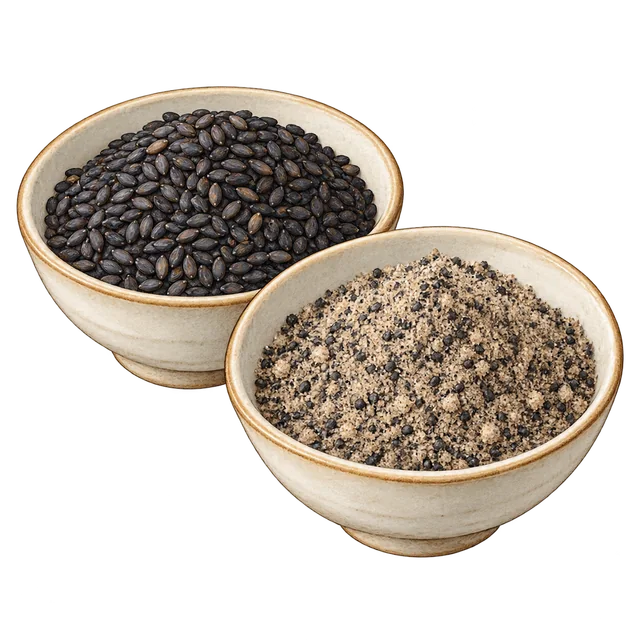
- Whole seeds
- Much of sesame's calcium is in the seed coat. Hulled and unhulled seeds therefore differ in calcium content.
- Ground sesame
- Grinding with the coat retains its calcium, but oxalate and phytate still affect absorption. The nutrient table is not the amount fully absorbed.
Illustration for understanding; not to scale. Saved figures include explanations and sources.
Mechanism · Calcium and its oxalate lock share a layer
Most of sesame's calcium is in the hull, but that is only half the story. The other half: most of the oxalate is in that hull too, and a good share of the calcium is already bound to oxalate before you ever eat it.Why a plant makes oxalate
Oxalate is a by-product of the plant's metabolism, but the plant puts it to use. Oxalate carries two negatively charged claws that fit a calcium ion with its two positive charges, and together they form insoluble calcium-oxalate crystals.
For the plant this does two jobs at once: surplus oxalate gets neutralized, and surplus calcium gets stored, as a solid. A solid does not wander around the cell and does not scramble the cell's internal signals (inside a living cell, calcium is a signaling molecule, and its concentration has to be kept very low).
So in the seed coat, a good share of the calcium was never free calcium to begin with. It is calcium already locked into crystals.
Two things that look contradictory are really one thing
In the lab, this calcium counts. Calcium content is measured by burning the sample completely or digesting it in strong acid, then measuring the total amount of the element. The crystals are broken apart at that step, and the calcium inside is counted like any other. So the handsome total calcium on the nutrition panel is not fake.In your small intestine, this calcium does not count. The gut does not digest food that way. The channels in the gut wall that carry calcium only recognize free calcium ions. Calcium oxalate barely dissolves in the gut, the calcium cannot work loose from the crystal, the channel does not recognize it, and the whole crystal leaves in the stool.
The same calcium counts in the lab and does not count in the gut. High content and poor absorption are not two claims fighting each other. They are two faces of the same warehouse.
Oxalate that is still unbound intercepts calcium on the spot
The calcium in the hull that did start out free meets oxalate released from the same layer, oxalate that has not yet bound calcium, and the two bind on the spot and are lost together. So sesame's oxalate does not only lock up the calcium in its crystals; it also takes a further cut from the free calcium.
This mechanism reaches far beyond sesame
To judge whether a plant food actually delivers calcium, the content table is not enough; you also have to check how high its oxalate is:
Spinach: the calcium content looks decent, but oxalate is high, and the amount that actually gets into the body is small enough to ignore.Low-oxalate greens (gai lan, napa cabbage and their relatives): the content is not always the highest, but the calcium is absorbed about as well as milk's.Sesame: sits in between. The content is genuinely high, but you have to take a real discount.
Why dairy is hard to replace follows from the same mechanism
Most of the calcium in milk is already soluble or loosely attached to casein, so in the gut it easily turns back into free ions, and milk has no oxalate to intercept it along the way. Its content is not low, and it takes no extra oxalate discount; both hold at once, and that is what makes dairy hard to replace.
In practice · Hulled or unhulled: which gives more
With the mechanism of calcium and oxalate sharing one layer, you can work this common question out yourself.Unhulled versus hulled: one ledger each
Unhulled sesame: total calcium is high, but part of it is locked in crystals before it reaches your mouth, and another part gets intercepted by oxalate released from the same layer. What you actually get is high content with a discount taken off.Hulled white sesame: total calcium drops sharply, and the oxalate hurdle is mostly gone too. What you actually get is low content with a smaller discount.
The net result most likely still favors unhulled, because the gap in content is much larger than the gap in absorption. But the extra calcium you gain is clearly smaller than the gap in total calcium on the panel. The marketing line that unhulled sesame has several times the calcium of hulled is stretched too far: it is the lab's ledger, not the gut's.
Phytate runs along a parallel track
Phytate is how a seed stores phosphorus: a ring carrying six phosphate groups, each negatively charged, which makes it a net that can grab several doubly charged ions at once. Calcium, iron, and zinc are all within its reach.
Here is one way to remember how the work divides: oxalate grips harder and more selectively (mainly calcium), while phytate grips more widely and more loosely (a little of any doubly charged ion).
So here is what sesame really looks like in the mineral column
The nutrition panel looks handsome (calcium, iron, zinc, magnesium, and copper are all reasonably high), but these minerals live in the same seed as the molecules that grab them. That is not a flaw peculiar to sesame; it is a shape shared by almost every seed and whole grain eaten with its coat or hull. Knowing the shape is far more useful than memorizing one food's ranking.
Can you have both the content and the absorption?
There are a few approaches. Each has a limited effect, but each makes sense:
Soaking, sprouting, fermenting: the seed already carries an enzyme that can take phytate apart, but it is normally switched off. Soaking and sprouting switch it on and break down some of the phytate. Part of the reason traditional cooks soak seeds before roasting them lies here. But most of the oxalate in sesame hulls is already bound to calcium as crystals, and neither soaking nor heating breaks those apart.Vitamin C helps iron, not calcium. Vitamin C in the same meal clearly helps non-heme iron get absorbed: it converts iron into the form the gut wall's transporter recognizes and keeps it dissolved. Calcium's door does not care about any of that; it only checks whether the ion is free. The same trick fails once you swap in a different mineral, which is why food-pairing rules of thumb need to be remembered together with the mechanism behind them.Get most of your calcium elsewhere and let sesame play a supporting role. This is the least fuss, and the most honest option.
Chapter 3
What the lignans in sesame are
Be clear about where the evidence stops: sesamin's antioxidant and related activities come mostly from cell studies, animal experiments, and small human studies. The idea of eating sesame to fight oxidation, balance hormones, or lower blood lipids still has no reliable evidence from human disease outcomes. Calling sesame a nutritious, flavorful seed is accurate; claiming it has a specific therapeutic effect goes beyond the evidence.
Mechanism · Lignans must be converted twice
Lignans are often talked about as a ready-made active ingredient, but the molecule you swallow and the molecule later measured in your blood are no longer the same thing. Two conversions sit in between, and those two conversions are exactly why results in this kind of research wander so much.Some of it is sealed when you swallow it
Part of the lignan in the seed carries a sugar. That sugar works like a seal: it makes the molecule larger and more water-loving, so it cannot cross the gut wall and cannot fit into any receptor.
The first conversion happens in the colon, and you are not the one doing it
When food residue reaches the colon, the bacteria there bring enzymes that people do not have. They cut off the sugar seal, then step by step convert plant lignans into mammalian lignans (enterodiol and enterolactone). Only at this point does the molecule become smaller and a little more fat-loving, so the gut wall can absorb it.
Notice the weight of this sentence: this step is not done by your body; it is done by the bacteria living in your gut.
The second conversion happens in the liver, and it loops back
Once absorbed, mammalian lignans get a water-soluble tag in the liver, ready to be excreted. Some of them return to the gut with bile, where bacteria remove the tag and they are absorbed again. That round trip keeps them in the body much longer than a single pass would.
Why this mechanism is worth knowing
It explains why lignan studies struggle to produce stable results.
The conversion step depends heavily on each person's own gut bacteria, and those differ a great deal from one person to the next. The same spoonful of sesame paste can put very different amounts of mammalian lignan into two people's blood. If an effect only shows up in the people who convert well, a small trial that does not separate them will average it out into no visible difference.
This also explains two things in passing:
In people who have just taken antibiotics, or who have eaten almost no dietary fiber for a long time, this conversion chain may weaken.For lignans, how much you eat and how much your body gets cannot be treated as equal, even less so than for most nutrients.
One more thing: why sesame oil keeps well
During roasting and pressing, the lignans in sesame are converted into a class of phenolic antioxidants that stay in the oil. That is one reason sesame oil resists oxidation better than many vegetable oils and holds its aroma. In other words, the mark lignans leave on the oil side is mostly not on you; it is on the bottle of oil itself.
Myth · Two misreadings of the word phytoestrogen
The name has estrogen in it, so two camps draw opposite conclusions from the same word: one fears it adds a hormone that should not be added, the other hopes it can stand in for hormones. Both are misreading the same mechanism.A receptor is less a lock and key than a seat
The estrogen receptor has a pocket, and a molecule of roughly the right shape can sit in it. Mammalian lignans carry two phenolic rings shaped enough like parts of estrogen that they can sit there, but they sit loosely, with much weaker binding than the body's own estrogen.
So the effect depends on whether the seat was empty to begin with
When your own estrogen is high, the lignan occupies the seat and keeps a stronger signal out, so it shows up as weakening.When your own estrogen is low, the lignan takes an empty seat and gives at least a little signal, so it shows up as a faint top-up.
That is why the same molecule gets called both anti-estrogenic and estrogen-like. It is neither. It is a weak signal, and the direction of that signal is set, in reverse, by the baseline.
But keep the conclusion in check
What is described here is reasoning that holds at the receptor, not eating sesame will change your hormone status. Between a molecule can sit in a receptor and a measurable, repeatable health outcome in people lie several gates: how much you ate, how much your gut bacteria converted, what concentration actually reached the target tissue, and how large the differences between people are. Sesame has no strong human evidence at any of those gates.
That is what it means to say the evidence on sesame lignans stops at mechanisms and small studies: not that the mechanism is false, but that the mechanism holds and eating it helps are two different claims, and so far only the first one stands.
A way of reading you can take with you
Next time a food is sold as naturally balancing your hormones, ask two questions:
Did the study measure, in people, a concentration of some molecule in the blood, or a real health outcome?Did anyone actually do better because of it: fewer symptoms, better test results, a better quality of life?
Lignans currently sit almost entirely in the first group. There is no shame in that; most plant compounds sit there. The problem is selling first-group results as if they belonged to the second.
Chapter 4
Oxalate, and how to eat it
The first is the hull itself. Sesame seeds are small and their hulls are hard, so much of what you swallow whole and do not chew through comes out intact, its nutrients never released. That is why eating it ground (sesame paste, sesame powder) or chewing thoroughly works much better than sprinkling whole seeds.
The second is oxalate. The oxalate in sesame, especially unhulled sesame, binds minerals such as calcium and iron and blocks part of their absorption (see spinach for the same mechanism). That does not mean sesame's calcium is wasted, only that the amount you actually absorb takes a discount.
If you want calcium and other nutrients from sesame, choose unhulled seeds and eat them as paste or ground; whole white sesame sprinkled on top is mostly there for flavor.
Mechanism · Grinding opens only the first gate
Sesame's two absorption traps are not two separate problems side by side. They are two gates in a row. Once you know which is which, you know what each way of eating actually solves, and why none of them solves everything.Gate one · physical: the seed coat
The seed coat is a hard jacket whose job is to protect the seed and resist being broken open, not to be digested. So it is no surprise when whole seeds pass straight through.
The problem is not that you chew carelessly; it is size. A sesame seed is small enough to hide in the grooves of a tooth and slip between two biting surfaces. Chewing a mouthful of rice and chewing a pinch of sesame are different acts: the first crushes one mass, the second pushes a few hundred tiny balls around.
This is the same principle as the cell wall is the first gate from the Bell Pepper and almond stories, one notch harder: a bell pepper's cell walls are thin, and chewing plus heat breaks them, while sesame has a hard seed coat on top of its cell walls.
There is only one way through this gate: mechanical grinding. A stone mill, a blender, a rolling pin all count. Grinding makes the surface area jump, and only then do oil, minerals, and lignans get a chance to leave the cells.
That is the real gap between sesame paste and whole sesame: not that one is more finely processed, but that the gate has been opened.
Gate two · chemical: oxalate and phytate
An open gate does not guarantee that what comes out gets absorbed. As the chapter on why the calcium sits in the hull explains, the calcium that is released still has to face the oxalate released from the same layer at the same time.
Grinding even has a slight counter-effect here: it releases calcium and oxalate together, so they meet more easily in the gut.
So the reasonable expectation is this: grinding lets the nutrients out, but once out they still take a discount and never reach full value. The two gates multiply; they do not add.
Put the two gates together, and here is what common ways of eating sesame are worth
Whole seeds sprinkled on flatbread or tossed into a dish: gate one stays shut. The main contribution is flavor and texture; nutritionally they mostly pass through.Sesame paste, sesame powder, freshly ground sesame: gate one is open, and this is the form in which you actually get the nutrition. If it was ground from unhulled seeds, it still carries the calcium from the hull.Sesame oil: gate one is opened most thoroughly (the whole seed is pressed), but the oil only carries the fat-soluble half; calcium and fiber stay in the pressed cake.Roasting: makes the seed coat brittle, easier to grind and chew, and brings aroma. But calcium-oxalate crystals are quite heat-stable, roasting does not break them apart, and you should not count on roasted, so it is fine.
In practice · Where sesame fits in your diet
Now sesame can be given an accurate place. That place comes from the mechanisms in this story, not from a slogan, so you can place other foods the same way.What it is good at
In a very small volume it brings high energy density, a decent set of fatty acids, and a very distinctive flavor. A spoonful of sesame paste can turn a plate of boiled greens into a dish someone wants to eat again. That job is badly underrated: the vegetables you will keep eating are far more useful than the vegetables that look better on a nutrition table.
What it is not good at
Being your main source of calcium. The reason is not low content; it is those two gates. Sesame is one of the best examples of the distance between high on the label and what you actually get.
Keep the amount in check
About half of sesame is fat, so its energy density is high. Added a spoonful at a time, it easily goes past the amount you thought you were using. It is a seasoning-sized food, not a portion-sized food, and that rule is easier to follow than any how many grams a day advice.
Who should think one step further
Anyone who has had a calcium-oxalate kidney stone: how much high-oxalate food to eat should be decided by you and your doctor together, not by an explainer. That matters more than any nutrition gain.Anyone allergic to sesame: there is no room to negotiate here, and that includes sesame hidden in sauces and on the surface of baked goods.Anyone getting calcium from a plant-based diet: put the main load on low-oxalate greens, tofu set with calcium, and calcium-fortified drinks, and let sesame go back to being the flavor in a supporting role, which is what it is actually good at.
A way of judging you can take with you
Next time you see a claim that some food has astonishing amounts of calcium (or iron, or zinc), ask three questions:
Which part of the food is it in?Do you actually eat that part?Does that part also house something that grabs it?
These three questions apply to sesame, spinach, wheat bran, and nuts alike. Being able to ask them is worth more than memorizing any ranking table.
References · 2
- U.S. Department of Agriculture, Agricultural Research Service. (2019). FoodData Central: Sesame seeds (whole/unhulled and hulled) and tahini. Calcium is concentrated in the hull (much lower once hulled); contains lignans (sesamin) and oxalate. fdc.nal.usda.gov
- National Institutes of Health, Office of Dietary Supplements. (2024). Calcium — Fact Sheet for Health Professionals. ods.od.nih.gov/factsheets/Calcium-HealthProfessional