Story
Rice
Last updated
In one pass White rice and brown rice are the same grain.
Educational content, not medical advice — consult a clinician.
Story path
Chapter 1
What rice is · what milling changes
A grain of rice has three layers, from outside in. The outermost husk is a hard shell that comes off for both white and brown rice. The middle ring, the bran and germ, is the grain's nutrient store: fiber, fat, magnesium, B vitamins, and plant polyphenols all sit there. The innermost endosperm is almost all starch plus a little protein, and it makes up most of the grain.
Milling does one thing: it grinds off that middle ring and leaves only the white endosperm. What you gain is a soft bite and a long shelf life (with less fat, the rice is slower to go rancid). What you pay is the fiber, magnesium, B vitamins, and polyphenols.
A CLOSER LOOK
One grain, with its outer layers milled away
Both forms have had their husks removed. Polishing also removes bran and germ, leaving mainly endosperm. The bowls do not represent equal-weight portions.
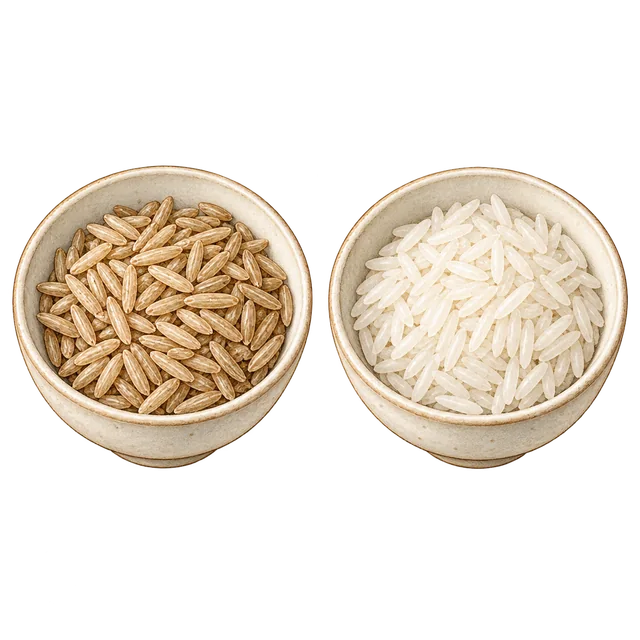
- Brown rice
- Bran and germ remain, carrying fiber, fat, magnesium and B vitamins.
- White rice
- Polishing removes the outer layers. The remaining endosperm is mainly starch with a little protein.
Illustration for understanding; not to scale. Saved figures include explanations and sources.
Background · The common kinds of rice
Rice (Oryza sativa) is the staple for more than half the world's population, and one of the single crops that has delivered the most dietary energy in human history. Under that one species, common varieties differ quite a bit:Japonica: East Asian short-round grainIndica: Southeast Asian long-grainJasmine: Thai fragrant riceBasmati: from India and Pakistan; high in amylose, with a relatively low glycemic index ()Black rice and red rice: whole grains; the bran layer still carries anthocyanins and other polyphenols
Varieties are worth remembering not for taste, but because they decide the molecular structure of the starch — and the shape those starch chains take decides how fast this bowl is taken apart in your gut. That chain is laid out in the later chapter on what sets how fast rice raises blood sugar.
Chapter 2
How white and brown rice differ
Brown rice has about 4–5 times the fiber of white rice and about 3.5 times the magnesium. Fiber itself supplies almost no energy, but it wraps the starch, so digestive enzymes take it apart a little more slowly, blood sugar rises somewhat more gently, and what is left undigested moves on to feed bacteria in the large intestine. Magnesium is a partner that hundreds of enzymes need, and blood sugar control, nerves, and muscles all use it (see Magnesium).
On protein the two are close, and they share the same weak spot: rice protein is low in lysine. The East Asian habit of eating rice with tofu or with beans grew out of this — the lysine in legumes fills exactly the gap rice leaves.
Numbers · White and brown rice, item by item
Per 100 g cooked (USDA FoodData Central):White rice (cooked): about 130 kcal · protein 2.7 g · fat 0.3 g · carbohydrate 28 g · fiber 0.4 g · about 70-80 (varies by variety)
Brown rice (cooked): about 112 kcal · protein 2.6 g · fat 0.9 g · carbohydrate 23 g · fiber 1.8 g · GI usually somewhat lower than white rice, though the gap is far smaller than the fiber gap
(GI is the glycemic index: how fast the same amount of carbohydrate raises blood sugar.)
A few points worth noticing:
First, measured by cooked weight, brown rice is actually a little lower in calories per 100 g. That comes mainly from differences in water content after cooking and in fiber; measured as raw grain, the two are about the same.
Second, protein is similar in both. Rice protein has a relatively good amino-acid profile for a grain, but lysine is still low. When white rice is the staple and protein comes from few other sources, lysine can fall short; pairing rice with legumes (including tofu) is the complement that formed naturally in East Asian eating.
Third, the fiber gap is the key one — it directly affects how fast blood glucose rises, how full you feel, and the colon microbiota.
The magnesium gap is also substantial: brown rice has about 43 mg magnesium per 100 g, white rice about 12 mg. Magnesium takes part in more than 300 enzymatic reactions, and matters for blood glucose, nerves, and muscle. see Magnesium for the mechanism.
Thiamin (Thiamin) and niacin: these B vitamins sit in the bran. Brown rice keeps them; milling strips them from white rice, so brown rice has several times more.
Chapter 3
What sets how fast rice raises sugar
Amylose is one long straight chain; digestive enzymes can only nibble at its two ends, so it breaks down slowly. Amylopectin is like a small tree with many branches, full of ends to bite into, so it breaks down fast. Ordinary white rice is mostly amylopectin, so its glycemic index (, how fast the same amount of carbohydrate raises blood sugar) runs high; basmati has more amylose and a somewhat lower GI; glutinous (sticky) rice is almost all amylopectin and has a very high GI.
How fast rice raises blood sugar, multiplied by how much you eat, is what decides how high blood sugar climbs; that product is called the glycemic load (). One bowl of white rice (150 g cooked) lands in the high-load band. But it is only one factor in a meal: the vegetables, protein, and fat on the same table all push the post-meal blood-sugar peak down somewhat.
When cooked rice is refrigerated and then eaten, part of the starch recrystallizes and becomes harder to digest, and the post-meal blood-sugar rise is a little lower; but only one small trial has tested this directly, and the effect was modest. For how blood sugar is regulated, see Type 2 Diabetes & Prediabetes.
Mechanism · The resistant starch that cooling makes
When cooked rice cools, part of the starch recrystallizes (a process called retrogradation). The enzymes of the small intestine cannot take it apart, so it travels on to the large intestine, where gut bacteria ferment it. This fraction is called resistant starch.The direct test on rice is a 2015 randomized crossover trial in Indonesia (Sonia 2015): refrigerating cooked white rice at 4°C for 24 hours and then reheating it raised resistant starch from 0.64 to 1.65 g per 100 g, and in the 15 healthy adults who ate it, the post-meal blood-sugar response was lower than after freshly cooked rice. It was a small trial, and the difference was real but modest; it did not turn white rice into a low- staple. Reheating gelatinizes some of the resistant starch again, but not all of it.
Why does cooling change how fast rice is digested? In freshly cooked rice, the starch chains have been opened up by hot water and lie loosely spread out, so digestive enzymes can bite in anywhere. As the rice cools, those chains slowly draw together, line up, and lock into dense crystalline regions. Enzymes need gaps they can reach into, and the crystals close those gaps. So this step does not change how much starch is in the rice; it changes whether digestive enzymes can get at it.
The part they cannot reach counts, from a blood-sugar point of view, as a little less carbohydrate. To get more of this effect, switching to whole grains and beans, carbohydrates with more fiber, does far more than fussing over the temperature of your rice.
If you eat cold or leftover rice, cool it quickly and put it in the fridge soon after cooking. Cooked rice left at room temperature for long lets Bacillus cereus, a bacterium rice often carries, multiply and make toxins that cause vomiting or diarrhea.
Chapter 4
What extra nutrients brown rice keeps
The ones most worth remembering are two B vitamins, thiamin and niacin. They are parts the body must attach when it turns sugar into energy, and they sit mainly in the bran and germ — the whiter the rice is milled, the more of this kit is lost.
Because so much is lost, some countries and regions require white rice to be enriched: thiamin, niacin, iron, and folic acid are added back. If you buy enriched white rice (the pack often says enriched), do not rinse it — those nutrients coat the surface of the grain and wash straight off.
Numbers · brown rice's mineral and B-vitamin highlights
Brown rice per 100 g (cooked), main highlights:Magnesium: about 43 mg. Magnesium deficiency is linked to insulin resistance and hypertension risk; see Magnesium.Thiamin (Thiamin): about 0.18 mg, versus about 0.02 mg in unenriched white rice — about 9 times higher.Niacin: brown rice has about 3 times as much as unenriched white rice; it takes part in energy metabolism.Phosphorus and manganese: substantially higher in brown rice, though phytate limits how much is absorbed.Vitamin B6: small amounts, higher in brown than white rice.
One last point worth saying on its own: the bran carries minerals and phytate at the same time, and phytate grabs positively charged minerals such as phosphorus, zinc, and iron and will not let go — so they leave with the stool. The content of minerals in brown rice is genuinely higher; the share that reaches the blood does not rise by the same multiple — soaking and sprouting loosen some of that hold, which is another reason mixed-grain rice is often soaked ahead of time.
Rice bran oil: extracted from the fat in the bran, it is relatively rich in unsaturated fat, but it is a by-product of rice processing and is not covered here.
Chapter 5
What it lacks · how to pair
Low lysine: tofu, soybeans, edamame, or fish, eggs, and meat fill it in.Very little fiber: a bowl of white rice has only about 0.6 g, so vegetables, beans, and whole grains have to make up the rest.Many vitamins and minerals lost in milling: with a varied diet, this is usually not a big problem.
An easy way to transition: steam half white rice and half brown rice or mixed grains together. It tastes better than all brown rice and is more nutritious than all white rice.
In practice · How to fill the three gaps
Lysine: lysine is the first amino acid to run out in rice protein. Pairing rice with tofu, soybeans, or edamame, as East Asian tables do, is a complement that formed naturally over history — legumes are rich in lysine and fill exactly the cell rice leaves empty. Animal proteins such as fish, eggs, and meat work too. Getting both within the same day is enough; you do not have to pair every bite.Fiber: a bowl of white rice has about 0.6 g of fiber, next to nothing against a day's needs. The fiber in that meal has to come from leafy greens, beans, and whole grains.
B vitamins: milling grinds away most of the thiamin and niacin. If your everyday diet has enough vegetables, beans, meat, eggs, and dairy, the gap is usually small; if white rice is almost the only staple and the diet is monotonous, B vitamins can fall short. Beriberi, which appeared in the past where polished white rice was the staple, is thiamin deficiency.
The frame of the whole meal: white rice with plenty of leafy greens, plus tofu or fish, is the basic shape of traditional East Asian eating. The quality of that whole meal is far better than white rice judged on its own.
Chapter 6
Key knowledge · inorganic arsenic in rice
Arsenic occurs naturally in soil and water. What sets rice apart is that it grows in flooded paddies. Long flooding starves the soil of oxygen, and in those conditions inorganic arsenic dissolves out more easily, gets taken up by the roots, and is moved into the grain. So rice carries more inorganic arsenic than other staples, usually more than wheat or corn.
The International Agency for Research on Cancer (IARC) places inorganic arsenic in its top category, carcinogenic to humans; that is a statement about how certain the evidence is, not about how large the risk is. What decides the risk is the total taken in over many years: decades of eating a lot of rice as the staple is what calls for attention, while a varied diet with moderate amounts carries very low risk.
Cutting arsenic is simple:
Cook in plenty of water: use roughly 6:1 water to rice, then pour off the excess water at the end; this removes a substantial share of the inorganic arsenicRinse: rubbing and rinsing in cold water removes some arsenic from the surface, less than cooking in plenty of water; do not rinse enriched white rice, because what washes off is the added nutrientsRotate: do not let rice be your only grain; take turns with oats, wheat, and corn
For most adults, a moderate amount of rice in a balanced diet is not a meaningful safety risk. This is general information only and does not replace specific guidance from doctors or food regulators.
Safety · Who should watch arsenic in rice most
The harm from inorganic arsenic is tied to long-term chronic exposure and to skin, bladder, and lung cancer — notice those words long-term chronic; they decide who should care.Who needs to pay most attention: infants and young children (higher intake per unit body weight; the developing nervous system is sensitive) — the FDA specifically advises against making rice cereal the infant staple; a mix of grains is safer; and adults whose only staple is a lot of white rice, several bowls a day.
Once you see why it is exactly these two groups, you do not have to memorize the list. Arsenic risk is not about how much you ate at one meal; it is the total taken in over years, then divided by body weight.
Infants and young children sit on the denominator of that fraction: body weight is small, and rice cereal is often the meal that keeps coming back through the day, so the same serving of rice works out to a higher dose per kilogram than in an adult; add a nervous system still being built, and the same exposure hits harder. So the advice is not do not eat rice cereal, but do not let rice cereal be the only one — rotate the grains, the denominator (body weight) stays the same, and the numerator is spread thinner.
Adults who treat white rice as the only staple and eat several bowls a day for decades sit on the numerator: each serving is not large, but the count is huge, and the accumulated total is where the problem lives.
The large group in the middle — varied diet, one or two bowls a day — sits in a very low-risk range; stack on excess-water cooking and rinsing, and there is even less reason to worry.
Chapter 7
Choosing, cooking and how much to eat
Choose: if you like the texture, brown rice or a brown-and-white mix is more nutritious; among white rices, basmati has more amylose and a somewhat lower glycemic index (, how fast the same amount of carbohydrate raises blood sugar).Cook: if arsenic worries you, boil the rice in a pot with plenty of water and drain off the excess at the end. If you want to keep rice for the next day, cool it quickly and refrigerate it soon after cooking; do not leave it out overnight.Serve: half the bowl rice and half vegetables is a very practical way to fill it.
For most adults who eat a varied diet, one or two bowls of white rice a day is perfectly reasonable; the overall diet matters far more than any single food choice.
In practice · Cooking, leftovers, and portions
Rice porridge and rice soup: the softer and longer rice is cooked, the more easily its starch is digested and the higher its , so these are not ideal as an everyday staple.Brown rice and mixed grains: soaking them for 2–4 hours beforehand shortens the cooking time and improves the texture.
Leftover rice: refrigerated rice raises blood sugar a little less than freshly cooked rice (resistant starch), provided it was stored safely. Rice often carries the spores of a heat-resistant bacterium called Bacillus cereus. When cooked rice sits at room temperature for a long time, the bacterium multiplies and makes toxins that cause vomiting or diarrhea, and one of those toxins is not destroyed by reheating. So cool cooked rice quickly and refrigerate it; when you use it for cold rice balls or fried rice, reheat it until it is hot all the way through, and do not reheat it again and again.
How much: rice is an energy-dense staple. The Dietary Guidelines for Americans (DGA) recommend making at least half of each day's grains whole grains, which points toward mixing white and brown rice. People at risk of type 2 diabetes, or already diagnosed, should favor varieties with a somewhat lower GI (brown rice, basmati) and watch portions, following their doctor's specific advice.
Chapter 8
Does white rice cause diabetes
First, admit the grain of truth: pooling several large cohort studies, people in Asian populations who ate more white rice did have a higher risk of type 2 diabetes. That is a real population signal, but it is an observed association.
But an association is not the same as eating white rice gives you diabetes, for three reasons:
White rice is probably a stand-in: in these studies, eating a lot of white rice often also meant a monotonous diet, few vegetables, and little physical activity. White rice looks more like a marker of a whole way of living than an independent cause of disease.The same rice, a different table, a different result: within the traditional East Asian pattern of plenty of vegetables, beans, and fish, the risk is not as high; the trouble comes from the whole pattern of lots of white rice, sugary drinks, and few vegetables.Portion is key: in someone with normal metabolism, blood sugar comes back down after a meal, and a normal insulin response can handle the rise from a bowl of rice.
The accurate statement is not white rice causes diabetes but years of large portions of white rice, together with poor overall diet quality, raise the risk. For most people, white rice eaten in sensible portions and well paired does not need to leave the plate.
Evidence · how strong is that signal
The part of the claim that has evidence is real: a of several large cohort studies (Hu et al. 2012, BMJ) did find that, in Asian populations, people who ate more white rice each day had higher diabetes risk.Portion size and glycemic load are what matter. One bowl of white rice (150 g cooked) has a of about 30 — on the high side; but with good pairing and a reasonable portion, someone with normal metabolic function can return to baseline blood glucose within 2 hours. A normal insulin response is built to handle this range.
So between the epidemiological signal and your own plate sits a layer that is often skipped: cohort studies compare the group that ate the most with the group that ate the least. What they give you is a population-level risk difference, not a verdict on this bowl in front of you. The same data can be read as white rice is harmful, or as the lifestyle that treats white rice as the only staple and eats poorly otherwise is harmful — to choose between those readings you have to ask whether the study put vegetables, activity, and total calories into the model together, and how much of the signal was left after adjustment. That is also the generic question to ask of any this food causes this disease headline.
References · 11
- U.S. Department of Agriculture, Agricultural Research Service. (2019). FoodData Central: Rice, white and brown, long-grain, cooked. Brown rice retains bran and germ fiber, magnesium, and B vitamins stripped from white rice. fdc.nal.usda.gov
- National Institutes of Health, Office of Dietary Supplements. (2022). Magnesium — Fact Sheet for Health Professionals. ods.od.nih.gov/factsheets/Magnesium-HealthProfessional
- National Institutes of Health, Office of Dietary Supplements. (2021). Thiamin — Fact Sheet for Health Professionals. ods.od.nih.gov/factsheets/Thiamin-HealthProfessional
- Ranawana, D. V., Henry, C. J. K., Lightowler, H. J., & Wang, D. (2009). Glycaemic index of some commercially available rice and rice products in Great Britain. International Journal of Food Sciences and Nutrition, 60(S4), 99-110. Glycemic index varies by rice variety and by cooking and cooling (retrogradation to resistant starch).
- Sonia, S., Witjaksono, F., & Ridwan, R. (2015). Effect of cooling of cooked white rice on resistant starch content and glycemic response. Asia Pacific Journal of Clinical Nutrition, 24(4), 620-625. Randomized single-blind crossover in 15 healthy adults; refrigerating cooked white rice at 4°C for 24 h then reheating raised resistant starch from 0.64 to 1.65 g/100 g and significantly lowered the postprandial glycemic response vs freshly cooked rice. pubmed.ncbi.nlm.nih.gov/26693746
- U.S. Department of Agriculture & U.S. Department of Health and Human Services. (2020). Dietary Guidelines for Americans, 2020-2025 (9th ed.). www.dietaryguidelines.gov/sites/default/files/2020-12/Dietary_Guidelines_for_Americans_2020-2025.pdf
- National Institutes of Health, Office of Dietary Supplements. (2022). Niacin — Fact Sheet for Health Professionals. ods.od.nih.gov/factsheets/Niacin-HealthProfessional
- U.S. Food and Drug Administration. (2016). Arsenic in Rice and Rice Products Risk Assessment Report. Inorganic arsenic is higher in rice than in other grains; cooking in excess water and draining lowers it; infants and high-intake groups are priority populations. www.fda.gov/food/environmental-contaminants-food/arsenic-rice-and-rice-products
- EFSA Panel on Contaminants in the Food Chain (CONTAM). (2014). Dietary exposure to inorganic arsenic in the European population. EFSA Journal, 12(3), 3597. Rice is a leading dietary contributor to inorganic arsenic exposure. 10.2903/j.efsa.2014.3597
- International Agency for Research on Cancer. (2012). Arsenic, metals, fibres, and dusts. IARC Monographs on the Evaluation of Carcinogenic Risks to Humans, Vol. 100C. Arsenic and inorganic arsenic compounds are classified as Group 1 (carcinogenic to humans). publications.iarc.fr/120
- Hu, E. A., Pan, A., Malik, V., & Sun, Q. (2012). White rice consumption and risk of type 2 diabetes: meta-analysis and systematic review. BMJ, 344, e1454. Associations were stronger in Asian populations and substantially confounded by overall diet and lifestyle. 10.1136/bmj.e1454