Story
Quinoa
Last updated
In one pass Quinoa is one of the few plant proteins that is not missing a piece even when eaten on its own.
Educational content, not medical advice — consult a clinician.
Story path
Chapter 1
What is quinoa · a seed, not a grass
That has to do with where quinoa comes from: it is not actually a cereal grain. Wheat, rice, and maize are grasses, while quinoa belongs to the amaranth family, a close relative of spinach and beets, and what we eat is its seed. Not being a grass, it never made wheat's gluten proteins, so it is naturally Gluten-Free; for people with celiac disease, that holds as long as it did not pick up wheat during processing.
It comes from the Andean highlands of South America, where it has been grown for thousands of years, and it was one of the staple foods of the Inca.
Background · What pseudocereal means
Calling quinoa a pseudocereal is a real botanical classification, not a joke: it means a seed that people eat as a staple but that does not belong to the grass family. Buckwheat and amaranth seeds are in the same group.Where does the difference lie? Grass seeds (wheat, rice, maize) and seeds like quinoa split apart early in evolution. Each side developed its own way of stocking the seed with rations: which storage proteins to pack, how much oil, how much starch, all differ. So the places where later chapters show that quinoa does not look much like rice (the amino-acid mix, the higher fat) mostly trace back to this fork, not to anyone deliberately breeding it that way.
White quinoa is the most common on the shelf; red and black varieties also exist. They differ mainly in anthocyanin content and chewiness, and nutritionally the three are close.
Mechanism · Why quinoa has no gluten
Gluten is not a single substance. It is the name for two classes of storage protein in the wheat seed. They sit dry in the grain until you add water and knead, and then they link into an elastic net: that net is why dough can stretch and rise.Quinoa seeds do not have these molecules, so pure quinoa flour will not make a stretchy dough (what it bakes always comes out on the crumbly side), and it also means that quinoa is naturally gluten-free.
The distinction is worth spelling out: many gluten-free products on the shelf are processed foods that had gluten removed from their ingredients and something else added back for texture. Quinoa is not one of them; it never had gluten in the first place. For people who need to avoid gluten long term, a whole food that never contained it is easier to build into everyday meals than a series of processed substitutes.
Chapter 2
Fewer carbs, more protein per bowl
Per 100 g cooked:
About 4.4 g protein (white rice about 2.7 g) and about 22 g carbohydrate (white rice about 28 g)About 2.8 g fiber (white rice about 0.4 g)About 120 kcal and about 1.9 g fat
The fat is different from most grains too: quinoa has more of it, mostly polyunsaturated (mainly linoleic acid), plus a little alpha-linolenic acid (, the omega-3 fatty acid found in plants). For how fats work, see Fats & Omega-3.
Numbers · Dry weight, cooked weight and GI
The figures at the start of this chapter are cooked. Quinoa soaks up a lot of water as it cooks, so it looks diluted; a fair comparison with other grains uses dry weight: per 100 g of dry quinoa, about 14 g protein, 64 g carbohydrate, 7 g fiber, and 6 g fat, for roughly 368 kcal.For glycemic index (), quinoa is about 53, in the low-to-moderate range and below white rice and most refined grains. GI measures how fast the same amount of carbohydrate reaches the blood: a low number does not mean less carbohydrate; it means the sugar seeps into the blood slowly, so the blood-sugar curve is a gentle slope rather than a spike. Quinoa lands in this range because its fiber and protein together slow digestion, as the chapter on carbohydrate quality explains.
Mechanism · Why a staple carries this much fat
Why does a staple food carry this much fat?Because it is a seed, and a seed with a large embryo. A seed has to pack rations for a seedling that has not yet grown leaves. Like rice, quinoa relies mainly on starch (per 100 g dry weight, about 64 g carbohydrate and about 6 g fat); the difference is that quinoa's embryo is large, and the embryo stores oil. Weight for weight, oil stores more energy. The fat you eat was meant as the seedling's start-up fund.
This has two direct consequences.
First, the seed decides what kind of fat it is. Plant storage oils are mostly unsaturated, so most of quinoa's fat is unsaturated, with little saturated fat.
Second, it spoils more easily than rice. Unsaturated fat chains contain double bonds, which are exactly where oxygen attacks first; as oxygen slowly breaks those bonds, a rancid taste appears. So quinoa should be kept sealed and out of the light, and stored somewhere cool once opened. Keep both for a long time and white rice is still fine while quinoa may already taste off. The chapter on choosing and cooking comes back to this.
Chapter 3
Carb quality · fiber, moderate GI, and the gut
First, fiber. Quinoa has nearly 7 times the fiber of white rice, both soluble and insoluble. The soluble part absorbs water in the gut and thickens, so sugar molecules have to squeeze through a sticky layer before they reach the gut wall; the insoluble part is not absorbed and mainly keeps the contents moving along. For the full mechanism of fiber, see fiber.
Second, protein puts on the brakes. Protein slows how fast the stomach empties, so food is released into the small intestine a little at a time, and the blood-sugar peak after the meal is shaved down with it.
The starch itself does not help much: like most starches, quinoa's is mainly amylopectin, with a fairly low share of amylose, so on its own the starch is not slow. Quinoa's gentler blood-sugar response compared with refined grains comes from its fiber and protein, not from some miracle ingredient. To follow the blood-sugar thread further, see Type 2 Diabetes & Prediabetes for type 2 diabetes.
Mechanism · How amylose and amylopectin differ
Amylose and amylopectin, taken apart, are two ways of packing starch.All starch is chains of glucose. Amylose is a long, mostly unbranched strand; amylopectin is like a tree, with short branches sprouting from the trunk everywhere.
That is where the difference lies: straight chains pack tightly against each other, coiling into dense helices and bundles that digestive enzymes have trouble getting into; the branched kind packs loosely, falls apart easily once heated in water, and gives enzymes places to work everywhere.
So among starchy foods, those high in amylose tend to release glucose into the blood a little at a time, while those high in amylopectin (glutinous rice is the extreme case) tend to release it all at once.
Quinoa is not on the amylose side: its starch is mainly amylopectin, with a fairly low share of amylose. Its slower blood-sugar rise comes from fiber and protein, a reminder not to look only at the starch.
You can take this further on your own: next time you hear that this staple raises blood sugar slowly, ask two things: is it high in fiber and protein, and is its starch mostly amylose or mostly amylopectin? Those two questions are far more reliable than the label whole grain or not.
Mechanism · Where fiber goes in the colon
Part of quinoa's fiber cannot be digested in the small intestine at all, so it travels the whole length of the small intestine into the large intestine. Dense communities of bacteria live there, and for them this is a real meal.The bacteria ferment the fiber, and one of the products is short-chain fatty acids () such as butyrate. What is interesting is where butyrate goes: it is not carried off in the blood to be used elsewhere, but taken up on the spot by the cells of the colon wall. Those cells would rather burn butyrate directly than draw glucose from the blood. In other words, the outermost layer of cells in your gut wall runs on fuel that your gut bacteria make on site.
When that layer has fuel, the junctions between its cells get repaired more often and stay tighter, and the gut barrier (the wall that decides what can enter the blood and what must stay in the gut) holds more firmly; this link comes mainly from cell and animal experiments.
So fiber is good for the gut, put in concrete terms, means you are not only feeding yourself; you are also feeding the bacteria that keep your gut wall in good repair.
Chapter 4
Complete protein, magnesium and iron
Complete protein. Most plant proteins are short on one or two essential amino acids: rice is short on lysine, wheat on lysine and threonine, maize on lysine and tryptophan. Quinoa is one of very few plant sources that lacks none of the nine essential amino acids, and its lysine stands out, which is exactly the slot grains lack most. But the amount of protein is not large: cooked quinoa has about 4.4 g per 100 g, far less than the same weight of tofu or eggs. Its strength is the mix, not the amount. For vegetarians, putting quinoa into the staple rotation makes the protein mix easier, but the total still has to come from beans and soy foods. For the amino-acid mechanism, see Protein & Amino Acids.
Magnesium. Quinoa's magnesium is in the high tier for a staple, clearly above white rice and above brown rice too. Magnesium is the kind of mineral that lets muscles relax and keeps insulin signaling running; see Magnesium.
Iron. Quinoa's iron is non-heme iron, harder to absorb than the iron in meat. Foods rich in vitamin C in the same meal (lemon juice, tomatoes) clearly help it get absorbed; see Iron.
Phosphorus, zinc, manganese, and copper, along with folate and riboflavin, are also present in good amounts.
Mechanism · Why one missing amino acid stalls it
Why is missing one essential amino acid such a problem? Because the body does not build protein by piling amino acids together; it strings them one by one from a blueprint.Imagine stringing a bead necklace from a pattern: the pattern says the next bead must be lysine. The drawer happens to have no lysine, so the necklace stops there. You cannot swap in another bead, and you cannot skip ahead. If it sits too long, the half-finished stretch gets taken apart and recycled.
So what decides how much protein you can build is never the total amount of amino acids but how much of the scarcest one you have. That one is called the limiting amino acid.
For people whose staples are rice and wheat, that slot is usually lysine. That is also why traditional diets around the world, independently, put grains and beans on the same plate: beans are high in lysine and low in sulfur-containing amino acids, grains are the reverse, and because their gaps are in different places, together they fill both.
Quinoa is different in that its own slots are already mostly filled, so it does not need a partner. That does not mean you have to eat quinoa (rice with beans completes the set just as well); it only means quinoa skips the pairing step.
From here you can reason further on your own: if a meal is only grain, consider adding a handful of beans or an egg; if a plant protein powder says very high in protein, look first at the shortest bar on its amino-acid chart.
Numbers · How much lysine, magnesium and iron
Turn those three into actual amounts.Lysine: about 0.8 g of lysine per 100 g of dry quinoa, far more than wheat or rice.
Magnesium: about 64 mg per 100 g of cooked quinoa, roughly 5 times cooked white rice. Magnesium is needed by more than 300 enzyme systems, and one often-overlooked reason is that , the cell's general energy currency, is only in usable form once a magnesium ion holds on to it. So behind every action that spends energy, whether a muscle contracting, a nerve firing, or protein being strung together one unit at a time, magnesium is standing there.
Iron: about 1.5 mg per 100 g of cooked quinoa, much more than white rice.
The form of iron matters more than the amount. Iron in meat is wrapped inside a heme molecule, and the gut wall has a dedicated channel that takes in the whole package. Iron in plants is unwrapped non-heme iron, which first has to be converted to the charge state that is easier to move before the gut wall's transporter can carry it. Vitamin C in the same meal does exactly that: it converts iron into the form the transporter recognizes and keeps it dissolved. So quinoa with lemon juice is not just a matter of taste; it opens the door for iron.
Chapter 5
What it lacks · how to pair
First, its iron is not easily absorbed. Quinoa's iron is non-heme iron, and the seed naturally carries phytate and oxalate, which grab iron in the gut and hold on. The fixes are practical: eat it in the same meal as foods rich in vitamin C (tomatoes, lemon juice, oranges), and rinse or soak it well before cooking, which removes some of the phytate and washes off the saponins at the same time.
Second, it is not a low-calorie food. Quinoa has about the same calories as white rice and many more than vegetables. It does keep you full longer, but keeping you full only makes it easier to eat less; it does not eat less for you. Treat it as healthy, so eat as much as you like and the calories still add up.
Third, it has no vitamin B12 and very little vitamin D. That is not a flaw of quinoa. Only bacteria can make B12, and plants do not have that production line; vitamin D is made mainly in the skin in sunlight, and plant foods contain very little of it. Long-term vegetarians must get B12 from fortified foods or supplements; for vitamin D, rely on sunlight, and use fortified foods or supplements when that is not enough.
In practice · What three common pairings add
There are three common ways to put quinoa into a meal, and each fills a different hole.Quinoa with stir-fried vegetables and tofu: the meal covers protein, fiber, and vitamin C, a solid plant-based plate; but tofu does not supply B12, so that slot stays emptyQuinoa with black beans or chickpeas: quinoa's amino acids are already complete, so adding legumes is not about patching a gap; it gives you more protein to spare and more fiberQuinoa with eggs or fish: adds B12 and complete animal protein in one move, and fish also brings well-absorbed heme iron; for people who eat everything, this is the easiest pairing
One rule you can work out yourself: quinoa has already filled the amino-acid mix slot, so when you choose what goes with it, you do not need to think about protein pairing. Think instead about the two slots it cannot fill: B12 and how well its iron is absorbed. The first can only come from animal foods or fortified foods; the second is helped by vitamin C.
Mechanism · Why plant iron is easily blocked
Why is non-heme iron so easily blocked?Start with phytate. A seed stores phosphorus for sprouting, and the storage form is phytate. This molecule carries many negative charges on its surface, while minerals such as iron, zinc, and calcium carry positive charges in the gut. When they meet, they cling together into an insoluble clump that the gut wall's transporter can neither pull in nor recognize, so that iron leaves with the stool. Oxalate does the same job with a differently shaped molecule.
That also explains why soaking and rinsing help a little: some of the phytate and oxalate dissolves into the water and gets poured away, and once the seed has soaked up water, its own enzymes start breaking phytate down. Sprouting is, at heart, the seed drawing on that savings account.
Now the vitamin C side. It does not fight phytate for the iron; it converts iron into the form the transporter recognizes and at the same time holds on to it and keeps it dissolved, so phytate cannot grab it back as easily.
So rinsing and adding vitamin C are not doing the same job twice: one reduces the molecules that block the way, the other raises how much of the remaining iron gets through. They act on two different steps.
Chapter 6
Why you rinse it before cooking
Quinoa seeds are coated in a natural layer of saponins. It is the plant's own defense, bitter and astringent, so birds and insects take one bite and do not want a second. For people, quinoa that goes into the pot without a proper rinse comes out noticeably bitter with a soapy feel, and that alone can ruin the meal.
How to rinse: pour the quinoa into a fine-mesh sieve and rub it with your hands under cold running water for 1-2 minutes, until the foam disappears and the water runs clear. That one step removes most of the bitterness.
There is no need to worry about safety. Eating large amounts of saponins can irritate the stomach and gut (nausea, for example), but store-bought quinoa is low in saponins to begin with and lower still after rinsing, and the little that remains is generally not a problem for healthy adults.
Mechanism · Why saponins foam and taste bitter
The name saponin is not a metaphor; it is a description.These molecules have a distinctive shape: one end is a sugar that loves water, the other a fat-soluble backbone that loves oil. A single molecule that gets along with both water and oil has exactly the structure of a soap molecule. So the foam you see when you rub quinoa is not dirt; it is the saponin layer doing what soap does.
The same structure is why it works against insects and birds: the oil-loving end can push into the oily layer of a cell membrane, and once enough of it gets in, the membrane cannot hold together. By coating its outside with this layer, the seed wears a jacket that says do not mess with me.
Bitterness is a second line of defense, and this one is aimed at you. The tongue is far more sensitive to bitter than to sweet, because over a long evolutionary history, bitter usually meant a food carried defensive compounds. If unrinsed quinoa tastes unpleasant to you, that warning system is working as designed.
The good news: saponins sit mainly on the outermost layer of the seed and dissolve in water, so something as simple as running water plus rubbing takes them away. No peeling, no overnight soak.
In practice · How to cook it and tell when done
Many packages say pre-washed, meaning the saponins were removed by machine or with water before packing. Even so, rinsing it once more yourself costs nothing and buys certainty.Cooking: usually 1 cup of dry quinoa to 2 cups of water; bring it to a boil over high heat, then turn it down low and cook for 12-15 minutes.
There is a very reliable sign that it is done: each grain puts out a small white tail. That is not overcooking; it is the seed's embryo. It was coiled around the outer ring of the seed, swelled once it took up enough water, and spiraled out of the seed coat. When it shows, water has reached the center of the seed and the starch has fully absorbed water and opened up.
So the kitchen tip look for the white tail rests on a real physical signal, and it is more accurate than watching the clock.
Chapter 7
Choosing, cooking and how much to eat
When you buy it, prefer sealed packaging that keeps out light, and store it somewhere cool once opened. Quinoa turns rancid more easily than rice, for the reason given in the chapter on its macronutrients: its embryo stores oil, and unsaturated fat is vulnerable to oxygen.
The easiest way to cook it: rinse it first (the chapter on why you rinse it explains why this step cannot be skipped), add water at 1:2, bring to a boil, then cover and simmer on low for 12-15 minutes; it is done when the white germ appears. Turn off the heat, let it sit for another 5 minutes, and fluff it with a fork.
How much: quinoa contains nothing that needs a special limit. 60-80 g dry weight per meal (about 180-240 g cooked) is a typical staple serving. For most people, swapping quinoa in for refined staples a few times a week is already a meaningful upgrade; there is no need to replace every other staple.
A CLOSER LOOK
The pale ring is the emerging germ
This shows raw and cooked forms of one white quinoa variety, without a quantitative comparison of seed size or bowl portions.
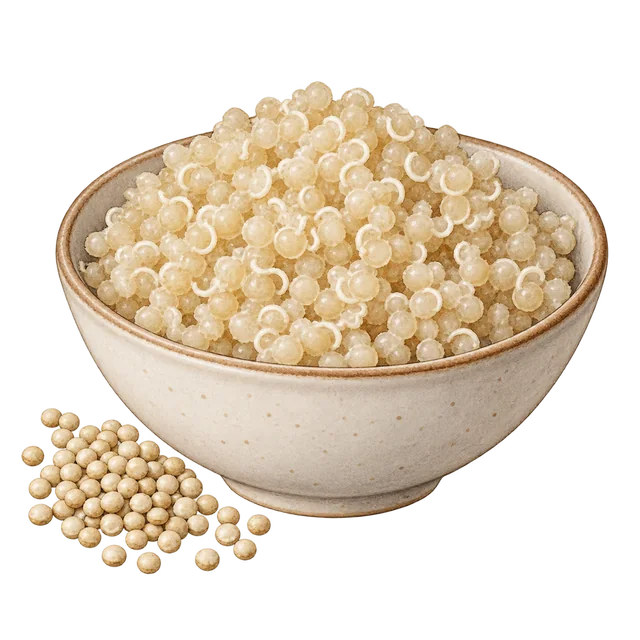
- Raw seeds
- Rinse before cooking. The next step in the article is adding water so the seeds hydrate and soften.
- Visible pale germ
- Cooking lets the germ emerge beside the seed as a pale curve, the visual cue used in the article.
Illustration for understanding; not to scale. Saved figures include explanations and sources.
In practice · A few ways to make it taste better
A few ways to make quinoa taste better and work harder.Toasting: before boiling it, dry-toast it in a pan over low heat for 2-3 minutes until it smells nutty, then add water. Heat makes the sugars and amino acids on the seed's surface react with each other, and that is where the aroma comes from. This step changes the flavor, not the nutrition.
Chilling overnight: cooked quinoa kept in the fridge overnight forms a small amount of resistant starch, so the blood-sugar rise is slightly flatter when you eat it again. Cold quinoa also makes a good salad base, because it tosses without clumping.
Which meal to put it in:
Breakfast: cook quinoa into porridge instead of oats, with milk or plant milk, for a change of tasteLunch: a quinoa salad bowl with chickpeas, tofu, or eggs, lots of vegetables, and olive oil with lemon juiceDinner: use it in place of white rice; the rest of the meal stays the same
Mechanism · Why cooling flattens the glucose rise
A flatter blood-sugar rise after cooling sounds like magic, but it is the physical state of the starch changing.In the seed, raw starch is neatly arranged, like bundles of tightly stacked chains. When you add water and heat, water pushes in, forces the bundles open, and the chains spread apart. This step is called gelatinization, and it is why rice and quinoa soften when cooked. Once the chains are spread out, there are places to bite everywhere, and digestive enzymes work fast.
After cooling, some of the spread-out chains slowly pull back together and re-form a tight structure. This is called retrogradation. Enzymes have trouble getting a grip on the retrograded part, so it passes through the whole small intestine without turning into blood sugar. It is called resistant starch, and it follows much the same path as fiber: to the large intestine, where it feeds bacteria and becomes short-chain fatty acids.
So in practice, overnight quinoa turns a small share of its carbohydrate into something that behaves like fiber. Keep in mind that the amount is small: amylose retrogrades most readily, and quinoa's share of amylose is fairly low, so not much can shift to begin with. It is a bonus, not a way to turn a bowl of staple food into zero carbohydrate. Reheating it until very hot also loosens part of that structure again, which shrinks the effect.
The same mechanism holds for rice, potatoes, and pasta, and that is the part you can take further on your own: any starchy staple that is cooked and then cooled shifts a little in this direction.
Chapter 8
Does quinoa help you lose weight
First, grant the part that is true: quinoa really is a very good whole food. It has all nine essential amino acids, a low-to-moderate blood-sugar effect, a fair amount of fiber, and a high density of micronutrients. All of that holds up.
What does not hold up is the word superfood. It is a marketing term with no scientific definition. When a food gets that label, it usually means the food is being sold, not that it does something other foods cannot.
When it comes to weight loss, there is really just one key misunderstanding: quinoa is not a low-calorie food. Its calories are close to white rice's, and they do not disappear because the food is called healthy. It is true that it keeps you full longer (it is high in both protein and fiber), but what fullness does is make it easier for you to eat less, not eat less on your behalf. That middle step is yours to take.
The conclusion: quinoa is an excellent whole-food staple, especially valuable for vegetarians who need complete plant protein. But it has no magic that other good staples lack, and portions still need watching.
Background · What the higher price buys
The price side is worth working out too.In Western markets quinoa often sells for several times the price of white rice, and in China it is also clearly more expensive. What does the extra money buy? Roughly: a complete amino-acid mix (which matters if you eat plant-based), more fiber and magnesium, and the superfood label itself.
For most people who eat everything, a combination like brown rice with tofu reaches similar overall nutrition at a much lower price: tofu has the lysine brown rice lacks, brown rice has the sulfur-containing amino acids tofu is shorter on, and together the amino-acid mix is just as complete. What quinoa saves you is only the pairing step.
One contrast worth knowing: in its Andean homeland, quinoa was long a cheap everyday staple, not a rare wonder food. Becoming a superfood is an identity that consumer marketing gave it; the plant itself did not change.
Myth · Does feeling fuller make you lose weight
It keeps me fuller, so I will lose weight: this sentence skips a whole stretch, and it is worth putting back.Feeling fuller does have a mechanism: protein and fiber both slow how fast the stomach empties, so a meal stays in the stomach longer and your next bout of hunger comes a little later. That stretch is real.
But the mechanism stops there. So you eat less is not the next link in that chain; it is your next link. Fullness only makes the choice a little easier: facing the same convenience store on the way home, the you who had quinoa for lunch finds it easier to walk past than the you who had plain rice porridge. It does not walk past for you.
That is also why claims like switch one food and you will lose weight almost never hold: a single food can change the difficulty, not the outcome. What decides the outcome is how much you eat and how much you move over a whole week.
The same yardstick works on other weight-loss wonder foods: first ask where the claimed mechanism stops, then ask how many steps remain between that point and losing weight. The more steps are missing, the shakier the claim.
References · 7
- U.S. Department of Agriculture, Agricultural Research Service. (2019). FoodData Central: Quinoa, cooked. A pseudo-cereal providing all nine essential amino acids plus magnesium and iron. fdc.nal.usda.gov
- Institute of Medicine. (2005). Dietary Reference Intakes for Energy, Carbohydrate, Fiber, Fat, Fatty Acids, Cholesterol, Protein, and Amino Acids. National Academies Press. nap.nationalacademies.org/catalog/10490/dietary-reference-intakes-for-energy-carbohydrate-fiber-fat-fatty-acids-cholesterol-protein-and-amino-acids
- Vega-Galvez, A., Miranda, M., Vergara, J., Uribe, E., Puente, L., & Martinez, E. A. (2010). Nutrition facts and functional potential of quinoa (Chenopodium quinoa Willd.), an ancient Andean grain: a review. Journal of the Science of Food and Agriculture, 90(15), 2541-2547. Complete amino acid profile, relatively high lysine, and a saponin coating. 10.1002/jsfa.4158
- U.S. Department of Agriculture & U.S. Department of Health and Human Services. (2020). Dietary Guidelines for Americans, 2020-2025 (9th ed.). www.dietaryguidelines.gov/sites/default/files/2020-12/Dietary_Guidelines_for_Americans_2020-2025.pdf
- National Institutes of Health, Office of Dietary Supplements. (2022). Magnesium — Fact Sheet for Health Professionals. ods.od.nih.gov/factsheets/Magnesium-HealthProfessional
- National Institutes of Health, Office of Dietary Supplements. (2024). Iron — Fact Sheet for Health Professionals. Fact sheet (updated September 4, 2025; Wayback snapshot 21 September 2026): RDAs 8 mg/day for men and for women 51+, 18 mg women 19-50, 27 mg pregnancy; UL 45 mg/day from age 14; bioavailability about 14%-18% from mixed diets with meat, seafood and vitamin C and 5%-12% from vegetarian diets; serum ferritin below 30 mcg/L suggests iron deficiency and below 10 mcg/L IDA, but inflammation can raise ferritin; supplemental iron of 45 mg/day or more may cause nausea and constipation; people with hereditary hemochromatosis are at risk of iron overload (fact sheet). Heme vs nonheme: heme iron (lean meat and seafood are the richest sources) has higher bioavailability than nonheme iron, and other dietary components affect it less; calcium might reduce the bioavailability of both forms; heme iron is about 10%-15% of total iron intake in western populations. The sheet gives no separate heme and nonheme absorption percentages (fact sheet, Wayback 2026 snapshot). ods.od.nih.gov/factsheets/Iron-HealthProfessional
- National Institutes of Health, Office of Dietary Supplements. (2022). Zinc — Fact Sheet for Health Professionals. ods.od.nih.gov/factsheets/Zinc-HealthProfessional