Story
Olive Oil
Last updated
In one pass Olive oil's benefit for blood lipids comes mainly from one move: when it replaces saturated fats such as butter and lard, the liver regains its ability to pull LDL (low-density lipoprotein, the bad cholesterol on a lab report) back out of the blood, and blood LDL falls.
Educational content, not medical advice — consult a clinician.
Story path
Chapter 1
What olive oil is · oil pressed from fruit
Which oil should I cook with is probably the most frequent health question in the kitchen. Among common cooking oils, olive oil, especially extra-virgin, is one of the most studied in people.
It is pressed from the flesh of the olive, while seed oils (Seed Oils / Linoleic Acid) such as soybean and corn oil are mostly extracted from seeds and then refined. A different process does not mean a different effect on the heart: what decides the effect is the oil's fatty-acid makeup, and what it replaces.
A CLOSER LOOK
Oil comes from fruit; its use still matters
Fruit and bottle explain the source relationship. Oil color cannot establish grade, polyphenols, amount or health effect.
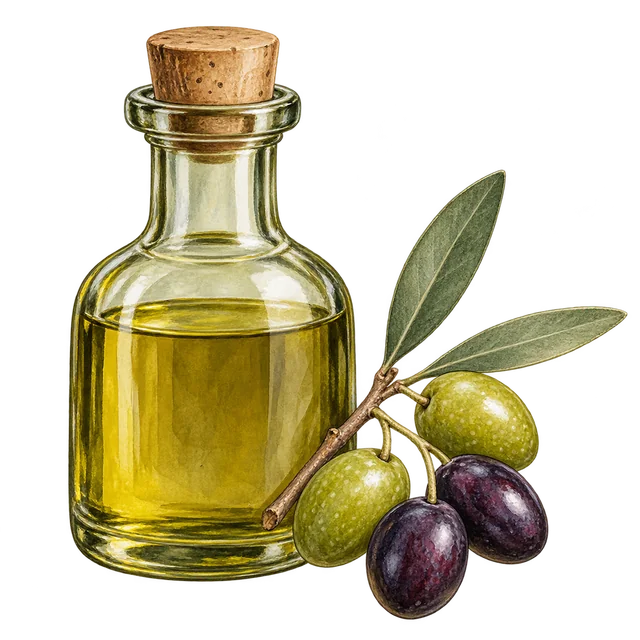
- Olive fruit
- Olive oil is pressed from the fruit's flesh, unlike oils extracted from seeds.
- Extracted oil
- Processing alone does not determine what an oil means for the body. The article also considers fatty-acid makeup and what it replaces.
Illustration for understanding; not to scale. Saved figures include explanations and sources.
Background · Extra-virgin versus refined
The olive oil on supermarket shelves falls into roughly two kinds, and the difference lies in processing, not in the raw material.Extra-virgin olive oil (EVOO) is the top grade: cold-pressed and unrefined, it keeps the olive's own polyphenols and flavor, along with that signature peppery bite at the back of the throat. Refined olive oil goes through processing such as bleaching and deodorizing, and it has far less flavor and far fewer polyphenols. Products labeled olive oil or pure olive oil are often refined oil blended with some virgin oil.
The two have similar fatty-acid makeups, both led by oleic acid, so they work in similar ways when it comes to replacing saturated fat and lowering ; the differences are mainly in polyphenols and flavor. This story is mainly about extra-virgin olive oil: its fat makeup, how it works through replacement, how far the trial evidence goes, and whether you can cook with it.
Chapter 2
Fat makeup · mostly oleic acid
Olive oil is about 73% monounsaturated fat (mostly oleic acid), about 14% saturated fat, and about 11% polyunsaturated fat. Being led by monounsaturated fat is what sets it apart from many oils. For contrast, coconut oil (Coconut Oil) is about 82% saturated fat, almost the reverse.
This makeup brings two advantages. Monounsaturated fat is relatively stable and slow to oxidize, and using it in place of saturated fat is good for blood lipids (the mechanism is in the later chapter on swapping it in). The full map of how different fat types affect the body is in Fat Types. Oils are not simply good or bad; what matters is their fatty-acid makeup, and what you replace with them.
Mechanism · Why more bends mean faster oxidation
When we say monounsaturated fat is relatively stable and slow to oxidize, where does that stability come from? The answer lies at the level of the molecule, and it is also the foundation for judging whether an oil can go into a hot pan.A fatty acid is a long carbon chain
Picture a fatty acid as a long chain in which every carbon holds hydrogens. If every carbon holds its full share of hydrogen, the chain is straight and relaxed. That is saturated: every hydrogen seat is taken and there are no vacancies.
If two neighboring carbons on the chain are short of hydrogen, they join hands directly in a double bond, and the chain bends at that spot. A chain with one bend is monounsaturated (oleic acid in olive oil is this kind), and a chain with several bends is polyunsaturated (the fats in soybean oil, corn oil, and fish oil).
Oxidation does not start at a bend; it starts at the carbon between two bends
When oxygen in the air attacks a fat chain, the easiest target is not the double bond itself but the carbon sandwiched between two double bonds. The hydrogen it holds is being pulled from both sides, so it is much looser and easy to snatch.
Once that hydrogen is snatched, the chain becomes an unstable, incomplete molecule that immediately grabs a hydrogen from the chain next to it, which then becomes incomplete too. Oxidation runs through the oil like a lit fuse, chain after chain. That is the chemistry of oil going rancid when it sits too long, and it is why heat and light speed the process up.
The key point: that especially loose carbon only appears when two bends sit next to each other.
Saturated fat: no bends at all, so no such weak spot; it keeps longest and handles heat bestMonounsaturated fat (oleic acid): only one bend, so there is no between two bends position, and it is also quite stablePolyunsaturated fat: bend after bend, and each extra bend adds another easy-to-snatch hydrogen, so it stands up less well to long storage and high heat
So olive oil does not spoil easily in the pan is not folklore, and it does not rest mainly on polyphenols. It is decided first of all by the shape of this chain.
But stability and blood lipids are two different dials
It is easy to draw the wrong conclusion from all this: then the most stable fat, saturated fat, must be best? No. The two things run independently.
The oxidation-resistance axis: fewer bends mean more stability; saturated fat is the most stable, monounsaturated next, and polyunsaturated the most delicateThe blood-lipid axis: saturated fat lowers the liver cell's ability to reclaim (the later chapter on swapping it in walks through this chain), while monounsaturated and polyunsaturated fats do not
Olive oil holds a special place in the kitchen because it looks good on both axes: with only one bend, it can handle everyday pan-frying and stir-frying, and because it is not saturated, swapping it in moves the blood-lipid chain.
This also explains why oils rich in polyunsaturated fat, and supplements such as fish oil, always come with reminders to keep them out of light, keep them sealed, not store them long, and not heat them again and again. They carry the most of those easy-to-snatch hydrogen positions.
Chapter 3
Swap it in, don't just add it
Many people think adding more olive oil is healthier. But simply adding oil to a diet only adds calories. Olive oil really works through replacement: when unsaturated fat (such as olive oil) replaces saturated fat that was there before (such as butter or lard), (low-density lipoprotein) cholesterol in the blood falls, which is linked to lower cardiovascular risk (the American Heart Association's advisory on dietary fats).
In other words, what works is the act of swapping, not some magic in the olive oil itself. Replacing the butter in your frying pan with olive oil is a step that matters; pouring an extra swirl of olive oil over a diet that already has plenty of fat just adds calories. This replacement logic is the key to understanding every cooking oil (Fat Types goes into it in depth).
Mechanism · The liver's doors that reclaim LDL
Swap out saturated fat and blood falls, but what actually happens in the body in between? Fill that in, and you can reason through questions like does pouring on one more spoonful help at all.First, how LDL is cleared from the blood
The particles that carry cholesterol in the blood are called LDL (low-density lipoprotein). Many people picture LDL as a pool that only fills and never drains, so whatever you eat piles up. It is really more like a pool filling on one side and draining on the other: the liver keeps sending LDL into the blood, and it also keeps fishing LDL back out. The level in the blood is the difference between those two rates.
The fishing happens on the surface of the liver cell. The side of the liver cell that faces the bloodstream is studded with connectors built to grab LDL, called LDL receptors. An LDL particle drifts by, a receptor latches onto it, and the particle is pulled into the cell together with the receptor. Inside, the particle is taken apart and its cholesterol unloaded; some is used by the liver cell itself, and some is sent into bile and out of the body.
So whether blood LDL is high depends largely on how many of these doors on the liver-cell surface are open. More doors, and LDL is pulled away quickly; fewer doors, and it keeps drifting in the blood.
The number of doors is not fixed; the cholesterol level inside the liver cell sets it
The liver cell keeps track of whether it has enough cholesterol inside:
When it is a bit low inside, the cell makes more receptors, opens more doors on its surface, and fishes a bit more back out of the bloodWhen it is a bit high inside, the cell makes fewer receptors, has fewer doors on its surface, and has no need to fish more out
This is a sensible feedback loop: the cell opens as many doors as it needs. The problem is that this internal level can be pushed by the kind of fat you eat.
What saturated fat does is close doors
A meal dominated by saturated fat (butter, lard, lots of fatty meat) pushes up the usable cholesterol level inside the liver cell. The cell reads the signal as there is enough in here, so it makes fewer LDL receptors.
The rest follows: fewer doors on the surface means fewer ways for blood LDL to be pulled back in, so it stays in the blood longer and its level rises.
Notice where this chain begins: it is not the cholesterol you ate turning directly into blood LDL, but the kind of fat in the meal changing how many doors the liver cell opens. That is also why looking only at how much cholesterol you ate often fails to explain changes in blood lipids.
What oleic acid does is lift the hand holding the doors shut
Most of olive oil is oleic acid, a monounsaturated fat. When it takes the place of the saturated fat that used to be in the meal, the suppressing signal goes away: the level inside the liver cell is no longer pushed up, the number of LDL receptors recovers, and more doors open on the surface again.
With more doors, blood LDL is pulled back into the liver cell to be unloaded, broken down, and sent into bile, and the level in the blood comes down.
Now look back at the slogan
The key is replacement, not addition: by now you no longer need to memorize this line, because it follows directly from the chain above.
Addition only: you drizzle one more spoon of olive oil over a meal that already has bacon and butter. The oleic acid in that spoon replaced no saturated fat, and the bacon is still holding the liver cell back from making receptors. Not a single extra door opened; you only ate the calories of one more spoon of oil.True replacement: you swap the butter in the frying pan for olive oil. One of the hands holding the doors shut is gone, a batch of doors comes back, and blood LDL finally has somewhere to go.
The same spoon of olive oil gives completely different results in these two situations. The difference is not in the oil itself but in whether it pushed something else out.
Following this chain, you can work out two more things for yourself:
Why olive oil is a healthy oil always needs a condition attached: its effect depends on what it replaces. If it replaces another oil that is also mostly monounsaturated, those doors were never being held shut, so there is nothing to restore.Why drinking a few extra sips of olive oil cannot count as a way to lower blood lipids: the switch on this chain is saturated fat stepping out, not olive oil stepping in. If the switch is not flipped, all that is left is the extra calories.
Chapter 4
Trial evidence for the heart
Read it with three conditions attached. It compared a Mediterranean diet plus olive oil (or nuts) with advice to eat low-fat, and olive oil was never tested on its own. The primary endpoint was cardiovascular events, not death from all causes. And the original paper was retracted because some participants had not been randomized according to the protocol; it was republished in 2018 with a corrected analysis and similar results, but the evidence now carries somewhat less weight. So do not reduce it to drinking olive oil protects the heart.
Evidence · The numbers and the retraction
PREDIMED enrolled 7,447 adults in Spain aged 55-80 who were at high cardiovascular risk but had no cardiovascular disease when they joined, and split them into three groups: a Mediterranean diet plus extra-virgin olive oil; a Mediterranean diet plus mixed nuts; and a control group advised to cut down on fat. All three groups attended regular diet sessions, and the two Mediterranean groups also received olive oil or nuts free of charge.Results: after a median of 4.8 years, the share of people who had a primary-endpoint event (heart attack, stroke, or cardiovascular death) was 3.8% in the Olive Oil group, 3.4% in the nut group, and 4.4% in the control group. The adjusted were 0.69 for olive oil and 0.72 for nuts, a about 30% lower; in absolute terms, about 1 fewer case per 100 people, or less.
The retraction: the paper first published in 2013 was later found to have departed from its protocol. Some household members had joined without being randomized, and at some sites participants had not been randomized either. The original paper was therefore retracted and republished in 2018 with a corrected analysis; after excluding 1,588 participants whose assignment may have departed from the protocol, the results were similar (this story cites the 2018 republication). So the accurate reading is that the corrected estimate is close to the original, but it is no longer a clean randomized trial.
What it can support: a Mediterranean diet built around extra-virgin olive oil (or nuts) reduced cardiovascular events in people at high cardiovascular risk. What it cannot support: the trial did not separate olive oil from the rest of the diet, so it cannot say which part did the work, and it cannot be stretched to the practice of drinking extra olive oil.
Chapter 5
Can you cook with olive oil
In fact, it is fine for everyday pan-frying, stir-frying, and roasting. Its fat is mostly monounsaturated, with only one bend in the chain, so it does not oxidize easily, and with its polyphenols it stays relatively stable when heated. What you really want to avoid is repeated high-heat deep-frying: the same pot of oil heated to smoking again and again and reused, which is bad for any oil.
If you change just one oil, swapping the -raising saturated fats at home (butter, some animal fats) for olive oil is a very worthwhile step. Do not let the cannot be heated rumor stop you from cooking with it.
In practice · How to cook with it and choose it
Extra-virgin olive oil has a smoke point of about 190-210°C. A smoke point answers only one question: at what temperature an oil starts to smoke visibly. How fast oil breaks down in the pan depends mainly on how hot it gets, how many times the same oil has been used, and how many bends its fat chains have; Cooking with Oil covers this in more detail. Olive oil has the advantage on that last count: it has few bends, so it handles heat relatively well.A few practical tips:
For everyday stir-frying, low-temperature baking, and dressings, extra-virgin olive oil is fineIf the oil in the pan starts to smoke, the heat is too high, so turn it down; that goes for any oilFor genuinely high-heat, repeated deep-frying, use a cheaper, more heat-tolerant oil and save extra-virgin for dishes where flavor mattersWhen buying, check two things: a dark glass bottle (it blocks light and slows oxidation) and a pressing or harvest date (the fresher it is, the more polyphenols it has)
Once the bottle is open, cap it tightly, keep it somewhere cool and away from the stove, and use it up soon. It can handle the pan, but long exposure to light, heat, and air wears it down.
References · 3
- U.S. Department of Agriculture, Agricultural Research Service. (2019). FoodData Central: Olive oil, extra virgin. About 73% monounsaturated (oleic acid), ~14% saturated, ~11% polyunsaturated; extra-virgin retains polyphenols; smoke point ~190-210°C. fdc.nal.usda.gov
- Sacks, F. M., Lichtenstein, A. H., Wu, J. H. Y., Appel, L. J., Creager, M. A., Kris-Etherton, P. M., et al. (2017). Dietary fats and cardiovascular disease: A presidential advisory from the American Heart Association. Circulation, 136(3), e1-e23. Coconut oil is ~82% saturated; the AHA advises against its use because it raises LDL-C with no known offsetting favorable effect, and recommends replacing saturated with unsaturated fat. 10.1161/CIR.0000000000000510
- Estruch, R., Ros, E., Salas-Salvadó, J., Covas, M.-I., Corella, D., Arós, F., et al. (2018). Primary prevention of cardiovascular disease with a Mediterranean diet supplemented with extra-virgin olive oil or nuts. New England Journal of Medicine, 378(25), e34. PREDIMED RCT (~7,447 high-risk adults); a Mediterranean diet supplemented with mixed nuts (or EVOO) reduced major cardiovascular events versus a control low-fat diet. (First published 2013; retracted in 2018 over randomization issues and republished the same year with corrected data.). 7,447 adults aged 55-80 (57% women) at high cardiovascular risk; median 4.8 years. Events 3.8% (olive oil), 3.4% (nuts), 4.4% (control); adjusted HR 0.69 (0.53-0.91) and 0.72 (0.54-0.95). Results similar after omitting 1,588 participants whose assignments departed from protocol (household members enrolled without randomisation, some participants at 1 of 11 sites assigned without randomisation, inconsistent use of randomisation tables at another site) (abstract, PMID 29897866). 10.1056/NEJMoa1800389