Story
Oats
Last updated
In one pass The thing most worth knowing about oats is their soluble fiber, beta-glucan (β-glucan).
Educational content, not medical advice — consult a clinician.
Story path
Chapter 1
What is oats · processing makes a big difference
Steel-cut, rolled, quick, and sugary instant packets are all called oats, but how finely the grain is cut and how fast it cooks decide how thick that gel is and how fast it arrives. The added sugar in instant packets also cancels most of the steadier blood-sugar advantage.
Background · How the four forms of oats differ
Oats (Avena sativa) are a whole grain that originated in Eurasia and are now one of the world's important cereal crops. Everyday oats come in a range of forms, and processing directly changes how the body handles them.From least to most processed:
Steel-cut oats (also called Irish oats): whole oat groats cut crosswise into 2-3 pieces, with the bran and germ fully intact; the chewiest, and they need 20-30 minutes of cookingRolled oats (also called old-fashioned oats): steamed soft and pressed flat; they cook faster (5-10 minutes) and keep most of the fiber structureQuick oats (also called instant oats): cut smaller and pressed thinner; they digest faster and raise blood sugar fasterFlavored instant oat packets: sugar, salt, and flavorings already added, so the nutrition picture differs from the first three
What sets oats apart from other grains is not protein or micronutrients but a soluble fiber they carry in unusual amounts: beta-glucan.
Chapter 2
How much energy and protein
Their protein is on the high side for a grain, and its amino-acid mix is closer to legumes than rice or wheat, but lysine is still short, so it is not a complete protein; milk, eggs, or soy foods fill the gap (see Protein & Amino Acids).
Numbers · Dry oats versus cooked porridge
Dry oats (uncooked) contain, per 100 g, roughly 379 kcal, 67 g of carbohydrate, 13-17 g of protein, 7 g of fat, and about 10 g of fiber. Cooking soaks up a lot of water, so cooked oat porridge has only about 71 kcal per 100 g, with far less protein and fiber by weight; but a bowl (about 240 g) still delivers a meaningful amount.The main storage protein in oats is avenalin, whose amino-acid mix is closer to legumes than rice or wheat, but lysine is still the weak point; legumes, dairy, or eggs fill the gap (see Protein & Amino Acids).
Oats carry more fat than most grains, mostly polyunsaturated and monounsaturated. They also contain a small, fairly well-studied group of polyphenols called avenanthramides, but these are not the main reason to eat oats.
Chapter 3
How oat fiber lowers LDL
The same gel also slows stomach emptying and glucose absorption, so the blood-sugar peak after a meal is lower and flatter. The more finely oats are processed and the faster they cook, the weaker this gel's effect; the added sugar in instant packets cancels most of the steadier blood-sugar advantage.
Mechanism · How the gel pulls LDL down
Beta-glucan is a soluble fiber in oat bran and the starchy core of the grain. In water it forms a thick gel that does two things in the digestive tract at once.First, it wraps up bile acids. The liver makes bile acids from cholesterol and releases them into the gut to help digest fat; afterward most are reabsorbed near the end of the gut and sent back to the liver for reuse, a loop called the enterohepatic circulation. The gel traps part of the bile acids and carries them out in the stool. When the liver finds bile acids running short, it uses more cholesterol to make new ones, and blood low-density lipoprotein cholesterol (, the so-called bad cholesterol) falls. Tiwari 2011, a that pooled several trials, found that at least 3 g of beta-glucan a day lowers LDL, and more lowers it further. The health claim the US FDA allows rests on this pathway (see Cardiovascular System). The drop is modest, nowhere near what a statin does.
Second, it slows stomach emptying and glucose absorption. The same gel makes food leave the stomach and get absorbed in the small intestine more slowly, so the blood-sugar peak after a meal is lower and flatter, which is also why oatmeal keeps you full. One trial in people with type 2 diabetes (Liatis 2009) used bread with added beta-glucan and saw LDL fall and insulin resistance improve (see Type 2 Diabetes & Prediabetes).
In practice · How form and cooling change the effect
Processing changes how the gel arrives: steel-cut oats keep the beta-glucan structure most intact and digest most slowly; instant oats are finely milled and cook fast, so the beta-glucan is still there but works somewhat less well; sugary instant packets cancel most of the steadier blood-sugar advantage.Cooking and then cooling adds one more small change: some of the starch that swelled during cooking recrystallizes as it cools into resistant starch, which small-intestine enzymes cannot reach, and it goes on to the large intestine to be fermented by bacteria. Cooling does not change how much starch the oats contain; it changes whether digestive enzymes can get at it, and the share they cannot reach does not count toward that meal's blood sugar. This is a general property of starch, and how much extra you get varies a lot with how you cook, so treat it as a small bonus, not the main reason to eat oats.
Chapter 4
Rich in what · manganese, phosphorus, B vitamins
These are all extras; the core value of oats is still that soluble fiber.
Numbers · Manganese and minerals in a bowl of oats
Manganese: a bowl of dry oats (about 40 g) holds roughly 1.4-1.9 mg of manganese, close to or at the adult daily adequate intake (). Manganese helps an antioxidant enzyme, superoxide dismutase, protect cells from oxidative damage (see Manganese).Phosphorus: bone mineralization and energy metabolism () both depend on it, and oats have a fair amount; but oats also contain phytate, which lowers the absorption of phosphorus and other minerals, and soaking and fermentation undo some of that.
B vitamins: thiamine (vitamin B1) and pantothenic acid are on the high side for a grain; folate is moderate.
Iron: non-heme iron, in a fair amount, but phytate holds back its absorption. Fruit rich in vitamin C, such as oranges, helps it absorb (see Iron).
Overall, oats sit in the upper middle of whole grains for micronutrient density.
Chapter 5
What it lacks · how to pair
All three can be covered by what you pair them with: milk, eggs, or soy foods for lysine; other sources for B12 and vitamin D; and fruit rich in vitamin C in the same meal to help iron absorb.
In practice · Pairings that cover the gaps
First, lysine is short. Oats are low in lysine for a grain (though better than rice), so relying on oats alone for protein leaves your amino acids unbalanced. Milk or yogurt adds protein and calcium together; eggs cover lysine well; tofu or soy milk works for plant-based eaters.Second, there is no vitamin B12 or vitamin D. B12 is found almost only in animal foods and fortified foods, and vitamin D is made mainly in your skin in sunlight; oats supply neither, so vegetarians need other sources.
Third, phytate gets in the way of minerals. The phytate in oats binds iron, zinc, and calcium and makes them hard to absorb. Soaking removes some phytate, but rolled oats have already been steamed during processing, and the oats' own phytate-splitting enzyme has most likely been destroyed by the heat, so do not expect an overnight soak to fix the problem. A more reliable move is fruit rich in vitamin C in the same meal to help iron absorb.
One easy combination is overnight oats with yogurt: the yogurt adds protein and calcium, and the soak means no cooking; add a handful of nuts for zinc and good fats, and scatter some berries, whose vitamin C helps iron absorb.
Chapter 6
Oats with celiac or gluten sensitivity
So people with celiac disease should choose certified Gluten-Free oats. A small minority react to avenin itself and get symptoms even from pure oats, so whether to eat them is a decision to make with a doctor or dietitian.
Clinical · Can people with celiac disease eat oats
Cross-contamination is the main issue: from the field to the mill to transport, oats easily pick up wheat, barley, or rye. Ordinary supermarket oats, even without a contains-gluten label, may carry gluten residue above the Gluten-Free standard. So people with celiac disease should choose certified Gluten-Free oats, meaning products processed on dedicated lines and tested.There is a further complication: in a small minority of people with celiac disease, the immune system also reacts to the oat protein avenin itself, and they get symptoms even from completely uncontaminated oats. So even certified Gluten-Free oats need to be avoided entirely by some people with celiac disease; whether to eat them, and how much, is a decision to make with a doctor or registered dietitian.
For people without celiac disease or non-celiac gluten sensitivity, oats are no problem at all, and a Gluten-Free label brings you no extra health benefit.
Chapter 7
Choosing, cooking and how much to eat
Choose steel-cut if you have time, rolled oats for everyday, and quick oats when you are in a hurry; as long as there is no added sugar, they still beat refined grains such as white bread. To get the 3 g of beta-glucan a day named in the FDA health claim, you need roughly 75-80 g of dry oats, about one large bowl of porridge.
A CLOSER LOOK
From oat grain to rolled flakes
This compares grain and rolled forms; the left is not steel-cut oats. Added sugar and processing still depend on the actual product.
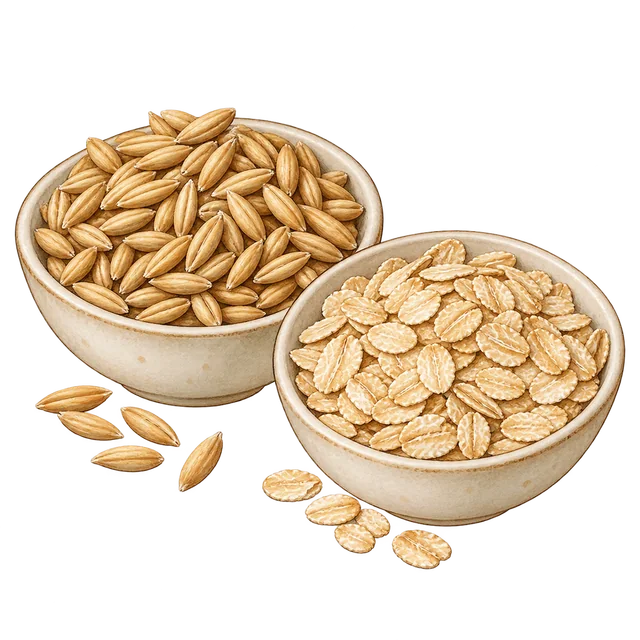
- Grain form
- Oats can be cut, rolled or processed further. The same grain name covers different forms.
- Rolled oats
- Rolled oats are one everyday option. The ingredient list tells you whether sugar was added.
Illustration for understanding; not to scale. Saved figures include explanations and sources.
In practice · Which oats suit which morning
Pick the form by how much time you have in the morning:When you have time: steel-cut oats raise blood sugar most slowly and keep the beta-glucan structure most intact; the trade-off is 25-30 minutes of cookingEveryday: rolled oats, 5-10 minutes, with good nutrient retentionIn a hurry: quick oats still beat refined grains such as white bread, as long as you add no sugarNo cooking: overnight oats, soaked in milk or yogurt in the fridge the night before and eaten straight in the morning; convenience is their biggest advantage
How much: a bowl a day is a sensible choice, rotated with other whole grains. Nothing in oats needs a special limit, but more is not better either; they are simply a good whole grain.
Chapter 8
Are all oat products equally healthy
The most common trap is treating a sugary instant packet as a healthy breakfast: the beta-glucan is still there, but the added sugar cancels its steadier blood-sugar advantage. Two more myths: that oats always spike blood sugar, so people with diabetes cannot eat them; and that oats help you lose weight, so portions do not matter. The first mixes up different forms of oats, and the second forgets that oat calories are real.
Myth · Added sugar, oat forms, and portions
The first trap: seeing the word oats, assuming health, and buying instant packets or oat cookies loaded with sugar. A standard flavored instant oat packet can hold 12-17 g of sugar, about 3-4 teaspoons. That much added sugar cancels beta-glucan's steadying effect on blood sugar, and the fiber advantage shrinks too.The second myth: oats raise blood sugar, so people with diabetes cannot eat them. This mixes up different forms of oats. Rolled or steel-cut oats have a low-to-moderate glycemic index (, a measure of how fast a food raises blood sugar), far below white bread; it is finely milled instant oats that come closer to moderate-to-high. And beta-glucan's own effect is to blunt the blood-sugar peak after a meal. People managing blood sugar can eat the right form of oats; how much is a question for their doctor.
The third myth: oats help you lose weight, so eat as much as you like. Oats do keep you full, but the calories are real: dry oats have about 379 kcal per 100 g. Feeling full helps you control total calories, but it is not a license for unlimited portions.
So oats are a good food, provided you choose products whose ingredient list says only oats and avoid the sugary versions.
References · 12
- U.S. Department of Agriculture, Agricultural Research Service. (2019). FoodData Central: Oats (raw; cooked oatmeal). A leading dietary source of beta-glucan soluble fiber. fdc.nal.usda.gov
- Institute of Medicine. (2005). Dietary Reference Intakes for Energy, Carbohydrate, Fiber, Fat, Fatty Acids, Cholesterol, Protein, and Amino Acids. National Academies Press. nap.nationalacademies.org/catalog/10490/dietary-reference-intakes-for-energy-carbohydrate-fiber-fat-fatty-acids-cholesterol-protein-and-amino-acids
- U.S. Food and Drug Administration. (1997, with later updates). Health claim: soluble fiber from certain foods (oat beta-glucan) and risk of coronary heart disease, 21 CFR 101.81. Authorizes a CHD-risk-reduction claim for at least 3 g/day oat beta-glucan via LDL lowering. www.ecfr.gov/current/title-21/section-101.81
- Tiwari, U., & Cummins, E. (2011). Meta-analysis of the effect of beta-glucan intake on blood cholesterol and glucose levels. Nutrition, 27(10), 1008-1016. At least 3 g/day beta-glucan lowers LDL cholesterol dose-dependently. 10.1016/j.nut.2010.11.006
- Liatis, S., Tsapogas, P., Chala, E., et al. (2009). The consumption of bread enriched with betaglucan reduces LDL-cholesterol and improves insulin resistance in patients with type 2 diabetes. Diabetes & Metabolism, 35(2), 115-120. 10.1016/j.diabet.2008.09.004
- National Institutes of Health, Office of Dietary Supplements. (2021). Manganese — Fact Sheet for Health Professionals. Breast milk 3–10 mcg/L; cow's-milk formula 30–100 mcg/L; soy-based formula 200–300 mcg/L (higher than milk-based, not a 50–75× ratio). Fact sheet (updated March 29, 2021; Wayback snapshot 15 September 2026): humans absorb only about 1% to 5% of dietary manganese; more than 90% of absorbed manganese is excreted via bile into the faeces; multivitamin/mineral supplements that contain manganese typically provide 1.0 to 4.5 mg, and manganese-only or few-nutrient supplements mostly contain 5 to 20 mg; people with chronic liver disease eliminate manganese poorly (fact sheet). ods.od.nih.gov/factsheets/Manganese-HealthProfessional
- National Institutes of Health, Office of Dietary Supplements. (2024). Iron — Fact Sheet for Health Professionals. Fact sheet (updated September 4, 2025; Wayback snapshot 21 September 2026): RDAs 8 mg/day for men and for women 51+, 18 mg women 19-50, 27 mg pregnancy; UL 45 mg/day from age 14; bioavailability about 14%-18% from mixed diets with meat, seafood and vitamin C and 5%-12% from vegetarian diets; serum ferritin below 30 mcg/L suggests iron deficiency and below 10 mcg/L IDA, but inflammation can raise ferritin; supplemental iron of 45 mg/day or more may cause nausea and constipation; people with hereditary hemochromatosis are at risk of iron overload (fact sheet). Heme vs nonheme: heme iron (lean meat and seafood are the richest sources) has higher bioavailability than nonheme iron, and other dietary components affect it less; calcium might reduce the bioavailability of both forms; heme iron is about 10%-15% of total iron intake in western populations. The sheet gives no separate heme and nonheme absorption percentages (fact sheet, Wayback 2026 snapshot). ods.od.nih.gov/factsheets/Iron-HealthProfessional
- National Institutes of Health, Office of Dietary Supplements. (2021). Thiamin — Fact Sheet for Health Professionals. ods.od.nih.gov/factsheets/Thiamin-HealthProfessional
- Sandberg, A.-S. (2002). Bioavailability of minerals in legumes. British Journal of Nutrition, 88(S3), S281-S285. Phytate binds iron, zinc, and calcium; soaking, cooking, and fermentation reduce phytate and improve mineral absorption. 10.1079/BJN/2002718
- EFSA Panel on Dietetic Products, Nutrition and Allergies (NDA). (2015). Scientific opinion on the safety of oats in people with celiac disease. EFSA Journal, 13(11), 4317. Most people with celiac disease tolerate uncontaminated oats; cross-contamination is the main concern. 10.2903/j.efsa.2015.4317
- Gilissen, L. J. W. J., van der Meer, I. M., & Smulders, M. J. M. (2014). Reducing the incidence of allergy and intolerance to cereals. Journal of Cereal Science, 59(3), 337-353. Reviews avenin-gliadin cross-reactivity and the minority of celiac patients reacting to pure oats.
- U.S. Department of Agriculture & U.S. Department of Health and Human Services. (2020). Dietary Guidelines for Americans, 2020-2025 (9th ed.). www.dietaryguidelines.gov/sites/default/files/2020-12/Dietary_Guidelines_for_Americans_2020-2025.pdf